

Menken Giving Back Through Coaching, Telling Story of Donor's Life-Saving Gift
By
Pam Shebest
Special for MHSAA.com
November 17, 2026
KALAMAZOO — In 2017, Andrew Nicholson was a 19-year-old senior at Holly High School.
 Roy Menken was a 52-year-old bowler who was dying of Alpha-1 antitrypsin deficiency, a fatal lung disease.
The two had never met, but through tragedy, the teen saved Menken’s life.
Menken, an assistant bowling coach at Kalamazoo Central, was given about six months to live when he got a call at 5:45 a.m. on May 24, 2017, from University of Michigan Health.
After waiting for 27 months, Menken was finally getting a new pair of lungs.
“Normally they give you about four hours to get to U of M,” Menken said. “In my case, Andrew’s lungs didn’t match anyone else in the U of M program, so I was the only one called.”
With his wife driving “like a mad person,” they made it to the medical center in Ann Arbor in less than two hours.
Preparing for the surgery, he said, he felt “a little scared, because you never know. Actually, I felt sad for the person who had passed. We were told that it was a young man, and he was involved in an accident.”

The teen was killed the day before in a welding accident.
Working in a junk yard, he was asked to weld some 55-gallon drums, which, unknown to him, still had some lacquer thinner in them.
“A week before I showed my son how to weld,” said Keith Nicholson, Andrew’s dad. “He made an eighth-inch weld and it burned through and blew up. Broke his neck, broke his forearm, broke his shoulder, broke his whole left side of his body, crushed his head.”
Fortunately for Menken, when the teen got his driver’s license at age 16, he checked the donor box.
“The day my ex-wife took him to get his driver’s license, she was standing there next to him and he said, ‘Donor, what’s that mean?’” Keith Nicholson said. “She said if you die, they can take your organs and help other people.
“Andrew shrugged his shoulders and said, ‘Well, they’re not going to do any good for me.’”
Those organs not only helped Menken, but saved four other lives, were life-changing for 12 more people (bones, etc.) and life-altering for another 33 (skin, science, etc.)
Menken sent a letter to Gift of Life Michigan through the hospital, hoping it would be forwarded to the donor’s family. The family answered, beginning a life-long friendship.
Keith Nicholson said he responded because “I was more curious making sure everything was all right. I’m really happy. I couldn’t ask for a better recipient.”
They have not only become “family,” but on the two-year anniversary of the transplant, Keith Nicholson went to Kalamazoo from Trenton to pick up the classic 1959 Impala that Menken started restoring before the surgery but could no longer finish.
Nicholson completed work on the car and said Andrew would have done it himself if he’d had a chance.
“The only thing I ever said to Roy (about the transplant) was when we were out in the shop welding on the car, he tried to sneak out there (to help)," Nicholson recalled.
And that question was a stark reminder.
“I stopped welding, looked at him and said, ‘Is this what you think of my son’s gift to you?’”
Living a full life
Fueled by healthy new lungs, Menken wasted no time getting back into sports.
The transplant was in May 2017, and by that September he was playing golf. He started bowling in November.
When he walked into Continental Lanes that first day, he saw his son, Donald, who was working there.
“You could just see the emotion on his face,” Menken said. “So was (manager) Dave Fawley and my other son, Perry.
“I slowly got back into the leagues that January and haven’t quit bowling since except when COVID hit.”
Bowling at least five days a week is no problem for Menken. The hardest part, he said, is wearing a mask when he is around people, something transplant recipients are supposed to do.
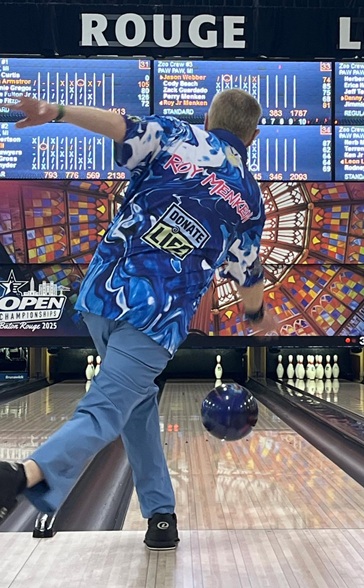
The mask hasn’t interfered with his game. He’s shot a couple of 300 games since then.
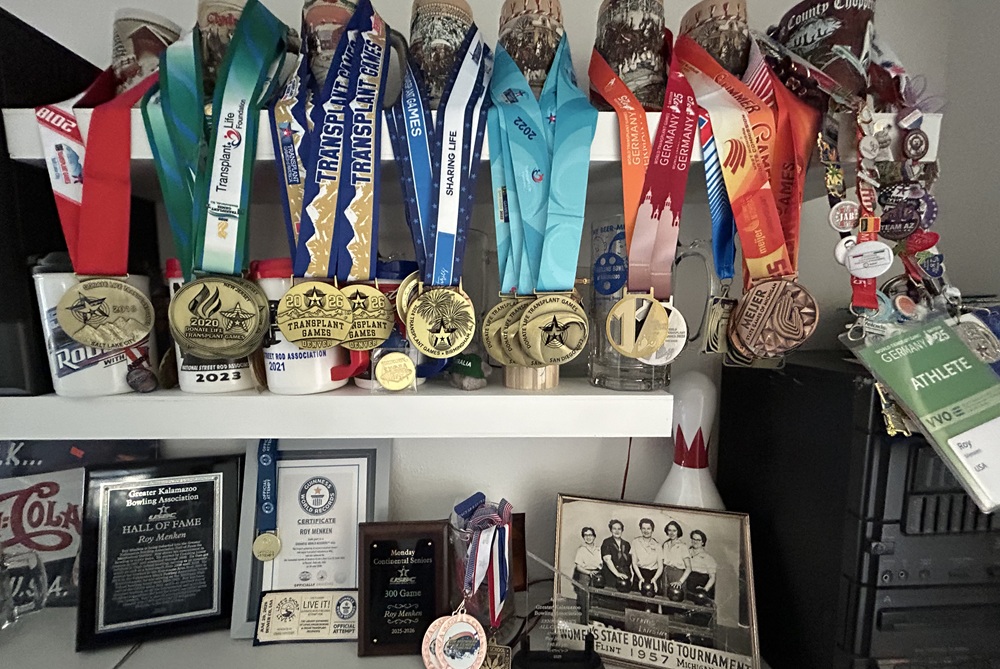
Menken also competes in Transplant Games of America and World Transplant Games. Several of his 12 gold medals came from both tournaments, including a mixed doubles gold in the U.S. Games with Becky Sheets from Charlotte, who was six months out from a heart transplant.
Traveling is no problem for Menken and his wife, Jan. The World Games, held every two years, move from country to country. Last year they were in Dresden, Germany, and next year will be in Belgium.
Menken still has to travel to Ann Arbor for checkups every three months and gets weekly infusions of Prolastin (an enzyme his liver doesn’t release) at home.
He is also in chronic rejection and relapsed twice before rebounding, which he attributes to how active he is and the 12 morning pills and 16 evening pills he takes each day.
As a teen, Menken was diagnosed with sports-induced asthma and began using inhalers.
He said doctors never really discovered that he had Alpha-1 until one day in 2013, while he was working as a building operator for Kalamazoo County and had trouble catching his breath.
“They sent me to their doctor, and he said do you realize you are disabled?” recounted Menken, who refused to believe it.
It was not until he went to Ann Arbor for tests that he was diagnosed with end-stage lung disease and given two years to live.
He and his wife “left U of M and we were both in shock,” he said.
After returning home, he was put on two liters of oxygen and could no longer work at his job. Once he got the call for surgery, Menken said he was more afraid that something would happen to cancel the surgery than he was of dying.
The operation lasted 14 hours and when he woke the next day, he wasn’t scared but knew the operation was a success when he saw “my wife and her Aunt Marcia Godisak, who was also one of my respiratory nurses, just the looks on their faces, even though I couldn’t speak because I was still on a ventilator.”
Coaching a passion
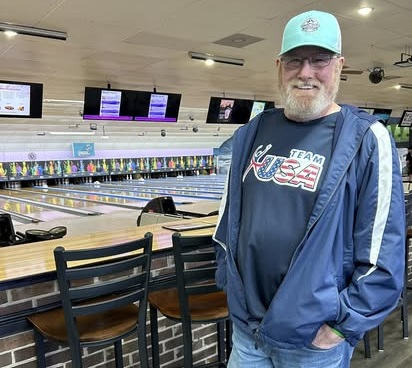
Menken coached bowling at Portage Northern for 10 years, then started at Galesburg-Augusta until COVID-19 shut down the program. He has helped coach at Kalamazoo Central the past two years and spends time talking to clubs and schools about his journey and organ donations.
He is also in charge of the Saturday morning junior bowling leagues at Continental.
“He brings a lot of bowling knowledge that I don’t have,” K-Central head coach Krys Briggs said. “I have not had the experience, so I find people I know that are definitely more knowledgeable than I am.

“The kids love him.”
The coach also said she passed around an article about Menken’s transplant journey for the bowlers who did not know about it.
“Personally. it makes me want to work on my health and make sure that I’m healthy just so that I don’t have to go through that,” said junior bowler Kaeden Lutzka, who heard Menken speak during one of his classes. “If I stay healthy and someone needs my organs, I can be a donor since I’m a donor on my license.”
Menken said the feeling of survivor’s guilt still haunts him.
“We honor Andrew every day,” he said.
Keith Nicholson said, “The biggest misinterpretation, and I know people say it because it’s the most common, but it’s not that we lost a son. I know where he went. I know what happened. He was just an amazing kid. He touched a lot of people’s hearts.
“Roy had less than six months to live. I’m happy for him.”

Pam Shebest served as a sportswriter at the Kalamazoo Gazette from 1985-2009 after 11 years part-time with the Gazette while teaching French and English at White Pigeon High School. She can be reached at [email protected] with story ideas for Calhoun, Kalamazoo and Van Buren counties.
PHOTOS (Top) Roy Menken’s collection of bowling awards includes several medals earned competing in national and world games for bowlers who have received organ transplants. (2) Andrew Nicholson, as an organ donor, provided lungs that have extended Menken’s life. (3) Menken, at a bowling center, is an assistant coach for Kalamazoo Central. (4) Menken rolls for a spare during tournament play. (5) Kalamazoo Central head bowling coach Krys Briggs and junior Kaeden Lutzka. (Menken, Nicholson and awards photos courtesy of Roy Menken. Headshots by Pam Shebest.)
NFHS Honors 4 of Michigan's Finest
By
Geoff Kimmerly
MHSAA.com senior editor
January 14, 2015
By Geoff Kimmerly
Second Half editor
Three longtime Michigan high school coaches and one of the state’s most highly-respected athletic directors were recognized Wednesday by the National Federation of State High School Associations Coaches Association.
Leland volleyball coach Laurie Glass, Trenton softball coach John Biedenbach and Traverse City Central boys track and field coach John Lober were named Coaches of the Year in their respective sports. Longtime Troy athletic director Jim Feldkamp – currently an instructor for the MHSAA’s Coaches Advancement Program – was honored as this year’s National Coach Contributor Award winner as an individual “who has gone above and beyond and who exemplifies the highest standards of sportsmanship, ethical conduct and moral character.”
Feldkamp served one year as a teacher and coach of three sports at Romeo in 1970-71 before moving on to New Baltimore Anchor Bay, where he taught, coached varsity boys basketball for 14 years, subvarsity basketball for five seasons and served as athletic director at the high school.
He moved on to West Bloomfield as director of health, physical education and athletics in 1985, then became citywide athletic director for the Troy School District from 1988-2004. Feldkamp consulted at Detroit University Prep from 2007-12, then served as district athletic director of L’Anse Creuse Public Schools during the 2012-13 school year.
Feldkamp received the MHSAA’s Charles E. Forsythe Award in 2005 for his outstanding contributions to the interscholastic athletics community after retiring from the Troy district, where he was responsible for 178 teams, more than 4,800 athletes and 315 coaches. He also received the MHSAA’s Allen W. Bush Award and has served as a CAP instructor for the last decade while co-authoring the program module Administrative Responsibilities of Coaching. He also previously was named Athletic Director of the Year by the Michigan Interscholastic Athletic Administrators Association and received a National Award of Merit from the National Interscholastic Athletic Administrators Association.
“Jim Feldkamp is an outstanding educator who understands and recognizes the qualities of leadership necessary in educational athletics while also appreciating the meaning and applications of the rules,” said MHSAA assistant director Kathy Vruggink Westdorp as part of the association’s nomination of Feldkamp for the award. “He has a great understanding of the coach’s role and has worked with thousands of coaches throughout Michigan in a continued effort to improve the sport experience of participating students.”
The following brief bios on Michigan coaching award winners include excerpts from coaching philosophies they were asked to submit after being identified as candidates:
Laurie Glass this fall led Leland to the Class D Volleyball Final and has taken her program to four MHSAA championships over three tenures stretching 20 seasons. Including four seasons at Traverse City Central, Glass has a 909-302-108 record dating to her first season at Leland in 1990-91.
“Athletics is all about opportunity, both for the athlete and the coach. Opportunity to learn life lessons that will help them as the move on outside of the athletic arena. Opportunity for personal growth. Opportunity to be passionate about something that you are willing to work hard for. … Most importantly, the opportunity to develop young women into strong young women who believe in themselves and value what they have to offer.”
John Biedenbach took over the Trenton softball program in 1975. He has led teams to more than 940 wins and was inducted into the Michigan High School Softball Coaches Association Hall of Fame in 1997. He also coached basketball teams to 445 wins beginning in 1977.
“Building that sense of being a ‘team’ is my most important job as a coach. The team leaves no one out in the cold; each member of the team plays as hard as they can for the sake of their teammates and for the sake of themselves. As coach, I lead by example, always stressing hard work and dedication, long hours practicing and the fundamentals of the game. If I have done my job, my players will start their adult lives stronger and better prepared for the challenges ahead.”
Lober has coached the Traverse City Central boys track and field team since 1977 and also the boys cross country team since 1989. His 1992 track team won the Class A championship, and he has coached 17 individual MHSAA Finals champions. He has built a record of 334-33-3 and was inducted into the Michigan Interscholastic Track Coaches Association Hall of Fame in 2006.
“Athletics are an integral part of the educational setting that should provide experiences through a variety of sports for every student, regardless of ability. While being part of the team, these experiences should foster the qualities of hard work, dependability, fitness and dedication to the team’s goals. Student athletes should be challenged, motivated, counseled and led through activities that develop their mental, social, physical and psychological needs.”