

Menken Giving Back Through Coaching, Telling Story of Donor's Life-Saving Gift
By
Pam Shebest
Special for MHSAA.com
November 17, 2026
KALAMAZOO — In 2017, Andrew Nicholson was a 19-year-old senior at Holly High School.
 Roy Menken was a 52-year-old bowler who was dying of Alpha-1 antitrypsin deficiency, a fatal lung disease.
The two had never met, but through tragedy, the teen saved Menken’s life.
Menken, an assistant bowling coach at Kalamazoo Central, was given about six months to live when he got a call at 5:45 a.m. on May 24, 2017, from University of Michigan Health.
After waiting for 27 months, Menken was finally getting a new pair of lungs.
“Normally they give you about four hours to get to U of M,” Menken said. “In my case, Andrew’s lungs didn’t match anyone else in the U of M program, so I was the only one called.”
With his wife driving “like a mad person,” they made it to the medical center in Ann Arbor in less than two hours.
Preparing for the surgery, he said, he felt “a little scared, because you never know. Actually, I felt sad for the person who had passed. We were told that it was a young man, and he was involved in an accident.”

The teen was killed the day before in a welding accident.
Working in a junk yard, he was asked to weld some 55-gallon drums, which, unknown to him, still had some lacquer thinner in them.
“A week before I showed my son how to weld,” said Keith Nicholson, Andrew’s dad. “He made an eighth-inch weld and it burned through and blew up. Broke his neck, broke his forearm, broke his shoulder, broke his whole left side of his body, crushed his head.”
Fortunately for Menken, when the teen got his driver’s license at age 16, he checked the donor box.
“The day my ex-wife took him to get his driver’s license, she was standing there next to him and he said, ‘Donor, what’s that mean?’” Keith Nicholson said. “She said if you die, they can take your organs and help other people.
“Andrew shrugged his shoulders and said, ‘Well, they’re not going to do any good for me.’”
Those organs not only helped Menken, but saved four other lives, were life-changing for 12 more people (bones, etc.) and life-altering for another 33 (skin, science, etc.)
Menken sent a letter to Gift of Life Michigan through the hospital, hoping it would be forwarded to the donor’s family. The family answered, beginning a life-long friendship.
Keith Nicholson said he responded because “I was more curious making sure everything was all right. I’m really happy. I couldn’t ask for a better recipient.”
They have not only become “family,” but on the two-year anniversary of the transplant, Keith Nicholson went to Kalamazoo from Trenton to pick up the classic 1959 Impala that Menken started restoring before the surgery but could no longer finish.
Nicholson completed work on the car and said Andrew would have done it himself if he’d had a chance.
“The only thing I ever said to Roy (about the transplant) was when we were out in the shop welding on the car, he tried to sneak out there (to help)," Nicholson recalled.
And that question was a stark reminder.
“I stopped welding, looked at him and said, ‘Is this what you think of my son’s gift to you?’”
Living a full life
Fueled by healthy new lungs, Menken wasted no time getting back into sports.
The transplant was in May 2017, and by that September he was playing golf. He started bowling in November.
When he walked into Continental Lanes that first day, he saw his son, Donald, who was working there.
“You could just see the emotion on his face,” Menken said. “So was (manager) Dave Fawley and my other son, Perry.
“I slowly got back into the leagues that January and haven’t quit bowling since except when COVID hit.”
Bowling at least five days a week is no problem for Menken. The hardest part, he said, is wearing a mask when he is around people, something transplant recipients are supposed to do.
The mask hasn’t interfered with his game. He’s shot a couple of 300 games since then.
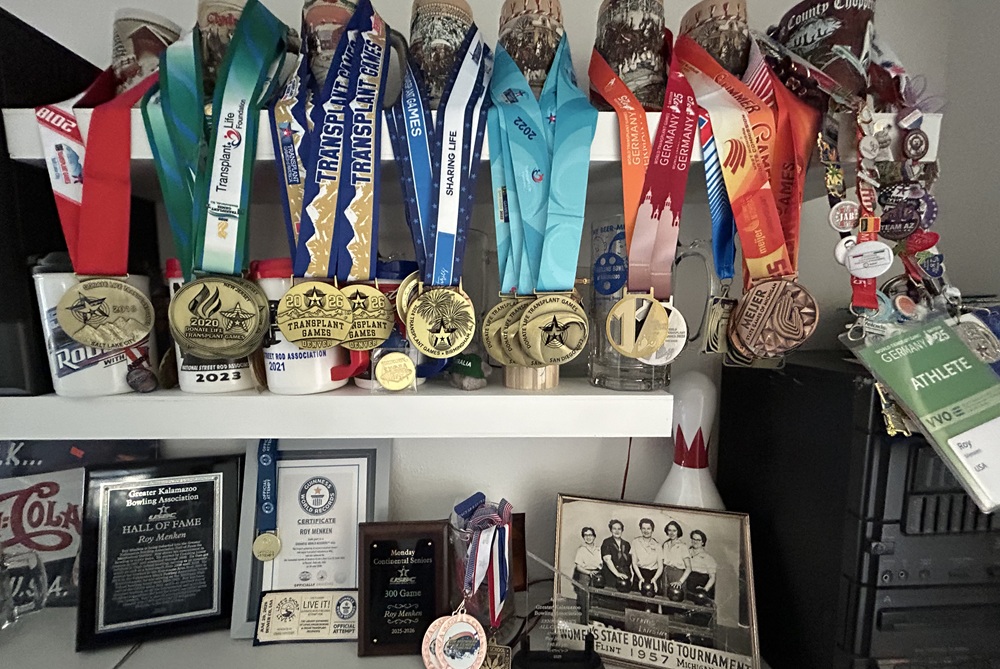
Menken also competes in Transplant Games of America and World Transplant Games. Several of his 12 gold medals came from both tournaments, including a mixed doubles gold in the U.S. Games with Becky Sheets from Charlotte, who was six months out from a heart transplant.
Traveling is no problem for Menken and his wife, Jan. The World Games, held every two years, move from country to country. Last year they were in Dresden, Germany, and next year will be in Belgium.
Menken still has to travel to Ann Arbor for checkups every three months and gets weekly infusions of Prolastin (an enzyme his liver doesn’t release) at home.

He is also in chronic rejection and relapsed twice before rebounding, which he attributes to how active he is and the 12 morning pills and 16 evening pills he takes each day.
As a teen, Menken was diagnosed with sports-induced asthma and began using inhalers.
He said doctors never really discovered that he had Alpha-1 until one day in 2013, while he was working as a building operator for Kalamazoo County and had trouble catching his breath.
“They sent me to their doctor, and he said do you realize you are disabled?” recounted Menken, who refused to believe it.
It was not until he went to Ann Arbor for tests that he was diagnosed with end-stage lung disease and given two years to live.
He and his wife “left U of M and we were both in shock,” he said.
After returning home, he was put on two liters of oxygen and could no longer work at his job. Once he got the call for surgery, Menken said he was more afraid that something would happen to cancel the surgery than he was of dying.
The operation lasted 14 hours and when he woke the next day, he wasn’t scared but knew the operation was a success when he saw “my wife and her Aunt Marcia Godisak, who was also one of my respiratory nurses, just the looks on their faces, even though I couldn’t speak because I was still on a ventilator.”
Coaching a passion
Menken coached bowling at Portage Northern for 10 years, then started at Galesburg-Augusta until COVID-19 shut down the program. He has helped coach at Kalamazoo Central the past two years and spends time talking to clubs and schools about his journey and organ donations.
He is also in charge of the Saturday morning junior bowling leagues at Continental.
“He brings a lot of bowling knowledge that I don’t have,” K-Central head coach Krys Briggs said. “I have not had the experience, so I find people I know that are definitely more knowledgeable than I am.

“The kids love him.”
The coach also said she passed around an article about Menken’s transplant journey for the bowlers who did not know about it.
“Personally. it makes me want to work on my health and make sure that I’m healthy just so that I don’t have to go through that,” said junior bowler Kaeden Lutzka, who heard Menken speak during one of his classes. “If I stay healthy and someone needs my organs, I can be a donor since I’m a donor on my license.”
Menken said the feeling of survivor’s guilt still haunts him.
“We honor Andrew every day,” he said.
Keith Nicholson said, “The biggest misinterpretation, and I know people say it because it’s the most common, but it’s not that we lost a son. I know where he went. I know what happened. He was just an amazing kid. He touched a lot of people’s hearts.
“Roy had less than six months to live. I’m happy for him.”

Pam Shebest served as a sportswriter at the Kalamazoo Gazette from 1985-2009 after 11 years part-time with the Gazette while teaching French and English at White Pigeon High School. She can be reached at [email protected] with story ideas for Calhoun, Kalamazoo and Van Buren counties.
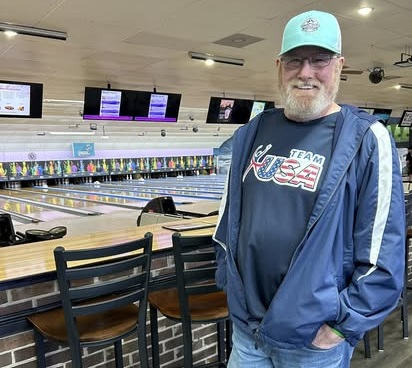
PHOTOS (Top) Roy Menken’s collection of bowling awards includes several medals earned competing in national and world games for bowlers who have received organ transplants. (2) Andrew Nicholson, as an organ donor, provided lungs that have extended Menken’s life. (3) Menken, at a bowling center, is an assistant coach for Kalamazoo Central. (4) Menken rolls for a spare during tournament play. (5) Kalamazoo Central head bowling coach Krys Briggs and junior Kaeden Lutzka. (Menken, Nicholson and awards photos courtesy of Roy Menken. Headshots by Pam Shebest.)
Answers from the Athletes
By
Rob Kaminski
MHSAA benchmarks editor
May 22, 2014
By Rob Kaminski
MHSAA benchmarks editor
MHSAA Student Advisory Council members were asked their opinions on several of the current issues facing the MHSAA Junior High/Middle School Committee and the MHSAA JH/MS Task Force. Students also shared experiences from their junior high/middle school days and from participation with non-school teams. Following is a sampling of responses:
Length of Contests and Seasons
Based on your junior high/middle school experiences, would you favor an increase in the number of contests/events that a junior high/middle school is allowed to play? Would you favor longer game times?
Kiersten Mead, Saginaw Swan Valley: “I personally don't believe that longer seasons are necessary. In middle school, student athletes are just starting to learn how to balance sports and school, so I think that the season time is already pretty reasonable.
“I do, however, believe that longer games would be really beneficial to all ages. It would allow more students to play and participate.”
Jonathan Perry, McBain Northern Michigan Christian: “When I was playing, I wish my season would have been longer, but it is at a reasonable length. It would be harder on parents having a middle school player and a high school player, but it would get you more ready for a high school-length schedule.
“The games are at a reasonable length also. The one benefit of having more games and longer games is that more kids get to play who otherwise might not if they had a shorter game or season.”
Connor Thomas, Marlette: “As a player, I would be totally in favor. If I were an adult, I would say no because of the traveling. As for the lengths of games, again, I’d favor it as a player. But with schools that have A and B teams for both grades, that could be a late night.”
Kristen Law, Bloomfield Hills Andover: “I really enjoyed playing in middle school, and I would have loved to be able to play more. Increasing the length of games might depend on the sport. For tennis, from what I remember, the matches were a shortened version of what we play in high school, and I thought they were appropriate given the level of the majority of the players that were competing.”
Zack Nine, Pinconning: “Based on my middle school sports experience, I would favor an increase in the number of contests and a longer game time. These changes would give athletes who do not get much playing time a chance to gain more experience. I also believe that more games and a longer game length would keep our youth in better shape and better prepare them for high school athletics through an easier transition.”
Mandy Paull, Cheboygan: “I think that middle school sports should be allowed to play more games, but I do not think that the length of games should be increased.”
Coby Ryan Manistique: “I would favor an increase in the number of contests. The seasons are quite short and go by too quickly, in my opinion.
“I would also favor longer game times. With this, more kids will get the opportunity to play, and it will also make the travel and the time invested more worthwhile.”
6th-Grade Participation
Is it time to also include 6th-graders at junior high/middle schools under MHSAA guidelines? Consider enrollments, sports and participation with 7th- and 8th-graders.
Eliza Beird, Holland Black River: “I would favor the addition of 6th-graders in all sports. This would allow for the possibility of two teams in some sports and it gets the kids playing with people they might be playing with for the rest of their high school careers.
“It is definitely easier to put 6th-graders with 7th- and 8th-graders at a smaller school because one grade usually won’t out-number another grade. In a big school, a bunch of 8th-graders will try out for the team because more go to a school. In larger schools, 6th-graders would have a chance to make only a 6th-grade team.
Hayden Smith, Hamilton: “I think it’s time for 6th-graders to be included, but not in all sports; just the non-contact ones. The various sizes of schools would make it easier for some to compete and harder for others, but it shouldn’t matter overall. All schools’ 6th-graders should be able to play. I think that would be a great experience for them.”
Mandy Paull, Cheboygan: “I think that 6th-grade students should be able to play middle school sports. Sports are a good way to initiate incoming elementary students to the middle school as well as provide a fun, constructive activity that they can participate in with their friends, and a way to make new ones as well.
“The 6th-grade athletes should only be mixed with the 7th and 8th grade in cross country and track, and have their own teams for sports like volleyball and basketball, just as the 7th- and 8th- graders do. Only non-contact sports should mix all grades.”
Connor Thomas, Marlette: “Coming from a smaller community, I think the MHSAA should include 6th-graders in only the schools that need them, such as small Class D schools. They should be allowed to play with 7th- and 8th-graders as long as the schools need them, and aren't bringing them up to have a ‘dream team.’ Enrollment has to be a factor; the schools should be struggling for numbers in order to have a 6th-grader on a team.”
Zack Nine, Pinconning: “I believe that 6th- graders should not be held accountable to MHSAA regulations. My opinion largely stems from the fact that not every school includes 6th grade as part of its middle school. I know mine does not. It would be difficult to regulate the participation of 6th-graders in some schools (because they're considered middle schoolers) while other schools cannot let their 6th-grade elementary students compete.”
Jonathan Perry, McBain Northern Michigan Christian: “I think all sports should be included if 6th-graders were allowed to play. I think it’s more helpful to small schools, but wouldn’t limit it based on enrollment. I go to a small school; last year my school did not have enough kids for a 7th-grade team.”
Kiersten Mead, Saginaw Swan Valley: “I understand the monetary considerations schools may have with 6th-grade teams through the MHSAA, but I do believe that the MHSAA should start setting guidelines for the schools which see it as feasible. Middle schools don't have to go through the MHSAA, but I believe that by including 6th-graders, it may generate a positive reaction from member schools.
“I feel like as long as the coaches don't see a major physical disadvantage to it, then it would be okay for 6th-graders to participate with the 7th and 8th grade in all sports. Non-contact sports would most definitely be alright, because in high school, you compete against all ages anyways.
Coby Ryan Manistique: “I believe that it is time for 6th-graders to get the chance to participate in athletics, regardless of school size. By choice, a child should always be given the opportunity to be active, stay out of trouble, learn about teamwork and leadership, and build a foundation for fundamentals that will be used for the rest of their athletic careers. Many schools do not have locally run programs, and the MHSAA running it would give thousands more kids a chance to play.”
Kristen Law, Bloomfield Hills Andover: “When I was in 6th grade, I was competing against 7th- and 8th-graders (on community teams), and I probably would have been upset if I couldn't compete against them. Sixth-grade participation should definitely be allowed in non-contact sports, but I don't know too much about contact sports and the risk of injury to 6th-graders if it were to be allowed.
“I don't think the size of the school should determine whether or not 6th-graders can compete against 7th- and 8th-graders.”
Community and Club Sports
If you played community sports during your JH/MS years, how did the experience compare with school sports? If you could have played MHSAA-based sports in 6th grade, would you have done so?
Emileigh Ferguson, Bear Lake: “I played little league softball prior to middle school, until 5th grade. I prefer MHSAA sports over other kinds because they are more serious and organized. My school has basketball for 5th and 6th grade so we don’t play with middle school.”
Eliza Beird, Holland Black River: “I played soccer and basketball from Kindergarten through 6th grade and still play club sports. My outside-of-school sports tended to be a bit better.
“If there were MHSAA sports in 6th grade, I would have definitely played basketball. I already played with a bunch of girls from school so playing for my school would not have been much different. Plus it’s fun to play for my school. I probably would not have played soccer because the club team I was on at the time was quite a bit better than the school team.”
Hayden Smith, Hamilton: “In my experience (community sports) was somewhat similar, but still different. School sports weren't coached by parents anymore; the best players got to start. Also, it was different in that a lot of kids stopped playing; only the ones who really liked it kept playing. However, it was similar because there were always people (parents and kids) complaining about playing time. It was similar in that there was always a strong community at your back.
“If I could have played school sports earlier, I would have done so because of the aspect of representing my community and school. I think I still would have done the travel baseball stuff, but that is always in the summer.”
Mandy Paull, Cheboygan: “I played girls little league softball from 3rd to 5th grade, and house hockey from 1st grade to 9th. In middle school the sports were more serious and I enjoyed them much more. As a team we would dress up for our games, and we got to travel on a bus to away games. There was a much stronger bond and all the players were more serious. The teams were also better in middle school due to tryouts.
“I definitely would have played middle school sports in 6th grade as opposed to community teams.”
Jonathan Perry, McBain Northern Michigan Christian: “I did not notice a huge difference between community sports and school sports. The big difference in community sports is that you get a wide range of kids, not just the kids in your school. I like playing the school sports better because I knew that the kids I was playing with were who I would play high school sports with.
“I would have played school sports in 6th-grade or earlier if the option was there. A lot of community sports I played on (were) all about winning. The school team sports provide learning sessions for both sports and life. It's an extension of the classroom. I saw that more with school sports than community sports.”
Kiersten Mead, Saginaw Swan Valley: “I did not play anything prior to middle school, but in 6th grade I was a part of an AAU volleyball team since my school did not offer a 6th-grade team. I also bowled in leagues at a few different bowling alleys.
“I definitely would have played with my school versus community. We really didn't have a solid AAU program in our area so the school team was much more organized. I found that the volleyball teams through my school were much more beneficial to me. We practiced on a regular basis, and it was nice to play with girls that I was already friends with. We were able to grow more as a team and gain a greater sense of unity. I believe that my school team made me a better athlete as well.”
Kristen Law, Bloomfield Hills Andover: “I enjoyed being able to play sports with my friends in middle school, but I also liked the competitiveness of the community- based sports I participated in. The middle school sports atmosphere didn't feel as competitive.
“When I was in 6th grade, I played tennis on the middle school team, but it was not affiliated with the MHSAA.”