


Menken Giving Back Through Coaching, Telling Story of Donor's Life-Saving Gift
By
Pam Shebest
Special for MHSAA.com
November 17, 2026
KALAMAZOO — In 2017, Andrew Nicholson was a 19-year-old senior at Holly High School.
 Roy Menken was a 52-year-old bowler who was dying of Alpha-1 antitrypsin deficiency, a fatal lung disease.
The two had never met, but through tragedy, the teen saved Menken’s life.
Menken, an assistant bowling coach at Kalamazoo Central, was given about six months to live when he got a call at 5:45 a.m. on May 24, 2017, from University of Michigan Health.
After waiting for 27 months, Menken was finally getting a new pair of lungs.
“Normally they give you about four hours to get to U of M,” Menken said. “In my case, Andrew’s lungs didn’t match anyone else in the U of M program, so I was the only one called.”
With his wife driving “like a mad person,” they made it to the medical center in Ann Arbor in less than two hours.
Preparing for the surgery, he said, he felt “a little scared, because you never know. Actually, I felt sad for the person who had passed. We were told that it was a young man, and he was involved in an accident.”

The teen was killed the day before in a welding accident.
Working in a junk yard, he was asked to weld some 55-gallon drums, which, unknown to him, still had some lacquer thinner in them.
“A week before I showed my son how to weld,” said Keith Nicholson, Andrew’s dad. “He made an eighth-inch weld and it burned through and blew up. Broke his neck, broke his forearm, broke his shoulder, broke his whole left side of his body, crushed his head.”
Fortunately for Menken, when the teen got his driver’s license at age 16, he checked the donor box.
“The day my ex-wife took him to get his driver’s license, she was standing there next to him and he said, ‘Donor, what’s that mean?’” Keith Nicholson said. “She said if you die, they can take your organs and help other people.
“Andrew shrugged his shoulders and said, ‘Well, they’re not going to do any good for me.’”
Those organs not only helped Menken, but saved four other lives, were life-changing for 12 more people (bones, etc.) and life-altering for another 33 (skin, science, etc.)
Menken sent a letter to Gift of Life Michigan through the hospital, hoping it would be forwarded to the donor’s family. The family answered, beginning a life-long friendship.
Keith Nicholson said he responded because “I was more curious making sure everything was all right. I’m really happy. I couldn’t ask for a better recipient.”
They have not only become “family,” but on the two-year anniversary of the transplant, Keith Nicholson went to Kalamazoo from Trenton to pick up the classic 1959 Impala that Menken started restoring before the surgery but could no longer finish.
Nicholson completed work on the car and said Andrew would have done it himself if he’d had a chance.
“The only thing I ever said to Roy (about the transplant) was when we were out in the shop welding on the car, he tried to sneak out there (to help)," Nicholson recalled.
And that question was a stark reminder.
“I stopped welding, looked at him and said, ‘Is this what you think of my son’s gift to you?’”
Living a full life
Fueled by healthy new lungs, Menken wasted no time getting back into sports.
The transplant was in May 2017, and by that September he was playing golf. He started bowling in November.
When he walked into Continental Lanes that first day, he saw his son, Donald, who was working there.
“You could just see the emotion on his face,” Menken said. “So was (manager) Dave Fawley and my other son, Perry.
“I slowly got back into the leagues that January and haven’t quit bowling since except when COVID hit.”
Bowling at least five days a week is no problem for Menken. The hardest part, he said, is wearing a mask when he is around people, something transplant recipients are supposed to do.
The mask hasn’t interfered with his game. He’s shot a couple of 300 games since then.
Menken also competes in Transplant Games of America and World Transplant Games. Several of his 12 gold medals came from both tournaments, including a mixed doubles gold in the U.S. Games with Becky Sheets from Charlotte, who was six months out from a heart transplant.
Traveling is no problem for Menken and his wife, Jan. The World Games, held every two years, move from country to country. Last year they were in Dresden, Germany, and next year will be in Belgium.
Menken still has to travel to Ann Arbor for checkups every three months and gets weekly infusions of Prolastin (an enzyme his liver doesn’t release) at home.

He is also in chronic rejection and relapsed twice before rebounding, which he attributes to how active he is and the 12 morning pills and 16 evening pills he takes each day.
As a teen, Menken was diagnosed with sports-induced asthma and began using inhalers.
He said doctors never really discovered that he had Alpha-1 until one day in 2013, while he was working as a building operator for Kalamazoo County and had trouble catching his breath.
“They sent me to their doctor, and he said do you realize you are disabled?” recounted Menken, who refused to believe it.
It was not until he went to Ann Arbor for tests that he was diagnosed with end-stage lung disease and given two years to live.
He and his wife “left U of M and we were both in shock,” he said.
After returning home, he was put on two liters of oxygen and could no longer work at his job. Once he got the call for surgery, Menken said he was more afraid that something would happen to cancel the surgery than he was of dying.
The operation lasted 14 hours and when he woke the next day, he wasn’t scared but knew the operation was a success when he saw “my wife and her Aunt Marcia Godisak, who was also one of my respiratory nurses, just the looks on their faces, even though I couldn’t speak because I was still on a ventilator.”
Coaching a passion
Menken coached bowling at Portage Northern for 10 years, then started at Galesburg-Augusta until COVID-19 shut down the program. He has helped coach at Kalamazoo Central the past two years and spends time talking to clubs and schools about his journey and organ donations.
He is also in charge of the Saturday morning junior bowling leagues at Continental.
“He brings a lot of bowling knowledge that I don’t have,” K-Central head coach Krys Briggs said. “I have not had the experience, so I find people I know that are definitely more knowledgeable than I am.

“The kids love him.”
The coach also said she passed around an article about Menken’s transplant journey for the bowlers who did not know about it.
“Personally. it makes me want to work on my health and make sure that I’m healthy just so that I don’t have to go through that,” said junior bowler Kaeden Lutzka, who heard Menken speak during one of his classes. “If I stay healthy and someone needs my organs, I can be a donor since I’m a donor on my license.”
Menken said the feeling of survivor’s guilt still haunts him.
“We honor Andrew every day,” he said.
Keith Nicholson said, “The biggest misinterpretation, and I know people say it because it’s the most common, but it’s not that we lost a son. I know where he went. I know what happened. He was just an amazing kid. He touched a lot of people’s hearts.
“Roy had less than six months to live. I’m happy for him.”

Pam Shebest served as a sportswriter at the Kalamazoo Gazette from 1985-2009 after 11 years part-time with the Gazette while teaching French and English at White Pigeon High School. She can be reached at [email protected] with story ideas for Calhoun, Kalamazoo and Van Buren counties.
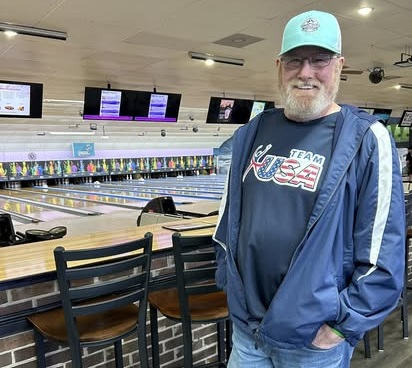
PHOTOS (Top) Roy Menken’s collection of bowling awards includes several medals earned competing in national and world games for bowlers who have received organ transplants. (2) Andrew Nicholson, as an organ donor, provided lungs that have extended Menken’s life. (3) Menken, at a bowling center, is an assistant coach for Kalamazoo Central. (4) Menken rolls for a spare during tournament play. (5) Kalamazoo Central head bowling coach Krys Briggs and junior Kaeden Lutzka. (Menken, Nicholson and awards photos courtesy of Roy Menken. Headshots by Pam Shebest.)
Nurturing Our Lower Level Programs
May 15, 2014
By John E. “Jack” Roberts
MHSAA Executive Director
When I’ve been faced with the most difficult choices as to different courses of action for the MHSAA, I’ve tried to face up to this reframing of the issue: “If we were creating the MHSAA for the first time today, would we do this, or would we do that?”
For example, would we or would we not limit coaches’ contact with athletes out of season? Would we have a 90-day period of ineligibility for transfer students or would it be 180 days?
There are other examples of such “either, or” questions I could provide, but none is as difficult or defining as this: Should school sports under the MHSAA’s auspices provide more opportunities for 7th- and 8th-graders and new opportunities for even younger students?
I won’t be coy about what I think our answer should be. I haven’t always felt this way, and I recognize it is a different opinion than some who are quoted in this publication; but today it’s my belief that if we were creating the MHSAA for the first time in 2014, the MHSAA would allow more contests and longer contests for 7th- and 8th-graders, and the MHSAA would have competition policies and programs for younger middle schoolers too.
I believe this is what parents want for their children and what students want for themselves; and I believe, within reason, that the better we serve these students in their junior high/middle school years, the stronger high school sports will be and the better these programs will support the educational missions of schools.
I believe we must begin to serve middle school students more comprehensively, and that our doing so today is the best hope we have for retaining comprehensive programs for high school students tomorrow. Not only does the lower profile and pressure of lower level programs nurture the highest ideals of educational athletics, they provide our highest hope for preserving those ideals at the high school level.
The Lasting Impact of First Impressions
The over-arching question before us is how to maintain policies that encourage multiple sport experiences for students at the junior high/middle school level while at the same time adjusting those policies in terms of grade level served and the numbers and lengths of contests allowed in order to be more attractive to junior high/middle school parents and to school districts which desire additional competition opportunities in the school setting for students prior to high school.
There is a good healthy discussion in our midst about the scope of junior high/middle school athletics – how much should occur and how young it should commence; and the result of these discussions may have long-lasting effect on students, schools and the MHSAA.
Here are two central issues:
1. Contest Limits
Many people over many years have contributed to developing the current season limitations for the number of contests permitted by MHSAA member junior high/middle schools. These good people have believed in a philosophy of sports at this level that encourages students to try multiple sports.
“Kids haven’t fully matured yet,” they say. “Kids haven’t been exposed to some sports yet. They don’t know what they might like or be good at. So let’s have policies and programs that encourage new opportunities and experiences at this level.”
The season limits that have been put in place allow some junior high/middle schools, or their entire leagues, to fit four distinct seasons in a nine-month school year, consistent with this over-arching philosophy to encourage these students to try new things and learn.
There is another educationally grounded and equally astute group of administrators and coaches who are concerned that the current limits are too severe in comparison to non-school youth sports programs. For example, community/club basketball or soccer programs may schedule 15 or 18 or more games per season versus the MHSAA limit of 12 at the junior high/middle school level.
These folks think these restrictive limitations create a disincentive for kids to play school sports, and that many of those who have no place in junior high/middle school sports have no interest later in high school sports.
2. 6th-Graders
Historically, the popular opinion among educators has held that 7th and 8th grade is early enough for schools to provide competitive athletics, early enough to put youth into the competitive sports arena, and early enough to pit one school against another in sports.
Today, however, many educators and parents point out that such protective philosophies and policies were adopted about the same time “play days” were considered to be the maximum exertion females should experience in school sports. Some administrators and coaches argue that both our severe limits on contest limits at the junior high/middle school level, and our refusal to serve 6th-graders, are as out of date and inappropriate as play days for females.
Today, in nearly four of five school districts with MHSAA member schools, 6th-graders go to school in the same building with 7th- and 8th-graders. But MHSAA rules don’t allow 6th-graders to participate with and against 7th- and 8th-graders. In fact, the MHSAA Constitution doesn’t even acknowledge that 6th-graders exist.
Today, in many places, 6th-graders have aged-out of non-school, community sports, but they are not permitted to play on MHSAA junior high/middle school teams.
Last school year, 50 different school districts requested this rule be waived for them, and the MHSAA Executive Committee approved 46 of 50 waivers, allowing 6th-graders to compete on 7th- and 8th-grade teams. During 2011-12, 37 of 40 requests for waiver were approved, in all cases for small junior high/middle schools. Many of these schools want, and some of them desperately need, these 6th-graders to fill out junior high/middle school teams.
Young people are starting sports much younger today than 100 years ago when the MHSAA was created. Younger than even 50 years ago when the MHSAA was incorporated. If the MHSAA were created today to serve any students before 9th grade, I’m certain it would not leave out 6th-graders who are walking the same halls with 7th- and 8th-graders, and who have been playing competitive sports almost since the first day they started walking at all.
Eyes on the future
The most important thing we can do to enhance high school sports is to grow junior high/middle school sports programs. The earlier we disconnect young people from non-school sports and engage them in school-sponsored sports, the better our chances are of keeping high school athletic programs healthy, and the better our prospects are of keeping both participation rates and conduct standards high.
School sports are in competition for hearts and minds of young people. Our competition includes movies, jobs, cars, video games, boyfriends and girlfriends and club sports ... especially club sports. School sports needs to market itself better, and part of better is to be available earlier – much sooner in the lives of youth. More contests at the junior high/middle school level and more opportunities for 6th-graders should be parts of our marketing strategies on behalf of educational athletics generally.
For at least 50 years there have been predictions by people outside of our member schools that the system of school-sponsored sports that is almost unique to the United States would someday give way to the system of most countries where youth sports is provided by non-school community groups and private athletic clubs. Some people challenge school-sponsored sports on a program basis – for example, that competitive athletics creates a distraction to the core educational mission of schools. Others may challenge school-sponsored sports on a financial basis – that interscholastic athletics compete for the limited resources communities have to support their schools.
Today there also exists among our member schools a small percentage of administrators who have come to their leadership roles without involvement in school sports and who either desire and believe that interscholastic sports will be moved from schools to communities or who do not want but predict that such will occur as resources for schools continue to shrink.
I believe this is more likely to happen, or to happen sooner, if we do not change our approach to junior high/middle school sports. If we continue to restrict 7th- and 8th-graders to so few contests of such limited length compared to what those students have in non-school sports, and if we continue to offer nothing for younger students, we essentially and effectively force these students to non-school sports.
It is an often cited statistic that between 80 and 90 percent of all young people who ever begin playing competitive athletics stop playing before they reach the age of 13, meaning the vast majority of young people never, ever are involved in school programs. Thus, it is no mystery why people question the future of school sports. We’re doing nothing to make programs available to them. They have no experience in them.
Our restrictive and possibly outdated policies and procedures regarding contest limits and lengths and the age at which we begin to serve junior high/middle school students may assure that the dire predictions about school sports’ future will be accurate. We are doing too little, too late. It is marketing at its worst.
In my mind there is little doubt that we are doing too little too late with junior high/middle school students. Now the challenge before us is to think beyond “we can’t afford it” and make some necessary changes, while still avoiding a system that allows or even encourages schools doing too much too soon.