

Menken Giving Back Through Coaching, Telling Story of Donor's Life-Saving Gift
By
Pam Shebest
Special for MHSAA.com
November 17, 2026
KALAMAZOO — In 2017, Andrew Nicholson was a 19-year-old senior at Holly High School.
 Roy Menken was a 52-year-old bowler who was dying of Alpha-1 antitrypsin deficiency, a fatal lung disease.
The two had never met, but through tragedy, the teen saved Menken’s life.
Menken, an assistant bowling coach at Kalamazoo Central, was given about six months to live when he got a call at 5:45 a.m. on May 24, 2017, from University of Michigan Health.
After waiting for 27 months, Menken was finally getting a new pair of lungs.
“Normally they give you about four hours to get to U of M,” Menken said. “In my case, Andrew’s lungs didn’t match anyone else in the U of M program, so I was the only one called.”
With his wife driving “like a mad person,” they made it to the medical center in Ann Arbor in less than two hours.
Preparing for the surgery, he said, he felt “a little scared, because you never know. Actually, I felt sad for the person who had passed. We were told that it was a young man, and he was involved in an accident.”

The teen was killed the day before in a welding accident.
Working in a junk yard, he was asked to weld some 55-gallon drums, which, unknown to him, still had some lacquer thinner in them.
“A week before I showed my son how to weld,” said Keith Nicholson, Andrew’s dad. “He made an eighth-inch weld and it burned through and blew up. Broke his neck, broke his forearm, broke his shoulder, broke his whole left side of his body, crushed his head.”
Fortunately for Menken, when the teen got his driver’s license at age 16, he checked the donor box.
“The day my ex-wife took him to get his driver’s license, she was standing there next to him and he said, ‘Donor, what’s that mean?’” Keith Nicholson said. “She said if you die, they can take your organs and help other people.
“Andrew shrugged his shoulders and said, ‘Well, they’re not going to do any good for me.’”
Those organs not only helped Menken, but saved four other lives, were life-changing for 12 more people (bones, etc.) and life-altering for another 33 (skin, science, etc.)
Menken sent a letter to Gift of Life Michigan through the hospital, hoping it would be forwarded to the donor’s family. The family answered, beginning a life-long friendship.
Keith Nicholson said he responded because “I was more curious making sure everything was all right. I’m really happy. I couldn’t ask for a better recipient.”
They have not only become “family,” but on the two-year anniversary of the transplant, Keith Nicholson went to Kalamazoo from Trenton to pick up the classic 1959 Impala that Menken started restoring before the surgery but could no longer finish.
Nicholson completed work on the car and said Andrew would have done it himself if he’d had a chance.
“The only thing I ever said to Roy (about the transplant) was when we were out in the shop welding on the car, he tried to sneak out there (to help)," Nicholson recalled.
And that question was a stark reminder.
“I stopped welding, looked at him and said, ‘Is this what you think of my son’s gift to you?’”
Living a full life
Fueled by healthy new lungs, Menken wasted no time getting back into sports.
The transplant was in May 2017, and by that September he was playing golf. He started bowling in November.
When he walked into Continental Lanes that first day, he saw his son, Donald, who was working there.
“You could just see the emotion on his face,” Menken said. “So was (manager) Dave Fawley and my other son, Perry.
“I slowly got back into the leagues that January and haven’t quit bowling since except when COVID hit.”
Bowling at least five days a week is no problem for Menken. The hardest part, he said, is wearing a mask when he is around people, something transplant recipients are supposed to do.
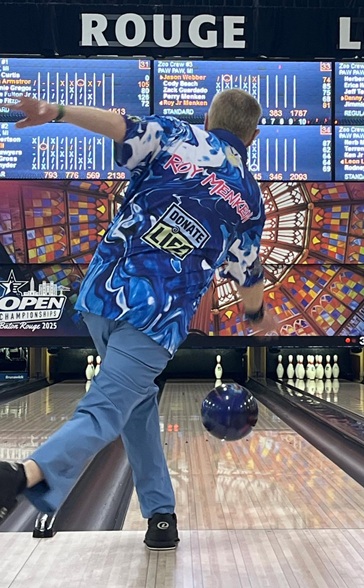
The mask hasn’t interfered with his game. He’s shot a couple of 300 games since then.
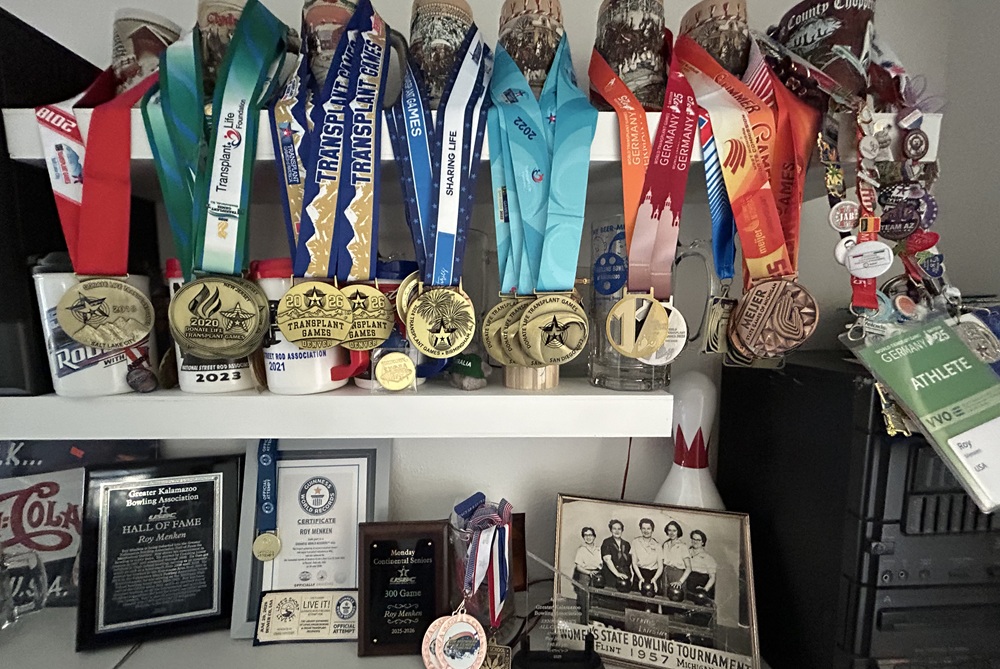
Menken also competes in Transplant Games of America and World Transplant Games. Several of his 12 gold medals came from both tournaments, including a mixed doubles gold in the U.S. Games with Becky Sheets from Charlotte, who was six months out from a heart transplant.
Traveling is no problem for Menken and his wife, Jan. The World Games, held every two years, move from country to country. Last year they were in Dresden, Germany, and next year will be in Belgium.
Menken still has to travel to Ann Arbor for checkups every three months and gets weekly infusions of Prolastin (an enzyme his liver doesn’t release) at home.
He is also in chronic rejection and relapsed twice before rebounding, which he attributes to how active he is and the 12 morning pills and 16 evening pills he takes each day.
As a teen, Menken was diagnosed with sports-induced asthma and began using inhalers.
He said doctors never really discovered that he had Alpha-1 until one day in 2013, while he was working as a building operator for Kalamazoo County and had trouble catching his breath.
“They sent me to their doctor, and he said do you realize you are disabled?” recounted Menken, who refused to believe it.
It was not until he went to Ann Arbor for tests that he was diagnosed with end-stage lung disease and given two years to live.
He and his wife “left U of M and we were both in shock,” he said.
After returning home, he was put on two liters of oxygen and could no longer work at his job. Once he got the call for surgery, Menken said he was more afraid that something would happen to cancel the surgery than he was of dying.
The operation lasted 14 hours and when he woke the next day, he wasn’t scared but knew the operation was a success when he saw “my wife and her Aunt Marcia Godisak, who was also one of my respiratory nurses, just the looks on their faces, even though I couldn’t speak because I was still on a ventilator.”
Coaching a passion
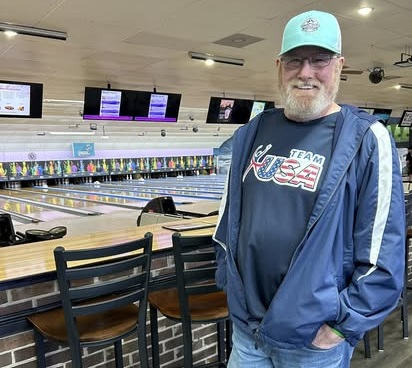
Menken coached bowling at Portage Northern for 10 years, then started at Galesburg-Augusta until COVID-19 shut down the program. He has helped coach at Kalamazoo Central the past two years and spends time talking to clubs and schools about his journey and organ donations.
He is also in charge of the Saturday morning junior bowling leagues at Continental.
“He brings a lot of bowling knowledge that I don’t have,” K-Central head coach Krys Briggs said. “I have not had the experience, so I find people I know that are definitely more knowledgeable than I am.

“The kids love him.”
The coach also said she passed around an article about Menken’s transplant journey for the bowlers who did not know about it.
“Personally. it makes me want to work on my health and make sure that I’m healthy just so that I don’t have to go through that,” said junior bowler Kaeden Lutzka, who heard Menken speak during one of his classes. “If I stay healthy and someone needs my organs, I can be a donor since I’m a donor on my license.”
Menken said the feeling of survivor’s guilt still haunts him.
“We honor Andrew every day,” he said.
Keith Nicholson said, “The biggest misinterpretation, and I know people say it because it’s the most common, but it’s not that we lost a son. I know where he went. I know what happened. He was just an amazing kid. He touched a lot of people’s hearts.
“Roy had less than six months to live. I’m happy for him.”

Pam Shebest served as a sportswriter at the Kalamazoo Gazette from 1985-2009 after 11 years part-time with the Gazette while teaching French and English at White Pigeon High School. She can be reached at [email protected] with story ideas for Calhoun, Kalamazoo and Van Buren counties.
PHOTOS (Top) Roy Menken’s collection of bowling awards includes several medals earned competing in national and world games for bowlers who have received organ transplants. (2) Andrew Nicholson, as an organ donor, provided lungs that have extended Menken’s life. (3) Menken, at a bowling center, is an assistant coach for Kalamazoo Central. (4) Menken rolls for a spare during tournament play. (5) Kalamazoo Central head bowling coach Krys Briggs and junior Kaeden Lutzka. (Menken, Nicholson and awards photos courtesy of Roy Menken. Headshots by Pam Shebest.)

MHSA(Q&)A: Stevensville-Lakeshore wrestling coach Bruce Bittenbender
February 9, 2012
Bruce Bittenbender grew up in Bethlehem, Pa., in the heart of steel country, and worked part-time in a mill as a young adult. That helped land him in Michigan City, Ind., not long after graduating from Milligan College in Tennessee in 1969.
But Bittenbender wanted to teach and coach.
Bittenbender took a teaching job at South Haven that fall, and as an assistant coach helped that school's wrestling team to the MHSAA Class B championship. A year later the wrestling coaching job opened at Stevensville Lakeshore. He says now that he was too young for the job, but Bittenbender applied and was hired. The program was struggling at that point -- but not for much longer.
According to the National Federation of State High School Associations' record book, Bittenbender trailed only Rex Peckinpaugh of New Castle, Ind., in career dual coaching wins heading into this season (796-780). Bittenbender won his 800th match on Jan. 14 -- and has his team just two more victories from MHSAA Finals weekend Feb. 24-25 in Battle Creek.
Bittenbender retired from teaching two years ago after 35 teaching biology and seven more physical education. At 64, he still gets on the mat with his wrestlers from time to time, although perhaps not as much as he once did. But countless wrestlers -- including those who won a combined 20 individual championships -- have benefited from his instruction.
His coaching tree includes current Rockford coach Brian Richardson and former Lowell coach Dave Strejc, who led teams to MHSAA Division 2 championships in 2002 and 2004. Bittenbender was named National Coach of the Year by the National Federation of State High School Associations in 2002 and again by the National High School Athletic Coaches Association in 2010. He is a member of the Michigan Wrestling Association Hall of Fame, and he will be inducted into the Pennsylvania Wrestling Coaches Association Hall of Fame this spring.
Stevensville Lakeshore is ranked No. 7 in Division 2. His team won its District on Tuesday, downing St. Joseph 35-34 with a decision win in the final match.
What keeps you coming back for another season?
Every year, when you think you've seen it all, something else comes up. When I was in middle school, it was junior high school back then, I was on the edge. The coach (Jim McIntyre, who went on to coach at Kutztown University) grabbed me on the back of the neck and said, "What are you doing?" I was hanging out with kids of questionable character, and he said, "You need to come out for wrestling." I still go back and play golf with that guy once in a while. ... I came from a big family. We didn't have much. I have empathy for the kids that were kicked around, misdirected. Somebody took time out for me. I felt maybe I could kick some of that back.
After so many wins, do you still enjoy all of them the same?
I tell ya, last night I certainly enjoyed the win. It was just like I was 23 again. Yeah, I enjoy it. It's addictive. That's what you're out there for.
The NFHS changed its wrestling weight classes this season, but Michigan chose to stay with its current lineup. What is your thought on that switch?
I think it's going to switch back. It makes no sense to me. The average kid graduating from high school is 5-(foot-)9, 155 pounds. Why add a weight class at the top where you have to compete for kids with football and basketball. … Our sport has prided itself on giving the little guy a chance. ... He can be a state champ in wrestling.
Your teams have finished MHSAA Finals runner-up twice. How much would you like to win that first championship?
I would love to. That's the ultimate goal. We've been so close. We were up three points in '94, and got pinned at heavyweight (to lose 28-25 to Fowlerville). In '86 we broke the record for individual number of points scored, but Eaton Rapids broke it too. We were that close.
I'm assuming you're not going to stop coaching any time soon.
Being around people and the community, and working with kids, it keeps you young. Keeps you in shape, keeps you motivated. I think that's one of the reasons. Now that I'm not teaching, my wife and I are able to travel quite a bit in the fall and summer. I think that's basically a motivator, just being around people.
What do you tell, or would you tell, young coaches who are just getting started in high school wrestling?
I tell them to be careful the first few years. It's different today. … I tell coaches you need to set up standards, discipline, goals and objectives, and go by those. You try to accommodate some of these kids, and this and that, but you can go only so far. You’ve gotta stick to the rules and let the cards fall where they are. If you don't, you'll have problems down the line.
And I think communicating with people, making friends, getting out there and strumming up support for the program is important too. I've had the opportunity to speak to the Lions Club, various civic organizations, at hospitals. You have to try to make yourself available. People have to learn to put their trust in you."