

Athens Ends Inspired Run with OT Surge
November 2, 2019
By Dean Holzwarth
Special for Second Half
COMSTOCK PARK – It was nearly three decades ago to the day that Todd Heugh won an MHSAA Finals championship as a soccer player at Troy Athens High School.
Heugh experienced that same joy as the head coach of his alma mater Saturday after the Red Hawks defeated Traverse City West 4-1 in overtime in the Division 1 Final at Comstock Park High School.
“I was on the 1989 state championship team at Athens, and now in 2019 I win one as a head coach,” Heugh said. “We’ve talked all season about enjoying the journey and this moment of playing on the big stage at a great facility. They seized their moment, and I’m thrilled for them. I know it’s something that they are not going to forget the rest of their lives.”
Troy Athens (23-2-1) won the program’s fifth Finals title, but first since 1997. Heugh’s 1989 squad won a Class A championship with a 1-0 victory over Salem.
“I think it’s amazing,” said Red Hawks goalkeeper Jason Kemp, who had four saves. “He talked about it the other day in the locker room, and he pulled out his varsity jacket and his medals and everything. He said 30 years ago he won the state championship, and now you guys have the opportunity in front of you yourselves.
“It’s been a while since our school has won a state championship, so to finally give this great institution another state championship is indescribable.”
After a scoreless first half, Troy Athens got on the board with just more than 27 minutes remaining.
After a penalty that resulted in a free kick, senior Andri Myftari ripped a shot from just outside of the box into the left corner of the goal.
Traverse City West (18-4-2), which had won 13 of its last 14 games, answered with less than 14 minutes left when sophomore Colin Blackport scored on a penalty kick.
 “I think for the first time this season, maybe we got a little rattled after they scored on the PK,” Heugh said. “We started to foul, but we had time to calm down before overtime and we talked about seizing your moment. They are going to have theirs, we are going to have ours, and what are you going to do in those moments. I was super proud of them.”
Both teams failed to score during the first 10-minute overtime period. But over the next 10 overtime minutes, the Red Hawks strung together a flurry of goals to take command.
Troy Athens scored three goals in a span of four minutes.
Sophomore Ryan Gruca had a pair, including the go-ahead goal, and senior Rishi Kalyan added the other to send the Athens faithful into a frenzy.
“We’ve scored in bunches throughout this tournament, so there wasn’t a doubt that we could do it,” Heugh said. “I didn’t think we would get three, but I knew if we scored one then we might be able to score two. We’ve done it quite a bit in the tournament.”
Troy Athens drew inspiration from last year’s disappointment. The team was unbeaten through the regular season before being upset in the District Final.
Thirteen seniors returned from that team in a bid for redemption.
“That was always our motivation coming into the season,” Myftari said. “Just doing better than we did last season, and I think that’s what helped us win. We’ve just always pushed to do better, and we had that grind in us.”
Heugh said last year’s ending was brought up only for a short time.
“We talked about last year for a day, and we were going to make a conscious effort not to do it after that,” he said. “A lot of these kids were on that team and came back as seniors. The just won their 44th game in the last two years playing a difficult schedule, so I’m excited they are champions.”
Titans' keeper Blade Kalbfleisch was outstanding in the net and made a pair of incredible saves.
Click for the full scoring summary.
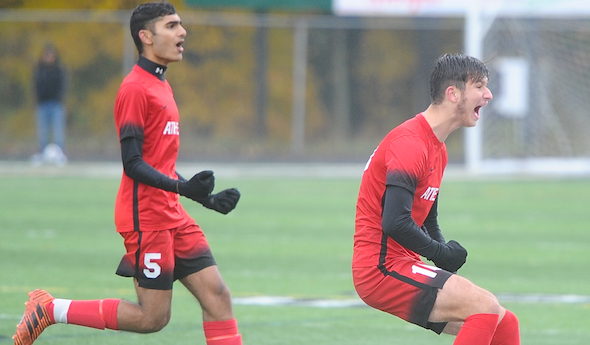
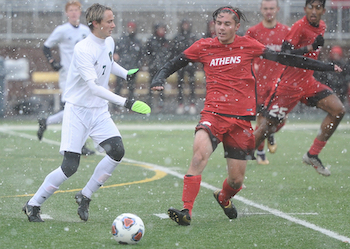
PHOTOS: (Top) Troy Athens’ Nikhil Somani (5) and Andri Myftari (10) celebrate during Saturday’s Division 1 championship game win. (Middle) Traverse City West’s Kaden Ales (7) works to get the ball through Athens’ defense and the snow.
Cengic's First Goal Golden for Falcons
November 3, 2012
By Geoff Kimmerly
Second Half editor
TROY – Junior Emir Cengic had played defender all season. He wasn’t even sure why his coach made the snap decision to move him up front.
But that astute maneuver by East Kentwood coach John Conlon on Saturday helped set up Cengic for the most memorable moment of his high school career.
Cengic hadn’t scored this fall, and hadn’t really had an opportunity while lined up on the other side of the field. But 20 minutes into the MHSAA Lower Peninsula Division 1 Final, Cengic found himself in front of Grand Blanc’s goal receiving a 20-yard pass from teammate Josh Hagene, and then right-footing his own rebound into the net.
His first goal this season was the only goal East Kentwood needed to claim its fourth MHSAA championship. The Falcons outlasted the Bobcats over the final 65 minutes at Troy Athens to come away with a 1-0 win in the final soccer game this season.
“The ball just came. It was a lucky shot,” Cengic said. “I never imagined something like this. It’s unbelievable.
“This is probably the best thing that’s ever happened to me.”
East Kentwood most recently had won Division 1 in 2010, and this season’s title was its fourth in six seasons. The Falcons finished 22-1-4, giving them seven seasons in the last eight with at least 20 victories.
How they won this time bore some similarities to other recent title runs.
East Kentwood’s goal in the 2008 1-0 win over Livonia Stevenson also came from a primarily defensive player, Bung Jin Lee.
In 2010, then-sophomore Charlie Constantino played in the back as well, biding his time as many younger players in the program must before taking leading roles. He was the Falcons’ primary offensive player this fall, and Conlon expects Cengic to move up front fulltime as well next fall.
“I actually had him in class as a fifth grader, and the kid never gets rattled,” Conlon said. “I could put him anywhere on the field. I could probably put him in goal and he’d be fine. We just ask our guys to buy into their roles, and whatever their role is, to take advantage of it. And Emir had a great moment today.”
 Only two minutes before, Grand Blanc had its best scoring opportunity. Junior midfielder Ali Mukhtar moved the ball ahead to junior forward Nick Berklich, who had a chance from point-blank range that was deflected by East Kentwood sophomore keeper Peyton Gonzalez.
Falcons back-up keeper Denis Duratovic also made a major impact. It was the senior’s suggestion that led to Conlon moving Cengic up on the far side as East Kentwood prepared to throw-in from the sideline side of the field.
The loss was another heart-breaker for a Grand Blanc team that total played in 13 one-goal games this season – but had won the last three and another by two goals in overtime over No. 4 Rochester Hills Stoney Creek in a Regional Semifinal. The Bobcats (16-7-2) could muster only six shots on goal this time, but freshman keeper Pearce Skinner had 11 saves and is one of nine players who should return in 2013.
This was Grand Blanc’s second championship game appearance, and first since 1987.
“I told the guys they’ll be disappointed (Saturday), maybe through the weekend. But when they reflect back on everything starting Aug. 9, the way we battled all year. I think they’ll be happy,” Grand Blanc coach Greg Kehler said. “To get to the Finals is a great accomplishment.
“The experience of this, you can’t replace it. And to have those kids get involved and be a part of this, I think is going to carry on to next year’s young kids. And obviously, that helps greatly.”
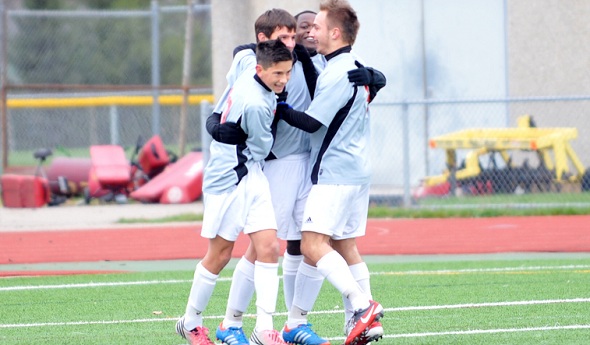
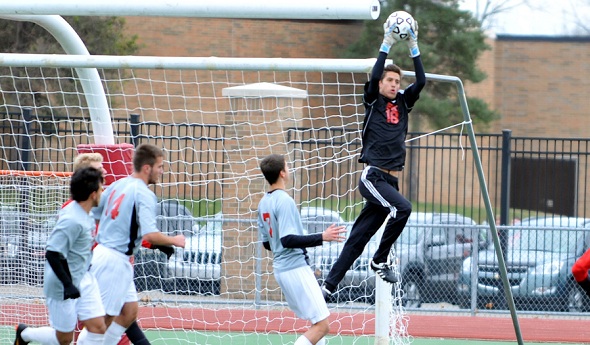
PHOTOS: (Top) East Kentwood’s Emir Cengic (second from left) celebrates his goal with teammates a little more than 15 minutes into the Division 1 Final. (Middle) Falcons sophomore Peyton Gonzalez goes high to make a save.