

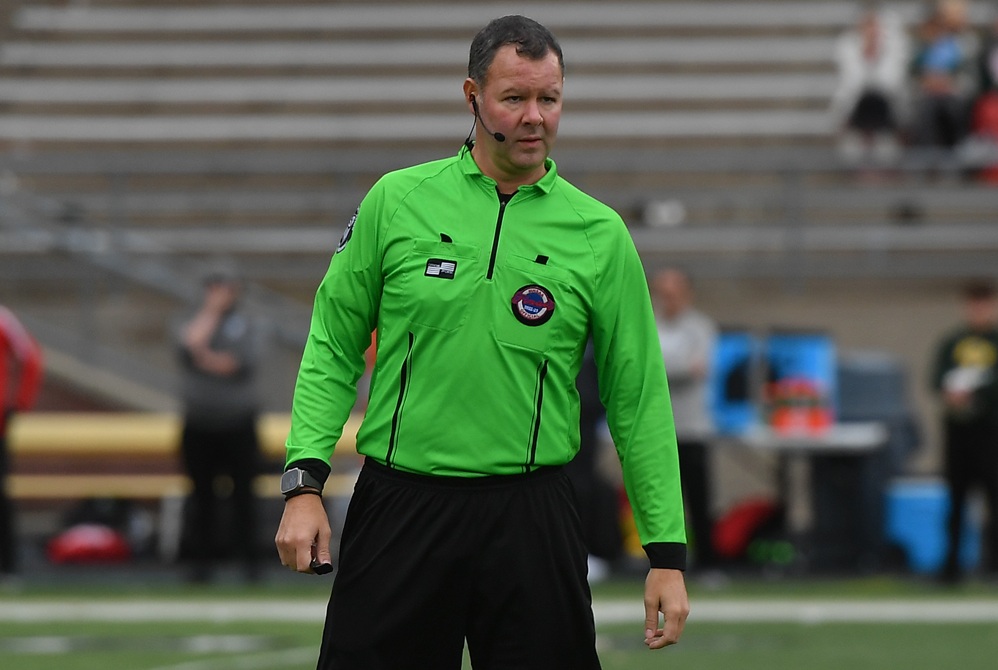
Be the Referee: Soccer Advantage
By
Paige Winne
MHSAA Director of Brand Management
October 13, 2026
Be The Referee is a series of short messages designed to help educate people on the rules of different sports, to help them better understand the art of officiating, and to recruit officials.
Below is this week's segment – Soccer Advantage - Listen
We’re on the soccer field today, where Team A has possession. A player from Team A is carelessly tackled by a Team B player in the middle of the field. The referee applies advantage because the fouled player quickly gets up and retains possession. However, a Team B defender intercepts the ball and kicks it out of bounds. What’s the call?
- Is it a throw-in for Team A since Team B kicked it out?
- Is it a free kick for Team A at the point of the foul?
- Or is it a free kick for Team A and a caution to Team B for kicking the ball away?
If you said a free kick for Team A at the point of the foul, you are correct. Advantage allows officials to keep play moving when the fouled team benefits from continuing. Here, that advantage never materialized, so the referee goes back to the original foul.
Previous 2026-27 editions
Oct. 6: Defensive Holding - Listen
Sept. 29: Minimum Number of Volleyball Players - Listen
Sept 22: Soccer Changes - Listen
Sept: 15: Dead Ball Penalty - Listen
Sept. 8: Libero Ejected - Listen
Sept. 1: Soccer Foul After Shot on Goal - Listen
Aug. 25: Fumble Out of Bounds - Listen
Be the Referee: Concussions
September 15, 2016
This week, MHSAA assistant director Mark Uyl discusses the official's role when an athlete experiences a possible concussion.
Be The Referee is a series of short messages designed to help educate people on the rules of different sports, to help them better understand the art of officiating, and to recruit officials.
Below is this week's segment – Concussions - Listen
In all contact sports, the biggest issue of the day continues to be concussions. Game officials play a vital role in keeping athletes safe on the field, court, ice and mat.
While officials are never placed in the position to diagnose a possible concussion, the officials can often see when a player first becomes injured. When that possible injury is noticed by an official, all game rules require the contest be stopped and the student is evaluated by the school’s health care team.
It then becomes the call of the school to determine if the player has suffered a possible concussion. If yes, the player is out for at least the rest of that day. If no, the player can return to the contest.
Past editions
Sept 8: Equipment Covering the Knees - Listen
Sept. 1: Play Clock Experiment - Listen
Aug. 25: Clipping in the Free Blocking Zone - Listen