

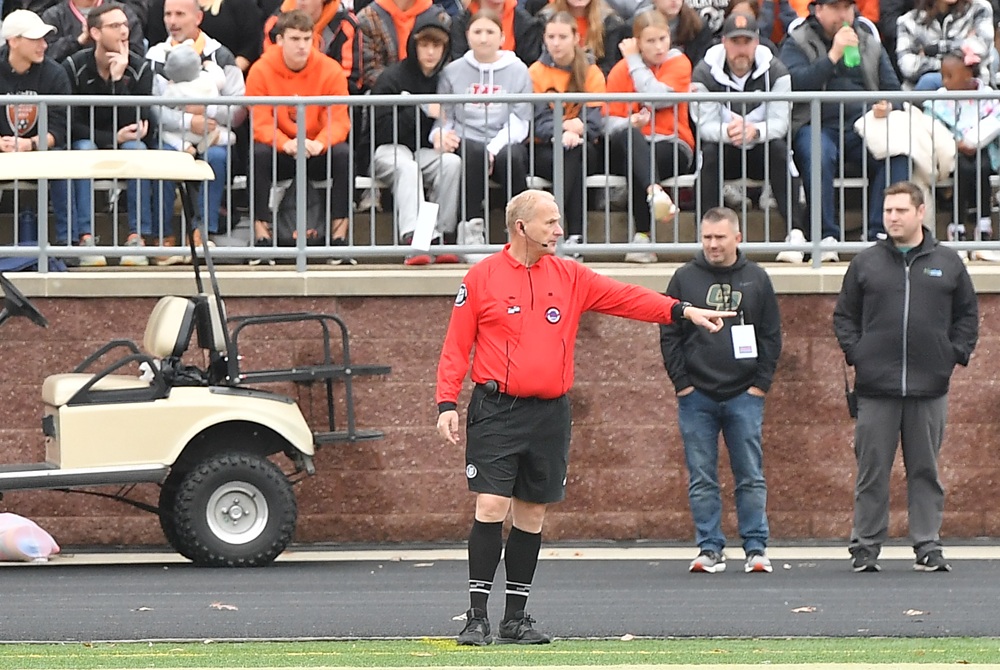
Be the Referee: Soccer Foul After Shot on Goal
By
Paige Winne
MHSAA Director of Brand Management
September 2, 2026
Be The Referee is a series of short messages designed to help educate people on the rules of different sports, to help them better understand the art of officiating, and to recruit officials.
Below is this week's segment – Soccer Foul After Shot on Goal - Listen
We’re on the soccer field today, and the home team has the ball and is on the attack.
The ball makes it around to a forward from the home team, who is on-side and within the penalty area. His shot just misses – going wide for a goal kick.
However, just after the ball crossed the goalline, a player from the away team tackles the home team forward with excessive force.
What’s the call?
Because excessive force was used, it’s a red card for the away team player, which is an automatic ejection. But because it happened after the ball crossed the goalline and not at the time of the shot, it’s still a goal kick for the away team, not a penalty kick for the home team.
Previous 2026-27 editions
Aug. 25: Fumble Out of Bounds - Listen
Become an Official: HS Sports Need You
January 24, 2018
By Bob Gardner, Executive Director of the National Federation of State High School Associations
and Mark Uyl, Assistant Director of the Michigan High School Athletic Association
They don’t make the headlines, their names are not in the box scores and they don’t make the all-star teams. But perhaps the most important individuals in high school sports are the contest officials.
These individuals are so important that, in fact, there would be no organized competitive sports at the high school level without the men and women who officiate these contests every day across the country. Subtract the dedicated men and women who officiate high school sports, and competitive sports would no longer be organized; they would be chaotic.
In some areas of our country, high school officials are retiring faster than new ones are being added. And junior varsity, freshmen and middle school games are being postponed – or even cancelled – because there are not enough men and women to officiate them.
Anyone looking for a unique way to contribute to the local community should consider becoming a registered high school official. For individuals who played sports in high school, officiating is a great way to stay close to the sport after their playing days have ended. Officiating helps people stay in shape, expands their social and professional networks and offers part-time work that is flexible, yet pays. In fact, officiating is a form of community service, but with compensation.
Another benefit of officiating is that individuals become role models so that teenagers in the community can learn the life lessons that high school sports teach. Students learn to respect their opponents and the rules of the game and the importance of practicing good sportsmanship thanks, in part, to those men and women who officiate. And the objectivity and integrity that high school officials display is an example that every young person needs to observe firsthand. In short, communities around the country will be stronger because of the life lessons that high school officials help teach the next generation.
Officiating is a great way to stay connected to sports and to give back to the local high school and community. We need dedicated men and women to become involved so that high school sports can continue to prosper for years to come.
Individuals interested in learning more about becoming a high school official, and even beginning the application process, can do so at www.HighSchoolOfficials.com.