

Capac Standout Delivers 3-Letter Fall
November 14, 2013
By Geoff Kimmerly
Second Half editor
The Blue Water Area Conference, on the eastern side of the Thumb, created this fall a patch it will award to athletes who letter in three sports during a school year.
Winning a high school letter always has been a notable accomplishment. Earning two is a sign of a well-rounded athlete. And in these days of single-sport specialization, we celebrate those who continue to play three at the varsity level.
Then there’s the rare – if not unique – case of Capac junior Nick Geliske.
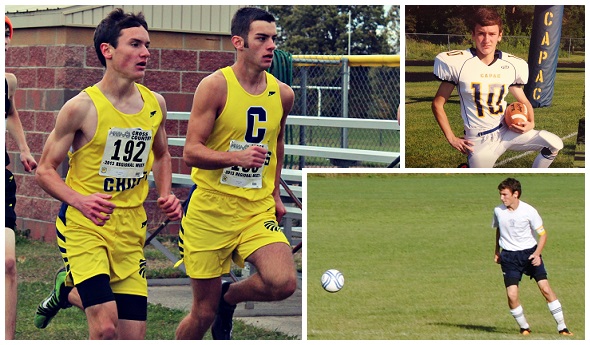
Earlier this week, he became the first to win the newly-minted BWAC award – after just one season. He finished his fall as an all-league midfielder for the soccer team, an all-league honorable mention cross country runner and the fulltime kicker for the football squad.
“I wasn’t sure how it would work out when I decided to go into it. I wanted to do all of them, but a year ago I wouldn’t have seen myself doing this,” Geliske said. “I was just hoping to help my teams this year.
"I’ve got bigger expectations for myself next year.”
Three-sport letterwinners are not a rarity in Geliske’s hometown. Despite an enrollment of 100 fewer students than all but one of the other schools in its eight-team conference, Capac has the most who play a sport every season. The Chiefs had 41 three-sport athletes during 2012-13, athletic director Arnie VandeMark said, and 33 athletes who earned letters in three sports played as part of the BWAC – 24 more three-sport athletes than the league school with the next-highest total.
Playing two sports during the same season, while uncommon, also occurs from time to time when an athlete can handle the added load and coaches can work out a flexible schedule. But VandeMark never had seen an athlete do what Geliske accomplished this fall – not to mention the success he had in the process. Geliske just kept finding ways to compete – and contribute to Chiefs teams alongside his friends.
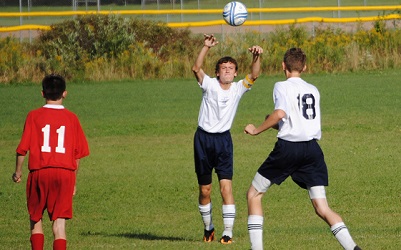
He has been a starter on the soccer team for three seasons and captain these last two, and that’s his primary sport. A midfielder, he led the team with five assists this fall to go with three goals as Capac – in its eighth season as a program – set a wins record in finishing 11-8.
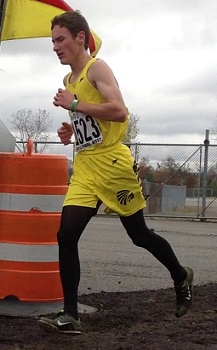
 Geliske decided to double in cross country this season at the urging of a few friends on that team. Great move on their part, as Geliske ended up the team’s regular second- fastest finisher. He took sixth at his Regional (in 17:52) and was part of the lineup that made the Lower Peninsula Division 3 Final at Michigan International Speedway.
But before practice for either of those sports began, Geliske had another request from his best friend on the football team. Capac needed a kicker. Geliske loves football but never had played at the high school level and never had kicked. No matter – two hours before the first practice he decided to give it a try, showed up and won the job.
“Nick was a huge part of our team qualifying for team states. He set an example for others to follow being a very busy athlete in soccer and football,” Capac boys cross country coach Tim Gross said. “He would show up for practice and set the standard for everyone else to follow. He was not only a great athlete, but a very organized person.”
On schedule
Geliske also holds a 3.85 grade-point average – after earning a 4.0 during the first quarter of this school year – and is involved with Capac’s student council and chapters of the National Honors Society and Business Professionals of America.
Pulling off the above plus participating on three athletic teams takes heavy doses organization and discipline both. Thankfully, the sports schedules just happened to fall into place.
 First-year soccer coach Jerry Parisot needed to hold his practices at 6 p.m., leaving the afternoon for Geliske’s other pursuits. Geliske ran with the cross country team from 3-4 p.m. and kicked with the football team until 5 before catching a quick meal and heading to the soccer field.
On cross country meet days, Geliske would run and usually make it back in time for soccer practice. On soccer game days, he’d kick with the football team right after school before switching uniforms.
The biggest challenge came on Friday, Oct 25, when Geliske ran in the cross country team’s Regional at Algonac – an hour trip south of Capac – then had to drive nearly two hours back north for a football game at Sandusky. He made it two minutes before kickoff.
But amid jumping through those hoops, Geliske continued to make academics a priority with study time from 8-10 p.m. most weeknights.
“Usually, for football I’d just talk to my coach and could schedule around because I’m the kicker, and I have awesome coaches. For soccer, my dad is the assistant coach so that worked out pretty well, and the varsity coach coached me at younger levels. And for cross country, he was an awesome guy too. They knew I’d be busy all the time,” Geliske said.
“My mom wasn’t so sure about (three sports), but she said as long as I keep my grades up I can play all of those sports. I gave myself studying time; I didn't want to let my teams or myself down.”
Before the season began, Geliske brought Gross a schedule detailing where he’d be every day over the next three months. Gross credits Geliske's parents for his runner's discipline, and Nick also credits Mom and Dad with instilling that trait – and a lot more.
Cracking the code
Geliske was so competitive as a kid, sometimes he’d get a little out of control and his parents would have to calm him down. That intensity hasn't faded much – “Even during pick-up games and stuff, people get mad that I’m so competitive,” he said. “I don’t like losing ... (but) I have to tone it down a little bit.”
“He's 200 percent competitive,” Parisot said. “It’s not really about winning or losing. It's more about trying as hard as you can.”
 That streak was ingrained by his father Barry Geliske, who along with coaching soccer and serving on the school board works on the chain gang for home football games and is “the most competitive and passionate guy about sports,” Nick said.
His athletic side? Geliske believes that comes from his mom Sandra. And then, matter-of-factly, he reveals a family line that backs his theory pretty well.
Among second cousins is former Marquette University basketball standout Travis Diener, who beginning in 2005 played for three NBA teams and now plays professionally in Italy. Sandra Geliske’s maiden name is Thome – as in Jim Thome, another cousin, and a likely future Hall of Famer who hit 612 home runs during a Major League Baseball career stretching two decades.
There’s another cousin, former NFL tight end Dave Casper, who made five Pro Bowls for the Oakland Raiders during the late 1970s. A great uncle named Ronald Jackson played seven seasons of pro baseball with the Chicago White Sox and Boston Red Sox from 1954-60.
Geliske will begin basketball practice Monday and plans to play baseball and run track this spring before coming back for all six sports as a senior. VandeMark has had an athlete finish high school with 13 letters – but Geliske hopes to graduate with 15.
That leads to another significant question – how will Geliske display them?
Like at most schools, some Capac athletes wear traditional letter jackets. They receive an actual letter for their first, then a series of pins and medals for each additional year on a varsity team.
Geliske’s mom wants instead to frame the awards. If that’s the decision, Geliske is looking for something sizable – and he’s got to fit that BWAC patch now as well.
It's been a fall full of other accolades too. He made the all-league soccer team and earned an all-league cross country award, and was part of an academic all-state team in the latter as well. But he’s got much higher expectations for fall 2014 since he’ll be settled into his balancing act. And no way does that include picking a favorite.
“I can’t imagine it for myself. I’ve been playing these sports my whole life,” Geliske said. “Sometimes someone might be really good in that (one) sport and stay with it, but I say doing more sports is better. It keeps you active. I just love competing, and that’s the big thing about it.”
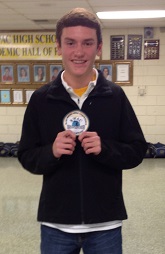
PHOTOS: (Top) Capac’s Nick Geliske lettered as part of the school’s cross country, boys soccer and football teams this fall. (Middle) Geliske throws a ball in during a soccer game and turns a corner during a race this season. (Below) Geliske poses with his Blue Water Area Conference three-letter patch after becoming the first to earn the award. (Photos courtesy of Capac athletic department and Geliske family.)
Marquette Primed to Continue Dynasty
October 21, 2015
By Dennis Grall
Special for Second Half
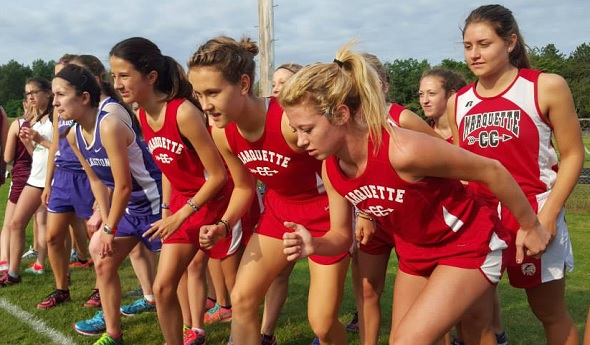
MARQUETTE – Red is the dominant color when you talk about cross country in Michigan's Upper Peninsula.
Courtesy of one of the pre-eminent cross country programs in the state, red is worn by the Marquette High School teams that have been a scourge to the rest of the U.P. since the sport's inception.
 The boys have won 22 Upper Peninsula big-school championships heading into Saturday's U.P. Finals at Beauchamp's Grove in Flat Rock, in the countryside west of Escanaba. The boys have been competing since 1966, and Marquette began its title string in 1979.
The girls have been even more dominant, claiming 29 U.P. titles since the sport began in 1980, including a string of 13 straight (1980-92).
Both teams have won the past two U.P. Division 1 titles and are expected to repeat again Saturday.
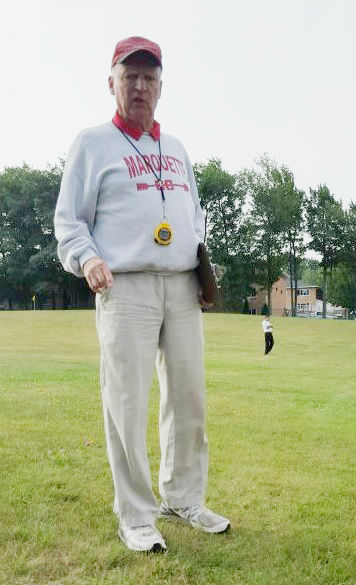
All of the championships have come with Dale Phillips as head coach. Phillips, 73, started coaching both teams in 1977. He was inducted into the Upper Peninsula Sports Hall of Fame in 2009 for his coaching exploits with Marquette's cross country and track and field programs.
Asked what has kept him running the program for 39 years, Phillips did not hesitate. "My love working with the program and the young men and young women and seeing the success they can achieve," he said, noting he is coaching a second generation of runners and enjoys visiting the parents of today's athletes, many of whom he coached.
"They are a great recruiting tool," he said of parents bringing their kids into the program.
Phillips traces the program's success to when it started piling up those various trophies. "Then we started drawing boys and girls into it. They like what we do," he said. "The program kept building. It is like the Menominee football program. It seems they re-load every year, just like we do.
"You are going to hit a down period. There were some lean years," said Phillips. Of course, those "lean years" meant settling for second, third or fourth place.
"Sometimes you just don't get that quality you need. You just get kids into the program and they really work."
This year's leaders are Lance Rambo for the boys and Lindsey Rudden for the girls. Rambo is looking into running at either Central Michigan University, Michigan State or Grand Valley State after graduation. Rudden, who has never won a U.P. cross country title but owns eight U.P. track championships (with MHSAA meet records in the 800, 1,600 and 3,200 and with the 1,600 and 3,200 relay units), has verbally committed to run for MSU.
But it is not about super individuals. Rather, it is about the overall depth of the program and the family-like atmosphere. "The varsity cheers for the jayvee group, and the jayvees cheer for their varsity teammates. They know they are a total team. It is not just the top seven we are interested in," Phillips said.
 "You don't have to be the number one or two runner," Phillips tells his squads. "You can be number five, six or seven. You can help us immensely by getting ahead of the scorers of our opponents."
To illustrate, at the recent Great Northern Conference meet at Marquette's Presque Isle (complete with a water spout on Lake Superior, tornado warning, lightning, thunder and rain), the first nine girls jayvee finishers wore Marquette red. Marquette's boys and girls swept the varsity and junior varsity team titles.
"We emphasize that we are a team. The kids get so close as a team," Phillips said of the runners gathering for a variety of activities such as meals, movies and swimming. "We are a family. That word has come up for years."
Of course, a lot of that likely comes from the success they have all enjoyed together throughout their careers and from watching their predecessors do the same thing.
Agreeing that success breeds success, Phillips said, "that is a tremendous positive we have going for us. We have a large freshman class out and they learn how we do our workouts correctly and how we handle pace (of racing). We have some talent coming up."
The Redmen set such a tremendously high bar of success without piling up excessive mileage. "We try to get them to reach their peak at the end of the season," said Phillips.
While every coach tries to accomplish that goal, there is a fine line to reach in the process – no matter the sport or the level the athlete is playing.
"Leadership on a team is important," said Phillips, noting he sends groups of runners out at various distances and locations and tries to match them up with those of similar skill sets. With captains such as Rambo and Rudden setting the pace this year, Phillips knows the workouts will be fruitful. "Those kids lead by example. They keep the young runners going. They have responded well over the years," he said.
The coaching staff sets mileage limits and tries to monitor how much the athletes do on their spare time. "We are not a high mileage team," said Phillips. "We try to get a recovery day after a tough workout or a tough meet. We structure our program to keep the legs fresh and minimize injuries."
The runners do just 30-40 miles a week, much of it on an exquisite city trail system or at a grassy park close to nearby Northern Michigan University. "If we do a hard workout, we try to find a soft surface," said Phillips. "We can do hard workouts but they are not hard on the legs."
 Including pre-and-post stretching sessions, the weekday workouts last two hours a day in August before classes begin and no more than 90 minutes a day once the academic season starts. "We do longer intervals before the start of the season and shorter intervals later," he said, adding runners are told not to run on one of the weekend days.
Having quality runners throughout the group prevents varsity runners from becoming complacent. "Our jayvees keep the varsity on their toes," Phillips said.
He also encourages his runners to use alternative sports in their training to keep their legs fresh. "If you don't feel like running, jump on a bike. Biking is an excellent cross-trainer. They also go cross country skiing. You shouldn't run 365 days a year," he said.
"If you're in a winter sport, you can't get in better shape than running in cross country," said Phillips, noting several of Marquette's highly successful winter athletes have been on his teams. "That has been a drawing card as well" to attract participation.
In his 39 years at the helm, Phillips said a major highlight was when the girls won the prestigious Holly Invitational and the boys were 10th out of 30 teams in 1982. It was the first time the Redettes and Redmen participated, and many of the downstate runners were surprised to learn Marquette came from the Upper Peninsula.
The girls finished second, fifth, seventh, ninth and 11th and beat Clio, ranked No. 1 in the state at the time. "They couldn't believe someone from the U.P. could come down and dominate a big meet," said Phillips.
Competing in Holly, and big meets in Wisconsin, gives his runners a chance to see "other faces and other teams" and a chance to gauge their performances. That is especially important because cross country (in addition to track and field, tennis, golf, and swimming and diving) is split into Upper Peninsula and Lower Peninsula Finals.
While Phillips and former U.P. cross country coaches John Prokos, Dave Lahtinen and Arne Henderson previously made a strong push to merge for an all-peninsula MHSAA Finals, they were unable to convince the majority of U.P. teams to accept the proposal, which has been rejected twice.
In the meantime, Marquette makes everyone else look at red across the Upper Peninsula.
 Denny Grall retired in 2012 after 39 years at the Escanaba Daily Press and four at the Green Bay Press-Gazette, plus 15 months for WLST radio in Escanaba; he served as the Daily Press sports editor from 1970-80 and again from 1984-2012. Grall was inducted into the Upper Peninsula Sports Hall of Fame in 2002 and serves as its executive secretary. E-mail him at [email protected] with story ideas for the Upper Peninsula.
PHOTOS: (Top) Marquette’s girls cross country runners, including Lindsey Rudden, front right, prepare for the start at Marquette’s cross country relays earlier this season. (Middle) A pair of Marquette runners including Lance Rambo, right, compete during the boys race. (Below) Coach Dale Phillips has led the program for 39 years. (Photos courtesy of Marquette athletic department.)