

Roscommon Star Keeper Home Again, Providing Expertise as TC West Team Doctor
By
Tom Spencer
Special for MHSAA.com
November 20, 2026
Jason Carmien was coaching Traverse City West when he first saw Grant Carey on the pitch two decades ago as a star goalkeeper for Roscommon High School and his travel soccer team.
 West and Roscommon both reached the MHSAA Finals in 2006. West won 1-0 over Livonia Stevenson in Division 1, and Roscommon fell 6-4 to Richmond in Division 3.
Today, Carmien and Carey are on the same team. Carmien is the Traverse City West athletic director, and Carey is the Titans’ first-year team physician.
They’ve seen a lot of changes in high school sports since they crossed paths initially nearly 20 years ago. And all for the better, they say, especially in player safety when it comes to returning to play from head injuries.
“Concussion protocols certainly weren't a thing in the late 90s when I began coaching at West. … The evolution of care for our student athletes and how we address these types of injuries has been a key step in student safety,” said Carmien. “Munson (Medical Center) has been a key partner in developing our baseline concussion testing and protocols over the years. Grant was a great soccer player at Roscommon, and I would imagine he didn't have the support in place like we do today for athletes and these types of injuries.”
Carey was on the sidelines for all West football game this fall and provided support for certified athletic trainer Mikayla Scholts as she took care of soccer, golf, tennis, volleyball and cross country athletes. They’re now moving into wrestling, swimming & diving, bowling, hockey, skiing and basketball as winter sports commence.
West administration was happy to have Carey come on board along with Scholts, who is also in her first year with the Titans.
“Tom O'Hagen worked with West students for many years and had tons of professional experience with the Philadelphia pro teams like the Eagles and Phillies,” Carmien said of the medical support West has received over the years. “Having Dr. Carey step in has been seamless. Mikayla and Grant have been a big value add for us as our students and families get top level care. We have been lucky to have folks like John McDougall, Anthony Cillufo, Taylor Chaulk in the past and now Mikayla Scholts.”
The services of Scholts and Carey are provided through a partnership with Munson orthopedic and sports medicine and Mary Free Bed. They’re providing medical services, offering advanced treatment options, specialized surgical expertise and rehabilitation services.
Carey, who went on to play soccer for Kalamazoo College before med school, was happy to have the opportunity to return to Northern Michigan and be around high school sports again. He came home with extensive professional sports team physician experiences. He earned his medical degree from the University of Michigan and completed his orthopedic surgery residency at the renowned Hospital for Special Surgery in New York City, where he worked with the New York Giants, New York Mets and New York Knicks. He then completed advanced fellowship training in sports medicine, shoulder and elbow surgery at OrthoCarolina in Charlotte, N.C. During his fellowship, he served as an associate team physician for the Carolina Panthers, Charlotte FC, and the Charlotte Knights, a minor league professional baseball team.
“Now we're in Traverse City, and I’m covering West,” he said, recalling memories of his NorthStorm club teammates playing for the Titans. “It's this crazy full circle moment of life, seeing totally different environments of sports medicine, from all over the country, and then now I'm back to where I played club soccer and it's kind of just turned out to be a dream come true. I didn't grow up in Traverse City but a lot of my athletics took place here. It was so much fun.”
Carey believes treatments of professional athletes’ injuries has led to improvements for high school athletes.
“I think what kind of led the charge on that front is the NFL, truthfully,” Carey said. “Now if a kid comes to the sideline and Mikala evaluates them, and they any symptoms at all, it’s now concussion protocol. The timer starts and once you stop having symptoms, it's one week mandatory out before a return. Concussions aren't necessarily something I routinely treat, but I do see them a lot. But what's nice is Munson has a ton of neurologists that we can get them plugged into.”
Carey works closely on a daily basis with Scholts.
“We text every day and we talk on the phone about all the kids so it’s better coordination of care,” Carey said. “It’s Mikayla that I would consider the captain of the whole show on the sideline.”
If surgery of any sort is necessary, the team physician can help navigate the way through the health system for the athlete and his or her family.
“I view my role as I'm there for support and expertise if they need it, but really where the partnership kind of provides value is access for the kids,” Carey said. “We have streamlined their ability to get into clinic to see us even with same-day appointments. If there's a football game on a Friday and a kid gets hurt, they're first on my schedule on Monday. And we have ways that we streamline their ability to get imaging done. We want to get the kids in, get them diagnosed, and come up with a game plan so they can get back on the fields.”
Carey, who also collaborates to facilitate services for athletes with Northern MI Hand Surgery, was thrilled to report no surgeries were needed resulting from injury to West athletes this fall.
“We do our best to mimic what the DI college and professional athletes get,” Carey said. “Ideally world class care essentially immediately.”
In addition to concussion protocols coming into place in high school sports, Carey has seen an increase in anterior cruciate ligament (ACL) injuries. Research is connecting the increase to kids playing one high school sport year-round.
“What seems to continue popping up is playing one sport from a really young age,” Carey said. “They don't play any other sport, starting in elementary school, and it seems to have a pretty strong relationship of ACL ruptures.”
High schools providing strength and conditioning coaching is helping to prevent ACL and all kinds of other injuries though, Carey is quick to note.
“Maybe it's because I went to a small school, but now schools have a strength and conditioning coach,” Carey pointed out as a change from his playing days. “It is awesome they have guidance in the weight room for all the teams all week. If single sports specialization is a bad thing, I think the focus on strength and conditioning is huge to keep the kids healthy.”

Tom Spencer is a longtime MHSAA-registered basketball and soccer official, and former softball and baseball official, and he also has coached in the northern Lower Peninsula area. He previously has written for the Saginaw News, Bay County Sports Page and Midland Daily News. He can be reached at [email protected] with story ideas for Manistee, Wexford, Missaukee, Roscommon, Ogemaw, Iosco, Alcona, Oscoda, Crawford, Kalkaska, Grand Traverse, Benzie, Leelanau, Antrim, Otsego, Montmorency, Alpena, Presque Isle, Cheboygan, Charlevoix and Emmet counties.
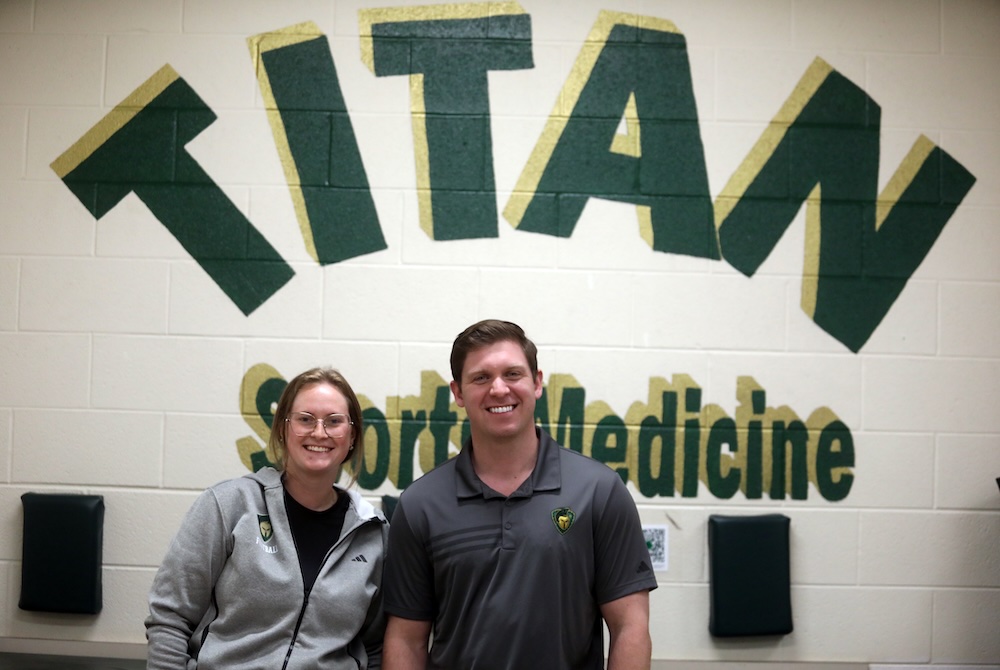
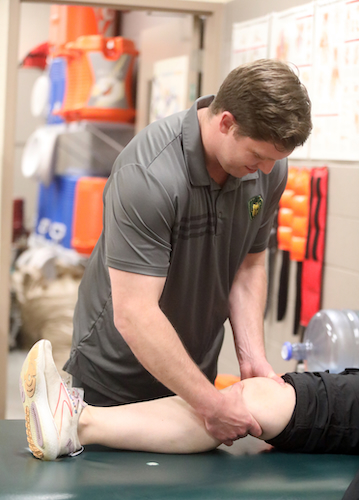
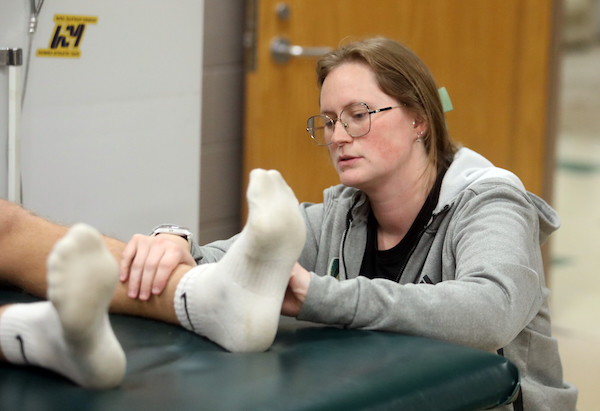
PHOTOS (Top) Traverse City West certified athletic trainer Mikayla Scholts, left, and Dr. Grant Carey stand for a photo together in the school’s athletic training room. (Middle) Carey examines an athlete’s knee in the training room. (Below) Scholts examines an athlete’s foot. (Photos by James Cook/Traverse City Record-Eagle.)
How To Warm Up Correctly Before Playing Different Sports
July 10, 2024
When you see professional athletes gearing up to race or getting ready to take the field, you’ll notice that they’re always in motion. That’s because they are warming up in preparation for going all out.
 And there’s a good reason why you’ll never see a pro go straight from the bench into a full sprint. “You need to allow your muscles to gradually accept the demands of your activity,” says Jennifer Burnham, a certified athletic trainer at Henry Ford Health. “Otherwise you risk causing an injury.”
Why You Should Warm Up
As the name implies, a warmup is a series of movements designed to warm up your muscles. “You want to increase blood flow to your muscles and loosen up and lubricate your joints,” says Burnham. “And you need to do it gradually, so that your body has time to adapt to the increasing intensity.”
Warming up involves more than just stretching. According to Burnham, studies have actually shown that holding a static stretch when muscles are cold can decrease performance. “Instead, before activity you want to do a dynamic warmup that incorporates movement as well as some gentle stretching."
Your warmup only needs to take 5 to 10 minutes. When deciding what to do, think about the movements you’ll be doing in your activity and which muscles and joints are most involved. Then choose movements that slowly get them warmed up and primed for more intense action.
How To Warm Up For Different Activities
No matter your sport, the warmup before your workout should include some exercises to activate and engage your core (the abdominal and back muscles). “Waking up those muscles helps decrease injury potential,” says Burnham. She suggests incorporating bridges and mini squats (no deeper than 45 degrees) into your warmup routine. To do a bridge, lie on your back, knees bent, feet flat on the floor. Tighten your stomach muscles and squeeze your butt as you lift your hips up to form a straight line from knees to shoulders.
The rest of your warmup can be more specific to muscles and movements of your planned activity.
Running
Before a run, or even a jog, you want to warm up all the muscles and joints from the waist down.
- Rotate your hips (lift your knee up and do some circles in both directions to move the joint) and ankles (circle one foot at a time both clockwise and counter-clockwise).
- Get powerful muscles like your glutes and quads ready with high knees and butt kicks.
- Walk on your toes and then on your heels to warm up shin and calf muscles.
- When you’re ready to run, start off slowly and gradually increase your speed.
Racquet sports
You still need to warm up your lower body using the same moves as the running warmup. But you’ll want to add in others specific to the upper body movements of tennis, pickleball or other racket sports.
- Warm up shoulders with big arm circles both forwards and backwards
- Circle your hands in both directions to get wrists ready for action
- Lunge forward and rotate your upper torso to increase your spine mobility
Basketball, soccer and football
You want to make sure your lower body has time to adapt to the demands of sports that require bursts of sprinting and quick shifts of direction. Your warmup should gradually increase in speed and intensity as you move your body in all directions:
- Side shuffles while swinging your arms (shuffle in both directions)
- Grapevines in both directions
- Skip forward, lifting knees high, then skip backward
Swimming
Prepping your body for a swimming workout means warming up your arms, shoulders and upper back.
- Circle arms backwards and forwards
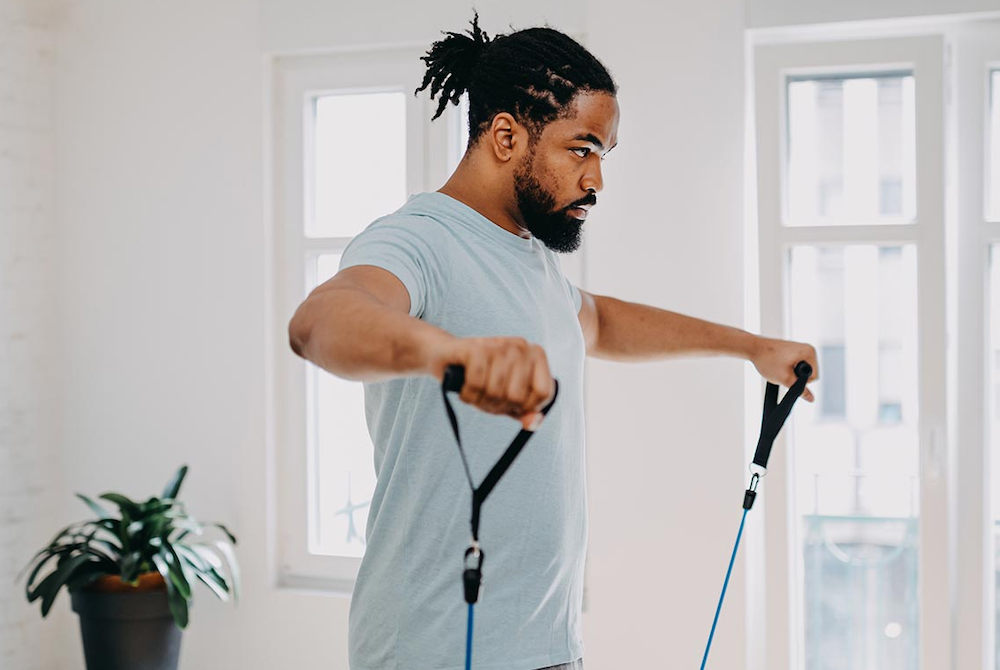
- Use a light resistance band to do shoulder rows
- Use a light resistance band or light dumbbell and lift straight arms up to shoulder height in front and to your sides
- Start with an easy tempo freestyle swim before going into more dynamic strokes like butterfly
Jennifer Burnham is an athletic trainer who sees patients at the Henry Ford Center for Athletic Medicine in Detroit.
To find a sports medicine provider at Henry Ford Health, visit henryford.com/athletes or call 313-651-1969.