

Armada's Fredette Receives NFHS Honor
January 16, 2020
By Geoff Kimmerly
Second Half editor
Longtime Armada tennis coach David Fredette has been named one of 23 National Coaches of the Year for 2018-19 by the National Federation of State High School Associations (NHFS) Coaches Association.
Fredette was selected first at the state level and then from among the eight sections that make up the NFHS – Michigan is part of Section 4 with Illinois, Indiana, Iowa and Wisconsin.
The following brief bio includes an excerpt from Fredette’s coaching philosophy, which nominees were asked to submit after being identified as candidates for the awards.
 David Fredette began Armada’s tennis program in 1966 and coached the boys team through the 2018 season. He led more than half his teams over the years to the MHSAA Finals, and 17 to top-10 finishes at the championship meet – including four straight from 2009-12. He also was a major contributor during the early days of the Michigan High School Tennis Coaches Association, and began serving on its board in 1982. Four times he was selected MHSTeCA state Coach of the Year: in Class C-D in 1982, Class B in 1992, and as one of two selections in Division 4 in both 1998 and 2018. Fredette was inducted into the MHSTeCA Hall of Fame in 1988. Armada’s tennis courts are named for him.
Fredette played tennis at Dowagiac High School and then Benton Harbor Community College. He also coached basketball and football during his time at Armada.
“Athletics give students a chance to become student-athletes, which means athletics teach athletes discipline, a strong work ethic, and cooperation with others. Athletics teach athletes how to not only compete, but how to handle both winning and losing. … I know that students who play sports upon graduation are more prepared to face the challenges that life presents them. While I always expected my players to work hard, I wanted my athletes to enjoy the experiences on and off the courts. My former players tell me how much they enjoyed competing, but also how much fun they had on the trips we went on together, whether it was to play top competition across the state of Michigan or on the Florida trips I took my boys teams on over Easter vacation from 1989 through 2001 to practice and bond as a team. Athletes learn how to compete, but they also gain friendships that last a lifetime, if only in their memories.”
Four more Michigan coaches earned honors in Section 4. Brighton girls swimming & diving coach Jason Black led the Bulldogs to a Lower Peninsula Division 1 Finals runner-up finish in Fall 2018, its best placing in program history. Dexter boys swimming & diving coach Michael McHugh was selected for the second-straight year as a Section 4 winner after leading his team to its fourth-straight Lower Peninsula Division 2 championship last winter. Battle Creek St. Philip volleyball coach Vicky Groat at one point guided the Tigers to nine Class D championships in 10 seasons from 2005-14 and is the sixth-winningest coach in MHSAA volleyball history with a record of 1,154-262-93. Bloomfield Hills Academy of the Sacred Heart co-coach Judy Hehs helped lead that program to its second-straight Lower Peninsula Division 4 championship this past fall, its sixth title in eight seasons, in her final tournament before retirement. She previously was named NFHS Coaches Association National Coach of the Year for girls tennis in 2016.
The NFHS has been recognizing coaches through an awards program since 1982. Winners of NFHS awards must be active coaches during the year for which they receive their award.
Inside or Out, Black Hawks Dominate D1
October 20, 2018
By Chris Stevens
Special for Second Half
MIDLAND – Inside or outside, the Bloomfield Hills boys tennis team knows exactly what it takes to win an MHSAA Finals championship.
Last year, the Blacks Hawks won on the outdoor courts at the Greater Midland Tennis Center. Saturday, at the same location, they went back-to-back in capturing a second straight Lower Peninsula Division 1 title. This time, the action took place inside because the outdoor courts were wet due to overnight showers and winter-like weather.
Regardless of location, the taste of winning a second straight championship is incredibly sweet. Bloomfield Hills, which dominated the competition with 37 points, has now won three of the past four Division 1 titles. Birmingham Brother Rice and Ann Arbor Huron tied for second Saturday with 22 points. Northville was fourth with 20 points, and Troy placed fifth at 17.
“We have a very close team,” said Black Hawks star senior No. 1 singles player Andrew Zhang, a hard-hitting left-hander, who captured an individual title en route to running his season record to 26-0. “Everyone has a close bond with each other and cheers for one another.
“We put in a lot of hard work this season. The entire team showed a lot of dedication throughout the season. We trained very hard,” added Zhang, who’ll play his college tennis at Duke University. “We are very fortunate to have such a strong team.”
Bloomfield Hills coach Greg Burks was proud of his team’s effort, saying the Black Hawks steadily improved throughout the fall. In particular, he said that Zhang’s stellar play led the way.
“Every bit of adversity that he faces on the court, he handles spectacularly. He’s one of the best thinkers on the court that I’ve ever seen,” Burks said. “He’s the ultimate sportsman. If you ask any of the players in our area who they think is the nicest tennis player, Andrew would be right there (at the top.) He’s a great kid, and I’m going to miss him.”
The Black Hawks captured Finals titles in five of eight flights.
At No. 1 singles, Zhang did not drop a set during the tournament. In the championship match, he posted a 6-1, 6-1 victory over Brother Rice’s Jarreau Campbell.
“It was a tough match,” Zhang said. “Jarreau is a great player.”
Bloomfield Hills also won at No. 3 singles, No. 1 doubles, No. 2 doubles and No. 4 doubles.
 At No. 3 singles, Sebastian Burman needed three sets to defeat Clarkston’s Frank Piana in the title match, 7-6, 4-6, 6-4.
At No. 1 doubles, Noah Roslin and Adrian Wilen recorded a 6-3, 2-6, 6-4 decision over Troy’s Michael Song and Aniket Dagar. At No. 2 doubles, Ryan Frank and Andrew Chen swept Daniel Dong and Justin Yang of Northville, 6-1 and 7-6.
At No. 4 doubles, Michael Lee and James Piel, who were seeded fourth in their flight, upset the second-seeded tandem of Troy’s Alex Yang and Noah Tanguay, 6-3, 6-2.
“As a team, we continued to improve throughout the season,” Burks said. “(Like Andrew said), the entire team got along well, and bonded together.”
In other championship flights, Brother Rice’s JJ Eterbeek went three sets to beat Bloomfield Hills’ Tommy Herb, 2-6, 6-4, 6-4 at No. 3 singles. At No. 4 singles, Northville’s Matthew Freeman posted a 7-6, 6-1 win over Cade Burman of Bloomfield Hills.
Then, at No. 3 doubles, Ann Arbor Huron’s Sammy Clyde and Pranav Sharma outlasted Max Nosanchuk and Phoenix Williams in three sets, 4-6, 6-3, 6-1.
Bloomfield Hills posted 24 points on Friday to open the tournament. Next was Ann Arbor Huron with 20 points.
The Black Hawks built such a decisive lead early on Saturday that the team title was sealed before all of the title matches had concluded.
“Obviously, it’s an unreal feeling,” Burks said of the team capturing a second straight Division 1 title. “We played well last year, but this year, all eight flights played great (in the tournament), and that doesn’t always happen.”
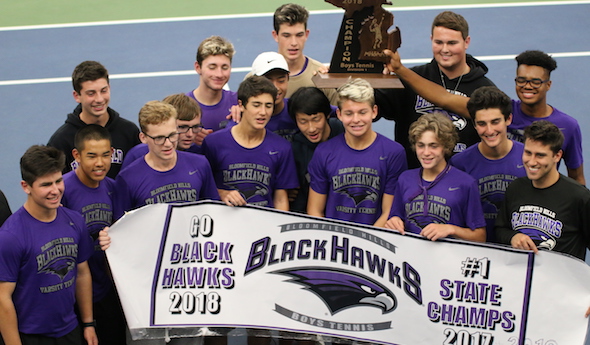
PHOTOS: (Top) Bloomfield Hills’ boys tennis team holds up its Division 1 title trophy and a banner celebrating its back-to-back championships Saturday. (Middle) Black Hawks No. 1 singles player Andrew Zhang prepares to return a volley during his run to the No. 1 singles title. (Click to see more from HighSchoolSportsScene.com.)