

Blind Vaulter Builds on Promising Launch
By
Paul Costanzo
Special for MHSAA.com
May 24, 2019
When Bradly Rainwater’s family members learned he was born blind, they decided to not put any limits on him.
 As it turned out, Bradly had the same mindset.
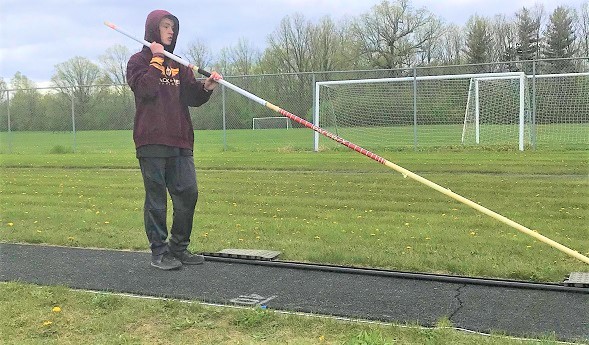
The Davison sophomore is a pole vaulter on the track & field team. It’s an event that he took up not just because his father and uncle were former all-state pole vaulters, but because it was one of the most difficult events in any sport.
“I have always gone after the hardest things,” Rainwater said. “I thought this would be another thing that I would see if I could do it.”
Rainwater, who also is a member of the marching band and wrestling teams at Davison, recently finished his first full season competing as a vaulter and has proven that he can do it, with a personal best of 8 feet, 6 inches. But he’s not satisfied with simply clearing a height in competition – he wants to go higher.
“In the end, I’d like to go to state and get a reasonable placing,” Rainwater said of his career goals. “That would be good for me. I’d enjoy that. For someone in a situation like mine, or a situation similar, you have to work twice as hard to get things where you want them to be. But I am dedicated to it.”
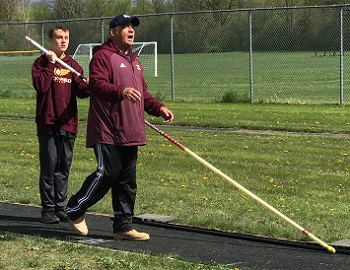
Davison pole vaulting coach Brad Rainwater, Bradly’s grandfather, is also dedicated to it, and is doing all he can to help his grandson reach his goals. Brad Rainwater has been coaching for four decades, but had to teach himself some new tricks when Bradly came along.
“It’s a learning process for us, as well,” Brad Rainwater said. “We started by putting our heads together, my sons and I, and I took it basically like I would coach anyone, but we had to be more hands-on. Basically, it’s step-by-step. It’s the same way when he wrestles; they have to literally do every movement like step, step, step, step. Everything on the vault is done by steps, so we start him with doing three steps, then four steps, then five steps. We’re thinking of ways to teach him to turn, so we use a lot of rings and high bar so he can get that feel.
“What it’s done for me is made me a better coach, because I have to break everything down. Now I’m a little more technical with them all.”
Recently, Bradly began using a track on the runway to help guide his pole to the box, which allows him to start his run farther back. He’s made steady improvement throughout the season, setting his personal best May 13 during a dual meet against Flint Carman-Ainsworth and matching it two days later at the Heritage Hawks Last Chance Invitational.
During practices with a bungee cord, he has cleared more than 10 feet. He’s also started imparting wisdom on other vaulters.
“If I have young vaulters, he teaches them the first three steps and a plant,” Brad Rainwater said. “If people are around (Bradly) and they didn’t know he was blind, because he’s actually doing the drills or showing kids how to do drills, they go, ‘He’s blind?’”
Bradly said the reaction from teammates and opponents alike has been great.
 “They work with me some, like they’ll say, ‘You didn’t turn correctly,’ or ‘You didn’t do this correctly,’ which I appreciate, because criticism like that I can’t necessarily see on film,” he said. “Opponents, some of them come up to me and say thank you to me, and that I inspired them. It’s still hard for me to grasp, because I’m not as good as I should be, but I appreciate people saying that.”
While there’s no official number of blind individuals who have competed in the pole vault, it is rare.
“I know that he’s only one of maybe three others in the state (history), and the other three had some sight,” Brad Rainwater said. “We try not to limit him; we try not to put him in a box that he can or can’t do that. As far as I know, he’s one of the very few in the country that’s doing this. We love it, because we hope it opens doors for other kids that have desire to do other things.”
Bradly, however, said he hasn’t quite grappled with the fact that what he’s doing is special, as he feels he still needs to get better. That’s his focus now, and it’s reflective of someone who has played sports his entire life, from T-ball to soccer to basketball, and now wrestling and track.
He’s not a blind pole vaulter; he’s simply a pole vaulter. And when he’s done, he wants to be known as a great one.
“I’ve always had the attitude of why not,” he said. “Why not work extra hard to be as good as they are?”
 Paul Costanzo served as a sportswriter at The Port Huron Times Herald from 2006-15, including three years as lead sportswriter, and prior to that as sports editor at the Hillsdale Daily News from 2005-06. He can be reached at [email protected] with story ideas for Genesee, Lapeer, St. Clair, Sanilac, Huron, Tuscola, Saginaw, Bay, Arenac, Midland and Gladwin counties.
PHOTOS: (Top) Davison pole vaulter Bradly Rainwater lines up for an attempt this spring. (Middle) Rainwater works with his grandfather Brad Rainwater, the school’s longtime pole vaulting coach. (Photos and video provided by the Rainwater family.)
McNeill Regaining Finals Form, Aiming to Best Last Season's Close Seconds
By
Keith Dunlap
Special for MHSAA.com
May 21, 2026
The number 0.01 might be as miniscule as there is in sports, but it certainly was way more gigantic for Novi High School track sprinter Chance McNeill at last year’s Lower Peninsula Division 1 Finals.
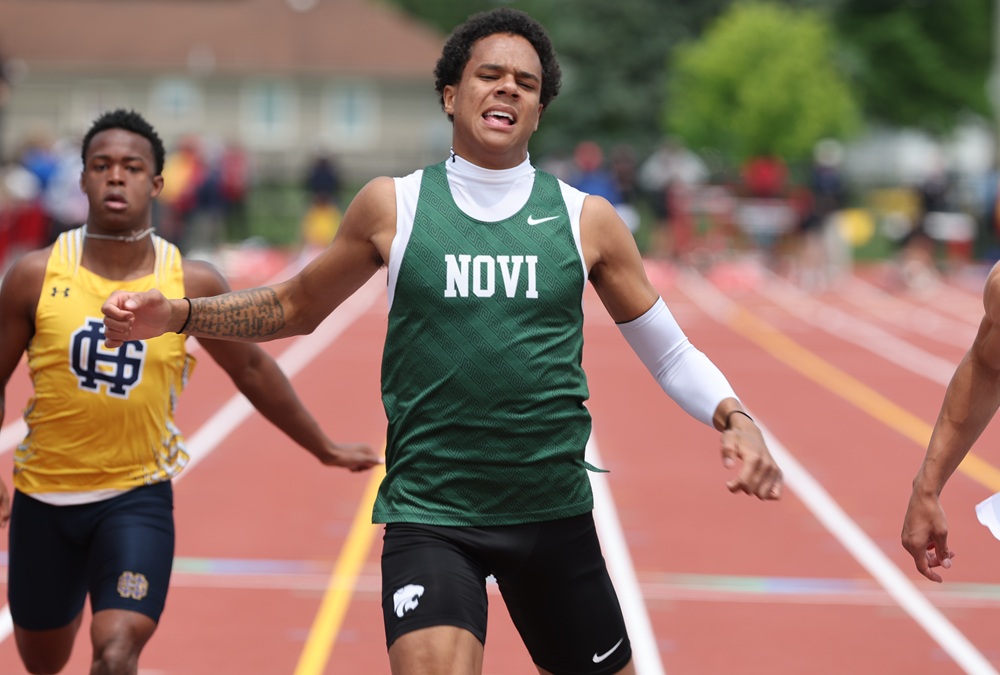
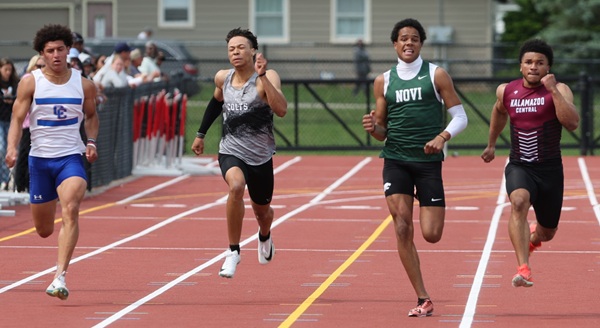
 First, McNeill nearly won the 100-meter dash but finished 0.01 -- one hundredth of a second -- back of Detroit Catholic Central’s Samson Gash (10.41).
As hard as it was to shake off, McNeill quickly did so and was right in the thick of the 200-meter dash. Ultimately, he finished second in that race as well to Jeremy Dixon of Kalamazoo Central (21.11), once again by 0.01.
Losing out on one Finals title by such a thin margin is tough enough. But falling short by that time twice in a matter of a couple hours? It probably felt like getting kicked in the gut by someone wearing track shoes with all the spikes on the bottom.
“Definitely the first few months after (the Finals), it was crazy,” McNeill said. “I’ve kind of gotten over it by now. But it’s been my motivation for sure.”
Indeed, McNeill is using that experience as fuel for the remaining days of his senior year and as he prepares to compete once again in those events at next week’s Division 1 Finals at Rockford.
Headed to run track next at Alabama, McNeill is actually just ramping back into peak form this spring.
He has been battling a lower leg injury suffered after running a 6.75 in the 60-meter dash during indoor season, saying he sprinted again about three weeks ago for the first time this outdoor season.
McNeill certainly looked to be getting back into form during a competitive Regional last week hosted by Novi.
He won the 100-meter dash with a time of 10.73 and then claimed the 200 meters in a time 21.84. Yes, he and the Novi coaches know he’ll have to be faster to win at the Finals, but it was a great sign of progress given where he has come from – and there is definitely another gear in him.
“To say that he’s back to form probably wouldn’t be accurate,” Novi boys track & field head coach Danny Taylor said. “What I mean by that is given all the personal training that he’s done, given the way in which he’s worked back, I think he’s poised to do great things at the state meet.”
 Taylor said that he didn’t know anything about McNeill and his track prowess until he arrived at the high school for his freshman year but discovered quickly that McNeill was more than just an athlete running track to get in better shape for another sport. McNeill legitimately prioritized track & field.
“It seemed that when Chance came to us, he already had that love and that passion,” Taylor said. “We just wanted to stoke it further.”
McNeill said he initially ran track “for fun” when he started high school but got more serious about it when he got more involved with a local club and started running more meets outside of high school season.
Going into this spring, he said he was actually more intent on running the 400-meter dash, but his injury changed those plans.
“I’ve always wanted to do the 400,” he said. “Now, I just have to forget about that, just try it in college.”
McNeill will head to Rockford next week a year older and stronger, but then again so are other competitors. In particular, Gash, a Michigan State football signee, is also back in both events as he hopes to repeat in the 100 meters and improve on a third-place finish in the 200 from last year.
McNeill and Gash are the only top-five finishers in those races from last year who didn’t graduate.
McNeill hopes that he can be at least 0.01 seconds faster this time and end his high school career on top of the podium.
“I think whatever it takes, I’ve got it in me already,” McNeill said.
 Keith Dunlap has served in Detroit-area sports media for more than two decades, including as a sportswriter at the Oakland Press from 2001-16 primarily covering high school sports but also college and professional teams. His bylines also have appeared in USA Today, the Washington Post, the Detroit Free Press, the Houston Chronicle and the Boston Globe. He served as the administrator for the Oakland Activities Association’s website from 2017-2020. Contact him at [email protected] with story ideas for Oakland, Macomb and Wayne counties.
PHOTOS (Top) Novi’s Chance McNeill crosses the finish line during last season’s 100-meter championship race at the LPD1 Finals. (Middle) McNeill, second from right, races eventual champion Jeremy Dixon from Kalamazoo Central in last year’s 200, with DCC’s Samson Gash, far left, also among those in the field. (Click for more from RunMichigan.com/Carter Sherline.)