

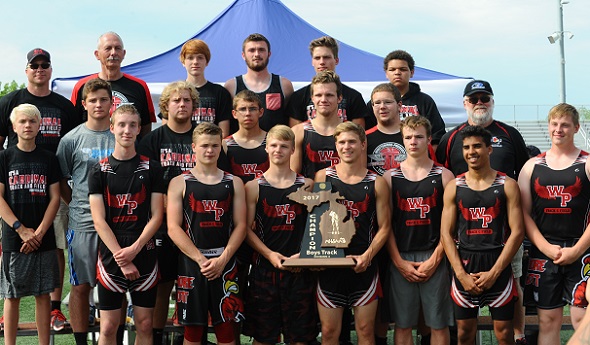
Cardinals Cap Unbeaten Season with 1st Title
June 12, 2017
By Geoff Kimmerly
Second Half editor
As coach Jeff Erickson searched the hallways for athletes to bolster his boys track & field team, he let them know up front this was not a sport where they’d get tons of attention and hype.
 This season, those 28 athletes instead earned an MHSAA Finals championship.
With a few football players here, some basketball players there, and a boost from the cross country program started only four years ago, Whittemore-Prescott routed its Lower Peninsula Division 4 Regional opponents by 98 points and then claimed the Michigan Interscholastic Track Coaches Association Division 4 team championship over Memorial Day weekend.
Technically, those accomplishments earned the Cardinals the MHSAA/Applebee’s Team of the Month award for May. But it’s impossible to not also mention what Whittemore-Prescott accomplished the following weekend, on June 3 – the Cardinals won their first MHSAA Finals boys track & field title, by five points over Manton, and without an individual event champion.
“For a Division 4 school to be as deep as we were, we had kids come out this year that really helped us out and added to our depth,” Erickson said. “We had the banquet (last week), and I told the kids the difference between us and everybody else was our number two and number three (in each event). Everybody is going to have one or two good kids, and sometimes that’s enough to win a state meet … but we had our share of really good kids, and our key was our number two and number three.”
Whittemore-Prescott won every meet it participated in this season.
The 187 points scored at the Regional not only led to the large margin of victory, but were the most scored by a boys team at any Regional this spring. The Cardinals then won the MITCA team meet by 202 points with first place finishes in four events: junior Michael Eagen in long jump, junior Zane Aldrich in the 1,600 and by the 400 and 800 relays.
The MHSAA Finals are scored a little differently than MITCA’s team meet, taking more into account a team’s elite performances – but the Cardinals’ depth still showed through.
Although there were no individual winners, Eagen was second in the long jump, a half-inch out of first. Senior Azaiyah Bell took fifth in the 100 meters, and junior Bradley Lomason was sixth in the 400. Senior Hunter Kensa was seventh in the 800, and Aldrich was fourth in the 3,200. The 1,600 relay of senior Ian Driscoll, Bell, sophomore Ridge Schutte and Lomason took second, only a half-second back, and after the same group placed third in the 800 relay.
“I thought we had a chance to be very, very good, but believe it or not we lost a lot from last year,” said Erickson, referring to his team that finished sixth in LP Division 4 in 2016. “But teams lose kids every year. It’s really about trying to fill those voids and seeing into the future. We go after the (MITCA) team meet, because to be in the position (to win) you have to have three pole vaulters, three hurdlers, and that’s helped us to have that depth. We always try to have a back-up plan.”
 Erickson, a 1989 graduate of the school, also had an advance plan to build up the program – although all of the pieces fell into place perhaps more smoothly than could have been imagined and with a few beneficial surprises along the way.
Groundwork was laid when Erickson started an offseason “Iron Club” for athletes from any program – for example, the softball team has been one of the biggest participants as Cardinals from all sports take advantage of another chance to put in extra work. Among those Erickson recalled recruiting to the Iron Club was now-senior Nick Stern, who won Regional titles this season in both the discus and shot put.
Another significant piece was the formation of the cross country program in 2013. Erickson, then the athletic director and track & field coach, was approached by then-sophomore Clayton Lange about starting the team. Erickson told Lange he’d do so and coach if Lange could find six classmates to fill out the roster with him – and when Lange did, Erickson and assistant Leroy Oliver got that program rolling.
In addition to Oliver, Erickson found more valuable help. Al Kushion joined his track & field staff after 31 years coaching at McBain. Doug Grezeszak, a MITCA Hall of Fame coach at Ogemaw Heights and Whittemore-Prescott alum, also came on to assist. Tim and Jody Yorton joined to instruct the throwers; Jody had been an All-American at Ferris State.
And Erickson’s contributions can’t be overstated. He originally took over the program on short notice while serving as athletic director in 2007 when his coach at the time was called into active military duty. Add in his roles in the formation of the cross country program and as a recruiter in the halls both for his team and the Iron Club. And then consider that this was his first school year not at the school – he moved on before last fall to the Clare-Gladwin Regional Education Service District, about an hour drive from Whittemore-Prescott.
That daily trip meant relying more on his assistants. It also meant pushing Iron Club later into the afternoon, which meant athletes often went home and came back to work out – and Erickson said this team was especially committed to doing so.
“It was kind of a unique story from the perspective of that, and the kids and what they were able to do,” Erickson said. “What the kids were able to accomplish, it was such a great thing.”
Past Teams of the Month, 2016-17
April: Frankfort baseball - Report
March: Flushing girls basketball - Report
February: Grand Rapids Forest Hills Central girls skiing - Report
January: Powers North Central boys basketball - Report
December: Dundee boys basketball - Report
November: Rockford girls swimming & diving - Report
October: Rochester girls golf - Report
September: Breckenridge football - Report
PHOTOS: (Top) Whittemore-Prescott’s boys track & field team stands together with its first MHSAA Finals trophy in the sport. (Middle) The Cardinals’ Zane Aldrich leads the pack during the 3,200 at the Lower Peninsula Division 4 Finals at Grand Rapids Houseman Field. (Photos by Dave McCauley/RunMichigan.com.)

Saginaw's Martin Leaps Into All-Time Elite
By
Paul Costanzo
Special for MHSAA.com
May 1, 2019
Sometimes greatness can come from random circumstance.
 One spring day after having their basketball taken away during lunch, then-Saginaw High sophomore Tony Martin and his friends improvised by playing the game without a ball. With one of his track coaches looking on, Martin received a “pass” from a teammate, ran to the free-throw line and took off, touching the rim before returning to the ground.
“You’re long jumping at our next meet,” the coach said, introducing a new event to the sprint specialist, and a star was born.
In the two years since that fake basketball game, Martin has become arguably the best long jumper in Michigan history. He recently leapt 26 feet, 6 inches, which according to michtrack.org smashed the previous record by a Michigan high schooler of 25-2½, set by Lansing Everett’s Marcel Richardson in 1988.
“I felt it when I hit the board, and when I was in the air, because I had more time in the air to move my legs and reach,” said Martin of his record-breaking jump, which he achieved April 25 in a home dual meet against Saginaw Arthur Hill. “I had more of a fold in my legs when I was landing. I felt it in my spine when I was stretching. My reaction was, I looked at it and it said 26-6, and I had to look again because it’s an unbelievable jump. I had to look at it again and again when they marked it.”
Martin, who opened his senior season at Saginaw by breaking the school’s 45-year-old long jump record, came into the year looking to set school and state records. As the calendar turns to May, he’s setting his sights farther.
“Right now, it would have to be me breaking the national record,” Martin said. “It has to be the national one now, because really there’s no other one. The only other thing I could think about is actually hitting the Olympic standard.”
The national high school record as regarded by the National Federation of State High School Associations (NFHS) is 26-4¾, jumped by Tulane Union, California’s James Stallworth in 1989. Others consider the national record to be 26-10, set in 2009 by current San Francisco 49ers wide receiver Marquise Goodwin while a high schooler at a USA Track & Field junior championships meet. The Olympic standard is 8.22 meters, which is a little more than 26-11½.
The MHSAA record book includes only Finals performances, and the MHSAA generally confirms records to the National Federation record committee that have occurred only during Finals, where officials are on hand to certify results and conditions including wind speed. (The MHSAA Finals record of 24-2¾ was set in 2017 at the Lower Peninsula Division 1 meet by Salem’s Mason Phillips.) However, an official will be on hand at Friday’s Bay City Western Invitational to monitor the long jump and certify the national record if Martin breaks it.
Martin’s 26-6 would tie for seventh all-time nationally, with only four people ever jumping farther at the high school level. Among them is United States Track & Field legend Carl Lewis, who had an official high school best of 26-8¼.
“I’ve watched him jump against Mike Powell every day,” Martin said of the epic 1991 showdown between Powell and Lewis at the 1991 World Championships, where Powell broke the world record. “That’s what I study, that video of Mike Powell breaking the record. That’s like my favorite track video ever (along with) videos of Usain Bolt. It’s definitely an honor joining somebody that I’ve watched.”
 Saginaw coach DeEddie Sanders believes Martin can reach those goals.
“He’s got the potential, if he keeps working hard, to make the Olympic team,” Sanders said. “That’s what he wants, and I know he’s going to keep working hard.”
Martin, who has signed to compete for Michigan State University, came into this season plenty accomplished. He is the reigning Division 2 MHSAA Finals champion in the long jump, and a returning state placer in the 100 (fourth) and 200 (third) meters. He was also part of Saginaw’s fifth-place 400 relay team.
Last season’s Finals were a high point for his career, but also something he saw as just the beginning.
“It was pretty exciting,” Martin said. “It was emotional, because I was really tired at the state meet my sophomore year from jumping. I was not ready for the state meet at all (as a sophomore), so I had to win something (as a junior). That’s my goal (this year); I have to win all three for me to be satisfied, really. That is my goal, and I feel like I really have a chance this year.”
Martin has official personal bests of 10.71 seconds in the 100 and 21.71 in the 200, although he’s been hand-timed at 10.25 and 21.5. He said his goal is to get under 10.5 and 21 officially (fully automatic time), which would certainly put him in the running for a sprint double at this year’s Finals.
He should be a heavy favorite in the long jump, of course, and a lot of that can be attributed to taking a longer approach. After lining up about 80 feet from the pit in past years, Martin was urged to move backward to about 100 feet by the coaches he spoke with on his college visits. That allows him to build up more speed before takeoff.
“Ever since I changed my mark from indoor to outdoor, because I got faster, every time I jump is a (personal record), or over my best from last year,” Martin said.
In his first meet of the season, Martin showed that off, jumping 24-¼ to eclipse his previous best of 23-4¾, and the Saginaw High record of 23-7¾ set by Larry Foster in 1974.
“That was something that I cherished for a long time,” said Foster, who went on to play football and basketball at Northern Illinois, and now lives in Atlanta. “I’m glad I was alive to see him break it. I didn’t think it was going to last 45 years. I thought maybe in the 80s or 90s, somebody would break it. But my daughter, she was born in ‘74, and when she turned 45, I realized that was a long time. I’m so proud of that young guy. He did a fantastic job.”
Foster, who said he went to school with Martin’s grandmother, said he was able to speak with Martin and congratulate him after the record was broken.
“In a way, I was hoping it would (last) a little longer,” Foster said. “But 45 years, that’s long enough for me. When he goes to college, I’m going to follow him. I’m very proud of him.”
What Foster will be following is an athlete who believes he can further tap into his potential at MSU – a potential that even amazes Martin himself.
“To me, it’s unbelievable, because I’m only in high school and I’ve only been jumping since my sophomore year,” Martin said. “I’m kind of surprising myself every meet. It’s kind of unreal.”
 Paul Costanzo served as a sportswriter at The Port Huron Times Herald from 2006-15, including three years as lead sportswriter, and prior to that as sports editor at the Hillsdale Daily News from 2005-06. He can be reached at [email protected] with story ideas for Genesee, Lapeer, St. Clair, Sanilac, Huron, Tuscola, Saginaw, Bay, Arenac, Midland and Gladwin counties.
PHOTOS: (Top) Saginaw High sprinter and long jumper Tony Martin prepares to launch. (Middle) Martin is taking aim this spring at MHSAA Finals and national records. (Photos by Scott Keyes.)