

Chesaning Boys Vault to Top of Podium, Ovid-Elsie's Tokar Completes Pole Vault Sweep
By
Tom Lang
Special for MHSAA.com
May 31, 2025
KENT CITY – Chesaning came into Saturday’s Lower Peninsula Division 3 Boys Track & Field Finals with some confidence.
But truly, some might not have seen coming what the team went on to accomplish.
After all, Chesaning’s boys did not crack the top 20 last year – but they zoomed to the top in 2025, winning the team title with 57 points ahead of 2024 champion Pewamo-Westphalia with 34 points, Reed City with 33 and Lawton with 32.
Chesaning became the seventh team to win the boys title over the last seven seasons.
“It’s a great group of boys,” said Chesaning coach Dylan Harrington. “They are supportive of each other. They are in it for the team above all else. They work hard together and motivate each other. They pick each other up if they’re down a little bit. And they put their best foot forward today. It was great to see.”
Harrington said there were not really any surprises. He said Caleb Walker has been as solid as anyone can be in the hurdles, and Walker indeed won the 110 race Saturday and finished second in the 300.
“I don’t think he’s been beaten all year in the 110 – and overall, every event we stepped up where they needed to. Our throws got us points. It was just a great team effort.”
The team of Cole Maier, Blake Hoerner, Zach Harlan and Walker won the 1,600 relay at 3:25.20, just ahead of Traverse City St. Francis by 0.59 seconds. That was Chesaning’s only other outright win on the day, proving that team balance works.
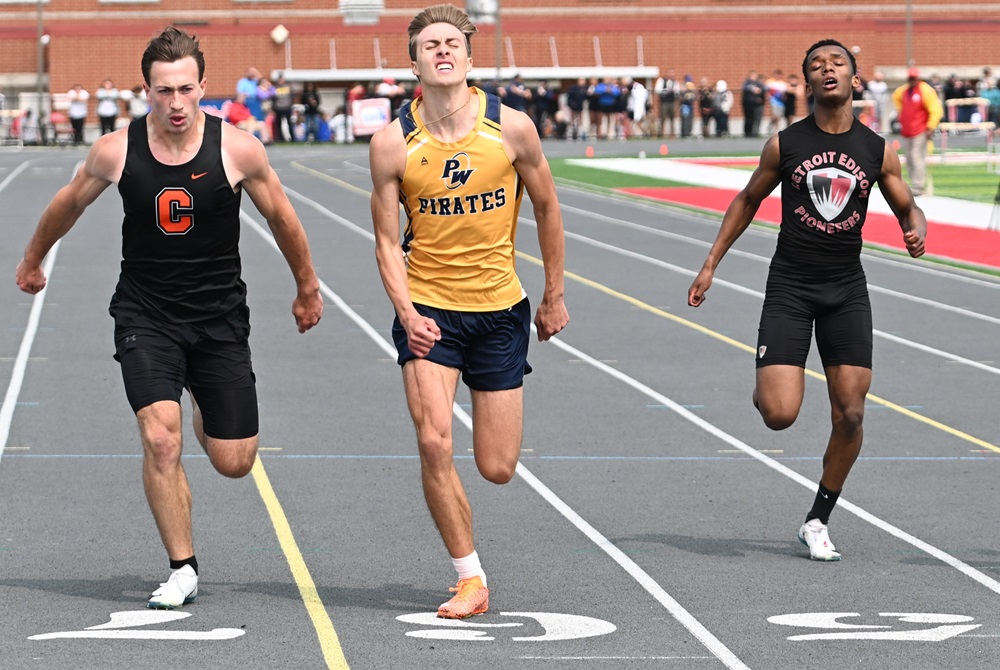
Both the 100 and 200 dashes were photo finishes.
Grosse Pointe Woods University Liggett senior Cicarella Santino won the 100 at 10.86 seconds, less than a whisker ahead of Pewamo-Westphalia senior Trevor Smith, the 2024 champion, at 10.88. Smith redeemed himself by winning the 200 in 22.40, just ahead of Chesaning’s Harlan at 22.44 and Cicarella in third.
“I knew Trevor is a great competitor,” Santino said about the 100 race. “I knew it was going to be a close race and come down to the wire. And I was prepared for that, but thankfully I came out at the end.
 “There are ups and downs throughout the season, but I think I stayed consistent all the way through. I started out indoors, and I worked at it and slowly kept bringing my time down and getting better every single week. Last year, I came in fourth in the 100 (to Smith). Trevor was obviously the guy I was going for all year as the returning champ.”
Smith would have loved to take both titles, but he was content with the 200 win.
“Being able to get another photo finish opportunity, and win this one, was really great,” Smith said about the second race. “I prefer running the 100, but today, I love the 200 win. They were both really great races, really close, and I enjoy that the most out of anything.”
Smith ran in two relay races as well.
“Usually, my favorite race anytime is the 4 x 100,” Smith said. “It’s because I’m running my favorite open race, the 100, but I’m at full speed by the time I get the baton, and I’m able to run, so it just makes you feel a lot faster and a lot better about yourself.”
Smith said he is going to Ferris State on Tuesday to talk to the coaches about a possible future there.
Another college bound senior is heading to Alma College, but to play football.
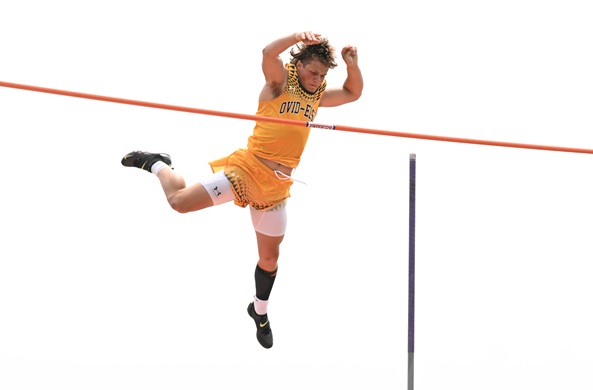
Pole vaulter Tryce Tokar of Ovid-Elsie won his fourth title in that field event, completing a Finals career sweep. He finished at 15 feet.
“It’s relieving now to win four straight,” he said. “That pressure is off. But it was fun today. I like vaulting.
“I had a couple of injuries early on, which I normally do honestly,” Tokar explained about the start to the spring season. “That’s pretty consistent when you transfer from football to track; you have some injuries to overcome. Everyone does, I’m not singled out. But I overcame it.
“I’m not really the fastest guy,” he added about excelling in pole vault. “I don’t really run sprints or anything. But I’m pretty athletic and just good enough to be a good vaulter. It takes a lot of technique. I owe a lot of it to coaches, and I like the athletic aspect of it.”
PHOTOS (Top) From left, Chesaning's Zach Harlan, Pewamo-Westphalia's Trevor Smith and Detroit Edison's Dennis Jackson push to the finish of the 200 championship race at Kent City. (Middle) Ovid-Elsie's Tryce Tokar crosses over the pole vault bar on the way to winning that championship for the fourth-straight season. (Click for more from RunMichigan.com.)
North Branch Cousins Carry on Family Tradition with Record-Setting Throws
By
Paul Costanzo
Special for MHSAA.com
April 16, 2025
Aubree Deshetsky wasn’t able to be there last week when her cousin, Eli Bickel, broke the 30-year-old North Branch discus record.
 She was there, however, when the former record holder, her dad Daniel Deshetsky, got the call.
“I was with my dad at a volleyball tournament in Louisville,” Aubree Deshetsky said. “We wanted (Eli) to break the record. It was cool to see him do that.”
Bickel not only knocked his uncle off the Broncos’ record board with his throw of 160 feet, 4 inches on April 11 at Davison, he joined Aubree as the school’s all-time leaders in the event. She had thrown 131-5 two days earlier, breaking her own school record.
The similarities go well beyond that. Both have committed to Division I universities in other sports. Deshetsky will be playing volleyball at Wofford (South Carolina), while Bickel has committed to play football at Michigan State.
And they’re both still juniors.
“I think for both of them, they’re not done,” North Branch athletic director and throwing coach Al Margrif said. “They’re both really motivated to be able to make their best marks this year. Eli, he puts in a lot of study. He watches a lot of film. He has a cousin that he talks to that’s a (collegiate) throws coach. He’s more technical and a student of discus. Aubree, she’s a super-fast learner. She’s just so athletic, and it just comes out so much.”
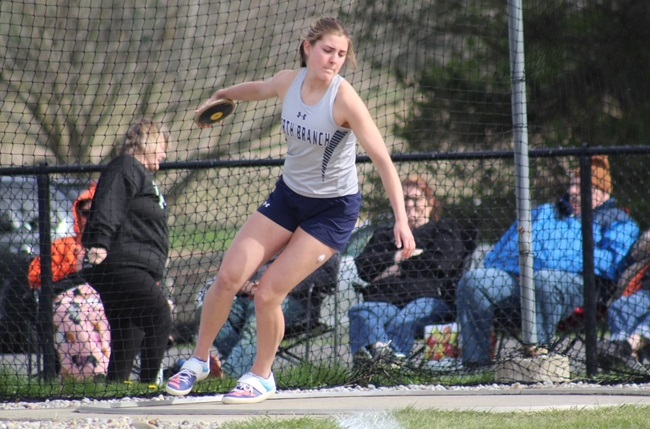 Deshetsky is a two-time Finals champion in volleyball, winning titles her freshman and sophomore seasons. She’s also a returning all-state thrower, having taken fifth in the shot put and sixth in the discus at the Lower Peninsula Division 2 Finals a year ago.
That’s despite never really being solely focused on throwing. During her freshman year, she ran the 200, 400 and 800 meters, multiple relays and also high jumped along with her throwing events.
As a sophomore, she cut back on some of those races and the high jump, but was part of North Branch’s 400-meter relay team, which qualified for the Division 2 Finals.
And all along, she’s been playing high-level club volleyball, which takes her around the country.
“I kind of (started throwing) because my dad threw in high school,” she said. “It’s just something my family has done. I was really a big high jumper and 800 runner in middle school and early high school, but once volleyball ramped up more, it was harder to train for those, so I focused more on the throwing side. I got serious into discus last year. But my coach, he literally puts us in events at the meets to get us the most points, so I just do whatever he asks and hope for the best.”
She threw 127-1 at the Blue Water Area Conference championship meet a year ago to claim the school record. That came last May, so to be well ahead of that right now in early April is a good sign for what she wants to accomplish this season.
“I was actually very surprised,” she said. “That meet was my first time throwing outdoors this year. We’ve just been practicing inside, but something that’s helped this year, our school has these foam rings and with rubber discs, I can basically do a full throw into a divider in the gym. But I honestly did not expect to throw that far. I’m kind of aiming for the 140 mark this year. I think starting out at 131 is a good starting point.”
Bickel, who will play on the offensive line at MSU, has been more focused on throwing since middle school. He started tagging along to throwing practices when his sister Natasha, a 2023 North Branch graduate who was Deshetsky’s volleyball teammate, began competing in high school, and realized pretty quickly he had a future in the sport. So much so that he originally thought throwing could be his path to becoming a college athlete.
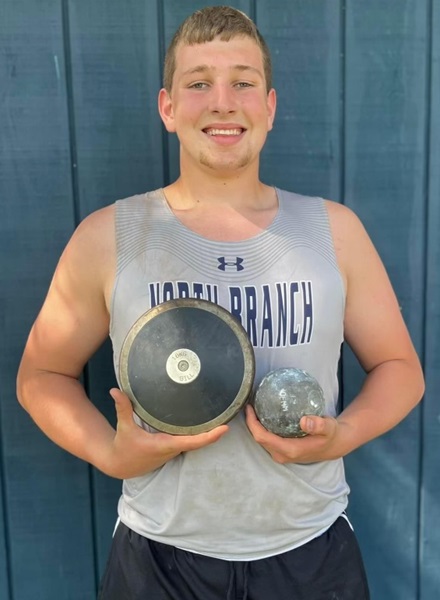 All along, he had his uncle’s record in his sights.
“It’s been a goal of mine,” Bickel said. “I knew I could do it. Last year was a frustrating year, because I hit that mark so many times in practice, but I never could in a meet. This was my first meet this year – I got cleared on Tuesday (after recovering from a torn meniscus), then the next day I threw 151 and felt good. Then Friday came and my first two throws, I was over-excited, but my next throw, I really connected.”
Bickel is a four-sport athlete at North Branch, as he wrestled and played basketball this winter. Even though he did get injured in January, he said the MSU staff has been supportive of him continuing to branch out.
“They actually encouraged it,” Bickel said. “They wanted people who could stay moving and be athletic on the offensive line.”
His football commitment could mean this is his final track season, however, as there’s a chance he will enroll early at MSU. That put some more urgency into breaking that record this season and getting back to the Division 2 Finals to make up for a disappointing finish a year ago.
He’s certainly on track to do that, as his record-breaking throw is currently the best in Division 2 this spring.
The best throw for Division 2 girls, meanwhile, belongs to Deshetsky.
It’s fitting for cousins who have had simultaneous success for so long.
“Our family is very close together,” Bickel said. “We actually do 4-H in the summer, and they show pigs out of our barn. I go to every one of her volleyball games that I can make it to. On the track side of things, there are times on a Saturday afternoon where I’ll ask her if she wants to go practice throwing, and she’ll do it.”
 Paul Costanzo served as a sportswriter at The Port Huron Times Herald from 2006-15, including three years as lead sportswriter, and prior to that as sports editor at the Hillsdale Daily News from 2005-06. He can be reached at [email protected] with story ideas for Genesee, Lapeer, St. Clair, Sanilac, Huron, Tuscola, Saginaw, Bay, Arenac, Midland and Gladwin counties.
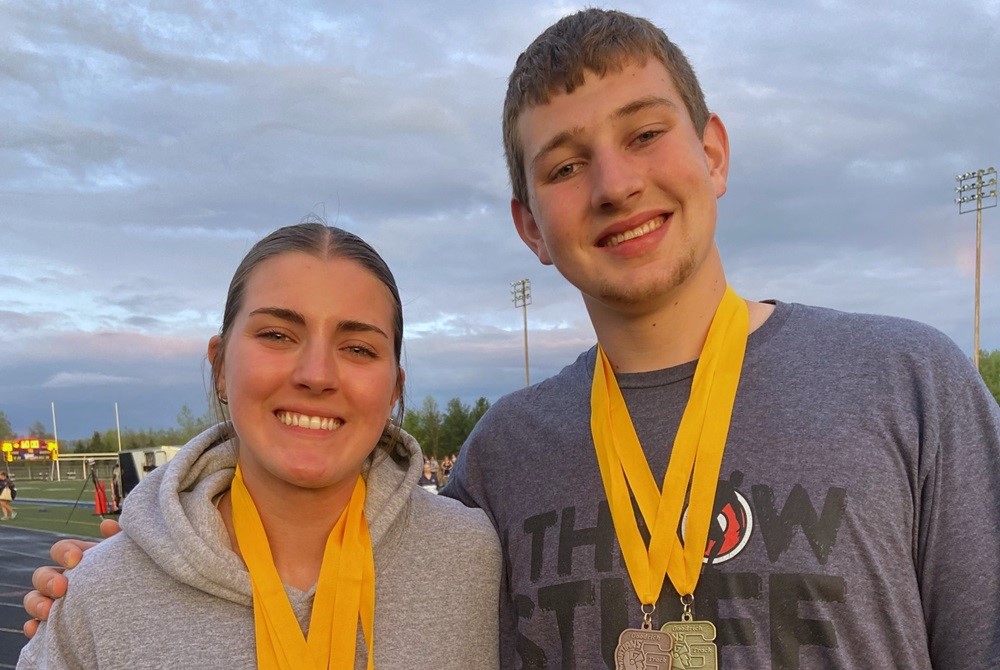
PHOTOS (Top) Cousins Aubree Deshetsky, left, and Eli Bickel take a photo together during a successful day last season at the Goodrich Invitational. (Middle) Deshetsky unwinds during a discus throw. (Below) Bickel holds up his discus and shot put. (Photos courtesy of the North Branch athletic department.)