


Emeott Closes Prep Career Helping Vault East Kentwood to Team Title #9
By
Steve Vedder
Special for MHSAA.com
May 30, 2026
ROCKFORD – Reece Emeott went from not knowing state history to making it.
The East Kentwood senior said he wasn't aware he could become the first pole vaulter in state history to win three-straight MHSAA Lower Peninsula Division 1 Finals titles until he was informed that was indeed what he accomplished following Saturday's meet at Rockford.
Emeott shook off some unexpected setbacks to win this time with a vault of 16 feet, 6 inches. After becoming the first sophomore ever to win the Division 1 pole vault two years ago, then repeating the feat last spring, Emeott said he prefers not to live in the past.
"I try to focus on the now," said Emeott, whose finish sparked the Falcons to their Finals team title since 2019. "I don't think about the past or winning other state titles. I just take it day-by-day, but that is crazy, to win three state titles."
East Kentwood narrowly won the team prize, finishing with 63 points to 62 for runner-up Detroit Catholic Central.
Emeott's title featured a couple of strange turns, including a pass at the15-feet, 9-inch mark, then a miss at 16 feet. At one point late in the event, he ranked just fifth.
"It wasn't how I planned it at all," said Emeott, who will compete at Michigan next season. "I had a sprained foot, and I was kind of nervous about it. I couldn't do everything I wanted. There's pressure, but only because I need to score points to help the team. It would have been bad luck not to win."
Falcons coach Dave Emeott, whose teams have now won nine Finals titles, said the latest championship comes on the heels of a book he wrote last December, "Beyond The Finish Line." The book stresses the importance of relationships, positive parental involvement, the role of winning and being process oriented. Emeott admits the program may have drifted from those factors since winning three straight Division 1 titles from 2017-19.
"We had kind of a drought, and I looked at myself and the team and tried to figure out what we were doing," he said. "I thought, 'Hey, maybe we should be doing those things again. It was a magical year. I thought we could be in the conversation (for a title), but then again, there were days I would have said I don't know."
 East Kentwood's other first place came from the 800 relay (1:26.76).
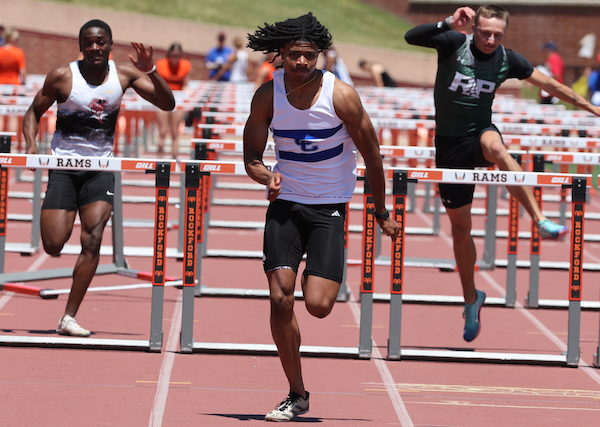
Among the other championships were a pair by Detroit Catholic Central's Zacchaeus Brocks, who captured the 300 hurdles (36.33) and 110 hurdles (13.40). The 300 time is the fourth-best in the country. He was seeded first in both events.
"I got out hard and set the tone," said Brocks, whose 2025 season was prematurely ended by a stress fracture in his toe. "I knew it was in me. I was anxious, but never defeated. I knew I had the confidence and grit to go out and get it. It's a great legacy to leave."
Rodney Endsley of Walled Lake Western was also a double winner, taking the 200 (21.14) and 400 (47.11), with the 16th and 17th-best times, respectively, in state history in those two events.
"I'm not a cocky guy, but when I feel I can win, I do," he said.
Wendell Childs Jr. of Clarkston successfully defended his 2025 title by winning the 800 (1:50.81), less than two seconds ahead of runner-up Greg Myers of Ypsilanti Lincoln. Childs Jr. won last year's title with a 1:51.49.
"Greg is a tough competitor, and I worked and worked to get to the point where I didn't think anybody could beat me," he said. "Last year was big for me, but I knew this was going to be tough."
Luka Hammond of Grand Haven also repeated by winning the 1,600 (4:09.53). Hammond said he learned a valuable lesson about health after what he called "limping" through last fall's cross country season.
"My body got beat up, and I learned my lesson," he said. "I learned that missing a couple days doesn't need to affect you. The most important thing is to be healthy, and I didn't have any problems this spring.
"There was definitely more pressure because I wasn't even supposed to be here last year. I'd be lying if I said I could be here. But you can't let that get the best of you."
Vernall Lee of Detroit Martin Luther King won the 100 (10.76), barely inching past runner-up Peyton Trammer of Belleville (10.77).
"It's a good feeling," said Lee, who was slowed by a pulled hamstring and broken ankle suffered six months ago. "It's mental. I knew it was going to be a tough challenge when I couldn't even walk. I'm still not completely healthy (with the hamstring), maybe 75-80 percent. But the ankle is completely healed."
Among the other champs were Detroit Catholic Central’s Paxton Heitsch in the shot (58-6) and Malachi Clayton in the long jump (24-5). Jase Behmlander of Saginaw Heritage won the high jump (6-10), Cameron Gramzow of New Baltimore Anchor Bay won the discus (172-1) and Brandon Cloud of Northville won the 3,200 (9:02.40).
Detroit Renaissance won the 1,600 relay (3:17.14), Detroit Catholic Central the 400 (41.50) and Ann Arbor Pioneer the 3,200 (7:40.02).
Macomb L’Anse Creuse North’s Cooper Shain (100, 200, 400) and South Lyon’s Owen Moerdyke (shot put) finished first in adaptive events.
PHOTOS (Top) East Kentwood's Reece Emeott clears the bar during a pole vault Saturday. (Middle) Detroit Catholic Central's Zacchaeus Brocks, center, sprints toward the finish in the 110 hurdles. (Click for more from John Brabbs, Carter Sherline and Jamie McNinch/RunMichigan.com.)

Hillsdale Begins March Toward Big June
By
Doug Donnelly
Special for MHSAA.com
April 3, 2018
HILLSDALE – The MHSAA Track & Field Finals are still a couple months, a few thunderstorms and maybe even some snow showers away.
 But, there’s once again one thing you can most likely count on – the Hillsdale Hornets boys track & field team will be well represented June 2 at Comstock Park High School.
In Clay Schiman’s first season coaching the Hornets track team in 2013, Hillsdale scored three points at the Lower Peninsula Division 3 Finals meet. In 2014, Hillsdale made the big jump to a fourth-place finish. In each of the three seasons since, Hillsdale has finished second. In each of the past two seasons, they finished five points out of first place; Chesaning won the championship in 2017 and Sanford Meridian in 2016.
Schiman says it’s much too early to tell if the Hornets will have the depth and points to finish that high again. But, no one is counting Hillsdale out.
“It takes so many points in so many different areas to win that state meet,” Schiman said. “We haven’t set our team goals yet. We try and get a few meets under our belt first, then take a realistic look. I’d say we have a chance to score some points and have a few all-state athletes.”
That translates into a team to watch come June.
“Our kids value hard work, whether that is in the weight room or the classroom or learning technique,” Schiman said. “The kids know if they are going to be an athlete here, they are going to work.”
Hillsdale had eight seniors qualify for the boys meet last year, either in an individual event or relay. They have 33 out for track this season, which is slightly down from the last couple of seasons but enough to give the Hornets some depth and options when it comes to dual meets, Lenawee County Athletic Association events and invitationals.
“For a Division 3 school, we have a lot of options for kids,” he said. “It’s just about getting them out and motivating them. We don’t focus on winning every meet or invitational. It’s all about progressions and improving from one meet to the next or one year to the next.”
A good example of how an athlete can improve from one year to the next is what Rees Nemeth did last year for the Hornets. The pole vaulter went from 11-foot-6 as a junior to winning the LPD3 championship last year.
“Track is unique in that way,” Schiman said. “You never know who else is out there or who is going to take that leap from one year to the next.”
At the top of this year’s list of Hornets is junior Spencer Eves, the Division 3 high jump champion last year. He has a good track pedigree. His older brother was an all-state distance runner who now races in college. Spencer went 6-7 last year at the Finals.
“He was on the MITCA team, representing Michigan in the high jump,” Schiman said. “For a Division 3 athlete, that is really impressive. We are excited about his prospects and potential this year.”
Sam Nash was on the Division 3 championship 1,600 relay team in 2016 and will be in multiple events this year, including the 400.
“In his first event of this season he was right where he left off in June,” Schiman said. “That doesn’t happen very often. It was a great start to the season.”
Hurdlers Noah LoPresto and Colby Nash have a ton of potential and Ryan Reiniche is one of those athletes that Schiman expects to make great strides. Reiniche is a discus thrower.
“He finished (last) season really strong,” the Hillsdale coach said.
Hillsdale began this spring like it has for the last several years – at the Charger Preview, hosted annually by Hillsdale College. Hillsdale High uses that meet as a barometer for the season. The school is on spring break next week, meaning the athletes will have a week of working out on their own before returning to action the first full week in April.
“It’s great for us,” he said. “It sets the tone for the whole year. Twenty teams were there competing, so you know, in every event, you are going to get some good competition. It’s good for all of the kids who go to that meet.”
Hillsdale made some strides, Schiman said. Now, its up to the athletes to keep working, improve each week and be prepared for the big stage come June, whether it’s raining, windy or 85 degrees and sunshine.
“We believe in our program and what we are doing,” Schiman said.
 Doug Donnelly has served as a sports and news reporter and city editor over 25 years, writing for the Daily Chief-Union in Upper Sandusky, Ohio from 1992-1995, the Monroe Evening News from 1995-2012 and the Adrian Daily Telegram since 2013. He's also written a book on high school basketball in Monroe County and compiles record books for various schools in southeast Michigan. E-mail him at [email protected] with story ideas for Jackson, Washtenaw, Hillsdale, Lenawee and Monroe counties.
PHOTO: Hillsdale's Spencer Eves competes in the high jump last season.