

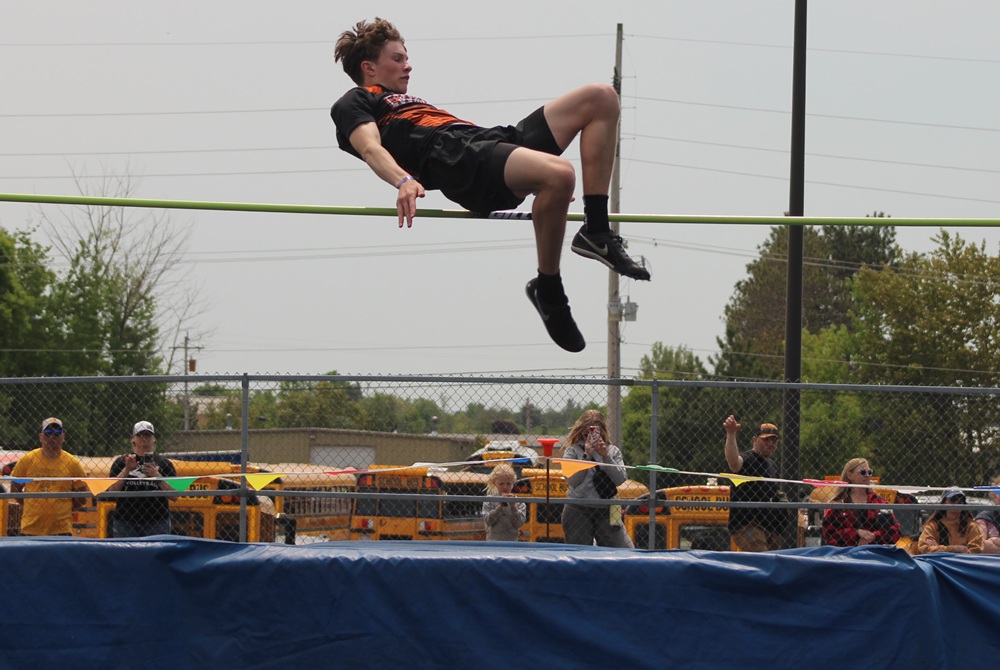
Hamlin Breaks Escanaba's 48-Year-Old High Jump Record, Climbing List of State's Best
By
Adam Hinch
Special for MHSAA.com
May 7, 2026
ESCANABA — Over the last three seasons, Escanaba sophomore Andrew Hamlin has shown big gains annually in the high jump – and this year he has broken Escanaba High School’s record not once but twice, with plenty of opportunities remaining to better his best performance.
 Hamlin took his first jumps in seventh grade but did not actively start competing until his eighth-grade year at Holy Name School in Escanaba.
“I remember the meet in Bark River,” Hamlin said. “I used to go off my right side with my left leg and then switched halfway through the season and ended up breaking the record.”
Hamlin broke Holy Name’s school record at the Escanaba Junior High Invitational with a jump of 5-foot-7 on May 14, 2024.
He also came in 11th at the Upper Peninsula Division 3 Finals that spring with a jump of 5-4 as one of only two eighth graders to compete in the Division 3 boys high jump that day.
“I knew Andrew since he was in fourth grade,” Holy Name athletic director Tony Derkos said. “He is a great kid, and track really gives him a chance to be his own athlete.”
Hamlin switched to Escanaba High School as a freshman and had a jump of 6-foot at the Division 1 Regional in Escanaba last spring. He then came through with a jump of 6-2 at the UP Finals in Kingsford where he was finished second as one of only two freshmen to place among the top 10.
“I really enjoy the competitiveness of the sport,” Hamlin said. “It definitely helps to fuel you as an athlete to improve every time out.”
Hamlin also has a personal coach, Hugo Munoz, who was a member of the Peru national team and competed in the 1996 and 2000 Summer Olympics.
Hamlin has competed in two high jump camps, one in Wisconsin and most recently one in New Prague, Minn.
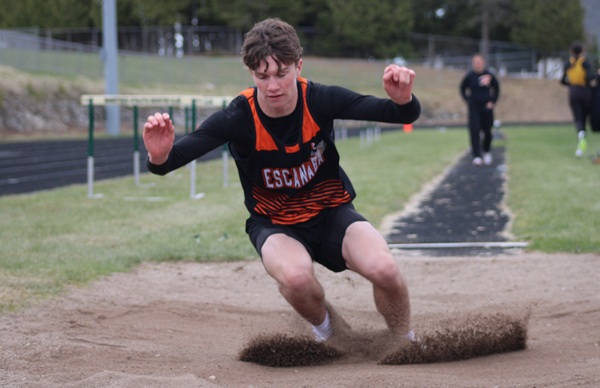 Now a sophomore, he broke the high jump record for Escanaba High School with a jump of 6-6 on April 21at the Delta County Invite in Gladstone. The previous record was set in 1978 by Keenan Failing.
“It meant a lot to get the record,” Hamlin said. “It was one of the goals for the season coming in, and I was just kind of surprised that it happened this early in the season.”
That record lasted for 10 days until the Escanaba Invitational on May 1, when Hamlin completed a jump of 6-7. That height ranks eighth statewide this season and first among Upper Peninsula jumpers.
“I have to adjust my goals for the season,” Hamlin said. “I never thought I would hit this high of a height this early in the season, so now I’m just trying to stay consistent and improve my height when I can.”
Hamlin will be taking part in the Nike Nationals this summer as well as some other high jump events. He also competes for Escanaba in the long jump, 400 meters and 1,600 relay, and plays football and basketball for his school.
“He’s everything you want in an athlete,” Eskymos track coach Scott Dykema said. “He is a good competitor and is always working on his game and what he can do to improve every time he goes out.”
Hamlin has overcome various injuries but works to get back in action as soon as he can.
“He never lets injuries keep him down,” Derkos said. “He is a tough kid and battles through injuries, and that is the sign of a natural competitor – which is what he is.”
Hamlin has aspirations of taking the high jump to the collegiate level and said he also enjoys distance running. He competes in 5K races and said he would enjoy running a marathon at some point.
“I think it would be fun to run a marathon,” Hamlin said. “That would come after college as there is so much time and training that goes into preparing for a marathon, but definitely something I would have interest in down the road.”
Hamlin has at least four track meets left this season as Escanaba will compete in Negaunee on May 8, at the Division 1 Regional at Manistique on May 13, and at Gladstone and Gaylord as well before finishing at the UP Finals on May 30 in Kingsford.
PHOTOS (Top) Escanaba’s Andrew Hamlin soars over the high jump bar during a meet. (Middle) Hamlin completes a turn in the long jump pit. (Photos by Adam Hinch.)
Memorable Wins and Multi-Champs Highlight LPD1 Track's Return
By
Steve Vedder
Special for MHSAA.com
June 5, 2021
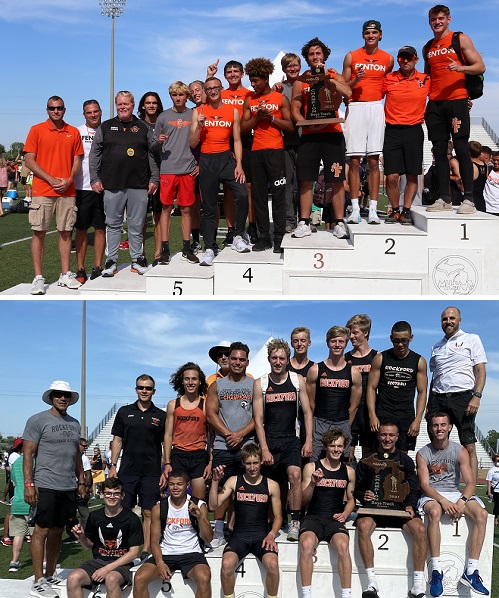
KENTWOOD – The particulars didn't necessarily matter to Rockford coach Andrew Martin. The only thing which truly mattered was the stunning finish to Saturday's Lower Peninsula Division 1 boys track & field championships at East Kentwood.
Seemingly out of the running for the team title, the Rams' 1,600 relay – a foursome not even running in the event's fast heat – managed a third place in the final event to earn Rockford a tie with Fenton for first place in a wild meet.
Both teams finished with 34 points. Instead of finishing as low as third place in a meet where the top eight were separated by just 12 points, Rockford earned its first Finals crown in 12 years under Martin.
"It doesn't matter how we got there," Martin said of tying for the title. "We were seeded 10th, but these kids are all about doing your own thing."
The Rams relay was comprised of three seniors in Daniel Leja, Gage Martin and Jacob Peck and junior Jacob Bissell. While they finished with a time of 3:23.84, Fenton was slowed by not having a team qualify for the final relay. It was a turn of events which left Fenton coach Anthony McMillan pacing nervously as the final race played out.
"To still do what we did was great," he said. "These kids left a legacy, a path. To bring a state title home is a very special moment. To be one of the (two) teams means a lot to us."
 Rockford and Fenton were far from the only teams with a breath of life until the final event. Zeeland West finished third with 30 points, Ann Arbor Skyline had 28, Pinckney and Novi 25 and Dexter and Macomb Dakota 24.
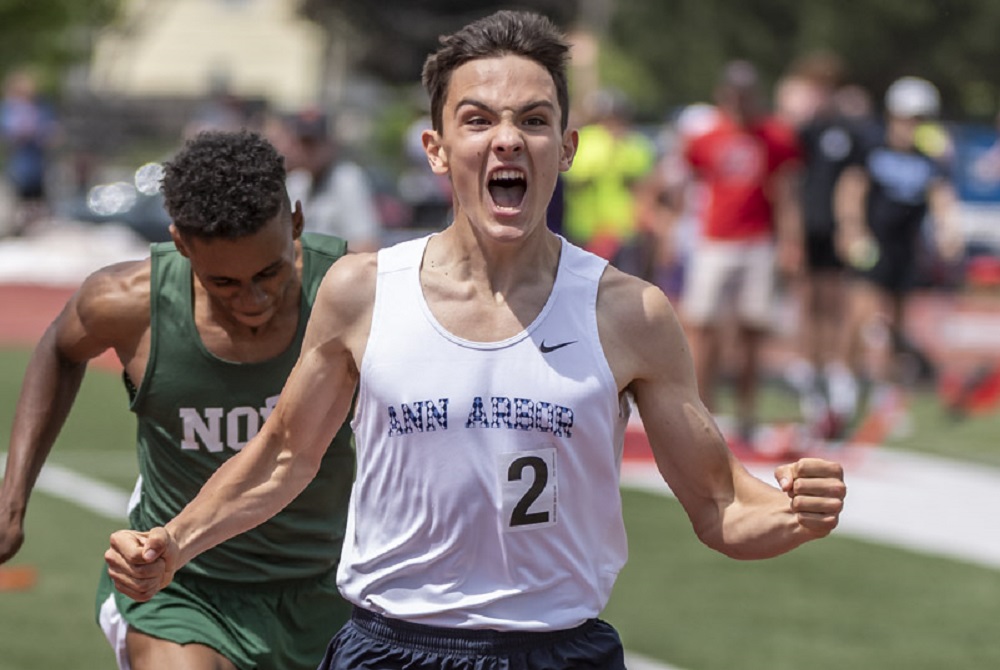
While the team title was captivating to the very end, Skyline's Hobbs Kessler virtually stole the individual part of the Finals. Kessler, who became the first Michigan high schooler to qualify for the Olympic trials in 80 years, won the 1,600 (4:16.68) and the 800 (1:54.13). While those finishes weren't necessarily surprises, Kessler's ability to live up to high expectations – including amazing kicks in both events – was even more impressive.
"It's the way I like to win," he said of running his last lap of the 1,600 in 55.1 seconds while also coming from behind to win the 800. "I want to give myself the best shot to win. The wind hit, and I snuck in.
"I know if I work out well and run my best, good things will happen. I know who I have to listen to, and the others aren't as important. I have a good support system, so I can just go out and win."
Kessler qualified for the Olympic trials last Saturday. He said he'll think more about the future now that the high school season is completed. But he wouldn't rule out competing in this summer's Japan Olympics.
"There's no reason to think I can't," he said.
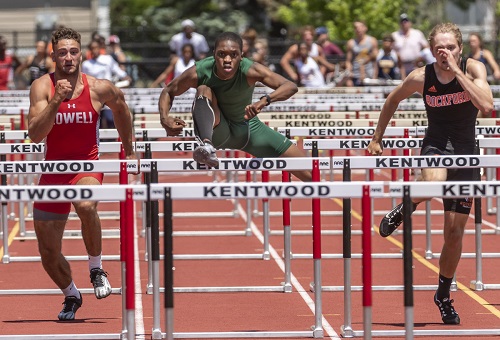
Among the other double winners at East Kentwood were Tamaal Myers II of Detroit Cass Tech, who claimed the 110 hurdles (14.26) and 300 hurdles (37.87), and Udodi Onwuzurike of Bloomfield Hills Brother Rice, who won the 100 (10.55) and 200 (21.23).
Myers said an extremely strong headwind didn't do runners any favors. But he was able to overcome the obstacle because of physical toughness, he said.
"It was a strong wind, but I just pushed through it to finish where I did," he said. "Mentally, you just keep going forward. It's all about technique; it's the arms, legs, everything."
Among other runners winning events were Terrence Muex of Flint Carman-Ainsworth in the 400 (46.52) and Hartland's Riley Hough, who won the 3,200 (9:07.91).
Zeeland West won the 800 (1:28.12) and the 1,600 (3:21.82) relays. St. Joseph won the 400 (42.65) and Novi the 3,200 (7:48.53).
 Dexter's Cole Sheldon won the pole vault (15-3) to complete an inspiring climb that included failing to qualify as a freshmen, to finishing 26th in 2019 to winning Saturday.
"It was just hard work," said Sheldon, who was seeded fourth. "It's nice being the underdog. I didn't have that great of a Regional, and I told my coach I was saving it for the Finals."
Sheldon also credited teammate Noah Schultz, who finished second with a vault of 14-9.
"That was probably the best thing that could have happened to me," Sheldon said. "He's the reason I did so well. If he goes high, I want to go higher."
Among other field event winners was Zachary Webb of Macomb Dakota, who won the high jump in 6-6. While some competitors are actually surprised by winning a state title, Webb doesn't count himself among them.
"I knew when I came in here I couldn't miss," he said. "I wanted to put the pressure on others, and I think I did that. I practice so much, I knew I could do this. I break down a lot of video. If I'm going bad, I look at the video and fix what I need to fix."
The other field event winners were Drake Willenborg of South Lyon in the discus (183-3), Levi Honderd of Holland in the long jump (22-6) and Ben Haas of Clarkston in the shot put (57-8).
PHOTOS: (Top) Ann Arbor Skyline’s Hobbs Kessler celebrates his victory in the 800 on Saturday. (Middle) Detroit Cass Tech’s Tamaal Myers II sets the pace during his hurdles sweep. (Below) Fenton, top, and Rockford celebrate their team championships.(Action photos by Ike Lea; team photos by John Brabbs/RunMichigan.com.)