

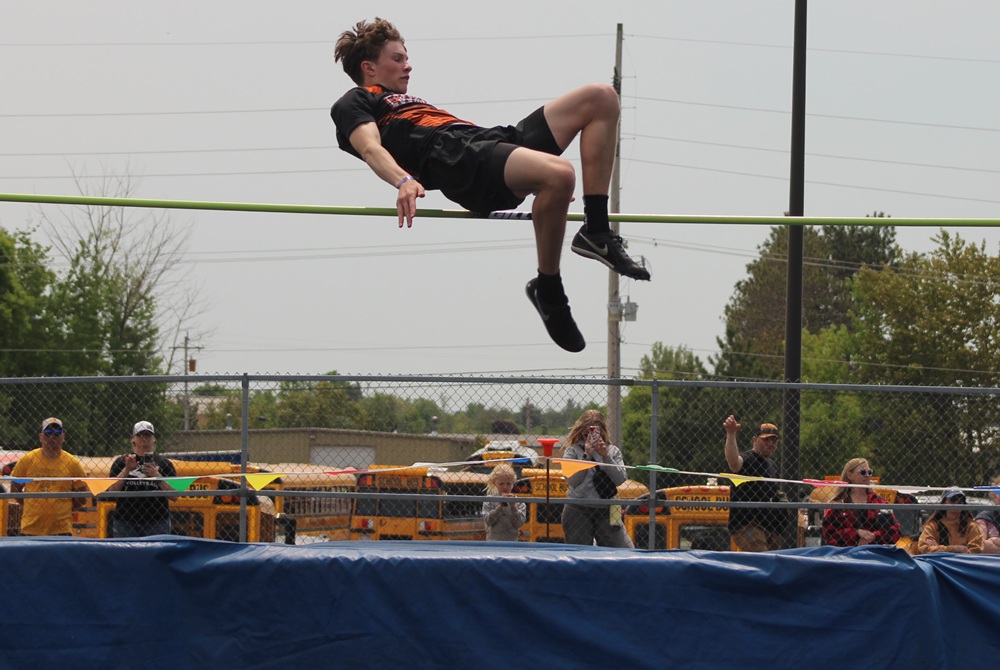
Hamlin Breaks Escanaba's 48-Year-Old High Jump Record, Climbing List of State's Best
By
Adam Hinch
Special for MHSAA.com
May 7, 2026
ESCANABA — Over the last three seasons, Escanaba sophomore Andrew Hamlin has shown big gains annually in the high jump – and this year he has broken Escanaba High School’s record not once but twice, with plenty of opportunities remaining to better his best performance.
 Hamlin took his first jumps in seventh grade but did not actively start competing until his eighth-grade year at Holy Name School in Escanaba.
“I remember the meet in Bark River,” Hamlin said. “I used to go off my right side with my left leg and then switched halfway through the season and ended up breaking the record.”
Hamlin broke Holy Name’s school record at the Escanaba Junior High Invitational with a jump of 5-foot-7 on May 14, 2024.
He also came in 11th at the Upper Peninsula Division 3 Finals that spring with a jump of 5-4 as one of only two eighth graders to compete in the Division 3 boys high jump that day.
“I knew Andrew since he was in fourth grade,” Holy Name athletic director Tony Derkos said. “He is a great kid, and track really gives him a chance to be his own athlete.”
Hamlin switched to Escanaba High School as a freshman and had a jump of 6-foot at the Division 1 Regional in Escanaba last spring. He then came through with a jump of 6-2 at the UP Finals in Kingsford where he was finished second as one of only two freshmen to place among the top 10.
“I really enjoy the competitiveness of the sport,” Hamlin said. “It definitely helps to fuel you as an athlete to improve every time out.”
Hamlin also has a personal coach, Hugo Munoz, who was a member of the Peru national team and competed in the 1996 and 2000 Summer Olympics.
Hamlin has competed in two high jump camps, one in Wisconsin and most recently one in New Prague, Minn.
 Now a sophomore, he broke the high jump record for Escanaba High School with a jump of 6-6 on April 21at the Delta County Invite in Gladstone. The previous record was set in 1978 by Keenan Failing.
“It meant a lot to get the record,” Hamlin said. “It was one of the goals for the season coming in, and I was just kind of surprised that it happened this early in the season.”
That record lasted for 10 days until the Escanaba Invitational on May 1, when Hamlin completed a jump of 6-7. That height ranks eighth statewide this season and first among Upper Peninsula jumpers.
“I have to adjust my goals for the season,” Hamlin said. “I never thought I would hit this high of a height this early in the season, so now I’m just trying to stay consistent and improve my height when I can.”
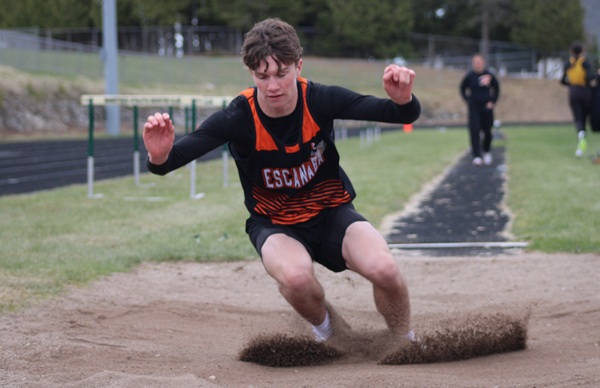
Hamlin will be taking part in the Nike Nationals this summer as well as some other high jump events. He also competes for Escanaba in the long jump, 400 meters and 1,600 relay, and plays football and basketball for his school.
“He’s everything you want in an athlete,” Eskymos track coach Scott Dykema said. “He is a good competitor and is always working on his game and what he can do to improve every time he goes out.”
Hamlin has overcome various injuries but works to get back in action as soon as he can.
“He never lets injuries keep him down,” Derkos said. “He is a tough kid and battles through injuries, and that is the sign of a natural competitor – which is what he is.”
Hamlin has aspirations of taking the high jump to the collegiate level and said he also enjoys distance running. He competes in 5K races and said he would enjoy running a marathon at some point.
“I think it would be fun to run a marathon,” Hamlin said. “That would come after college as there is so much time and training that goes into preparing for a marathon, but definitely something I would have interest in down the road.”
Hamlin has at least four track meets left this season as Escanaba will compete in Negaunee on May 8, at the Division 1 Regional at Manistique on May 13, and at Gladstone and Gaylord as well before finishing at the UP Finals on May 30 in Kingsford.
PHOTOS (Top) Escanaba’s Andrew Hamlin soars over the high jump bar during a meet. (Middle) Hamlin completes a turn in the long jump pit. (Photos by Adam Hinch.)
Hackett Catholic Prep's Baldwin Carrying Hopes from Home to Paris
By
Pam Shebest
Special for MHSAA.com
July 12, 2024
KALAMAZOO — Heath Baldwin studied Spanish at Hackett Catholic Prep, but he will need to brush up on some French as he heads to Paris to compete in the 2024 Summer Olympics.
The recent Michigan State University grad, who earned a master’s degree in marketing and research analytics, will compete in the decathlon, a two-day event Aug. 2-3 at the Stade de France.
While the Olympics will be televised in the United States, because of the time difference, Baldwin’s events will take place locally during the early morning hours.
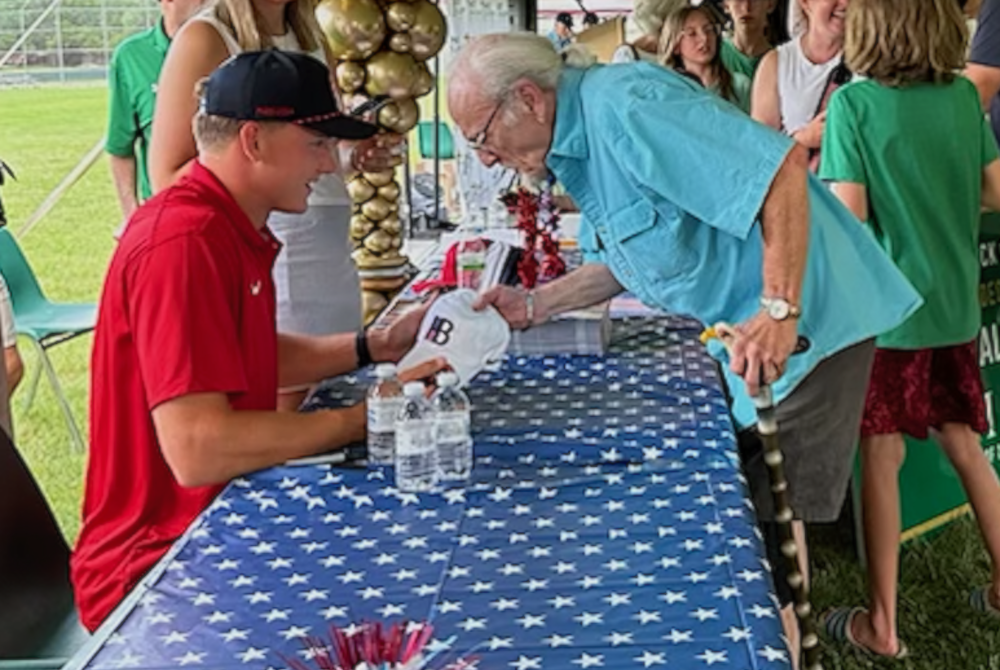
Wishing him a Bon Voyage, more than 200 former classmates, friends, family and well-wishers plus six television crews congregated Thursday for an impressive sendoff, starting with the Hackett “Summer Ensemble” playing the school fight song.
A 2019 Hackett grad, Baldwin led the track & field team to three Regional championships, two MHSAA Lower Peninsula Division 4 titles, was an individual five-time Finals champion, holds four school records and was named track & field Athlete of the Year for all divisions his senior season by the Michigan Interscholastic Track Coaches Association.
“I went through a lot at Hackett, obviously, with my dad (Roger) passing away (in 2016) and I always had a great support system of people who took care of my family and made sure we were doing good,” Baldwin said. “They’ve stuck with me through college, too, following me in all my events and to this point, so it’s cool that I’m doing well now and they’re along for the ride.”
 The ride will begin Tuesday when Baldwin travels to Germany to train before heading to Paris.
“Everything’s starting to feel more real,” he said. “I think once I get to Germany and start to train with other people, we’ll be able to get a little competitive. I think it will be fun training in Paris.”
Facing a huge crowd in Paris should not be a problem, he said.
“The more people will only help me. I’m a big adrenalin guy. I feel like I get more nervous talking at an event like this than I do for the Olympic Games.
“Once I get out on the track, everything just feels natural to me.”
Naturally a no-brainer
Baldwin’s Finals championships for Hackett had come in high jump, long jump and both hurdles races. Tackling the grueling decathlon was a no-brainer.
“I was good at the hurdles, high jump, long jump, which are three very technical events in the decathlon, so if you’re good at those three, you usually can pick up the other ones pretty easily is what they say,” he said.
“Also, I played baseball as a pitcher, so that correlated with the javelin. A lot of college coaches recruited me off that, I think.”
Baldwin said knew 2024 was an Olympic year, “so I thought it was something I maybe could do. After last year, when I scored above 8,000 points (in the decathlon) for the first time and came in sixth at the USAs, it became a little more realistic for me.”
The personable athlete not only qualified for the Olympics at this year’s U.S. Track & Field Trials in Eugene, Ore., but won the decathlon with a personal best 8,625 points.
He finished first in the shot put (54 feet, 2½ inches), high jump (6-11¾), 110 hurdles (13.77 seconds) and javelin throw (218-9).
 Other decathlon events are the 100 dash, long jump, 400 run, discus, pole vault and 1,500 run.
Baldwin earned Great Lakes Region Indoor and Outdoor Field Athlete of the Year honors and was named first team Academic All-American with a 3.8 GPA.
"We were awestruck at his athletic achievements (at Hackett),” said Judge Paul Bridenstine, the “Voice of the Irish.”
“While he continued to play football, basketball, baseball exceptionally at Hackett, his athletic life was transformed when he was introduced to (former HCP track & field coach Simon Cholometes).”
Cholometes said Baldwin’s success is something that didn’t come out of nowhere.
“Heath put the wheels in motion a long time ago and worked harder than most people can even fathom,” he said. “I can remember 5:40 in the morning, Heath running sprints up that hill over there,” he said, pointing. “A foot of snow, running sprints up that tall hill.
“In college, he’s a Big 10 champ, three-time All-American, Great Lakes Region Indoor and Outdoor Field Athlete of the Year, MSU’s Athlete of the Year twice, holds five school records plus Big 10 records in heptathlon and decathlon.”
Family won't be far
Baldwin plans to be in Paris for the opening ceremonies and will be cheered on by his mom Suzann, sister Hope and brothers Aiden and Gowan.
The Olympian also will have a remembrance of his late father with him. He has a tattoo of his dad’s signature on the inside of his upper left arm.
 Losing his father “was a big part of my life and obviously changed my perspective in the way I train and the way I live in a way he’d be proud of,” Baldwin said.
“We set some big goals going into this year and it’s been a dream. I love representing the Kalamazoo community and Michigan, Hackett and Michigan State.
“I like to remember everybody I compete for, and I think that gives you a bigger purpose when you go out there. That’s definitely something I’ll be doing at the Olympics in Paris. I’m excited to represent there and hopefully go for a medal.”
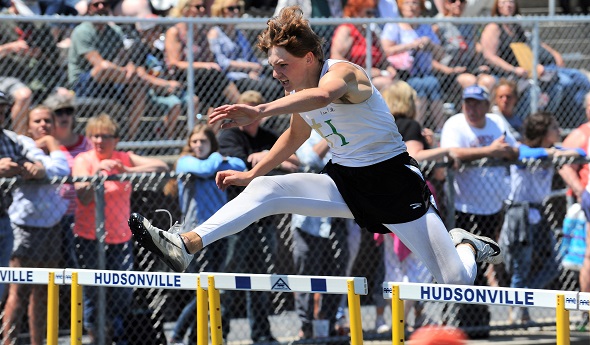
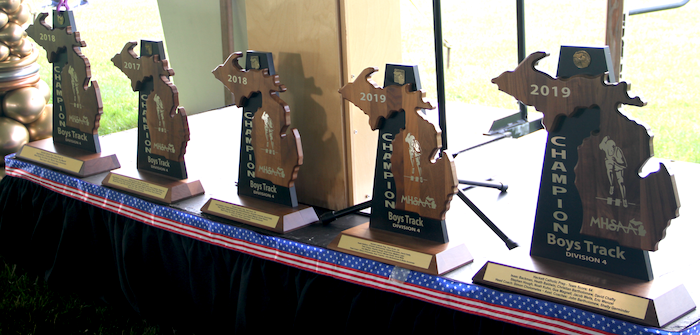
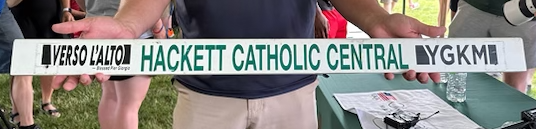
PHOTOS (Top) Health Baldwin, seated, signs a hat during his sendoff Thursday at Kalamazoo Hackett Catholic Prep. (2) Baldwin clears a hurdle during the 2019 MHSAA Finals. (3) A hurdle was gifted to Baldwin on Thursday. (4) MHSAA trophies Baldwin helped win decorated the stage for his sendoff. (Sendoff photo by Pam Shebest.)