


Hillsdale Begins March Toward Big June
By
Doug Donnelly
Special for MHSAA.com
April 3, 2018
HILLSDALE – The MHSAA Track & Field Finals are still a couple months, a few thunderstorms and maybe even some snow showers away.
 But, there’s once again one thing you can most likely count on – the Hillsdale Hornets boys track & field team will be well represented June 2 at Comstock Park High School.
In Clay Schiman’s first season coaching the Hornets track team in 2013, Hillsdale scored three points at the Lower Peninsula Division 3 Finals meet. In 2014, Hillsdale made the big jump to a fourth-place finish. In each of the three seasons since, Hillsdale has finished second. In each of the past two seasons, they finished five points out of first place; Chesaning won the championship in 2017 and Sanford Meridian in 2016.
Schiman says it’s much too early to tell if the Hornets will have the depth and points to finish that high again. But, no one is counting Hillsdale out.
“It takes so many points in so many different areas to win that state meet,” Schiman said. “We haven’t set our team goals yet. We try and get a few meets under our belt first, then take a realistic look. I’d say we have a chance to score some points and have a few all-state athletes.”
That translates into a team to watch come June.
“Our kids value hard work, whether that is in the weight room or the classroom or learning technique,” Schiman said. “The kids know if they are going to be an athlete here, they are going to work.”
Hillsdale had eight seniors qualify for the boys meet last year, either in an individual event or relay. They have 33 out for track this season, which is slightly down from the last couple of seasons but enough to give the Hornets some depth and options when it comes to dual meets, Lenawee County Athletic Association events and invitationals.
“For a Division 3 school, we have a lot of options for kids,” he said. “It’s just about getting them out and motivating them. We don’t focus on winning every meet or invitational. It’s all about progressions and improving from one meet to the next or one year to the next.”
A good example of how an athlete can improve from one year to the next is what Rees Nemeth did last year for the Hornets. The pole vaulter went from 11-foot-6 as a junior to winning the LPD3 championship last year.
“Track is unique in that way,” Schiman said. “You never know who else is out there or who is going to take that leap from one year to the next.”
At the top of this year’s list of Hornets is junior Spencer Eves, the Division 3 high jump champion last year. He has a good track pedigree. His older brother was an all-state distance runner who now races in college. Spencer went 6-7 last year at the Finals.
“He was on the MITCA team, representing Michigan in the high jump,” Schiman said. “For a Division 3 athlete, that is really impressive. We are excited about his prospects and potential this year.”
Sam Nash was on the Division 3 championship 1,600 relay team in 2016 and will be in multiple events this year, including the 400.
“In his first event of this season he was right where he left off in June,” Schiman said. “That doesn’t happen very often. It was a great start to the season.”
Hurdlers Noah LoPresto and Colby Nash have a ton of potential and Ryan Reiniche is one of those athletes that Schiman expects to make great strides. Reiniche is a discus thrower.
“He finished (last) season really strong,” the Hillsdale coach said.
Hillsdale began this spring like it has for the last several years – at the Charger Preview, hosted annually by Hillsdale College. Hillsdale High uses that meet as a barometer for the season. The school is on spring break next week, meaning the athletes will have a week of working out on their own before returning to action the first full week in April.
“It’s great for us,” he said. “It sets the tone for the whole year. Twenty teams were there competing, so you know, in every event, you are going to get some good competition. It’s good for all of the kids who go to that meet.”
Hillsdale made some strides, Schiman said. Now, its up to the athletes to keep working, improve each week and be prepared for the big stage come June, whether it’s raining, windy or 85 degrees and sunshine.
“We believe in our program and what we are doing,” Schiman said.
 Doug Donnelly has served as a sports and news reporter and city editor over 25 years, writing for the Daily Chief-Union in Upper Sandusky, Ohio from 1992-1995, the Monroe Evening News from 1995-2012 and the Adrian Daily Telegram since 2013. He's also written a book on high school basketball in Monroe County and compiles record books for various schools in southeast Michigan. E-mail him at [email protected] with story ideas for Jackson, Washtenaw, Hillsdale, Lenawee and Monroe counties.
PHOTO: Hillsdale's Spencer Eves competes in the high jump last season.
Revived Mancelona Boys Charging Ahead
May 9, 2019
By Chris Dobrowolski
Special for Second Half
Ability alone won’t get it done on the track.
 That’s why the transformation of the Mancelona boys track & field team didn’t happen until the Ironmen added confidence to their talent.
“I always thought they could do it,” said Rick Ancel, Mancelona’s head coach. “I always thought we had a lot of talent. They just didn’t believe in themselves, and they ran mediocre. Once they started believing, the workouts changed. The times changed. There are very few people they are afraid of. They get beat on certain days, but they don’t beat themselves up. I think before this change they were afraid before they ever got on the track.”
Since they’ve developed some faith in themselves the Ironmen have been a force to be reckoned with, running undefeated through every regular-season invitational they competed in last year on the way to capturing the Ski Valley Conference title. With most of its squad returning this season, Mancelona has continued to dominate meets and figures to be a shoo-in to capture the league crown for a second straight year when the conference championships are run May 22. The squad has been so impressive that it earned a No. 6 ranking in the Michigan Interscholastic Track Coaches Association Division 3 poll two weeks ago.
“It’s kind of hard to think about (being ranked) because a couple years ago we weren’t even winning our conference let alone being ranked at the state level,” said junior Johnny Ancel, one of the team’s three captains, along with classmates Tommy Palmer and Wesley Fulk.
Members of the team or coaching staff point to when Rick Ancel took over as head coach before last year as the pivotal moment when the Ironmen’s outlook, preparation and performance all changed. Ancel, who ran collegiately at Saginaw Valley State, deflects the credit back to his team and its willingness to do what it takes to find success.
“I do remember during the year that the workouts started changing,” said Rick Ancel. “They started going from trying to complete a workout because they had to run that much to trying to improve. Instead of just getting through it, they were doing the workout to get better.”
The fruits of their labor paid off in the form of the league crown, a fifth-place finish in the Regional — which came in their first year competing in Division 3 — MHSAA Finals qualifiers in three events and a school record in the 1,600-meter relay.
“At the end of last year I was feeling pretty good,” said Fulk. “We were only losing two of our (top) people, so the majority of our team was still going to be here. I knew we were going to be better than last season.”
The Ironmen haven’t disappointed. In an indoor meet at Central Michigan University in mid-March, the Ironmen kicked off their season by finishing second among Division 3 and 4 teams, easily surpassing their 11th-place finish a year ago. They followed that by winning their first five regular-season meets outside. Only a second-place finish at the Blue Devil Classic in Gaylord — where Mancelona tested itself against Division 1 and 2 teams — broke up the streak of regular-season first-place finishes that started early last season.
“This year we added some big meets,” said Rick Ancel. “We really tried to ramp up our competition this year.”
 Ancel’s veteran squad has welcomed the tougher competition. It’s a core of athletes who individually have the versatility to fill in at a number of different events and compete at a high level. The three captains, for instance, can run any event from the 100-meter dash up to the 800-meter run.
“We can try more people in different spots,” said Fulk.
It comes down to doing whatever the team needs at a particular meet. Even though track & field is in many ways an individual sport, the Ironmen see it from a team standpoint and embrace that perspective.
“We always start every meet and end every meet together as a team,” said Palmer. “You can’t do it alone, obviously. You can’t win a meet with just us three who are here or just one of us.”
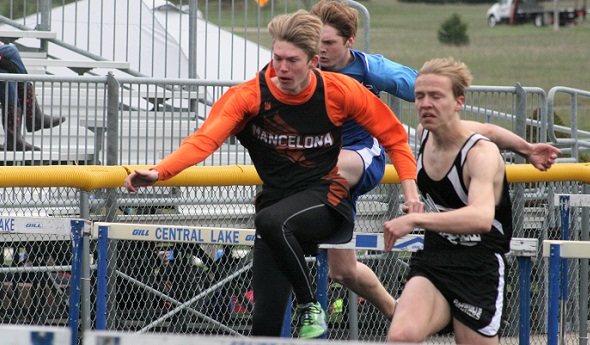
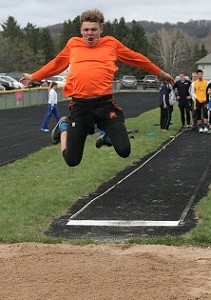
Two years ago the Mancelona team had only 11 members. Depth is not an issue any longer, however, as the Ironmen have bolstered their roster and now have nearly every event covered. Sophomore Ryan Rebh is ranked among the best hurdlers in the state in Division 3. Sophomore Jayden Alfred is the reigning Regional champion in the high jump and long jump and has emerged as the team’s top sprinter this season. Sophomore distance runner Tyler McClure is a Finals qualifier in the 3,200-meter run. Junior Michael Wagner is one of the better discus throwers in the Ski Valley Conference. James Dunne, Ben Palmer, Sam Squires and Austin Anderson have been key point scorers as well.
Mancelona also has four top-notch relays — all four should be favored to win conference crowns — highlighted by the 1,600 team. Ancel, Tommy Palmer and Fulk all return for that squad and have their sights set on breaking the school record for a second straight year.
“We’re just trying to find the right day where we all run fast at the same time,” said Johnny Ancel. “We could probably break it again right now. We just haven’t found the day.”
Records aside, the Ironmen seem to have the lineup that could challenge for a Regional title. Mancelona’s last Regional championship came in 2012, but that was in Division 4. Running in Division 3 is a bit more difficult, the Ironmen say, but they are up for the challenge.
“Harbor Springs was (in Gaylord), and they’re in our division. They’re really good. We’ll meet them again at Regionals,” said Rick Ancel. “That will be a tough day for us, but I think we’ve got a shot at winning that.”
 Chris Dobrowolski has covered northern Lower Peninsula sports since 1999 at the Ogemaw County Herald, Alpena News, Traverse City Record-Eagle and currently as sports editor at the Antrim Kalkaska Review since 2016. He can be reached at [email protected] with story ideas for Manistee, Wexford, Missaukee, Roscommon, Ogemaw, Iosco, Alcona, Oscoda, Crawford, Kalkaska, Grand Traverse, Benzie, Leelanau, Antrim, Otsego, Montmorency, Alpena, Presque Isle, Cheboygan, Charlevoix and Emmet counties.
PHOTOS: (Top) Mancelona’s Ryan Rebh leads the charge through the 110-meter hurdles during a recent meet. (Middle) Jayden Alfred launches during the long jump. (Photos by Chris Dobrowolski.)