

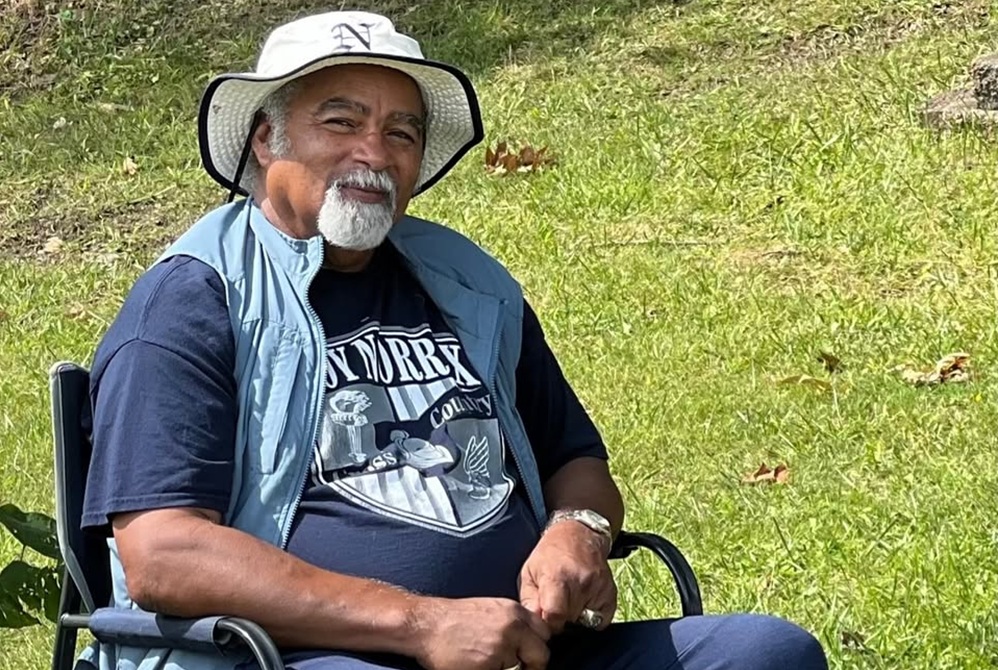
Loy Norrix Mourning Death of Longtime Coach, Teacher Duckett: 'He's All Knight'
By
Pam Shebest
Special for MHSAA.com
January 19, 2026
KALAMAZOO — Theophlis Duckett, known to generations of students and alumni as the more familiar “Ted” Duckett, dedicated 57 years of his life as a teacher and coach at Loy Norrix High School.
After his unexpected death Jan. 8, people will have a chance to show their respect and share memories at a community celebration of life, Saturday, Feb. 14, from 11 a.m.-noon (with doors opening at 10:30 a.m.) at the Loy Norrix auditorium.
At age 79, Duckett continued to teach three classes of physical education as well as coach the Knights girls and boys track & field teams.
“There aren’t many educators who have worked as long as he has, especially all those years in the same building,” said Andrew Laboe, Loy Norrix’s athletic director. "He connected with kids very well. He had a generational following: kids, parents, their grandparents, their great-grandparents.”
Some memories of Duckett bring a laugh from Laboe, who said he and Duckett had a running joke about his years as a Knight.
“I’m 55 years old and I told him I was negative-2 (years old) when he started working here,” Laboe laughed. “I believe he was a parapro or a locker room aide when he started here.
“In the teachers union seniority list, he is listed as 1969-70 for his first year teaching.”
Laboe said in losing Duckett, the school and community have lost a great resource for his knowledge of the history of the school and the people connected to it.
“He knows everybody,” Laboe said. “He was a consistent person in the lives of the kids he taught every day. Kalamazoo is not small like a lot of small towns around us, but it’s not very big, either.
"Ted knows everybody. You could get help from Ted on everything about children, who are they related to, who they are connected to, who can we contact to help them in any situation. That’s very helpful.”
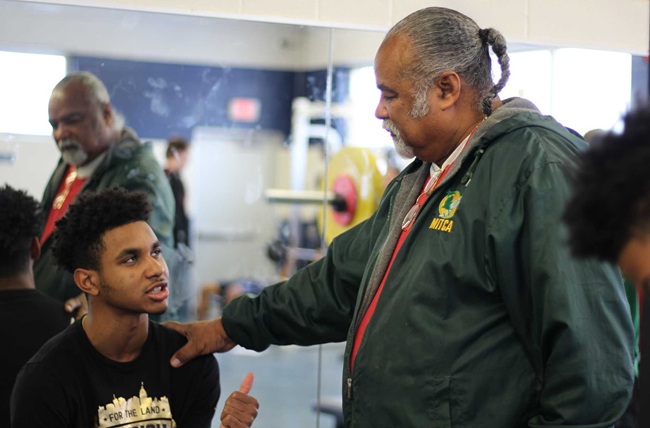 During his tenure at Loy Norrix, Duckett coached football, basketball and track.
“He’s definitely a good sprinter coach for track,” Laboe said. “He was a fixture at Loy Norrix forever. He’s all Knight.”
Duckett’s coaching tenure included developing several all-state football players. Among those were sons Tico and Todd, who continued their football careers at Michigan State and then the NFL.
Tico Duckett played for Washington while Todd was a first-round selection by Atlanta in 2002, and he also played for Washington, Detroit and Seattle.
Laboe laughs when he looks back on his first meeting with the coach.
“My first year (at Loy Norrix) was 2004,” Laboe said. “Ted came into my office the first day. I said, ‘Hi Mr. Duckett, how are you? I’m Andrew Laboe.’”
He told Laboe he already knew.
“He said, ‘I just want you to know you have one year to get all the information out of this head that you need to run this athletic department because I’m retiring in one year.’”
No matter how much Laboe got out of Duckett’s head that first year, it didn’t matter.
“I’ve been here for 22 years and he was still here. It’s crazy,” Laboe recalled.
“He’s one of a kind. I don’t think it will ever be replicated in my career. There’s not people like that anymore that are that dedicated to one school like Ted Duckett was to Loy Norrix.”
(Photos courtesy of the Duckett family and Loy Norrix High School/Knight Life.)
Knudsen's Early Perseverance Sign of Character to Come During Record-Setting Leland Run
By
Tom Spencer
Special for MHSAA.com
April 11, 2025
What was, nearly wasn’t.
 When the Buckley Invitational — weather permitted — takes place today, Ella Knudsen will begin to cap off a dream career at Leland.
The way her career began, frankly, was a little more like a nightmare.
Knudsen, the most decorated distance runner in the school’s history, is expected to challenge today for top honors in 400, 800, 1,600 and 3,200. Last year, weather forced cancellation of Buckley season-opening invite, but this year’s the forecast was much more encouraging.
Knudsen’s career — or at minimum her freshman season — was nearly cancelled as well as she tried to cross the finish line at her first high school event, the 2021 McBain Cross Country Invitational.
On an extremely hot August day, onlookers thought her difficulties finishing were caused by heat exhaustion.
“Her very first cross country first race could have been an end-all,” said her coach and mother Ann Knudsen. “It really talks to her determination, and her power of positivity overcoming adversity.”
Ella, one of the 10 student-athletes recently selected by MHSAA this year from Class C and D member schools to receive scholarships through the MHSAA/Farm Bureau Insurance Scholar-Athlete Award program, vividly recalls the moment.
“It was my first time truly racing a 5k, and as I was going down the last hill to the finish line about 15 feet from the finish line I heard three to five pops in my left hip,” Ella said. “My momentum from the hill carried me through the finish line, where I collapsed and was caught by people at the finish line.”
Event staff tried to keep Knudsen moving, but she went into shock. It took a few minutes for Knudsen to gather herself enough to communicate she was suffering extreme hip pain.
Her injury later was diagnosed as a hip avulsion fracture, and it was expected to sideline her for the season. That type of hip injury occurs when a tendon or ligament pulls off a piece of bone.
 “I looked at it as a challenge,” Knudsen said. “I continued to show for my team, racing other spectators to various positions on the course with my crutches because I wanted to be there for my team and encourage them in every way possible and lift them up.”
The Comets trained the summer ahead of Knudsen’s first season with high hopes of qualifying for the Lower Peninsula Division 4 Finals. She had noticed hip pain during training, but was pushing through it.
The Comets’ Finals dreams were shattered — but for the moment only.
Doctors told her there was very little chance she’d return to running that first fall. Regionals were out of the question, they told her. But, Knudsen recovered fast enough to lead the Comets in the Regional. She placed fifth, and her team advanced to the championship race at Michigan International Speedway. She also led Leland in the Final with a ninth-place finish.
The rest of her high school career has been one qualification after another for Finals in cross country and track, plus four-year lettering in basketball. Throw in four years of dual sporting in golf during the fall and two years of dual sporting in soccer in the spring, while Knudsen set and reset one school running record after another.
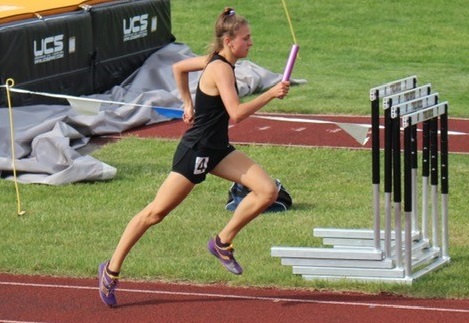
She was a member of the record-setting 3,200 relay team that qualified for MHSAA Finals in 2021 and 2022.
“We have a great team this year – a really big team, and I am super excited about that,” said Knudsen, who is in Leland’s record books for the 400, 800, 1,600 and 3,200 relays. “It’s a goal this year to make it back to the state meet for the 4x800 and also individually myself, as well as some others, be able to qualify to head to states again this year in individual events.”
And while Knudsen has experienced tremendous success competing in sports, she will value the relationships she has established along with the way.
Many of those relationships were developed during Finals competition and while serving on the MHSAA Student Advisory Council. She is one of eight seniors on the 16-member Council.
“You create relationships with others that go beyond just the court, or field of play or the competition,” Knudsen said. “You connect outside. It is so cool to have those relationships where you don’t look at each other as competitors.”
One of her fondest memories was made during the Lower Peninsula Cross Country Finals at MIS this past fall.
 “I was able to be in a box with other girls from our region who I had connected with this year, and we were able to just have a really cool moment in prayer before the race,” said Knudsen, who was joined by her freshman teammate Sophie Grinage in that moment. “It was just one of those things where it just allowed us all to take a deep breath. It allowed us to connect and feel like we were a part of something bigger that just ourselves.”
Knudsen, who also owns school records in 400, 800, 1,600 and 3,200 individual track events and cross country 5k, also has fond memories of being coached by both her mother and father. Ryan Knudsen, also the Comets’ athletic director, coached her all four seasons in basketball in addition to her mother’s coaching of track and cross country.
“Honestly, I would not want anybody else to coach me,” Ella said. “When you have a parent as a coach, you feel like you want to perform a better and you want to push yourself more. I have two amazing people who are going pick me up at the end of the day no matter what and love me and care for me even on my worst days.”
Ann Knudsen points out Ella’s ability to ground herself and those around her, especially those dealing with anxiety at the starting line.
“From a coaching perspective, she’s kind of a dream to coach,” Ann Knudsen said. “It’s kind of fun to be able to say that as a mom. Some moms and dads can coach their kids, and some know it is never going to work.”
It may be tough for the Knudsens to see Ella’s career come to an end in June. But her parents/coaches will be proud no matter how it concludes.
“I could not be more proud of who she is, and what she has accomplished during her high school career,” Ryan Knudsen said. “As a parent, coach, and athletic director I am most proud of how Ella has represented our school and our community by modeling for others what being a student-athlete is all about.”
In addition to her playing career and serving on the Student Advisory Council, Knudsen has been a leader in her school community participating on student council and as a member of the National Honor Society and National Art Honor Society. She also served in multiple other volunteer roles, including establishing an elementary wellness program with classmate Emerie Burda.
 Tom Spencer is a longtime MHSAA-registered basketball and soccer official, and former softball and baseball official, and he also has coached in the northern Lower Peninsula area. He previously has written for the Saginaw News, Bay County Sports Page and Midland Daily News. He can be reached at [email protected] with story ideas for Manistee, Wexford, Missaukee, Roscommon, Ogemaw, Iosco, Alcona, Oscoda, Crawford, Kalkaska, Grand Traverse, Benzie, Leelanau, Antrim, Otsego, Montmorency, Alpena, Presque Isle, Cheboygan, Charlevoix and Emmet counties.
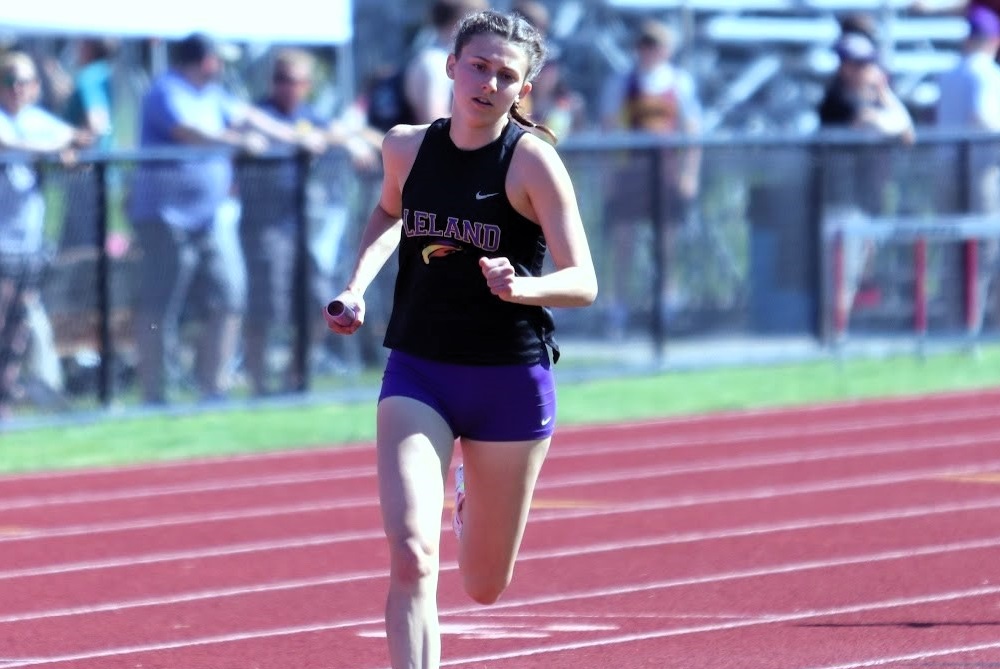
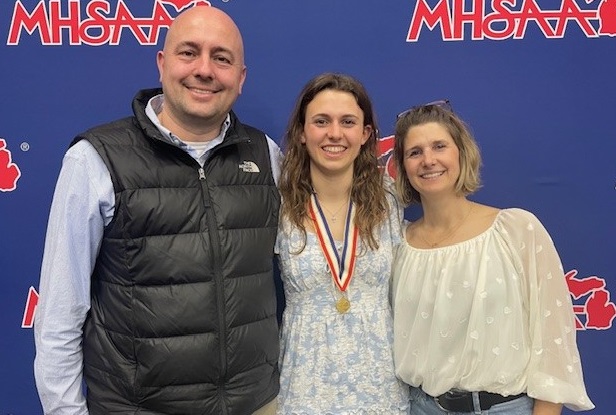
PHOTOS (Top) Leland’s Ella Knudsen rounds a curve carrying the baton during a relay race. (Middle) Knudsen, center, takes a photo with father Ryan and mother Ann after receiving her MHSAA/Farm Bureau Insurance Scholar-Athlete Award in March. (Below) Knudsen races toward the finish line. (Photos courtesy of the Leland athletic department.)