

McNeill Regaining Finals Form, Aiming to Best Last Season's Close Seconds
By
Keith Dunlap
Special for MHSAA.com
May 21, 2026
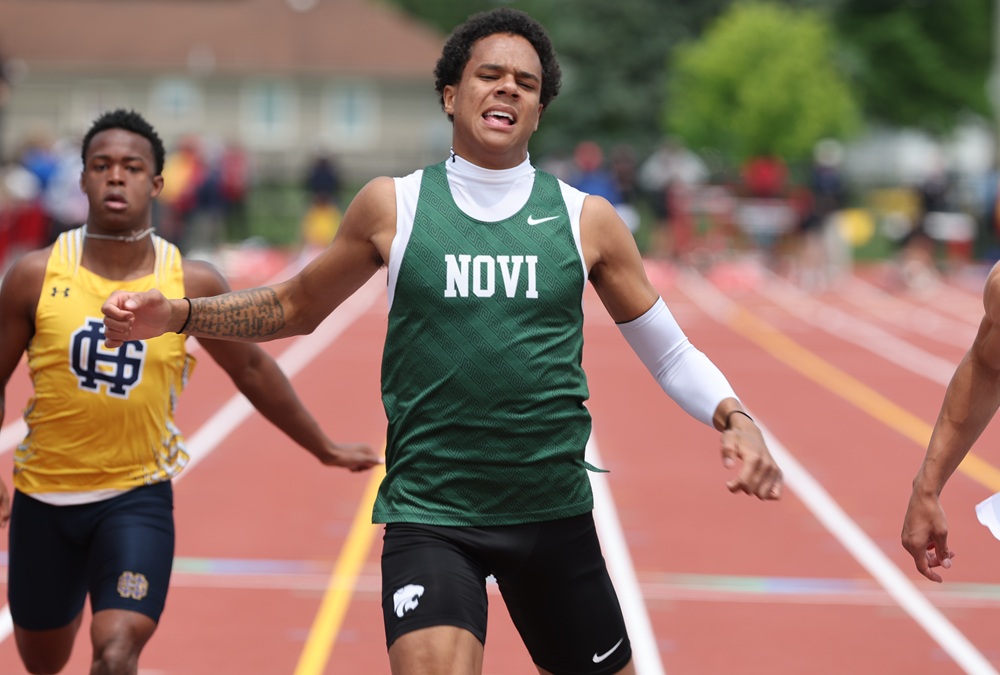
The number 0.01 might be as miniscule as there is in sports, but it certainly was way more gigantic for Novi High School track sprinter Chance McNeill at last year’s Lower Peninsula Division 1 Finals.
 First, McNeill nearly won the 100-meter dash but finished 0.01 -- one hundredth of a second -- back of Detroit Catholic Central’s Samson Gash (10.41).
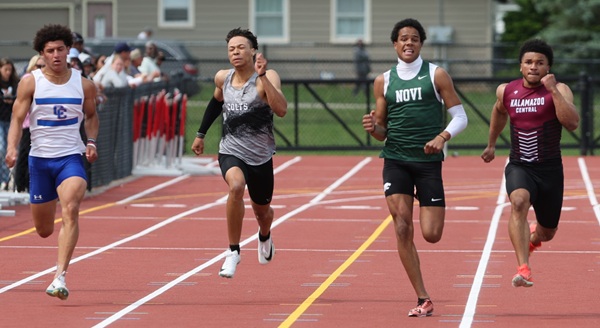
As hard as it was to shake off, McNeill quickly did so and was right in the thick of the 200-meter dash. Ultimately, he finished second in that race as well to Jeremy Dixon of Kalamazoo Central (21.11), once again by 0.01.
Losing out on one Finals title by such a thin margin is tough enough. But falling short by that time twice in a matter of a couple hours? It probably felt like getting kicked in the gut by someone wearing track shoes with all the spikes on the bottom.
“Definitely the first few months after (the Finals), it was crazy,” McNeill said. “I’ve kind of gotten over it by now. But it’s been my motivation for sure.”
Indeed, McNeill is using that experience as fuel for the remaining days of his senior year and as he prepares to compete once again in those events at next week’s Division 1 Finals at Rockford.
Headed to run track next at Alabama, McNeill is actually just ramping back into peak form this spring.
He has been battling a lower leg injury suffered after running a 6.75 in the 60-meter dash during indoor season, saying he sprinted again about three weeks ago for the first time this outdoor season.
McNeill certainly looked to be getting back into form during a competitive Regional last week hosted by Novi.
He won the 100-meter dash with a time of 10.73 and then claimed the 200 meters in a time 21.84. Yes, he and the Novi coaches know he’ll have to be faster to win at the Finals, but it was a great sign of progress given where he has come from – and there is definitely another gear in him.
“To say that he’s back to form probably wouldn’t be accurate,” Novi boys track & field head coach Danny Taylor said. “What I mean by that is given all the personal training that he’s done, given the way in which he’s worked back, I think he’s poised to do great things at the state meet.”
 Taylor said that he didn’t know anything about McNeill and his track prowess until he arrived at the high school for his freshman year but discovered quickly that McNeill was more than just an athlete running track to get in better shape for another sport. McNeill legitimately prioritized track & field.
“It seemed that when Chance came to us, he already had that love and that passion,” Taylor said. “We just wanted to stoke it further.”
McNeill said he initially ran track “for fun” when he started high school but got more serious about it when he got more involved with a local club and started running more meets outside of high school season.
Going into this spring, he said he was actually more intent on running the 400-meter dash, but his injury changed those plans.
“I’ve always wanted to do the 400,” he said. “Now, I just have to forget about that, just try it in college.”
McNeill will head to Rockford next week a year older and stronger, but then again so are other competitors. In particular, Gash, a Michigan State football signee, is also back in both events as he hopes to repeat in the 100 meters and improve on a third-place finish in the 200 from last year.
McNeill and Gash are the only top-five finishers in those races from last year who didn’t graduate.
McNeill hopes that he can be at least 0.01 seconds faster this time and end his high school career on top of the podium.
“I think whatever it takes, I’ve got it in me already,” McNeill said.
 Keith Dunlap has served in Detroit-area sports media for more than two decades, including as a sportswriter at the Oakland Press from 2001-16 primarily covering high school sports but also college and professional teams. His bylines also have appeared in USA Today, the Washington Post, the Detroit Free Press, the Houston Chronicle and the Boston Globe. He served as the administrator for the Oakland Activities Association’s website from 2017-2020. Contact him at [email protected] with story ideas for Oakland, Macomb and Wayne counties.
PHOTOS (Top) Novi’s Chance McNeill crosses the finish line during last season’s 100-meter championship race at the LPD1 Finals. (Middle) McNeill, second from right, races eventual champion Jeremy Dixon from Kalamazoo Central in last year’s 200, with DCC’s Samson Gash, far left, also among those in the field. (Click for more from RunMichigan.com/Carter Sherline.)
Machiniak Sets Pace as Berrien Springs Edges Corunna in Matchup of Recent Champs
By
Scott DeCamp
Special for MHSAA.com
June 1, 2024
HAMILTON – After a rainy afternoon Saturday, the precipitation let up long enough for Berrien Springs’ boys track & field team to put the finishing touches on another MHSAA Lower Peninsula Division 2 Finals championship.
After Shamrocks head coach Jon Rodriquez collected his program’s second team title in three years, rain fell again at Hamilton High School’s Hawkeye Stadium, only heavier this time.
The reign returned for Berrien Springs.
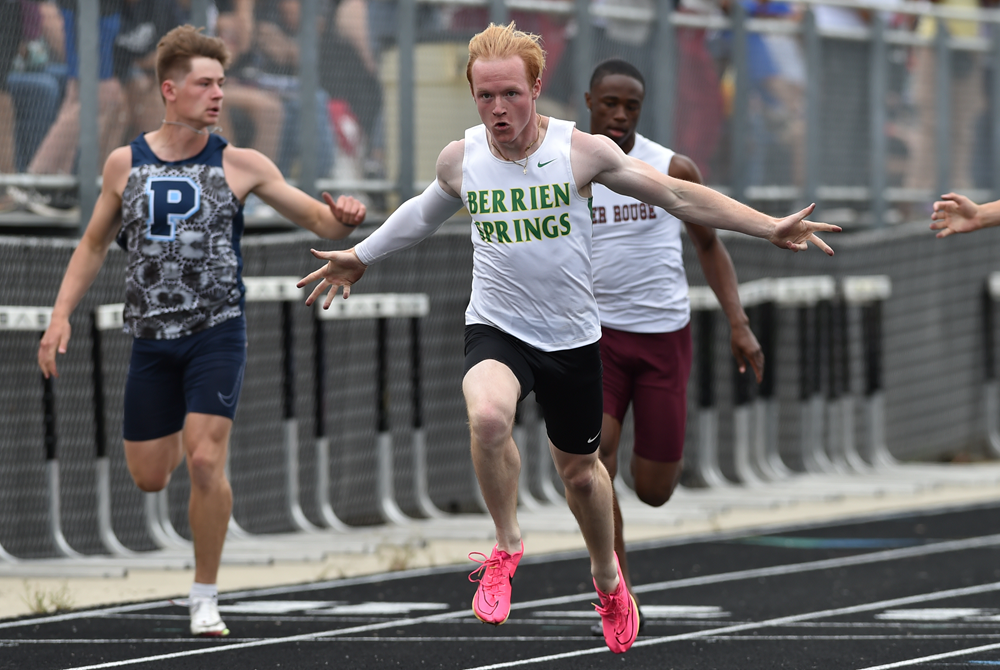
“It feels great, man. It’s hard to say what it feels like,” said Shamrocks senior standout Jake Machiniak, who sprinted to first-place finishes in the 100- and 200-meter dashes plus anchored winning 400 and 800 relays.
“This team, they worked all offseason. This is the hardest group of workers I’ve ever had. All these guys, all the guys that scored, they’ve all come year-round. The relays, we performed. I performed in the opens. It’s great. It’s a great feeling, man. Two times, man. Two times. Second time winning the state. It’s fantastic, man.”
Machiniak, a Grand Valley State University commit, repeated in the 100 with a time of 10.74 seconds. He won the 200 in 21.76 seconds in addition to running the closing leg on Berrien Springs’ first-place 400 relay (42.13) and victorious 800 relay (1:28.24).
Machiniak powered Berrien Springs to 40 points as a team, allowing the Shamrocks to edge runner-up Corunna (38 points), the 2023 champion. DeWitt was third (34) and Charlotte fourth (28), followed by Pontiac Notre Dame Prep and Parma Western tied at fifth (26).
Last year, Berrien Springs tied for seventh, which fueled the Shamrocks’ hunger all offseason.
“Jake was on that team two years ago. He ran the 4x100 for us,” Rodriguez said. “We’ve kind of had our eyes on this the last two years. Last year we fell short a little bit, and this year the kids were hungry. They worked their butts off all year long, running in the summertime, running in the hallways in the wintertime, just getting ready for this moment. It’s awesome. It’s awesome to see.”
In the 400 relay, Machiniak was joined by Zander White, Samuel Magesa, and Kameron Autry. In the 800, it was Magesa, White, and Noah Jarvis.
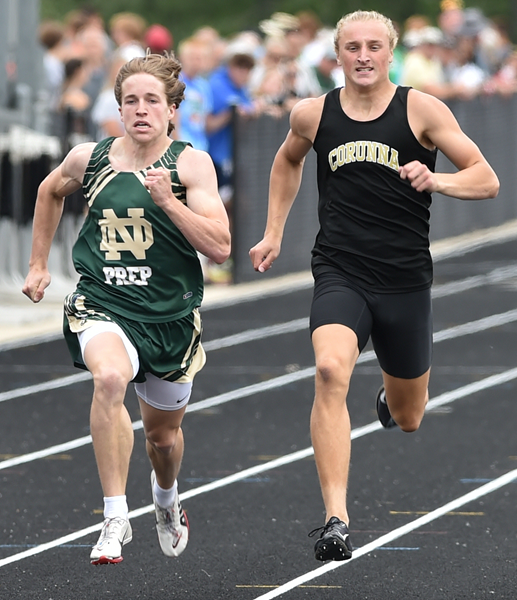
Notre Dame Prep senior Zachary Mylenek took first place in the 400, finishing nearly a second better than his personal-record time of 48.49 seconds, and he was runner-up in the 200 (with a personal season-record 21.92).
Bound for Purdue University, where he plans to study mechanical engineering and perhaps walk on to the Boilermakers’ track team, Mylenek also anchored Notre Dame Prep’s seventh-place 1,600 relay team.
 He adapted to his circumstances and performed at a high level.
“The rain sucked, but I’ve been fortunate enough because we’ve been running in the rain a lot this year and I ran last year in it,” he said. “I just ran my race and other guys, I was listening, they don’t like running in the rain. It’s a mindset thing, and I just dialed in.”
Grosse Ile junior Sam Vesperman repeated in pole vault with an effort of 14 feet, 7 inches.
Vesperman was not expected to win last year, and he pulled it off. Being ranked No. 1 in pole vault coming into Saturday’s meet created more pressure for him.
“It was definitely different because I was projected to win it (this season),” Vesperman said. “Last year I was the second guy, right – I wasn’t the big name. It was definitely different having everybody (saying), ‘Oh, that’s the guy to get, so … .’”
Vesperman’s official personal record in pole vault is 15-3. On Saturday, he was pushed by Whitehall senior Ca’Mar Ready, who turned in a PR effort of 14-4, but Vesperman was able to execute when needed.
“Yeah, it’s really nice to win, but we just keep chasing that next bar, that next height. That’s definitely the motivational factor,” Vesperman said.
Other event winners included: Clio’s Elliott Sirianni in the 800 (1:55.09 PR), Freeland’s T.J. Hansen in the 1,600 (4:11.31), Pinckney’s Paul Moore in the 3,200 (9:07.53), Grand Rapids Catholic Central’s Mill Coleman in the 110 hurdles (14.49), Charlotte’s Cutler Brandt in the 300 hurdles (38.48), Coopersville’s Gabe VanSickle in the shot put (61 feet, 2 inches), Wayland’s Adam Huff in discus (172-0), and Stevensville Lakeshore’s Declin Doroh in high jump (6-7) and Kaden Griffiths in long jump (22-9.25).
Hamilton won the 1,600 relay (3:23.40), while Marshall took first place in the 3,200 relay (7:48.49). Chelsea senior Jacob Nelson won the 100, 200 and 400 adaptive events.
Rodriguez started coaching at Berrien Springs in 2012, and he became head coach in 2014.
He said the Shamrocks improve in practice because there’s a lot of competition. Everybody is chasing Machiniak.
“I mean, we have Jake Machiniak, one of the top sprinters in the state, in practice and the kids want to beat him. They don’t just want to just, like, run with him; they want to try and beat him, so that competition in practice has been huge,” Rodriguez said.
“I’m just very proud of them. We showed up on the days that were important. On a big meet like this, it’s about being your best today – we had our best on the best day.”
Like Vesperman, Machiniak entered the 2024 season with a lot of pressure. He noted, however, that the only way to improve is to put oneself in pressure situations.
Machiniak said this team title feels better than the one won in 2022 because he played a bigger role. There’s strength in numbers, though, and Berrien Springs has been known to possess depth, especially in the sprints.
“That’s all Coach Rodriguez. Best coach in Michigan – it’s not even close,” Machiniak said. “He has us training in the offseason. He has us training winter, summer, spring, fall – all the time, man. We have a lot of guys at the state meet that come (put in the work) in the offseason, all year round. Year-round athletes that do speed training. As far as the sprints, that’s all Jonny Rodriguez – best coach in the nation.
“This group, I’ve grown up with this group, man. I’ve known these guys for a while. I’ve grown with them, I’ve trained with them, I’ve cried with them. You know, these are the guys that I’ve grown up with.”
PHOTOS (Top) Berrien Springs’ Jake Machiniak, second from left, crosses the finish line first in the 100 during the Lower Peninsula Division 2 Finals on Saturday. (Middle) Pontiac Notre Dame Prep’s Zachary Mylenek, left, and Corunna’s Wyatt Bower race to the finish in a 200 prelim. (Click for more from Dave McCauley/RunMichigan.com.)