

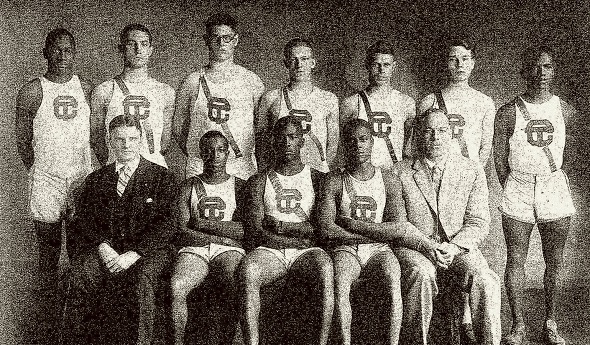
'Midnight Express' Got Start at Cass Tech
April 11, 2017
By Ron Pesch
Special for Second Half
If Eddie Tolan had his way, he might have been a football hero or, maybe, a star on the baseball diamond. But fate is a funny thing.
Instead, he became an Olympic track star and, one can strongly argue, the Michigan High School Athletic Association’s greatest athlete of all-time.
A heart attack took him early, at the age of 57 in late January, 1967. His kidneys had failed him two years prior, and were the primary reason for his early death. Easily recognizable by his horn-rimmed glasses, Tolan would inspire generations of athletes during his lifetime and in the years that followed. Recognition for his accomplishment, via induction to Halls of Fame, would mostly arrive after he departed.
“Eddie was just Eddie,” said his youngest sister, June, “very humble and gentle. He enjoyed meeting and knowing other people, and was loved by children.”
Born Thomas Edward Tolan, Jr., in Denver in 1908, Eddie and his family moved to Salt Lake City when he was young. His father, a hotel cook, then moved his wife and their four children to Detroit when Eddie was 15. Stories of opportunity for African-Americans had prompted the move.
Within the family, Eddie’s older brother, Hart, his senior by a year, was considered the better athlete.
“Only Hart neglected to train,” said sister Martha. “Eddie was a worker.” His mother, Alice, simply described Eddie as more determined.
Following in the footsteps of his brother, Eddie joined the football team at Detroit Cass Technical High School in the fall of 1924. A sub on the squad, Eddie emerged as the team’s quarterback in the fall of 1925 under the school’s new football coach, William Van Orden. Although Eddie stood only 5-foot-4, he threw a beautiful pass. He was also lightning fast, light, and evasive. It was here, on the football field, that it seemed he would find stardom.
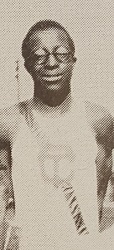 While the team saw limited success in the early going, Eddie quickly emerged as the star. He scored the lone touchdown in the Mechanics’ 12-6 season-opening loss to Detroit Southwestern. Held scoreless in the second game of the season, Cass Tech tied Southeastern, 6-6, in the season’s third game. The next week, the team exploded for 47 points, shutting out the Detroit Western Cowboys in “one of the biggest upsets of the current season,” according to the Detroit Free Press. Tolan accounted for four of Cass Tech’s seven touchdowns. His brother, Hart, also scored that day. Despite what the future held, it was the moment he would always rank as his favorite among his athletic achievements. Football was Eddie’s favorite sport, followed by baseball.
With the goal of avoiding injury and damage to Detroit’s prep gridirons, a heavy five-hour downpour on Saturday, Oct. 24 meant Cass Tech’s game with Hamtramck was rescheduled for Monday the 26th at Northwestern High School.
Despite the delay, the teams squared off on a field that was in worse condition than it had been Saturday. Early in the first quarter, the heavier Hamtramck squad dashed Cass Tech’s hopes for a shot at contending for the Detroit Public School League crown. Thrown for a four-yard loss, Eddie Tolan “was left lying in the mud, the victim of several torn ligaments.”
Cass Tech lost the game, 12-0, and Eddie Tolan was lost for the season.
“Rated as one of the best forward passers in the city, Tolan combined all the qualities of a first class quarterback,” noted the Free Press a few days later, “and his loss is a death blow to the chances of Cass finishing near the top.”
In spite of the injury, Eddie had been impressive enough to be named quarterback on the paper’s All City third-team squad at season’s end.
He would never return to the gridiron.
Birth of a legend
Back in the 1920s, winter meant indoor track for preps. It was the age of dynasties, where the sport at a team level was ruled by the public schools of Detroit, and one school in particular – Detroit Northwestern. The Colts had won four of the last five indoor city meets as the public schools entered the 1925 track season, and they would again reign that spring.
As it remains today, skill was needed across both track and field events to dominate as a team. Still, there was room for individuals to shine. Tolan arrived on the track scene during this time, and as a sophomore, showed early promise.
It was the golden age of athletics, as well as newsprint. Today it’s hard to imagine a time when track headlines could snake their way to the top of the sports page of a big city newspaper, highlighting the accomplishments of the local preps. Yet in the 1920s and 1930s, that was the case. Tolan earned two spots in the annual city meet in 1925, appearing in the 30 and 220-yard dashes. While he failed to place among the leaders in the furlong, Eddie did finish fourth in the 30-yard dash, behind three runners from Northwestern, including Charles “Snitz” Ross, the winner of the event and the city’s emerging sprint star. Unfortunately, Tolan’s finish was disqualified, as he had run out of his lane.
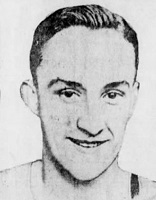 On March 20 and 21, the first indoor interscholastic track and field meet was hosted at the University of Michigan. The two-day event featured 20 in-state schools, and a pair from outstate – Waite High of Toledo and Austin High of Chicago. A total of 185 athletes showcased the university’s newly opened Yost Fieldhouse while competing in 12 events. The competition was ruled by Detroit Northwestern, with first-place finishes in eight of the events and a total of 51½ points. Cass Tech finished a distant second with 14 points. Tolan earned a second place in the 50-yard dash, behind Ross of Northwestern, the winner of the race.
Eddie’s skills continued to bloom during the outdoor season, which began in April. There, the sophomore excelled in the 100 and 220 events. A breakout performance at a late-season triangular meet with Northwestern and Southwestern, where Eddie defeated Ross in the 100-yard, caught the attention of many. His time of 10.2 seconds tied the city record, established by George “Buck” Hester of Detroit Northern in 1922. Born in Windsor, Ontario, Hester had competed for Canada in the 1924 Olympics, hosted in Paris. He would run collegiately at the University of Michigan.
At the same meet, Tolan topped the city mark in the 220-yard dash, covering the distance in 23.1 seconds.
Less than a week later, Ross toppled the century mark, with a 10.1 in the preliminaries to the city’s outdoor meet. A rivalry, bubbling at the surface, now exploded.
Anticipation for the showdown between Ross and Tolan at the city finals in the 100 was met with disappointment among fans, as Tolan won the race with a spurt in the final three steps to the wire, posting a 10.4 time, while Ross finished fourth. Tolan also won the 220 while Ross did not place. John Lewis of Northeastern finished second in both events.
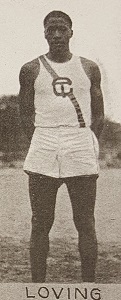 Junior William Loving of Cass Tech emerged as the city’s outstanding performer, “taking first place in the high jump, and both hurdles, aside from running in the relay and finishing third in the discus,” that Saturday, May 16 at Codd Field. The performances still were not enough to unseat Northwestern, the winner of the meet.
Northwestern also won the 25th Annual Outdoor meet at the University of Michigan. Loving finished as the high point winner at the event, while Tolan tied with Lewis of Northeastern for second in the century dash, behind Jimmy Tait of Northwestern. Ross finished fourth.
Beginning with their victory in 1920, Northwestern also ruled the annual state track championship in East Lansing, clinching the Class A title in four of the previous five years under the guidance of Bert Maris. (The 1922 Class A title was won by Detroit Northern).
At the first championship sponsored by the newly formed Michigan High School Athletic Association, the result was the same. This time, Maris was assisted by Warren Hoyt, and it took a prep “world’s record in the 880 relay” to top Cass Tech. Northwestern ended the day with only three first-place finishes. Team depth had allowed Colts to win the meet with 38 points against 34 2/3 by the Mechanics.
Cass Tech’s Loving ended the day with the top point total for an individual, with 12½, while his teammate Tolan added 10 points, by winning both the 100 (10.1) and 220-yard (22.4) dashes. While expected to do well, the sophomore was still an underdog in each event. Lewis again finished second in both events, while Tait landed third place and Ross finished fourth in the 100.
The injury, and a reminder
Following the football injury, Tolan was still unable to perform in January when the 1926 indoor track season opened. However, the high school junior was back in February in time for the Mechanics’ dual meet with Northwestern. Sporting a bandage on his left knee, Tolan topped Ross in the 30-yard dash. The bandage, covering the knee, would remain with him for the rest of his running career, symbolic of that return victory.
Hopes ran high that Cass Tech might challenge the Colts for the city’s indoor title in 1926, but it didn’t turn out that way. Northwestern again dominated the city’s seventh annual meet, winning five of the day’s first nine events. Ross and Tolan tied at the tape in the 30-yard dash, but the run was tainted. Ross’ “eagerness to outsprint Tolan, his most bitter rival,” resulted in two false starts, and Ross was set back two feet to begin the race. Without the penalty, there was little doubt that Ross would have won the event cleanly.
At the Second Annual Indoor Interscholastic, held at Yost Fieldhouse on March 20, George Simpson of East Columbus, Ohio, grabbed the 50-yard dash crown. Ross earned second in the race, while Tolan finished fourth. Detroit Northwestern again won the invitational, but this time in less-dominating fashion, as the field of participating schools was greatly expanded.
Multiple Detroit athletes were selected to compete at the prestigious Northwestern University Indoor prep invitational, scheduled for the following week in Evanston, Ill. Loving finished as high point scorer of the meet with 11, with a win in the 60-yard high hurdles and second-place finishes in the low hurdles and high jump. Combined with Tolan’s second-place finish in the 50-yard dash, the pair totaled 14 points, enough to win the event. Cass Tech’s return to Detroit as champion was loudly trumpeted in the press.
Based on the performance at the national level, the Mechanics were identified as strong candidates to dethrone the Colts during the upcoming outdoor season. Despite strong results at duals and triangular meets, Cass Tech still fell to Northwestern in total points at the annual city carnival.
Finally, a team victory
At the 26th annual University of Michigan outdoor interscholastic meet, Cass Tech scored its biggest triumph, surprising “the best of the schoolboy athletes from Detroit, Toledo and Chicago, without mentioning stars from the states of Michigan, Ohio, Illinois and West Virginia at large.” Amazingly, Kalamazoo Central also slipped past Detroit Northwestern in the standings. The Colts had to settle for a third-place finish at Ann Arbor.
While rain and cold temperatures meant record performances were few, Tolan won the 100, over Jimmy Patterson of Chicago Tilden Tech (winner of the 50-yard indoor race at Northwestern University earlier in the spring), Lewis of Northeastern and Ross of Northwestern, with a time of 10.3. His 22.1 seconds in the furlong topped Patterson, Edgar Fenker of Kalamazoo Central and Lewis, respectively.
Of course the Colts were expected to find redemption at the 20th annual state track and field meet, scheduled for May 28 and 29 at Michigan State College. As expected, both Northwestern and Cass Tech, along with Kalamazoo Central did well at the preliminaries. Yet, in a stunning turn of events, the finals mimicked that of a week before with Cass Tech, guided by Coach Van Orden, winning the Class A state title, followed by Kalamazoo Central, then Northwestern. Loving and Tolan were the stars of the event. Tolan “romped” in the 100 and 220 dashes, while Loving, now a senior destined for Western State Teachers College, repeated as winner of both the high and low hurdles.
Graduation gutted Cass Tech’s track roster, and by the time of the indoor city meet in 1927, only Tolan remained to take on Northwestern’s juggernaut. Jack Dant of Northwestern surprised everyone with a new city record in the furlong, with a 24.7 in the preliminary of the city meet. The mark would stand as the city indoor record for 24 years until topped in 1942. In the finals, Tolan grabbed top honors in the 30-yard dash and finished second in the 220. Dant placed fourth, with each runner trailing Edward Swan, captain of Northwestern. The Colts again reigned as city champions. Two weeks later on the 19th, Tolan won the 50-yard dash at the Third Annual Indoor event at the University of Michigan. At Northwestern University’s national indoor championships on March 26, he won the 50, running the distance in 5.3 seconds.
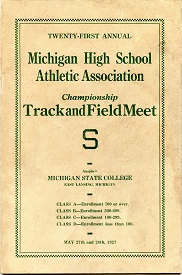 Tolan’s star shined brightest during the outdoor season. On May 14th at the University of Michigan’s annual outdoor interscholastic, Tolan won the 100 and 220 dashes. On the 22nd, he captured the same two events at the city’s outdoor meet.
One week later, for the first time in history, all four classes of Michigan high schools met for the state championships in East Lansing. Favored to win, Tolan closed out his career by matching Hester’s record time of 9.8 seconds in the 100 – a mark thought unattainable. With little rest, he then fought off Kalamazoo’s Fenker in the 220, winning by a stride with a time of 21.9. The victories meant Tolan was undefeated in each event over his three years running at the MHSAA state championships.
Northwestern returned as team champion, this time coached by Malcolm Weaver. Outside of back-to-back team victories in 1916 and 1917 by Grand Rapids Central, the Class A crown had been possessed by Detroit schools in 11 of the past 14 years. (No meet was run in 1918 due to World War I.)
Tolan wrapped up his high school career at the University of Chicago. One of 14 Detroit area athletes invited to the Interscholastic Track Championships, Tolan equaled the prep world’s record time of 9.8 seconds in the 100-yard dash, then grabbed the furlong, topping runners from Minnesota, Iowa, Illinois and Indiana.
Accurate or not, news spread from coast-to-coast via the media wire of Tolan’s track skill, noting he had won 17 out of 18 city and state outdoor championships in three years of prep competition.
As a junior, Tolan had run Amateur Athletic Union track, sponsored by the Detroit Department of Recreation in the summer, and he returned to AAU competition following graduation, running against active and former college track luminaries. At the state track championships at Belle Isle on July 4, Tolan starred. Running for the Detroit Athletic Association team, he won the 100 and 220, topping Victor Leschinsky, former University of Michigan sprinter.
Next stop: Ann Arbor
While enrolled at U-M, in January of 1928, Tolan was named a 1927 High School All-American by the AAU. At Michigan, he earned the nickname “Midnight Express” and began to chew gum while racing.
As a sophomore, Tolan tied the world’s record in the 100-yard dash, laying down a 9.6-second time at the Western Conference preliminaries at Evanston, Ill, against George Simpson, a former prep opponent from Columbus, Ohio, now running for Ohio State. One day later, on May 25, 1929, at Duche Stadium at Northwestern University, Tolan bested the mark.
With a slight breeze at the runners’ backs, Tolan came from behind, and “with his big horn-rimmed spectacles firmly taped to his head, electrified the crowd by winning the 100-yard dash in :09.5 seconds. He beat Simpson to the tape in an eyelash finish that was inconceivably close.”
These were the days when starting blocks were still not accepted for official races. It took a year before the International Amateur Athletic Association pronounced the mark as the new world’s record.
By college graduation, Eddie had run the 100 a total of 143 times for the Wolverines, losing the race on only nine occasions.
An Olympic hero
While the participants and witnesses have been silenced by father time, their voices gone thanks to the ailments that arrive as we age, Tolan’s exploits at the 1932 Olympics have been well recorded.
After graduation, Tolan and the nation’s top sprinters traveled North America, racing in preparation for the Olympic trials. When they finally arrived, he was beaten by Ralph Metcalfe of Marquette University in both the 100 and 200-meter races. Still, the top three times qualified, and both men, along with old rival George Simpson, made the Olympic roster.
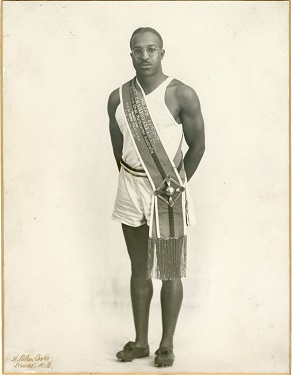 It was a time where the press was very cognizant of skin color and quick to note that this was the first time that the top two individual sprinters representing the United States were African-American. At the games, staged in Los Angeles, Tolan became the first African-American to receive the title “world’s fastest human” when he edged Metcalfe in the first-ever photo finish in the 100-meter race, and then earned a second gold with victory in the 200-meter event. His time in the 100 would remain an Olympic record until 1960.
Tolan returned to Detroit to a hero’s welcome when his train arrived at Michigan Central Station in late August. The acclaim continued at city hall, then at the Brewster Recreation Center, where he celebrated with friends and family. September 6, 1932, was declared “Eddie Tolan Day” by Michigan governor Wilber Brucker.
This country was in the depths of the Great Depression, and opportunity for all Americans was limited. But while his had become plentiful, Tolan had no plans to “cash in” on his fame, and he expected to remain an amateur.
For a short time following the games, he joined Bill “Bojangles” Robinson on the vaudeville circuit. There, he described his Olympic success to attentive crowds. It was ruled that the venture violated his amateur status. In 1933, with both his father and brother out of work, Tolan found employment as a filing clerk in the register of deeds office of Wayne County. In 1934, he was offered a chance to race professionally in Australia. Following a six month barnstorming tour, he returned home, resuming his position with Wayne County.
In 1937, he was appointed to Michigan’s National Youth Administration, where he assisted other African-Americans with vocational guidance and placement. He continued to support his parents financially. In his final years he worked as a physical education teacher in Detroit.
A bachelor all his life, in 1954 Tolan lost his mother to old age. Later in the year, he was named to a roster of 22 all-time greatest U.S. Olympians. In 1958, he was inducted into the Michigan Sports Hall of Fame along with five others. Only 12 names had preceded the group, and Tolan was just the second African-American honored by the Hall.
“Oh, man, it was a terrible thing,” said Jessie Owens, four-time U.S. gold medalist at the 1936 Olympics, discussing the loss with Jet magazine at the time of Tolan’s death in January 1967. “When I was in high school, Eddie and Ralph (Metcalfe) were my idols. Eddie and I later became close friends. I used to live in Detroit, and every time I’d go back Eddie was one of the first ones I’d look up.”
Posthumously, in May 1967, a 17-acre playground on Detroit’s east side, near the Children’s Hospital of Michigan, was dedicated with his name. An artificial kidney machine, purchased for Wayne County General Hospital with funds raised by his sisters, was donated in his honor in 1969.
Eddie was inducted into the University of Michigan’s Athletic Hall of Honor along with 10 others at the university’s third induction in 1980 and was added to the National Track and Field Hall of Fame along with its ninth class in 1982. Today, medals and a pair of his track shoes, donated by his sister, June Tolan Brown, are on display at the Charles H. Wright Museum of African American History in Detroit.
 Ron Pesch has taken an active role in researching the history of MHSAA events since 1985 and began writing for MHSAA Finals programs in 1986, adding additional features and "flashbacks" in 1992. He inherited the title of MHSAA historian from the late Dick Kishpaugh following the 1993-94 school year, and resides in Muskegon. Contact him at [email protected] with ideas for historical articles.
PHOTOS: (Top) The 1926 Detroit Cass Tech track & field team was led by a handful of standouts including the emerging Eddie Tolan. (Middle top) Tolan, in 1925. (Middle) Detroit Northwestern standout Charles Ross. (Middle) Bill Loving, also a Cass Tech star. (Middle below) The program cover from the 1927 MHSAA Track & Field Finals. (Below) Tolan after the World Professional Sprint Championships in Melbourne, Australia, in 1935. (Photos collected by Ron Pesch with assistance from Detroit Cass Tech's Regenia Kirk.)
Lake Linden-Hubbell Boys End Title Wait with 1st Finals Championship
By
John Vrancic
Special for MHSAA.com
May 31, 2026
KINGSFORD — They say there’s a first time for everything.
The Lake Linden-Hubbell boys proved that beyond any shadow of a doubt here Saturday, earning their first Upper Peninsula Division 3 track & field championship with 64 points.
Rapid River was runner-up with 55 and St. Ignace placed third at 46.
“We’ve been waiting for this for four months,” LL-H coach Brett Gervais said. “Back in March we started asking a lot of the boys. I couldn’t be happier for the kids. I’m super happy for the boys. Having coach (Gary Guisfredi) here really helps. He has coached the girls team for many years. I’ve watched the way they did things and learned a lot from that.”
The Lakes won just two individual events, but had enough depth to carry them through.
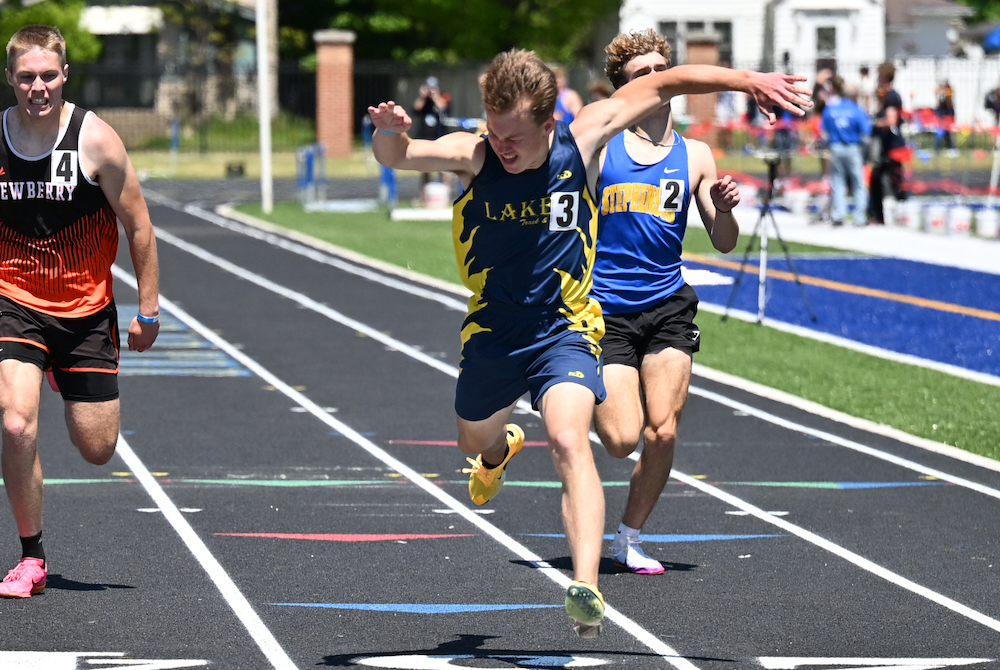
Junior Lukas Axford won the 400-meter dash in a personal-best 53.48 seconds and sophomore Tobin Baril took pole vault at 11 feet on this sunny and warm day at Flivver Field.
 “I was almost in disbelief with all the work the boys had done,” Gervais said. “The weather sometimes made it tough to prepare. There’s roughly 30 teams in our division. They’re working just as hard as we are. There’s a high level of competition in our region, which helps us so much. Dollar Bay and Baraga pushed us all year. It’s such a great feeling to be part of this.”
Baraga senior Matt Rinkinen won the 100-meter dash in 11.66 seconds, just 0.2 of a second ahead of LL-H junior Josh Daavettila.
Superior Central junior Will Spranger took the 200 (23.31), followed by Rinkinen (23.71) and Dollar Bay junior Baron Colbert (23.96).
“I thought my start was a little weak, but I was able to accelerate,” Spranger said. “I need to work on my blocks in the offseason. Our 4x2 (800 relay) went well. Our handoffs were good.”
Cedarville/DeTour junior Ethan Snyder set the meet record in the 1,600 (4:25.8), shaving 0.11 of a second off the previous best by Dollar Bay’s Nik Thomas from four years ago, then added firsts in the 800 (2:02.18) and 3,200 (10:24.21).
St. Ignace senior Kollin Bird captured both throws with a personal-best heave of 45-6 in shot and a toss of 138-11 in disc. L’Anse junior Taven Lewis placed second in shot (41-9) and disc (137-9).
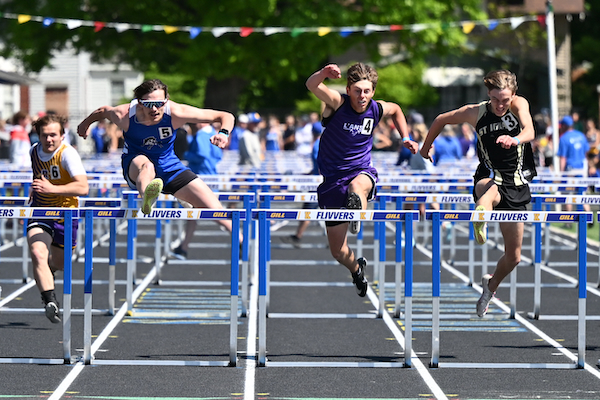
In the hurdles, it was Brimley junior Brady Leblanc winning the 110 event (16.43) and 300 (41.66), both with personal-best times. Connor Kemppainen, also a junior from L’Anse, was runner-up in both races at 16.54 and a person-best 42.68, respectively.
Also winning individual events were Rock Mid Peninsula sophomore Lewis Holmes with a personal-best leap of 6-3 in high jump and Bessemer junior Henry Jenkins taking long jump (19-2), also with a personal best.
PHOTOS (Top) Lake Linden-Hubbell's Lukas Axford, center, crosses the finish line first in the 400 meters Saturday. (Middle) Brimley's Brady Leblanc, second from left, and L'Anse's Connor Kemppainen, just to his right, jump over the last hurdle in the 100 hurdles. (Click for more from Cara Kamps/RunMichigan.com.)