

Norway, Mid Peninsula Welcome Back 1st Home Track Meets in Nearly Decade
By
John Vrancic
Special for MHSAA.com
May 15, 2026
NORWAY — It had been quite a while since Norway and Rock Mid Peninsula had been able to host a track & field meet.
 That changed last week as Mid Pen hosted a triangular meet Thursday, and Norway held its invitational Friday. Those marked Norway’s first varsity home meet in nine years and the first complete meet at Mid Pen since 2019.
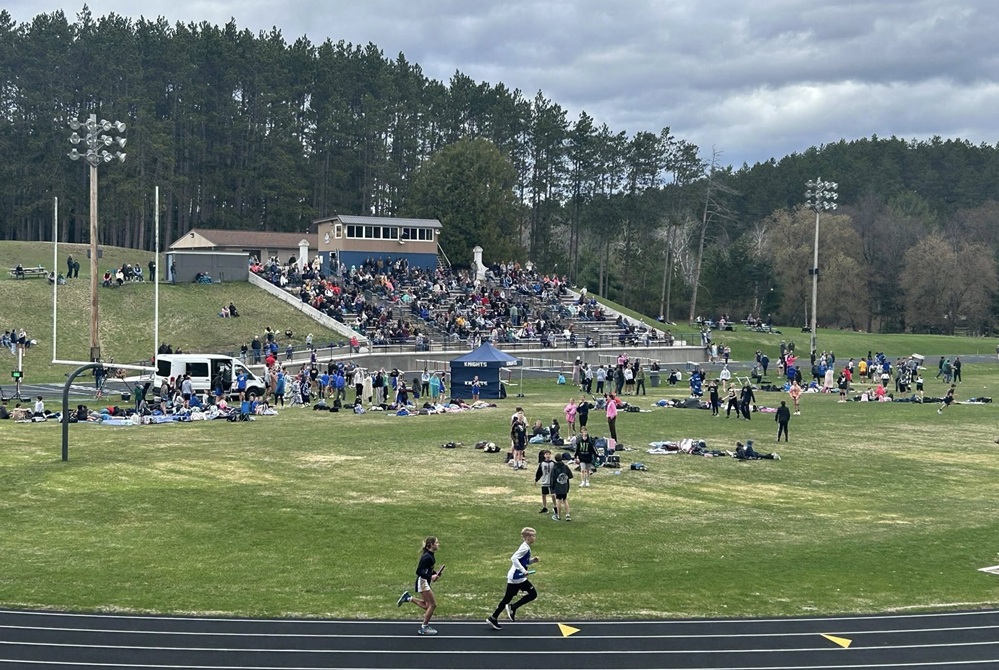
Norway debuted its rebuilt track during its junior high invitational April 28.
“Everything is all set, thanks to our referendum,” Norway boys coach Al Trudeau said. “It’s great to be able to host a meet. Our students, physical education instructors and community members will be able to use it. We’ll be set for a long time. We have lots of help, which is awesome.
“Our guys did all right. Our sprint relays went real well.”
Rapid River’s boys, who ran at Norway for the first time, won with 142 points. The Rockets were followed by Bark River-Harris with 130, Florence-Niagara, Wis., at 70 and Norway at 69.
Rapid River’s lone first came on freshman Coen Smith’s personal-best jump of 5 feet, 10 inches in high jump, and junior Lane Olson was runner-up on a tie-breaker to BR-H freshman Samuel Varoni in pole vault (10-6) on a sunny and mild day.
“I was happy with all the guys,” Rockets’ coach Steve Ostrenga said. “Our depth came through. Taking three places in the 3,200 decided the issue. We had some adversity tonight. We had to scramble to put a 1,600 relay team together. Our guys said it was a good track, and it was a very quick meet.”
BR-H junior Gionni McDonough was a four-event winner, taking the 100-meter dash in 12.2 seconds, 110 hurdles at 16.9 and 300s at 45.63, and long jump at 19 feet, 11½ inches.
“I’m very happy with that,” he said. “The track is nice and bouncy, and the long jump area is really nice.
“Doing well as a team is really a nice boost for us.”
BR-H coach William Soper was also impressed with the newly-resurfaced Norway facility, and delighted by his team’s progress.
 “It’s an awesome track,” he said. “I’d be happy to come back here.
“I think we’re developing more of a team mentality. The kids are willing to do anything to help the team. We got Ben Olson back from surgery, and Gionni just started practicing long jump Thursday. We’re trying to find people for events that will match our strengths.”
Felch North Dickinson captured the girls title at Norway with 106 points, followed by BR-H with 92 and Stephenson at 70.
Junior Aunika Lindholm provided the Nordics with victories in the 1,600 (5:58.04) and 3,200 (13:20.55), both personal bests.
“A lot of things went our way today,” Nordics coach Mike Roell said. “A lot of kids stepped up. They really competed. Aunika did a nice job winning the 1,600 and 3,200 and helping our longer relays take first. Aspen (Anderson) winning pole vault and going 1-2 in the 800 were also huge.”
Rapid River sophomore Victoria Coppock recorded her first varsity victory in the 100 hurdles (18.75).
“This is very exciting,” she said. “I haven’t been able to practice because of softball. The track was quite nice, and this is probably the best weather we’ve had.”
At St. Nicholas, the Mid Peninsula Wolverines got part of a meet in last year, but it was cut short by poor weather conditions.
“It went great today,” Mid Pen coach Carl Brunngraeber said. “We appreciate Superior Central and Big Bay de Noc coming over here. We tried to do a meet here last year, then it started raining and weren’t able to get it all in. What we’re trying to do is bring some of this back. I like the idea of having a smaller meet and giving the kids a chance to do something different. We’re hoping to make this a small-school invitational.”
Mid Pen sophomore Lewis Holmes took the 100 (11.98) and 200 (25.08), and eighth-grader Siwal Holmes won the 300 hurdles (48.49) on a revamped asphalt surface.
“I think I could have run a faster time, although it was exciting,” Siwal Holmes said. “It’s still a hard surface, but I like it. I know I have to raise my foot a little more and work on technique.”
Mid Pen senior Hope Brunngraeber captured girls shot put (30-9) and discus (107-7) in a meet for which team scores weren’t kept.
“It’s really nice to have a meet at our school,” she said. “It feels good to finally throw here in my senior year. It was also good to have people come here and watch us throw.”
Superior Central’s Kendra Peterson took the girls 400 (1:11) and 800 (3:07.81), slightly more than a second ahead of senior Addie Frusti in the longer race.
“I ran behind Kendra because she’s my pacesetter,” she said. “It felt good to have a meet over here. It was fun. The weather is good, ideal for distance running.”
 John Vrancic has covered high school sports in the Upper Peninsula since joining the Escanaba Daily Press staff in 1985. He is known most prominently across the peninsula for his extensive coverage of cross country and track & field that frequently appears in newspapers from the Wisconsin border to Lake Huron. He received the James Trethewey Award for Distinguished Service in 2015 from the Upper Peninsula Sportswriters and Sportscasters Association.
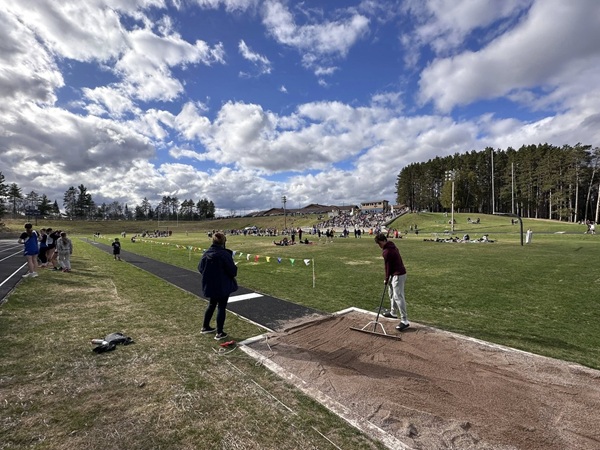
PHOTOS (Top) Norway welcomes back a home track meet with its junior high invitational April 28. (Middle) The long jump pit is prepared during the school’s first meet in nearly a decade. (Photos courtesy of Norway-Vulcan Area Schools.)
Coldwater Sends 7 Shot Putters to Finals
May 26, 2017
By Geoff Kimmerly
Second Half editor
Individually, Coldwater’s shot putters might not be the most sizable guys muscling up to the pit at this weekend’s MHSAA Track & Field Finals.
But as a group, the Cardinals might be the largest ever to advance to championship weekend – and perhaps the most athletic as well.
Coldwater has qualified an incredible seven shot putters for the Lower Peninsula Division 2 Finals at Zeeland.
They’ve been produced by throws coach Mike McConnell, one of the state’s more reputable in those events. But the magnificent seven also are a product of all-around athleticism – six are three-sport athletes, and the seventh plays two sports.
It’s difficult to track if seven qualifying shot putters from the same school was a first-time accomplishment at an MHSAA Regional. But it’s more than fair to call it rare.
“We have three seniors that are the cornerstone of our throwing team, but through the course of this year we have had three juniors and a freshman that have stepped up with them to make us, what I like to believe, one of the best throwing teams in the state,” Coldwater head boys track & field coach Jeff Schorfhaar said. “A lot of this has to do with the athleticism of our throwers … (and) I believe, and of course I am biased, that (McConnell) is one of the best throwing coaches in the state of Michigan.
“This will be something that we will remember for a long time, no matter what happens Saturday at Zeeland.”
McConnell’s work speaks for itself over two decades of Finals placers. He’s had at least one thrower score at an MHSAA Finals in 22 of the last 24 seasons at Coldwater and formerly Camden-Frontier. Highlighting some of the most recent successes, Coldwater’s Logan Targgart won shot put in Division 2 in 2015 and discus in 2014.
Senior Connor Covert, who finished fifth in both shot put and discus at the 2016 LP Division 2 Finals, led a group of Cardinals that took the top seven places in shot put at the Regional two weeks ago in Mason. Four throwers tossed personal records – third-place freshman Dylan Targgart, fifth-place junior Nathan Spray, sixth-place junior Cole Targgart and seventh-place senior Colin Klein.
Covert and senior runner-up Sam DeMeester advanced to the Finals by finishing among the top two in the event. The other five Coldwater throwers cleared the automatic qualifying standard of 48 feet, 5 inches. Fourth-place junior Zach Gipple joined the personal record-setters with his third-farthest toss of this season.
DeMeester and Gipple also competed at the Finals in shot put last season, DeMeester just missing the medal stand with a ninth place finish. Covert’s 54-7 at this year’s Regional was half an inch farther than last year’s Finals throw. He, Dylan Targgart and Cole Targgart also made the Finals in discus, Covert and Dylan Targgart finishing first and second, respectively, at the Regional with Cole Targgart coming in fourth but clearing the automatic qualifying standard of 142-0.
The Coldwater boys track & field team is enjoying another memorable season as a whole and will be seeking a fourth straight top-10 Finals finish and winning its league and that Regional earlier this month.
Last season, they Cardinals finished eighth as a team at the LP Division 2 Finals, but only 3.5 points out of fifth. Theys were ranked fifth in the final Michigan Interscholastic Track Coaches Association LP Division 2 poll two weeks ago before finishing ahead of No. 3 Battle Creek Harper Creek at both the Regional and league meets.
Block, Pilgrims Power to 1st League Title
We told the story at the start of this month of Lansing Christian junior Dawson Block, a multi-sport athlete contributing to three teams this spring – golf, baseball and track & field.
He’s now also a champion.
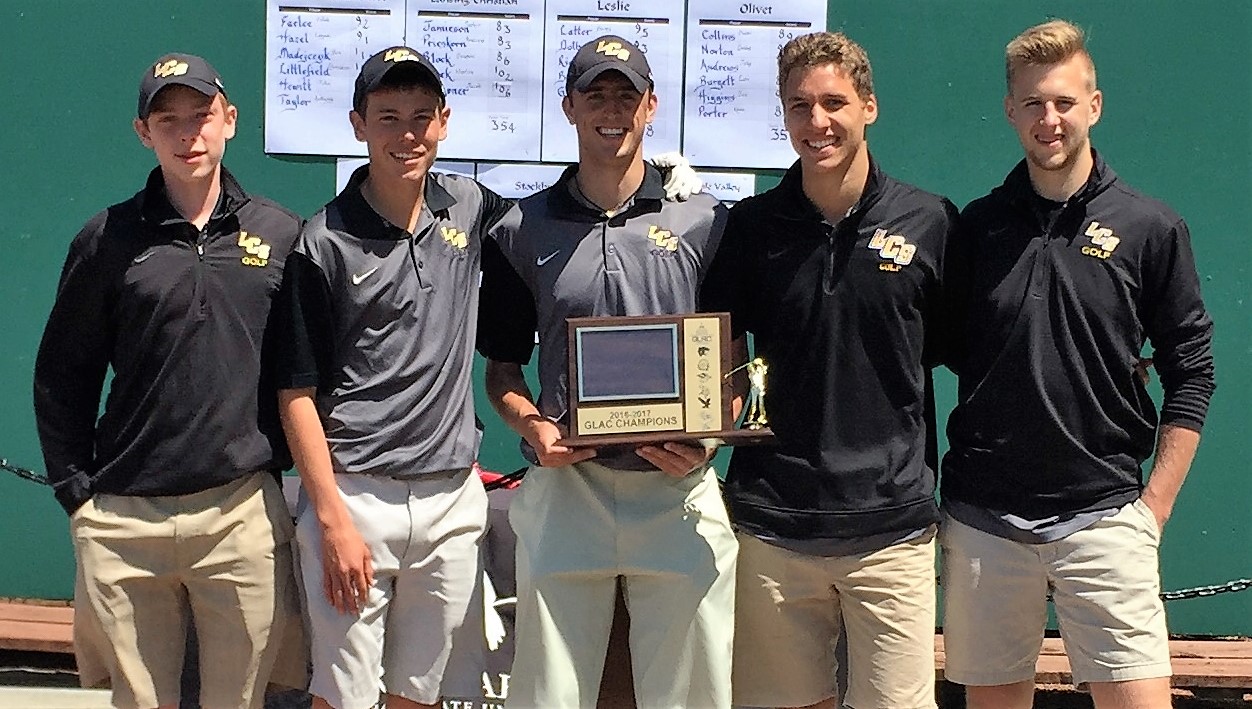 Block helped the Pilgrims to their first-ever league title in boys golf, as Lansing Christian finished one point ahead of Olivet in the Greater Lansing Activities Conference standings based on league jamborees and the end-of-season tournament.
Lansing Christian topped the standings heading into that final tournament, at Michigan State’s Forest Akers East, needing to finish no lower than second to clinch the title. Furthermore, they had to play without two seniors who were on a class trip to Washington, D.C.
With only five players available, the Pilgrims did finish second, just three strokes behind the Eagles. Parker Jamieson and Andrew Preiskorn were co-medalists with 83s, and Block shot a fourth-place 86 – in doing so, he earned the seventh and final spot on the all-league first team.
Block and his golf team continue their season Thursday with a Division 4 Regional at Hastings Country Club, seeking to make the MHSAA Finals for the first time. His baseball team will play in a Division 4 District on Saturday at Potterville. And while Block didn’t advance to the Division 4 Track & Field Finals, he did run a personal record and fifth-place 10:44.62 in the 3,200 meters at his Regional after finishing fourth in the 1,600 in 4:51.84.
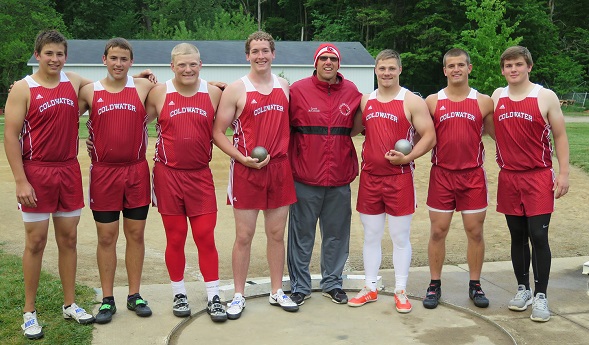
PHOTOS: (Top) Coldwater’s throwers and throws coach, from left: Cole Targgart, Dylan Targgart, Zach Gipple, Colin Klein, coach Mike McConnell, Connor Covert, Sam DeMeester and Nathan Spray. (Middle) Lansing Christian’s boys golf team celebrates its first league title. (Photos courtesy of Mason and Lansing Christian’s athletic departments, respectively.)