

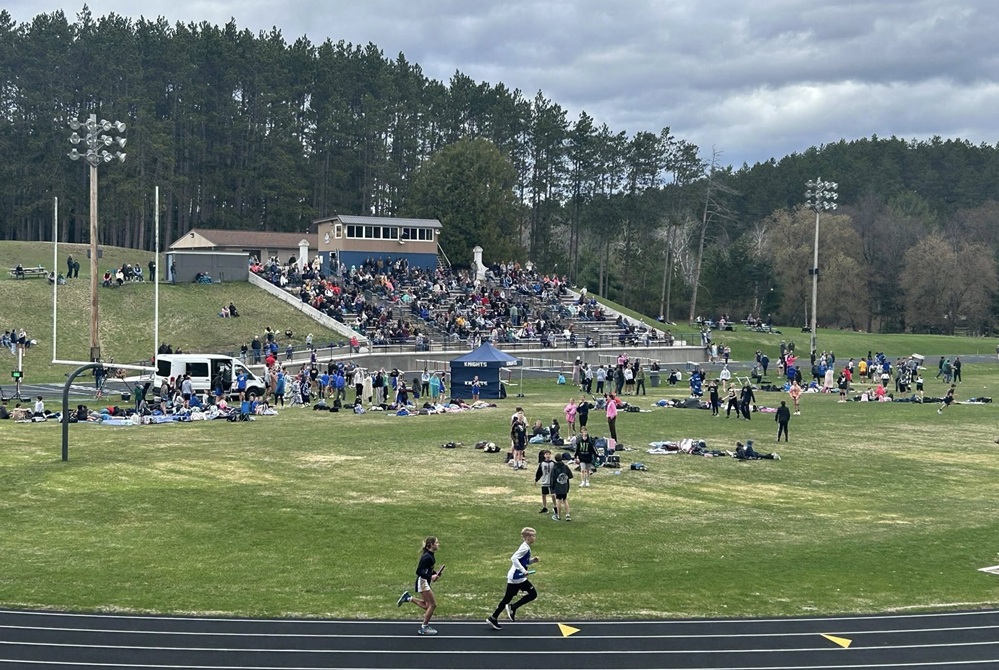
Norway, Mid Peninsula Welcome Back 1st Home Track Meets in Nearly Decade
By
John Vrancic
Special for MHSAA.com
May 15, 2026
NORWAY — It had been quite a while since Norway and Rock Mid Peninsula had been able to host a track & field meet.
 That changed last week as Mid Pen hosted a triangular meet Thursday, and Norway held its invitational Friday. Those marked Norway’s first varsity home meet in nine years and the first complete meet at Mid Pen since 2019.
Norway debuted its rebuilt track during its junior high invitational April 28.
“Everything is all set, thanks to our referendum,” Norway boys coach Al Trudeau said. “It’s great to be able to host a meet. Our students, physical education instructors and community members will be able to use it. We’ll be set for a long time. We have lots of help, which is awesome.
“Our guys did all right. Our sprint relays went real well.”
Rapid River’s boys, who ran at Norway for the first time, won with 142 points. The Rockets were followed by Bark River-Harris with 130, Florence-Niagara, Wis., at 70 and Norway at 69.
Rapid River’s lone first came on freshman Coen Smith’s personal-best jump of 5 feet, 10 inches in high jump, and junior Lane Olson was runner-up on a tie-breaker to BR-H freshman Samuel Varoni in pole vault (10-6) on a sunny and mild day.
“I was happy with all the guys,” Rockets’ coach Steve Ostrenga said. “Our depth came through. Taking three places in the 3,200 decided the issue. We had some adversity tonight. We had to scramble to put a 1,600 relay team together. Our guys said it was a good track, and it was a very quick meet.”
BR-H junior Gionni McDonough was a four-event winner, taking the 100-meter dash in 12.2 seconds, 110 hurdles at 16.9 and 300s at 45.63, and long jump at 19 feet, 11½ inches.
“I’m very happy with that,” he said. “The track is nice and bouncy, and the long jump area is really nice.
“Doing well as a team is really a nice boost for us.”
BR-H coach William Soper was also impressed with the newly-resurfaced Norway facility, and delighted by his team’s progress.
 “It’s an awesome track,” he said. “I’d be happy to come back here.
“I think we’re developing more of a team mentality. The kids are willing to do anything to help the team. We got Ben Olson back from surgery, and Gionni just started practicing long jump Thursday. We’re trying to find people for events that will match our strengths.”
Felch North Dickinson captured the girls title at Norway with 106 points, followed by BR-H with 92 and Stephenson at 70.
Junior Aunika Lindholm provided the Nordics with victories in the 1,600 (5:58.04) and 3,200 (13:20.55), both personal bests.
“A lot of things went our way today,” Nordics coach Mike Roell said. “A lot of kids stepped up. They really competed. Aunika did a nice job winning the 1,600 and 3,200 and helping our longer relays take first. Aspen (Anderson) winning pole vault and going 1-2 in the 800 were also huge.”
Rapid River sophomore Victoria Coppock recorded her first varsity victory in the 100 hurdles (18.75).
“This is very exciting,” she said. “I haven’t been able to practice because of softball. The track was quite nice, and this is probably the best weather we’ve had.”
At St. Nicholas, the Mid Peninsula Wolverines got part of a meet in last year, but it was cut short by poor weather conditions.
“It went great today,” Mid Pen coach Carl Brunngraeber said. “We appreciate Superior Central and Big Bay de Noc coming over here. We tried to do a meet here last year, then it started raining and weren’t able to get it all in. What we’re trying to do is bring some of this back. I like the idea of having a smaller meet and giving the kids a chance to do something different. We’re hoping to make this a small-school invitational.”
Mid Pen sophomore Lewis Holmes took the 100 (11.98) and 200 (25.08), and eighth-grader Siwal Holmes won the 300 hurdles (48.49) on a revamped asphalt surface.
“I think I could have run a faster time, although it was exciting,” Siwal Holmes said. “It’s still a hard surface, but I like it. I know I have to raise my foot a little more and work on technique.”
Mid Pen senior Hope Brunngraeber captured girls shot put (30-9) and discus (107-7) in a meet for which team scores weren’t kept.
“It’s really nice to have a meet at our school,” she said. “It feels good to finally throw here in my senior year. It was also good to have people come here and watch us throw.”
Superior Central’s Kendra Peterson took the girls 400 (1:11) and 800 (3:07.81), slightly more than a second ahead of senior Addie Frusti in the longer race.
“I ran behind Kendra because she’s my pacesetter,” she said. “It felt good to have a meet over here. It was fun. The weather is good, ideal for distance running.”
 John Vrancic has covered high school sports in the Upper Peninsula since joining the Escanaba Daily Press staff in 1985. He is known most prominently across the peninsula for his extensive coverage of cross country and track & field that frequently appears in newspapers from the Wisconsin border to Lake Huron. He received the James Trethewey Award for Distinguished Service in 2015 from the Upper Peninsula Sportswriters and Sportscasters Association.
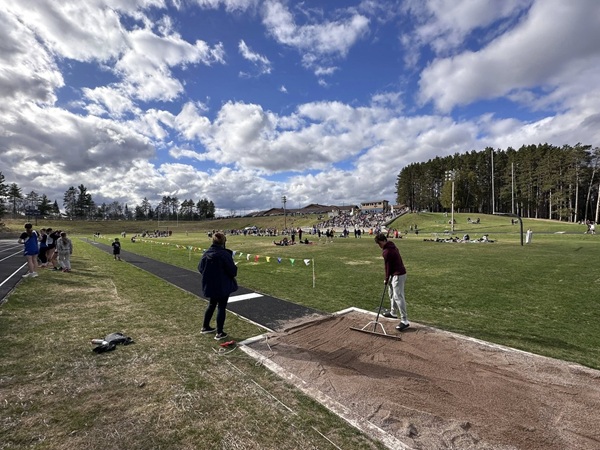
PHOTOS (Top) Norway welcomes back a home track meet with its junior high invitational April 28. (Middle) The long jump pit is prepared during the school’s first meet in nearly a decade. (Photos courtesy of Norway-Vulcan Area Schools.)
Bark River-Harris Lands 3-Peat, Shamion Joins Elite 4-Event Winners Club
By
John Vrancic
Special for MHSAA.com
June 2, 2024
KINGSFORD — The Bark River-Harris girls completed their season-long mission here Saturday, earning their third straight Upper Peninsula Division 2 track & field championship with 127½ points.
West Iron County brought home the runner-up trophy with 82, and third-place Ishpeming had 71.
“The girls have been working hard for this,” BR-H coach Jason Lockwood said. “Three U.P. titles under their belt is incredible. Everybody contributed, which is instrumental in putting up that many points.”
BR-H senior and Bay College basketball recruit Lauren Zawada captured the 100-meter hurdles in 17.74 seconds and 300s (50.92) and helped the Broncos win the 1,600 relay at 4 minutes, 24.4 seconds.
“My starts are what helped me this time,” she said. “That was my first individual U.P. title, which gives me a pretty good feeling. I’m pretty excited.”
Fellow senior and Bay College basketball recruit Mckenzie Hoffmeyer won long jump at 16 feet, ½ inch, helped the Broncos win the 800 relay (1:49.92) and placed second in the 100 (13.03) and 200 in a personal-best 26.52.
“Even though I didn’t win the 100 or 200, I still got points for the team,” she said. “It feels pretty awesome for us to come together and win this three times in a row.”
Hoffmeyer was runner-up to West Iron County senior Danica Shamion, who took high jump with a record 5-1, the 100 at 12.65 and also set U.P. records in the 200 (26.17) and 400 (56.94). She’s one of just nine girls to win four individual events at a Track & Field Finals.
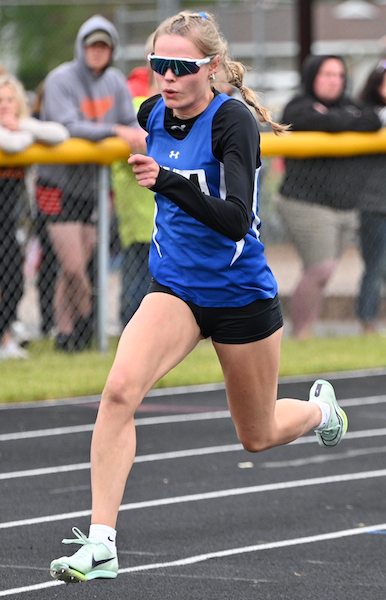 Shamion’s U.P. records took place four days after she set school records in the 200 (25.79) and 400 (56.74) and high jump (5-5) at Houghton.
“I went out with a bang, which is something I wanted to do as a freshman,” she said. “I kept thinking, ‘Take it one step at a time.’ The high jump runway was a little slippery (during brief rainfall). It was hard to get your grip.”
BR-H junior Marissa Ives, also part of the 800 relay, took third in the 200 (27.42) and fourth in the 100 (13.5).
“I think we did pretty good for having a young team (in the 800 relay),” she said. “The rain felt good during the race. It makes it a little harder coming out of the blocks, but it cools you off.”
Senior Julia Olson, who helped the Broncos win the 1,600 relay, set school records while taking fourth in the 400 (1:00.54) and 800 (2:29.2).
“This is honestly rewarding,” Olson said. “Part of this is due to our training in the weight room during the offseason. It really paid off. It’s also good to know I had good competition on top of it.”
Pickford sophomore Talya Schreiber won the 1,600 (5:19.16) and 3,200 (11:49.86) and was runner-up in the 800 (2:27.88).
“Lola (Korpi) is a great runner,” she said. “It definitely helps to have her here to push me. This feels really good. I’m happy to be here for our team. The atmosphere is awesome. Everyone is so nice.”
Ishpeming senior and Northern Michigan University recruit Korpi won the 800 (2:26.36) and placed second in the 1,600 (in a school-record 5:20.19) and 3,200 (12:12.63).
“I let her creep away from me a little too much and I couldn’t quite catch her in the 1,600,” said Korpi, who capped her career with 10 individual Track Finals titles. “She started her kick, too.
“I’m obviously happy with another school record. I feel I left my mark. I’m also happy for Talya. She worked so hard and helped me get my PR. Second place isn’t bad. I’m happy where I am.”
Sophomore Mya Hemmer added a first for Ishpeming in discus (114-6) and second in shot put (33-5¼), and Ironwood sophomore Emma Wardon took first in shot (34-5).
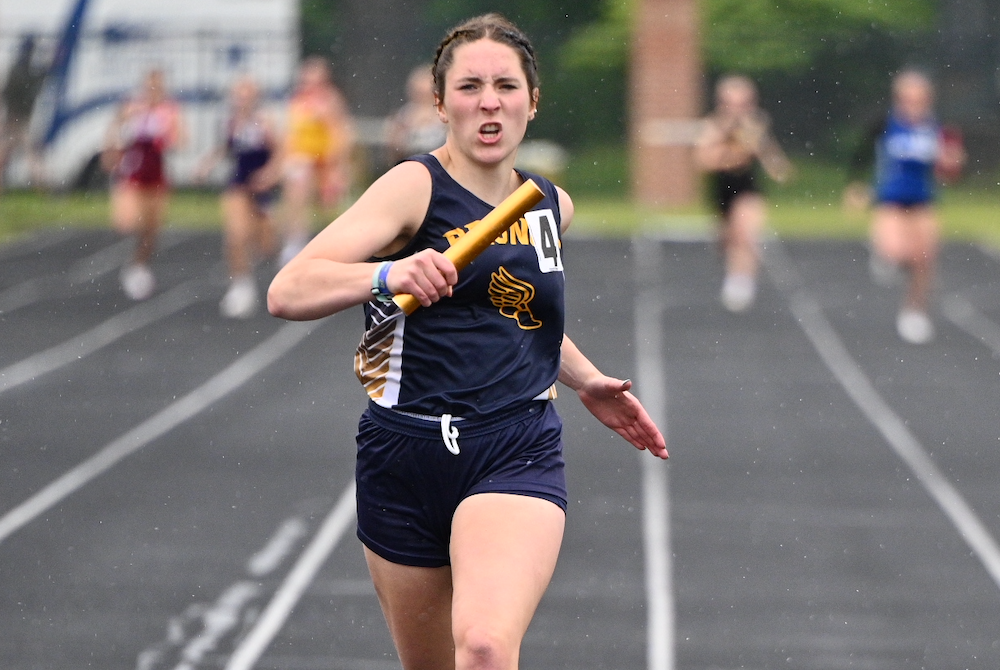
PHOTOS (Top) Bark River-Harris's Carli Erickson crosses the finish line far ahead of her competition in the 800 Relay. Other members of the winning team were Mckenzie Hoffmeyer, Julia Nault, and Marissa Ives. (Middle) West Iron County's Danica Shamion starts the 400, which she eventually wins. (Click for more from Cara Kamps/RunMichigan.com.)