

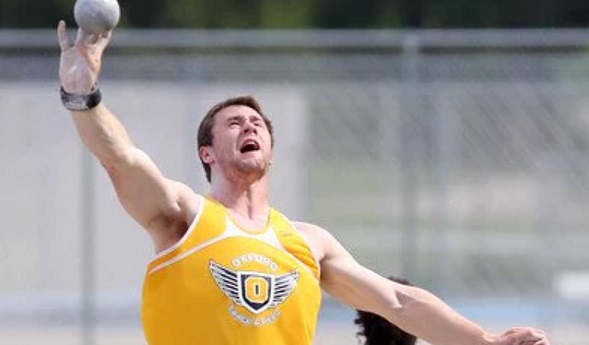
Performance: Oxford's Connor Bandel
June 1, 2016
 Connor Bandel
Oxford senior – Track & Field
Bandel could’ve been a selection most weeks this season; the spring has included that many highlights for the reigning Lower Peninsula Division 1 champion in shot put and discus. He was perhaps most dominant at his Regional on May 20 at Lake Orion, winning shot put by 16 feet with a toss of 63, 7 inches, and discus by nearly 28 feet at 189-2 to earn the Michigan National Guard Performance of the Week for May 16-22.
Bandel went on to win the Oakland County Championship titles Friday in both at 67-2½ and 192-0, respectively, and his top throws this spring are that shot put and a discus toss of 204-2 on April 23 at the Oxford Invitational. He will compete in the LP Division 1 Finals this weekend with opportunities to break the all-Finals records in shot put (Todd Duckett, Kalamazoo Loy Norrix, 64-0½, 1999) and discus (Cullen Prena, Walled Lake Central, 210-1, 2012). Prena is among those Bandel has consulted for advice as he’s improved significantly over the last few seasons; his top throws in 2016 are six feet better in shot put and 11 in discus from a year ago.
 The 6-foot-4, 230-pound senior also played goalkeeper for Oxford’s varsity soccer team the last four seasons and will be the second sibling from his family to play at the Division I college level; he’s signed for track & field with the University of Florida, while his older sister Darien plays volleyball at Oakland University. Connor also played basketball as a freshman and carries a 3.3 grade-point average; he’s considering majoring in chemical or biomedical engineering.
Coach Matt Johnson said: “The number one thing Connor brings is (his example) that track and field is a year-round event, from conditioning to weight training to building camaraderie with his teammates around the track. … He’s a dedicated athlete, he sets goals for himself, and that would be a value set that I’d say could be passed on to another level of student. He’s not just setting benchmarks for things within reach; he’s setting dreams he’s going to work toward. Early on last year, he told me he’s aiming not for the state record, he’s aiming to become an international competitor, and that raises the bar right there. Most high school kids are not even thinking (about that) at that point.”
Performance Point: “I’m trying to improve every meet; that’s always the goal. But this past week I started to improve more. I’m constantly moving the benchmark forward a bit. … Sometimes I just can’t really explain how much emotions I'm feeling when something (like a personal record) just happened. When you PR something that you’ve never reached, it’s just so satisfying to actually do that.”
Expert advice: “The biggest thing with (my sister) was her type of dedication and trying to do the same thing as her. Another big thing was the recruiting process; it was nice to have a sibling because not only did I get to learn from her but my parents got to learn a lot from her about the questions to ask coaches and that kind of deal. (From Prena), I learned definitely technique from him; it’s nice to have him having worked with his college coach, because … then he could teach me a lot of what he had learned. I always ask him about summer track, nationals and international competition. Even though he hasn’t gone to an international competition, he went to meet qualifiers for those, and if I have questions about what the atmosphere is like, things like what I need to bring, he’s always a good resource.”
The mental game: “For me, it’s not to get really tense. If I get really tense, really focus on trying to throw as far as I can, I’m not going to throw as well. The more relaxed you are, the longer you’ll be, the more comfortable you’ll be. Not getting tight and seized up and that sort of deal, that’s the biggest thing to me, to really relax … and trust what I’ve been doing the last couple of years, be comfortable and have fun with it. If you have a smile on your face, you’ll probably throw farther … (and) I’m just trying to throw farther than I did before.”
 Final countdown: “I’d definitely, now that I’ve won (in 2015), I would like to re-break the shot put record, and I would like to break the discus record for the first time. I really want to hit my goals; I wrote them down before the season, and I’m still on pace. I feel like breaking 79 (feet in shot put) and 215 (in discus) before the season is over, that would be absolutely fantastic.”
Create and explore: “I’ve always really been into math and science, always really liked the engineering aspects of creating and exploring new ideas. I thought with how much petroleum that the United State is using, and with how many athletes have injuries, I thought it would be cool to create new ways to produce energy, or for athletes the fastest ways to recover.”
– Geoff Kimmerly, Second Half editor
Every week during the 2015-16 school year, Second Half and the Michigan National Guard will recognize a “Performance of the Week" from among the MHSAA's 750 member high schools.
The Michigan Army National Guard provides trained and ready forces in support of the National Military Strategy, and responds as needed to state, local, and regional emergencies to ensure peace, order, and public safety. The Guard adds value to our communities through continuous interaction. National Guard soldiers are part of the local community. Guardsmen typically train one weekend per month and two weeks in the summer. This training maintains readiness when needed, be it either to defend our nation's freedom, or protecting lives and property of Michigan citizens during a local natural disaster.
Previous 2015-16 honorees
May 18: Kalyn Breckenridge, Birch Run girls soccer - Read
May 11: Morgan Beadlescomb, Algonac boys track & field - Read
May 4: Abby Krzywiecki, Farmington Hills Mercy softball - Read
April 27: Mike Mokma, Holland Christian baseball - Read
April 20: Abby Divozzo, Cadillac girls soccer - Read
March 30: Cassius Winston, Detroit U-D Jesuit boys basketball - Read
March 23: Kierra Fletcher, Warren Cousino girls basketball - Read
March 16: Jacob Montague, Grosse Pointe South swimming & diving - Read
March 9: Kyle Tuttle, St. Charles boys bowling - Read
March 2: Brittney Schnicke, Caledonia girls bowling - Read
Feb. 24: Kamari Newman, Detroit East English boys basketball - Read
Feb. 17: Jason Whitens, Powers North Central boys basketball - Read
Feb. 10: Rachel Hogan, Grand Ledge gymnastics - Read
Feb. 3: Nehemiah Mork, Midland Dow swimming & diving - Read
Jan. 27: Mardrekia Cook, Muskegon girls basketball - Read
Jan. 20: Sage Castillo, Hartland wrestling - Read
Jan. 13: Rob Zofchak, Dexter swimming & diving - Read
Jan. 6: Tyler Deming, Caro wrestling – Read
Dec. 15: Jordan Weber, East Jordan boys basketball – Read
Dec. 8: Kaitlyn Geers, Kent City girls basketball – Read
PHOTOS: (Top) Oxford's Connor Bandel unloads a shot put during a meet this season. (Middle) Bandel is the reigning champion in both the discus and shot put in Lower Peninsula Division 1. (Photos courtesy of Connor Bandel.)
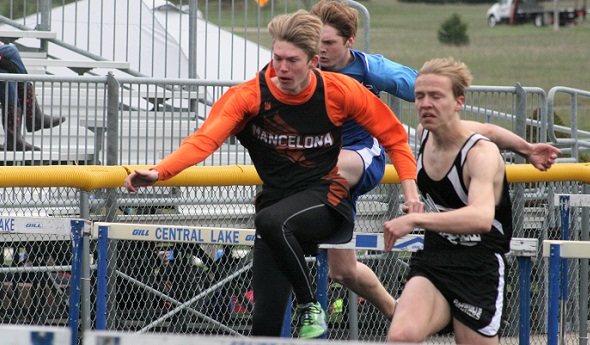
Revived Mancelona Boys Charging Ahead
May 9, 2019
By Chris Dobrowolski
Special for Second Half
Ability alone won’t get it done on the track.
 That’s why the transformation of the Mancelona boys track & field team didn’t happen until the Ironmen added confidence to their talent.
“I always thought they could do it,” said Rick Ancel, Mancelona’s head coach. “I always thought we had a lot of talent. They just didn’t believe in themselves, and they ran mediocre. Once they started believing, the workouts changed. The times changed. There are very few people they are afraid of. They get beat on certain days, but they don’t beat themselves up. I think before this change they were afraid before they ever got on the track.”
Since they’ve developed some faith in themselves the Ironmen have been a force to be reckoned with, running undefeated through every regular-season invitational they competed in last year on the way to capturing the Ski Valley Conference title. With most of its squad returning this season, Mancelona has continued to dominate meets and figures to be a shoo-in to capture the league crown for a second straight year when the conference championships are run May 22. The squad has been so impressive that it earned a No. 6 ranking in the Michigan Interscholastic Track Coaches Association Division 3 poll two weeks ago.
“It’s kind of hard to think about (being ranked) because a couple years ago we weren’t even winning our conference let alone being ranked at the state level,” said junior Johnny Ancel, one of the team’s three captains, along with classmates Tommy Palmer and Wesley Fulk.
Members of the team or coaching staff point to when Rick Ancel took over as head coach before last year as the pivotal moment when the Ironmen’s outlook, preparation and performance all changed. Ancel, who ran collegiately at Saginaw Valley State, deflects the credit back to his team and its willingness to do what it takes to find success.
“I do remember during the year that the workouts started changing,” said Rick Ancel. “They started going from trying to complete a workout because they had to run that much to trying to improve. Instead of just getting through it, they were doing the workout to get better.”
The fruits of their labor paid off in the form of the league crown, a fifth-place finish in the Regional — which came in their first year competing in Division 3 — MHSAA Finals qualifiers in three events and a school record in the 1,600-meter relay.
“At the end of last year I was feeling pretty good,” said Fulk. “We were only losing two of our (top) people, so the majority of our team was still going to be here. I knew we were going to be better than last season.”
The Ironmen haven’t disappointed. In an indoor meet at Central Michigan University in mid-March, the Ironmen kicked off their season by finishing second among Division 3 and 4 teams, easily surpassing their 11th-place finish a year ago. They followed that by winning their first five regular-season meets outside. Only a second-place finish at the Blue Devil Classic in Gaylord — where Mancelona tested itself against Division 1 and 2 teams — broke up the streak of regular-season first-place finishes that started early last season.
“This year we added some big meets,” said Rick Ancel. “We really tried to ramp up our competition this year.”
 Ancel’s veteran squad has welcomed the tougher competition. It’s a core of athletes who individually have the versatility to fill in at a number of different events and compete at a high level. The three captains, for instance, can run any event from the 100-meter dash up to the 800-meter run.
“We can try more people in different spots,” said Fulk.
It comes down to doing whatever the team needs at a particular meet. Even though track & field is in many ways an individual sport, the Ironmen see it from a team standpoint and embrace that perspective.
“We always start every meet and end every meet together as a team,” said Palmer. “You can’t do it alone, obviously. You can’t win a meet with just us three who are here or just one of us.”
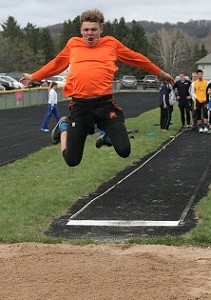
Two years ago the Mancelona team had only 11 members. Depth is not an issue any longer, however, as the Ironmen have bolstered their roster and now have nearly every event covered. Sophomore Ryan Rebh is ranked among the best hurdlers in the state in Division 3. Sophomore Jayden Alfred is the reigning Regional champion in the high jump and long jump and has emerged as the team’s top sprinter this season. Sophomore distance runner Tyler McClure is a Finals qualifier in the 3,200-meter run. Junior Michael Wagner is one of the better discus throwers in the Ski Valley Conference. James Dunne, Ben Palmer, Sam Squires and Austin Anderson have been key point scorers as well.
Mancelona also has four top-notch relays — all four should be favored to win conference crowns — highlighted by the 1,600 team. Ancel, Tommy Palmer and Fulk all return for that squad and have their sights set on breaking the school record for a second straight year.
“We’re just trying to find the right day where we all run fast at the same time,” said Johnny Ancel. “We could probably break it again right now. We just haven’t found the day.”
Records aside, the Ironmen seem to have the lineup that could challenge for a Regional title. Mancelona’s last Regional championship came in 2012, but that was in Division 4. Running in Division 3 is a bit more difficult, the Ironmen say, but they are up for the challenge.
“Harbor Springs was (in Gaylord), and they’re in our division. They’re really good. We’ll meet them again at Regionals,” said Rick Ancel. “That will be a tough day for us, but I think we’ve got a shot at winning that.”
 Chris Dobrowolski has covered northern Lower Peninsula sports since 1999 at the Ogemaw County Herald, Alpena News, Traverse City Record-Eagle and currently as sports editor at the Antrim Kalkaska Review since 2016. He can be reached at [email protected] with story ideas for Manistee, Wexford, Missaukee, Roscommon, Ogemaw, Iosco, Alcona, Oscoda, Crawford, Kalkaska, Grand Traverse, Benzie, Leelanau, Antrim, Otsego, Montmorency, Alpena, Presque Isle, Cheboygan, Charlevoix and Emmet counties.
PHOTOS: (Top) Mancelona’s Ryan Rebh leads the charge through the 110-meter hurdles during a recent meet. (Middle) Jayden Alfred launches during the long jump. (Photos by Chris Dobrowolski.)