

Record-Setter Dzurka Dreaming Big, but First Focused on Goal #1: Stay Healthy
By
Paul Costanzo
Special for MHSAA.com
April 22, 2026
When it comes to end of season goals, Midland Dow senior Zach Dzurka is keeping it simple: Get there.
 To an outsider, that aspiration might seem overly simple for a runner who has the state’s fastest 300-meter hurdles time and is ranked fourth in the 110 hurdles this spring, regardless of division. But after the opportunity to compete at the MHSAA Lower Peninsula Division 1 Finals was taken away from him a year ago, Dzurka is taking nothing for granted.
“Just try to keep on PRing (setting personal records) and hope to not get injured,” Dzurka said. “I’ve always been super injury-prone for some reason. But the goal is to keep myself healthy until states.”
Dzurka set a pair of Dow records on April 17 at the Graves/Swayze Relay Meet in Midland, running the 300 hurdles in 37.82 and 110s in 14.47. His 300-hurdle time is the fastest in the state so far this year, and just 0.03 seconds off last year’s Division 1 Finals championship time, run by Will Smith of Belleville, who has since graduated.
“I wouldn’t say surprising is the right word; this is totally expected for him,” Dow coach Jenna Oskvarek said. “He’s been working his butt off to make sure he can reach his goals. It was kind of only a matter of time, we knew (times this fast were) going to happen, we just didn’t know when. We couldn’t be happier.”
Dzurka, who also holds the school indoor record for the 60-meter hurdles (8.33), had already claimed the 300 hurdles record a year ago and was unbeaten in both outdoor hurdles events throughout the 2025 season.
But a persistent hamstring injury ended his season early.
“It wasn’t anything so extensive that it was season-ending, but we didn’t want to push it and injure him more long-term,” Oskvarek said. “It was more of a conversation with Zach about, ‘This is why we’re making the decision we are, so what do we need to do to support you to get you back to where you want to be?’ As much as we wanted the team to have success and wanted him to run, it’s not about us. He was completely understanding. There was disappointment, of course, but he knew why we made the decision we made and was totally on board. He could see the long-term reasons.”
Dzurka said the injury was never fully diagnosed, but it also wouldn’t go away.
“One practice I was hurdling and I felt like a mild sharp pain, and it would not stop,” he said. “It hurt each time I would hurdle. I thought it was going to get worse if I kept going. I was doing all the hamstring exercises, but it wouldn’t stop. It was really weird, because it finally stopped, literally the day after (the Finals). That was annoying.”
 Dzurka said he has been battling smaller injuries since his sophomore year, when he suffered a bulging disc in his back during a soccer game. In that moment, his feet got crossed up after making a pass, and when he fell to the ground took all the impact on his knees, which triggered the back issue, as well as arthritis.
He believes a lot of the soft-tissue injuries he’s dealt with stem from that back injury, which he’s mostly managed, but does still continue to work through.
“I would look up online how to fix back pain or how to fix bulging discs,” he said. “Then I would just brute-force the exercises until the pain went away. I was a pretty good coach for myself.”
Dzurka gives a lot of credit to Oskvarek and the Dow coaching staff for helping him get healthy – and keep him that way.
“We’re staying hopeful and staying careful as we do with all our athletes, so we can maximize his success and make sure not to run him into the ground,” Oskvarek said.
When healthy, Dzurka continues to thrive on the track in events he wasn’t introduced to until he was a freshman. He recently signed to run at Saginaw Valley State, where Oskvarek believes the resources and training available will allow Dzurka to take another leap forward.
“We always talk about how, especially at Dow, we’ve had such luck with such amazing athletes over the years, but we tell them that if you’re having this much success in high school, once you get to college, it’s just another ceiling to be broken,” Oskvarek said. “We prepare them to know that you’re having so much success here, imagine what you can do in college.”
Dzurka said the 400 hurdles will likely be his specialty moving forward, as he’s already seeing he’s more built for longer races.
“Before the season I said I was going to go sub-14 in the 110s, and that’s something to shoot for,” he said. “But I have super long legs that take a long time to get going, so I don’t know about that. But before the season I was joking with my buddies that I was going to go sub-37 in the 300 hurdles, and that’s actually possible.”
Sub-37 seconds would put him in rare company, as just four Michigan runners have ever done it. And, if he accomplishes his first goal of getting to the Finals in good health, could very likely put him at the top of the podium.
“It really would mean a lot because of how much I know I’ve put into the sport,” Dzurka said. “Even at indoor states, I came in third place this year, and at indoor states last year, I had my first-ever false start. So, getting to redeem myself would be great.”
 Paul Costanzo served as a sportswriter at The Port Huron Times Herald from 2006-15, including three years as lead sportswriter, and prior to that as sports editor at the Hillsdale Daily News from 2005-06. He can be reached at [email protected] with story ideas for Genesee, Lapeer, St. Clair, Sanilac, Huron, Tuscola, Saginaw, Bay, Arenac, Midland and Gladwin counties.
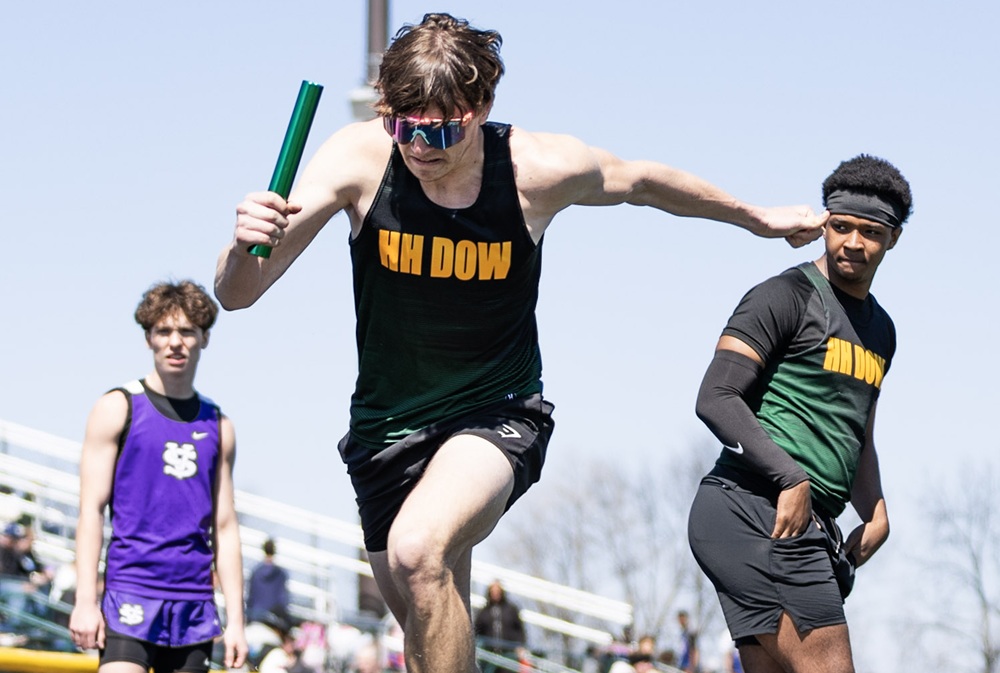
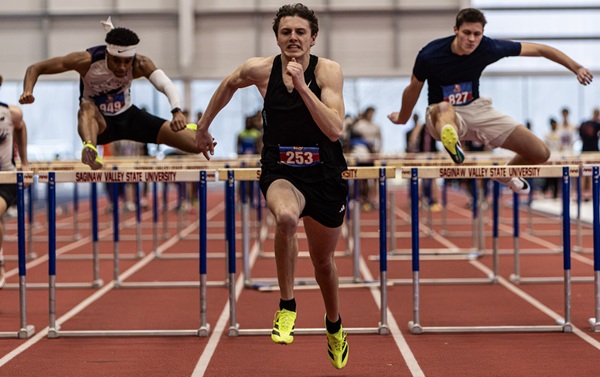
PHOTOS (Top) Midland Dow’s Zach Dzurka, with baton, takes off to start a relay race. (Middle) Dzurka, middle, leads a hurdles race during an indoor meet at Saginaw Valley State. (Photos courtesy of the Midland Dow athletic department.)
Bessemer Speediest for 1st Time since '51
By
John Vrancic
Special for MHSAA.com
June 3, 2018
KINGSFORD — It had been a long time since a Bessemer track team was last crowned Upper Peninsula champion.
A very long time.
The Speedboys changed that in convincing fashion Saturday, scoring 151 points for their first title since 1951, when they were competing in Class C.
Two-time reigning champ Rapid River was runner-up this time with 84 points, and Pickford took third at 45 in the U.P. Division 3 Finals at Flivver Field.
“Last year we lost by four points after winning every meet before the Finals,” said Bessemer assistant coach Tracy Rowe. “We were pretty hopeful coming in here. Our depth helped us out.”
The Speedboys won the first four running events and finished with nine firsts.
They began their quest with a victory in the 3,200-meter relay, covering the eight-lap race in 8 minutes, 31.15 seconds.
“The 3,200 relay set the tone for the day,” said assistant coach David Rowe. “We emphasized concentrating on the present, and the guys weren’t intimidated. This is something everybody was a part of. Our cross country team (co-op Gogebic Miners) won the U.P. (Division 2) title last fall, and the distances are where we racked up the points.”
Senior Isaiah Aili set a U.P. meet record in the 800 at 2:01.08, topping the previous mark (2:01.45) by Munising’s Brett Hannah run three years ago.
“I knew it was a big race, and there was a lot of competition,” said Aili, who was runner-up in the 1,600 (4:45.66). “I thought to myself, ‘I don’t want to lose this race.’ This means a lot to our school, team and coaches who have been there for us all year.”
Aili also helped the Speedboys win the 1,600 relay (3:37.74), as did senior Brayden Tomes, who took the 100 (11.92), 200 (23.7) and 300 hurdles (41.94).
“I can’t think of a better way to end my career, especially with all my teammates,” said Tomes. “This has been our goal since last year. We wanted to come back here and take the title.”
 Uriah Aili added a first in the 3,200 (10:25.29) and took second in pole vault (11-6), and sophomore Jamie Jett captured the 110 hurdles (16.97), took second in the 300 hurdles (44.11) and anchored the winning 800 relay (1:36.72), nipping Rapid River sophomore Tyler Sundling at the wire.
“One of the negative things is our handoffs weren’t as good as usual,” said Jett, who made up a 10-15 yard deficit in the anchor leg. “I like that distance (200 meters). I think 100 meters is a little too short, and I die a little in the end of a 400. I had a good start and used the three-step in the hurdles. I’ve been working on that, and I find it increases my speed (over the four-step).”
Junior Andy Aspinwall was also part of the 800 relay, and Tyler Busch added a first in shot put (46-6).
“We knew it would be real close with (Rapid River),” said Aspinwall. “I think they were our best competition. They’re a real good team.
“It’s awesome to go home with the U.P. title.”
Rapid River senior Logan Hardwick earned his third straight discus title (144-11), and junior teammate Gunnar Larson was runner-up (138-11).
Classmate Lucas Sundling won the 400 (53.06), followed by Tyler Sundling (54.0).
Cedarville sophomore Thomas Bohn set a U.P. meet record in the 1,600 (4:33.24), shaving 77 hundredths of a second off the previous best by Rapid River’s Tyler Crossman (4:34.01) in 2008.
“I knew I had to go out hard and tried to set the pace early,” said Bohn. “I knew there would be a lot of good runners. Bessemer especially had good runners. They have a good program.”
Bohn was runner-up in the 800 (2:02.8) and 3,200 (10:37.25).
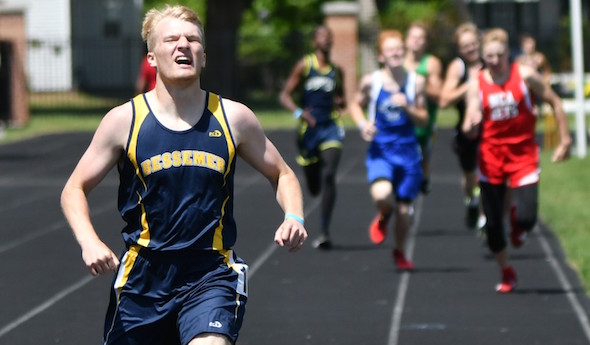
PHOTOS: (Top) Bessemer’s Isaiah Aili outdistances the field in the 800. (Middle) The pack takes a turn during the 1,600. (Photos by Cara Kamps. Click for more at RunMichigan.com.)