

Record-Setting Harper Woods Earns 1st Title, Western's Good Doubles Up on Greatness
By
Keith Dunlap
Special for MHSAA.com
May 30, 2026
HAMILTON — Parma Western junior Ryan Good was traditionally a competitor in the 400 and 800 dashes going into this spring, but he said he had a revelation earlier in the year while running the 1,600 at the Branch County Invite.
“I ran a 4:18,” he said. “I was just kind of like, ‘That’s pretty high up in the state. I might as well try and go for the 1,600 as well.”
Good did, and at the MHSAA Lower Peninsula Division 2 Finals, he was more than just good. He was the champion in two events.
First, he prevailed in the 1,600, claiming that title in a time of 4:13.20. Later, he won the 800 in a time of 1:53.81, pulling away over the last 100 meters with a big finishing kick.
“I’m definitely more 800 and 400 oriented,” he said. “But I think my body’s changed a lot. I used to be scrawny, a little bit weak. Over the past couple of years, I’ve gotten a lot more strength and mental strength as well.”
In the team portion Saturday, Harper Woods won going away, already having the title clinched before the final races of the day.
On the strength of dominant sprint relays, the Pioneers finished with 47 points, eight ahead of runner-up Otsego.
It was the school’s first Finals title in boys track & field.
“They had a lot of strong times going into indoor season,” said Harper Woods head coach Mike Carson, who was the coach of River Rouge’s runner-up team last year. “As we went from indoor into outdoor, we knew we wanted to do something special together as a team.”
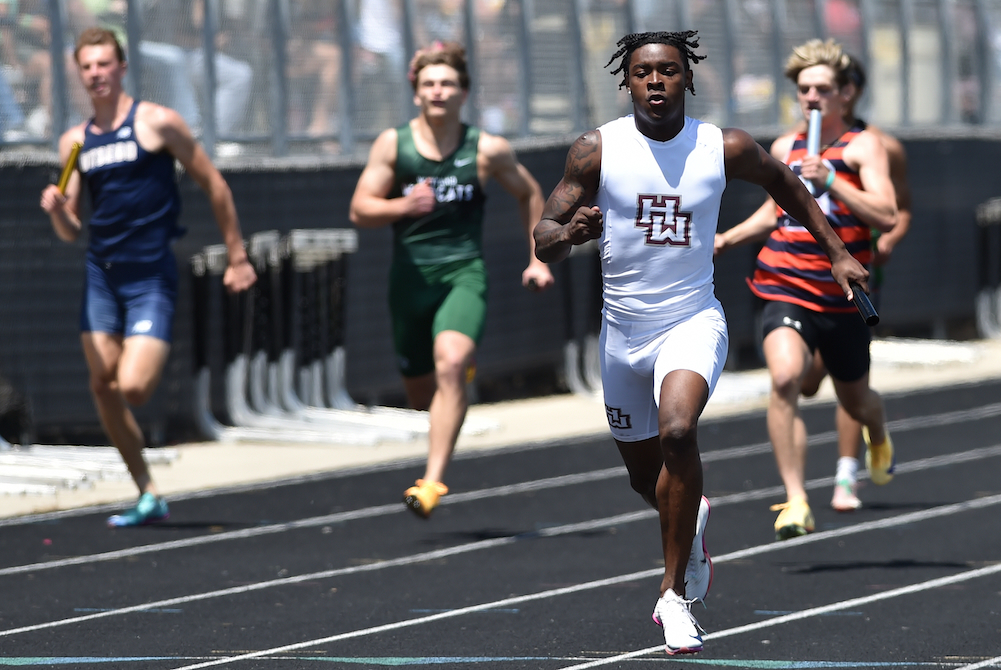
 Harper Woods set LPD2 Finals records in two relays. The 400 relay of Jayden Crump, DeAndre Bidden, Dakota Guerrant and Shawn Mosley won in a time of 41.50, which broke the record of 42.13 set in 2024 by Berrien Springs.
In the 800 relay, Harper Woods won in a record time of 1:27.26 with the team of Mosley, Crump, Dewayne Johnson and Bidden. The old record was 1:27.71 set by Orchard Lake St. Mary’s in 2016.
Crump, Bidden, Guerrant and Johnson are all standout football players as well, and Carson said there was little issue having them all come out for track.
“All the football players run track,” Cross said. “All the skill players run, and all the linemen do shot put. “They’ve been the ones to take the track program to the next level.”
Battle Creek Harper Creek senior DJ Wood repeated in the 110 hurdles in a time of 14.20, but fell short in his bid to repeat as champion in the 300 hurdles, finishing ninth. Corunna senior Logan Herrick claimed the 300 with a time of 38.02.
After finishing second in the high jump last year and reaching 7 feet at his Regional, Stevensville Lakeshore junior Declin Doroh won this time at 6-10.
Other champions Saturday included Coopersville’s Austin Langeland in the 100, Otsego’s Jack Cook in the 200, Portland’s Brady Rowe in the 400, Whitehall’s Robert Jazwinski III in the 3,200, Frankenmuth’s 1,600 relay and Grand Rapids Christian’s 3,200 relay, Vicksburg’s Kameron Kessler in the shot put, Otsego’s Alex Robbins in the discus, Spring Lake’s Ben Goran in the pole vault and Saginaw Swan Valley’s Jamison Pelt in the long jump.
Adrian’s Dillon Lauffer (100, 400) and Ethan Boprie (200) and Grand Rapids Christian’s Ezra Ippel (shot put) finished first in adaptive events.
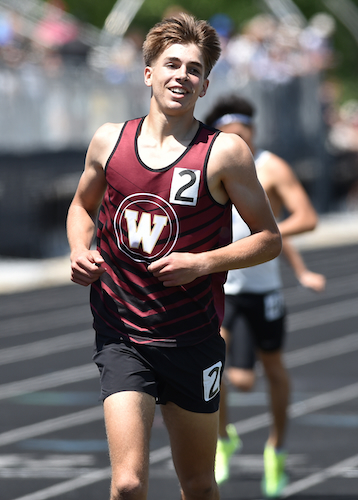
PHOTOS (Top) Harper Woods' DeAndre Bidden sprints to the finish ahead of the field in the 800 relay Saturday. (Middle) Parma Western's Ryan Good leads one of his two winning races. (Click for more from Dave McCauley/RunMichigan.com.)
Ruddy Brothers Return to Track, Help Lift Whiteford to Regional Title
By
Doug Donnelly
Special for MHSAA.com
May 23, 2023
OTTAWA LAKE – Shea and Ryin Ruddy are the answer to everyone who ever wondered if being fast in one or two other sports translates to being fast on the track.
 It does, and what they've accomplished this spring is more than enough proof.
In March, the Ruddy brothers came out for track for the first time since middle school for Ottawa Lake Whiteford after the district loosened the rules on athletes wanting to participate in multiple sports during the same season. About seven weeks later, the duo has qualified for the MHSAA Lower Peninsula Division 3 Finals in four events each and will lead a contingent of 10 Bobcats to Kent City next week.
“What they are doing on the track is amazing,” said Whiteford track & field coach Jay Yockey. “Really, when you look at it, they’ve only lost a couple of races here and there. They aren’t finishing second. They are going out and winning races, winning meets. It is not a small feat at all.”
Shea, a senior, was a four-year starting quarterback for Whiteford who led the Bobcats to the Division 8 championship last fall, scoring the game-winning touchdown on an unforgettable, 17-play fourth-quarter drive. Since his freshman season, he’s also played basketball in the winter and baseball in the spring.
Ryin, a junior, was also a starter on the Bobcats football team and followed in his older brother’s footsteps with basketball and baseball.
This year, however, they went to Whiteford athletic director Jeremy Simmons to inquire about also running track.
“I had each athlete attend a meeting with both coaches and their parents where we went over the rules,” Simmons said. “We made sure everyone was on the same page and answered questions that they had. Everything is outlined.”
Yockey found out early on what kind of athletes both were.
“They are confident in their abilities but aren’t arrogant and boastful,” Yockey said. “For what they have accomplished this year is truly outstanding – and I understand they are doing pretty well in baseball, too.”
Saturday’s Division 3 Regional at Adrian Madison was a milestone day for both.
Shea won the 400 and was on the 1,600 relay unit that finished first. He also was second in the 100 and part of the 400 relay that came in second.
Ryin was part of both of those relays, plus the 800 relay that placed second – and was Regional champion in the 300 hurdles.
Together, they helped the Bobcats to the team title.
“Ryin’s 300 race really sticks out to me as he is such a competitor and driven to win,” Yockey said.
 Ryin took to the hurdles quickly.
“He’s really done quite well with working his hurdle form, attacking each race and winning,” Yockey said. “He currently is seeded seventh in the state in an event that usually takes a season or two to perfect.”
Ryin last ran track in the seventh grade. Shea ran that season as well, which was his eighth-grade year.
“We had high expectations, but I think we exceeded what we thought we would do,” Shea said of this spring. “It was really tough to start, but it’s gotten a lot easier as I’ve gotten into the routine. I think it’s benefited me for both sports.”
Shea started out the season competing in the high jump. About two weeks ago he gave the 400 a shot. He ended up winning the Regional in the event and is seeded second going into the Finals.
The Hillsdale College football signee credits Coach Yockey with helping him get up to speed on what to do and not do on the track.
“Coach Yockey helped me a lot. He got me into shape and told me where I needed to be with my times,” Ruddy said. “I kind of wish I would have done it in the past, but it’s all right. I think the years of experience would have paid off.”
Shea is the anchor on the 400 relay and leads off the 1,600 relay. The 1,600 unit holds the school record and had the fastest time of any 1,600 relay in Division 3 earlier this season.
“I knew adding Shea and Ryin would be a benefit for us,” said Yockey. “But, to go in and win a Regional title … that’s always the dream. The fact that we won a Regional title and will go to states with 12 scoring opportunities is definitely exciting. It exceeds my expectations from the start of the season.”
Whiteford had two other Regional champions Saturday – Keegan Masters won both the 1,600 and 3,200 and Stepan Masserant won the Pole Vault. The Regional title was Whiteford’s first since 2007, the same year the Bobcats won the school’s only track & field state championship.
It also comes just a year after Whiteford christened its new track and hosted its first home meet in more than a decade. Yockey said the new track helped ignite interest in the sport.
“Having a new track is huge,” he said. “Kids want to be a part of something they can be proud of, and kids weren’t proud of our track facility. I still hear upperclassmen joke about the gravel lane they had before I got here.
“I think being able to host home meets, and a beautiful facility definitely helps in having kids come out and participate in track & field.”
Shea said he’s not surprised about the rapid rise of the Whiteford boys track & field team this season.
“I’m not shocked,” he said. “I knew we had the talent. We had to put it together, of course, and we’ve done that. I’m satisfied. I’m going to the states in four events. I can’t be disappointed with that.”
 Doug Donnelly has served as a sports and news reporter and city editor over 25 years, writing for the Daily Chief-Union in Upper Sandusky, Ohio from 1992-1995, the Monroe Evening News from 1995-2012 and the Adrian Daily Telegram since 2013. He's also written a book on high school basketball in Monroe County and compiles record books for various schools in southeast Michigan. E-mail him at [email protected] with story ideas for Jackson, Washtenaw, Hillsdale, Lenawee and Monroe counties.
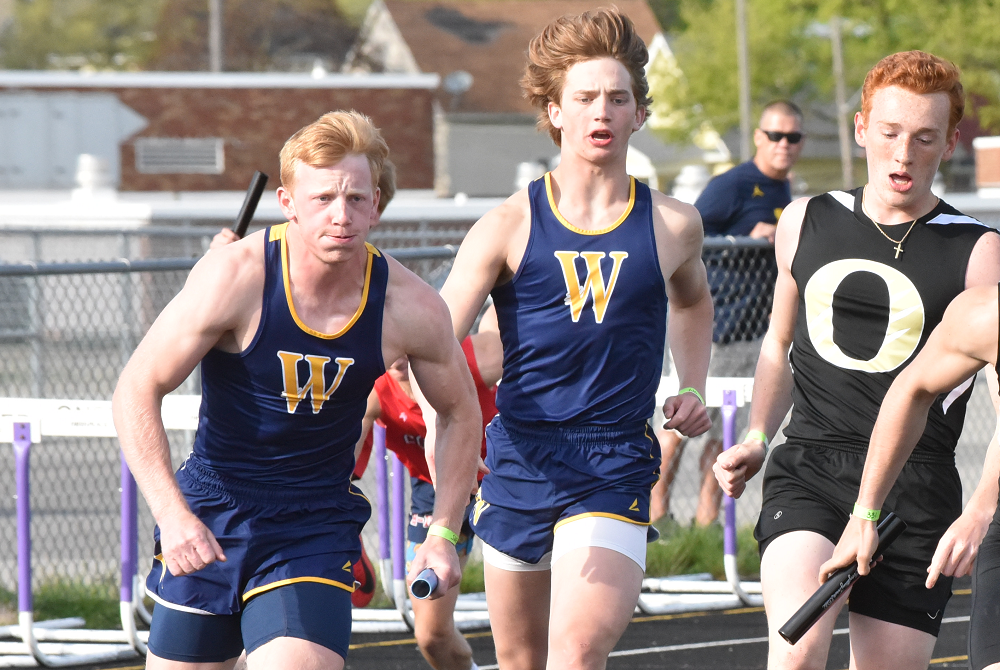
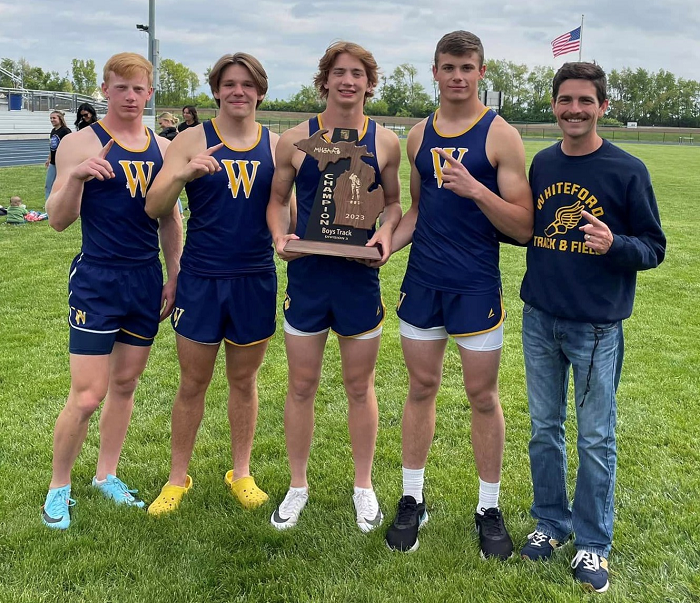
PHOTOS (Top) Shea Ruddy (far left) takes the baton from brother Ryin during a relay this season. (Middle) The 1,600 relay of Shea Ruddy, Dylan Anderson, Ryin Ruddy and Jake Iott show off their latest trophy with Whiteford coach Jay Yockey after the Bobcats claimed their first Regional track & field team title since 2007. (Top photo by Deloris Clark-Osborne; middle photo courtesy of the Whiteford boys track & field program.)