

Speedy Mann Helps Make Hackett Catholic Prep Champ to Chase Again
By
Drew Ellis
Special for MHSAA.com
June 4, 2022
HUDSONVILLE – After two years away, Kalamazoo Hackett Catholic Prep is back on top of the Lower Peninsula Division 4 boys track & field world.
Using a balanced effort Saturday, the Irish held off 2021 champ Carson City-Crystal to take home the Finals hardware with 64 points. The Eagles finished with 56, while Wyoming Potter’s House Christian placed third with 45.
“Everybody came to work. We knew if we stood a chance, everyone had to get every point possible, and our guys did that,” Hackett coach Carl Scholten said of his team, which added its first title since repeating in 2018 and 2019. “This is a competitive group that has been driven to succeed all year, and this is a great culmination of all their work.”
Highlighting the day for the Irish was a 1-2-3 finish in the 200-meter dash. Junior Liam Mann took home the victory with a time of 22.82, while teammates Andrew Finley and Isaac Backman finished right behind him.
Mann was overcome with energy after the finish, so much so that he tripped and tumbled to the ground. However, the pain of the fall couldn’t overcome his joy of winning.
“I just gave it my all and as I was coming through, I started to celebrate a little bit and my legs just gave out,” Mann said of the tumble. “The race felt great. I knew I had my work cut out for me, but it felt great to win and see my teammates right there with me.”
Mann was also with Finley and Backman, and also Evan Wurtz, as the winning 800-meter relay team. The Irish finished with a time of 1:31.55. Backman came through with a championship of his own in the 400, winning with a time of 50.85.
 Along with the three event wins, Hackett had a combined six runner-up or third-place finishes on the day.
Carson City-Crystal came up just shy of repeating as champion, but the Eagles still had three championship performances of their own.
Michigan-bound Zane Forist finished his throwing career on a high note, resetting his LP Division 4 Finals records in both the discus (200-4) and the shot put (67-5). His shot put toss was ¾ of an inch from matching the all-Finals record.
“I really didn’t know about (the record) until today, so it wasn’t something I was really shooting for,” Forist said. “I just wanted to PR (personal record), and I did that in both of my events, so I am really happy with my performance.”
Cavanaugh Barker took home the 300 hurdles title for Carson City-Crystal with a PR time of 40.02. He also finished second in the 110 hurdles.
Potter’s House was led by distance runner Lezawe Osterink, who won championships in both the 1,600 (4:24.29) and the 3,200 (9:38.23).
“The mile was more challenging. I have to do a lot of work in the mile,” Osterink said. “I was confident going into the two-mile. I knew I just had to run my race. In the mile, I knew I couldn’t make a mistake, because there were some really fast guys in that race that could leg me out.”
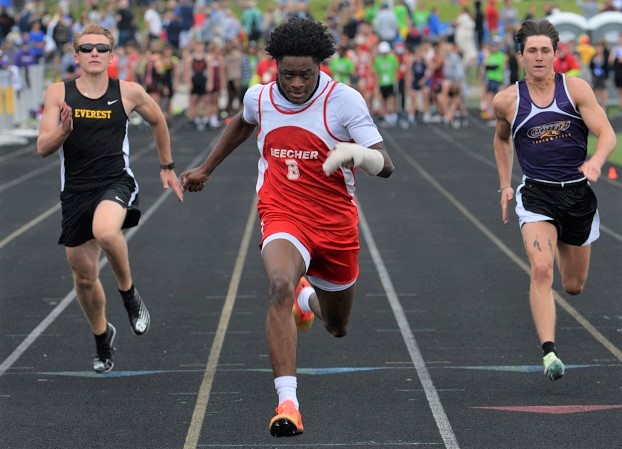
Flint Beecher junior Jaylin Townsend repeated as champion in the 100 dash with a time of 10.78. Townsend managed to win despite his left hand being in a cast after breaking a finger a little over a week ago.
“I feel pretty good about how things went. I’ve had to change my block start because of the broken finger,” Townsend said of his injury, which also is on his baton-carrying hand but didn’t prevent him from anchoring two scoring relays on the day. “It affected me more mentally than it did physically. I just had to focus on getting out quick and working on my technique.”
Reading junior Tyler Bays came out a winner in the 800 run with a time of 2:00.02, while Colon’s Alexander Stoll won the 110 hurdles with a PR time of 14.92.
Buckley won the 1,600-meter relay with a time of 3:30.71, while Clarkston Everest Collegiate won the 400-meter relay in a time of 44.17.
Coleman’s Isiah Biers won the championship in the pole vault with a PR vault of 13-4. Peck’s Alex Affer won the long jump with a PR leap of 22-3.25, while Marion’s Braden Prielipp won the high jump with a PR jump of 6-9.
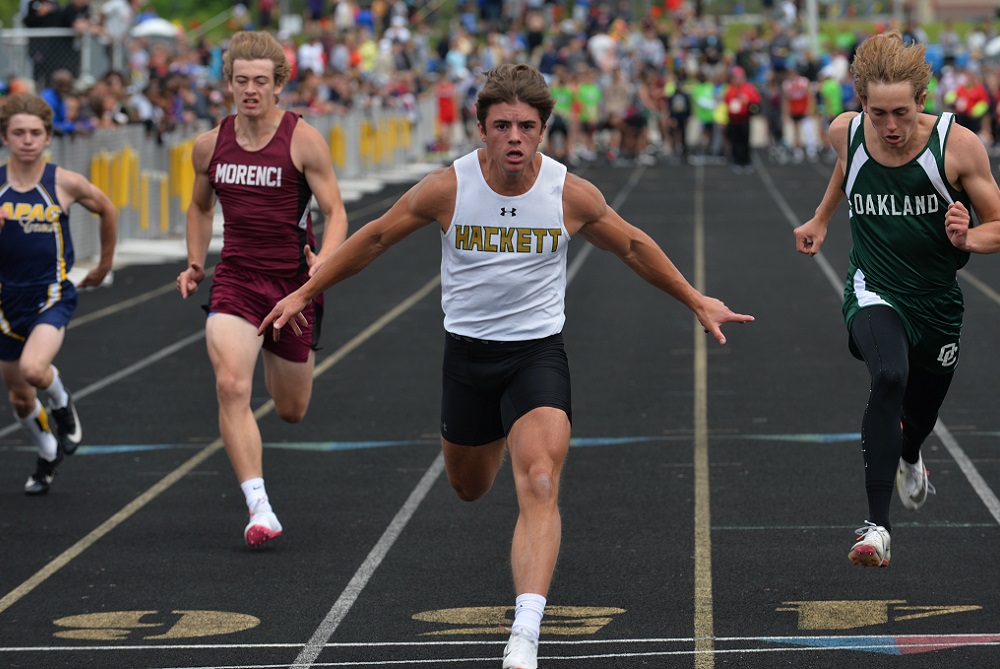
PHOTOS (Top) Hackett's Andrew Finley, middle, wins his 100 dash prelim Saturday. (Middle) Flint Beecher's Jaylin Townsend, also middle, wins his 100 prelim as well on the way to repeating as race champion. (Click for more from Dave McCauley/Run Michigan.)
Revived Mancelona Boys Charging Ahead
May 9, 2019
By Chris Dobrowolski
Special for Second Half
Ability alone won’t get it done on the track.
 That’s why the transformation of the Mancelona boys track & field team didn’t happen until the Ironmen added confidence to their talent.
“I always thought they could do it,” said Rick Ancel, Mancelona’s head coach. “I always thought we had a lot of talent. They just didn’t believe in themselves, and they ran mediocre. Once they started believing, the workouts changed. The times changed. There are very few people they are afraid of. They get beat on certain days, but they don’t beat themselves up. I think before this change they were afraid before they ever got on the track.”
Since they’ve developed some faith in themselves the Ironmen have been a force to be reckoned with, running undefeated through every regular-season invitational they competed in last year on the way to capturing the Ski Valley Conference title. With most of its squad returning this season, Mancelona has continued to dominate meets and figures to be a shoo-in to capture the league crown for a second straight year when the conference championships are run May 22. The squad has been so impressive that it earned a No. 6 ranking in the Michigan Interscholastic Track Coaches Association Division 3 poll two weeks ago.
“It’s kind of hard to think about (being ranked) because a couple years ago we weren’t even winning our conference let alone being ranked at the state level,” said junior Johnny Ancel, one of the team’s three captains, along with classmates Tommy Palmer and Wesley Fulk.
Members of the team or coaching staff point to when Rick Ancel took over as head coach before last year as the pivotal moment when the Ironmen’s outlook, preparation and performance all changed. Ancel, who ran collegiately at Saginaw Valley State, deflects the credit back to his team and its willingness to do what it takes to find success.
“I do remember during the year that the workouts started changing,” said Rick Ancel. “They started going from trying to complete a workout because they had to run that much to trying to improve. Instead of just getting through it, they were doing the workout to get better.”
The fruits of their labor paid off in the form of the league crown, a fifth-place finish in the Regional — which came in their first year competing in Division 3 — MHSAA Finals qualifiers in three events and a school record in the 1,600-meter relay.
“At the end of last year I was feeling pretty good,” said Fulk. “We were only losing two of our (top) people, so the majority of our team was still going to be here. I knew we were going to be better than last season.”
The Ironmen haven’t disappointed. In an indoor meet at Central Michigan University in mid-March, the Ironmen kicked off their season by finishing second among Division 3 and 4 teams, easily surpassing their 11th-place finish a year ago. They followed that by winning their first five regular-season meets outside. Only a second-place finish at the Blue Devil Classic in Gaylord — where Mancelona tested itself against Division 1 and 2 teams — broke up the streak of regular-season first-place finishes that started early last season.
“This year we added some big meets,” said Rick Ancel. “We really tried to ramp up our competition this year.”
 Ancel’s veteran squad has welcomed the tougher competition. It’s a core of athletes who individually have the versatility to fill in at a number of different events and compete at a high level. The three captains, for instance, can run any event from the 100-meter dash up to the 800-meter run.
“We can try more people in different spots,” said Fulk.
It comes down to doing whatever the team needs at a particular meet. Even though track & field is in many ways an individual sport, the Ironmen see it from a team standpoint and embrace that perspective.
“We always start every meet and end every meet together as a team,” said Palmer. “You can’t do it alone, obviously. You can’t win a meet with just us three who are here or just one of us.”
Two years ago the Mancelona team had only 11 members. Depth is not an issue any longer, however, as the Ironmen have bolstered their roster and now have nearly every event covered. Sophomore Ryan Rebh is ranked among the best hurdlers in the state in Division 3. Sophomore Jayden Alfred is the reigning Regional champion in the high jump and long jump and has emerged as the team’s top sprinter this season. Sophomore distance runner Tyler McClure is a Finals qualifier in the 3,200-meter run. Junior Michael Wagner is one of the better discus throwers in the Ski Valley Conference. James Dunne, Ben Palmer, Sam Squires and Austin Anderson have been key point scorers as well.
Mancelona also has four top-notch relays — all four should be favored to win conference crowns — highlighted by the 1,600 team. Ancel, Tommy Palmer and Fulk all return for that squad and have their sights set on breaking the school record for a second straight year.
“We’re just trying to find the right day where we all run fast at the same time,” said Johnny Ancel. “We could probably break it again right now. We just haven’t found the day.”
Records aside, the Ironmen seem to have the lineup that could challenge for a Regional title. Mancelona’s last Regional championship came in 2012, but that was in Division 4. Running in Division 3 is a bit more difficult, the Ironmen say, but they are up for the challenge.
“Harbor Springs was (in Gaylord), and they’re in our division. They’re really good. We’ll meet them again at Regionals,” said Rick Ancel. “That will be a tough day for us, but I think we’ve got a shot at winning that.”
 Chris Dobrowolski has covered northern Lower Peninsula sports since 1999 at the Ogemaw County Herald, Alpena News, Traverse City Record-Eagle and currently as sports editor at the Antrim Kalkaska Review since 2016. He can be reached at [email protected] with story ideas for Manistee, Wexford, Missaukee, Roscommon, Ogemaw, Iosco, Alcona, Oscoda, Crawford, Kalkaska, Grand Traverse, Benzie, Leelanau, Antrim, Otsego, Montmorency, Alpena, Presque Isle, Cheboygan, Charlevoix and Emmet counties.
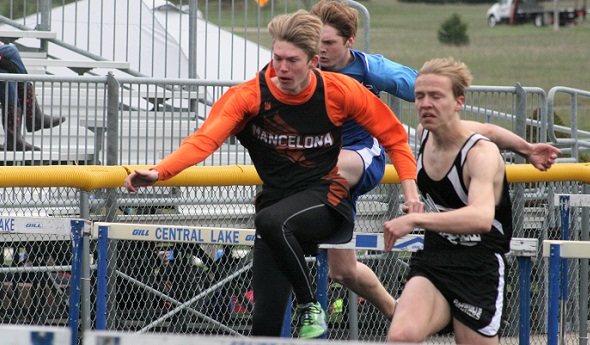
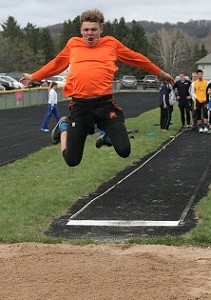
PHOTOS: (Top) Mancelona’s Ryan Rebh leads the charge through the 110-meter hurdles during a recent meet. (Middle) Jayden Alfred launches during the long jump. (Photos by Chris Dobrowolski.)