

Van Valkenburg Returns to Madison to Continue Dad's Pole Vaulting Program
By
Doug Donnelly
Special for MHSAA.com
April 8, 2026
Larry Van Valkenburg had two passions in retirement – coaching high school track & field and racing motorcycles.
 In September, only a few months after completing his 25th season as the pole vault coach at Adrian Madison, Van Valkenburg loaded up his motorcycle and headed to Harpster, Ohio, a tiny, unincorporated city of 160 residents in central Ohio.
“He loved racing motorcycles,” said his son, Trevor Van Valkenburg. “Seems like an odd hobby for someone in their 70s, but he loved it. He hadn’t done it for a couple of years and said he wanted to give it one more shot.”
While at a race in Harpster, Van Valkenburg, 78, was involved in a motorcycle crash, had trouble catching his breath and tragically died.
“He took a very hard fall,” Trevor said.
This spring, after months of deliberations, Trevor decided to end his nine-year run as track coach at nearby Onsted and take over for his father as an assistant at Madison. For all intents and purposes, he’s coming home.
“It really is like coming home,” Trevor said. “I have crazy Madison ties that go way back.”
Trevor was a big reason why his dad began coaching at Madison. He was a high school sophomore in the early 2000s when he switched from baseball to track.
“When Coach (Josh) Powers took over the program in 1999, Madison didn’t have pole vault,” Van Valkenburg said. “Most of the schools in the 1990s had gotten rid of it. As a sophomore, I said if you have pole vault, I’ll run track. That is how my dad got involved.”
Trevor knew his dad had some background in pole vault.
“He was a vaulter in high school,” he said. “He always told us he had the school record. He vaulted in the 1960s where he would land in a pit of saw dust. As a junior, he broke his arm vaulting. He had a scar he would show us from time to time. His proud accomplishment was he came back as a senior and set the school record.”
With Trevor a senior, the Van Valkenburgs were part of Madison’s run to a Michigan Interscholastic Track Coaches Association (MITCA) track & field team state championship.
“He ended up staying 25 years,” Trevor said, speaking of his dad. “He loved it.”
Pole vault is a tough event to learn – and teach.
 “In my opinion, it’s probably the most complicated high school sport,” Trevor said. “There are so many variables, how long your pole is, what the wind rating is, the flex rating and you have to set up your steps. You can move the bar so you have to know where to put it. It’s almost impossible to do well without a good coach. There are too many things an outside person needs to watch and give you feedback on.
“I always tell the kids every time you focus on one thing in pole vault about 30 other things go wrong – and that’s fine. It’s a very complicated high school thing to do. If you don’t have a good coach, it’s really hard to be successful.”
Last year, Trevor’s son Noah was on the Trojans middle school track & field team and chose the pole vault as one of his events. His grandfather was able to coach him.
“I am thankful for that,” Trevor said.
Over the years, the elder Van Valkenburg coached numerous league, county and Regional champs. Trevor joined his high school friend, Kyle Cessna, at Onsted, first coaching the pole vault but later coaching distance runners and the Wildcats cross country team. Madison and Onsted were in the same league, the Lenawee County Athletic Association, for the last several years.
“Over the years my dad and I had plenty of good pole vault coaching and team battles,” Trevor said. “We were really competitive at first. Over time, that relaxed a little bit.”
Returning to Madison to coach was an emotional decision for Trevor.
“I’ve coached Onsted for nine seasons,” Van Valkenburg said. “It was kind of always in the back of my head that if my dad was ever done, I’ll go back to Madison. I knew he would hold on as long as he could. It didn’t end up the way we thought it would, but it finally happened and I’m back home.”
Another reason it is home is because his wife, Kathryn, has taught at Madison schools for more than 20 years. His younger son, Dominque, also attends Madison schools.
“When I’m here after school, my whole family is here,” he said. “My wife is in the building. My one son is getting out of elementary at 3:30, my other son is on the middle school track team.”
Larry Van Valkenburg was an ex-Marine who retired as an air traffic controller in 2011. His legacy will remain at Madison, mainly because he teamed with Powers and the rest of the coaching staff to form a powerhouse track & field program that won numerous league championships and made an impact at MHSAA Finals.
“Larry was a great coach,” Powers said. “Trevor is a lot like him. We are really happy he came back to coach.”
Trevor Van Valkenburg is the director of the Lenawee District Library, a system that has six branches and a bookmobile. They circulate more than 150,000 items a year. Each spring, he adjusts his schedule to allow for coaching. He feels at home at Madison – and the track & field athletes can take comfort knowing a Van Valkenburg is still coaching them.
“We’re pretty similar,” Trevor said. “I learned a lot of it from (my dad), so it makes sense we would be similar. We both are pretty laid-back people. We’re not going to scream in kids’ faces. I might be a little more drill-heavy instead of just practicing jumping over the bar. I learned everything I know from him.”
 Doug Donnelly has served as a news and sports reporter at the Adrian Daily Telegram and the Monroe News for 30 years, including 10 years as city editor in Monroe. He's written a book on high school basketball in Monroe County and compiles record books for various schools in southeast Michigan. He is now publisher and editor of The Blissfield Advance, a weekly newspaper. E-mail him at [email protected] with story ideas for Jackson, Washtenaw, Hillsdale, Lenawee and Monroe counties.
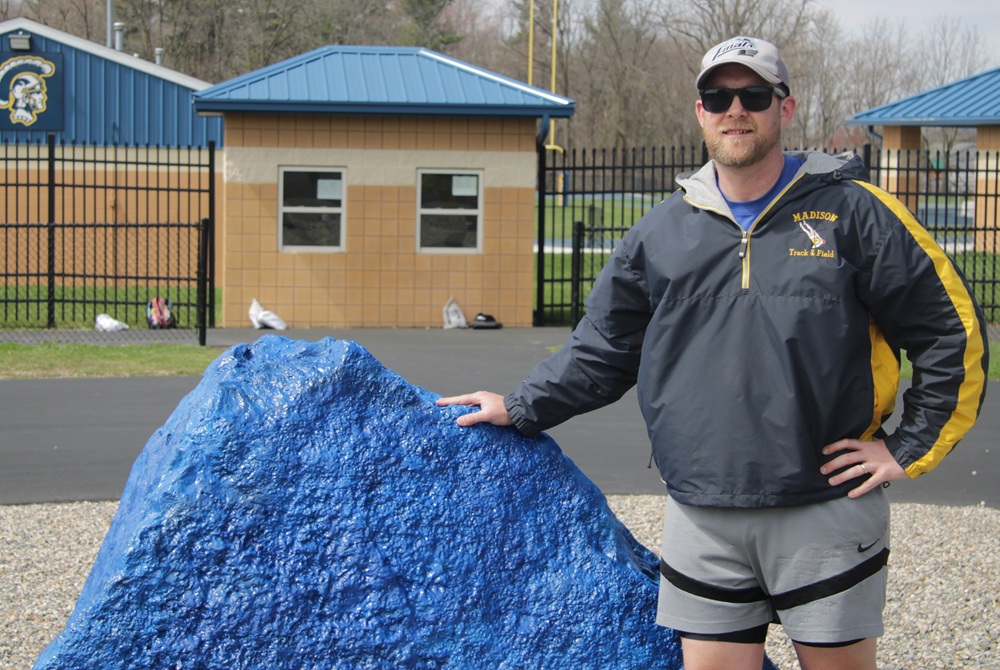
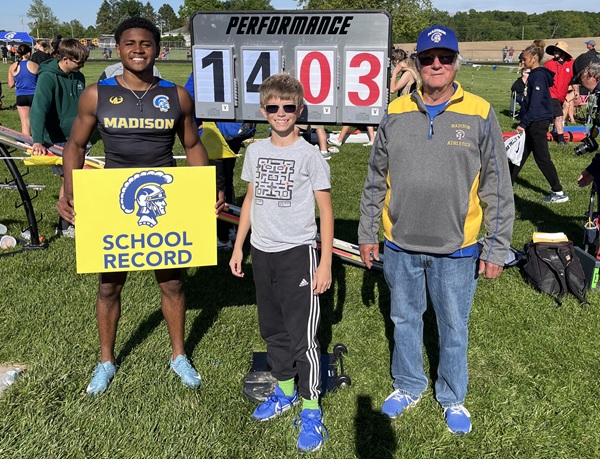
PHOTOS (Top) Adrian Madison track & field assistant coach Trevor Van Valkenburg stands at the entrance to the school’s track this spring. (Middle) At left, JaLonn Borders stands for a photo with Larry Van Valkenburg and Larry’s grandson Noah after breaking the school’s pole vault record during last season’s Lenawee County Championships. (Top photo by Doug Donnelly. Middle photo courtesy of Trevor Van Valkenburg.)
Northern Hopefuls Chase Dream Finishes
June 2, 2017
By Dennis Chase
Special for Second Half
TRAVERSE CITY – Can Gaylord’s Casey Korte, despite missing three weeks in May with shin splints, defend her MHSAA Lower Peninsula Division 2 title in the long jump?
 Can Benzie Central’s ironman, Brayden Huddleston, medal and earn all-state honors in four Division 3 distance races?
Can Harbor Springs sophomore Jeremy Kloss – the top seed in the 1,600 and 3,200, along with his teammates in the 3,200 relay – pull off a trifecta in Division 4?
Can the Traverse City West 400-meter relay team win the school’s first boys MHSAA Finals title in a running event?
In northern Michigan, those four storylines will be among the most compelling Saturday at the MHSAA track & field championships.
Casey Korte
The 17-year-old multi-sport athlete has been battling nagging leg injuries the last two seasons, but still won the long jump last June with a leap of 18-0¼.
Shin splints forced Korte to take three weeks off last month. She returned for the Regional and kicked off the rust by winning the long jump (17-01.25) and helping the 800-meter relay team qualify for the MHSAA Finals.
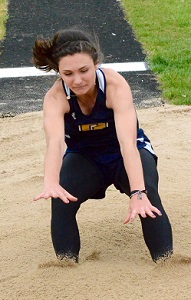 “It’s good,” she said of her health.
Her distance in the long jump was third best among state Regional performers.
“Usually my goal every meet is to be in the mid-17s,” she said. “Nobody was close to it (17-1¼) at the Regional so I was good with it.”
Korte had an interesting warmup Tuesday at Gaylord’s Meet of Champions. She won the 100, high jump and was on the victorious 800-meter relay, but took second in the long jump at 15-5½.
“Usually I don’t do the long jump last,” she said. “I do it second. But the way the meet was set up I did it after all my other events, and after it had rained and gotten cold and windy. My legs wouldn’t let me take off and jump.”
Korte does not expect similar problems Saturday.
“My goal is to double as a state champion,” she said. “Last year, during long jump, all the factors came together. I was feeling good, the high jump was going well, the wind was perfect. Everything went well. I’m hoping it happens again.”
Korte finished fourth in the high jump at last year’s Finals, but did not qualify in that event this year.
Nonetheless, it’s been a banner senior year for Korte. She was the team Most Valuable Player and an all-region pick in volleyball, then followed it up with a first-team all-state campaign in basketball, averaging 19.8 points, 12.3 rebounds and 3.5 steals per game. Korte signed to attend and play basketball at Cornerstone University.
But her focus now is on the track. And what would it mean to her if she could repeat in the long jump?
“It would show that my hard work paid off,” she said. “A state championship isn’t just handed to you. You have to work hard for it. It would be awesome to know I did that. It’s still surreal that I was the state champion last year. There are times I still can’t believe it.”
Brayden Huddleston
Huddleston is preparing for an event-filled day at the Division 3 Finals. The senior is seeded second in the 800, seventh in the 1,600 and eighth in the 3,200. He also runs a leg on Benzie’s 3,200-meter relay, which is seeded third.
His goal? Medal in all four.
His goal? A podium finish in all four events.
 “It’s pretty rare (to run four distance races at the Finals), especially if you’re a kid that has a shot to potentially win,” Benzie Central coach Asa Kelly said. “We talked. I said, ‘You’ve got to be a little crazy to do this.’ He said, ‘I want to.’
“He’s one of those exceptional kids that when he does something, he does it really well. He’s a 4.0 student, a salutatorian. I said, ‘You could be one of those rare kids that could be all-state in four distance races.’ That doesn’t happen too often. He’s committed 100 percent to this. It’s going to take a lot of careful planning (Saturday), as far as warming up, cooling down, diet, fluids. I think he’s going to do great.”
Huddleston, who will run at Bradley University, said he’s ready.
“They say it’s crazy to do (four distance races) at state finals, but I like that challenge,” he said. “I’m ready to put forth my best effort and see what I can do.’
Huddleston said he’s most concerned about the quick turnaround between the 800 and 3,200.
“I’m most nervous about that,” he said. “I think there’s only one heat in the girls two-mile at state finals so the turnaround will be quick. But I think I’m in good shape. This is the most fit I’ve ever felt.”
Huddleston won the Ryan Shay 1,600 meters in a season-best 4:19.84 at Tuesday’s Traverse City Record-Eagle Honor Roll meet. That time ranks second to St. Louis’ Evan Goodell’s 4:18.18 in LP Division 3 this year.
“I was shooting to see how close I could get to the school record of 4:14.7 by Jake Flynn,” Huddleston said. “I fell a little short, but I was running by myself, and running into a wind for half the lap. You take those things away and it puts me right in the ballpark. I was happy with my effort. It’s good to be rolling into the state finals.”
Huddleston smiles when he talks about a second seed in the 800.
“I’ve always looked at myself as a distance runner,” he said. “The two mile has been my best event. But this year I ran a couple open 800s, and I fell in love with it. It’s a strategic race.”
The 3,200 will be his last race of the day.
“He knows going in there will be guys who will be fresh,” Kelly said. “What a badge of honor if he could go out there and say, ‘This is my fourth event and I’m going to try and be all-state and beat some guys who haven’t run at all today.’”
Jeremy Kloss
Kloss will toe the line in three Division 4 distance races. His Regional times of 4:26.71 in the 1,600 and 9:49.52 in the 3,200 were best in the division. The Rams also had the top 3,200 relay time of 8:20.69.
Kloss, who was second in the LP Division 4 Cross Country Final, said he’s peaking at the right time.
“With the state meet coming up, it was time to kick it into gear, get motivated, get serious,” he said.
Kloss, who is coached by his father Mike, said he would like to achieve some goals he set at the beginning of the season – to run in the high 9:30s in the 3,200 and low 4:20s in the 1,600.
“I think I can,” he said.
Jeremy is the youngest of four brothers to run for the Rams. His mother, Emily, coaches the girls team.
“I was born in early October and wasn’t even a month old when I went to my first state finals cross country meet,” he said.
His brother Jake ran on the school’s LP Division 4 cross country championship teams in 2002 and 2003.
Jeremy Kloss was sixth in the 1,600 and 3,200 as a freshman. He said the 1,600 is his favorite event because it combines the speed of the 800 with the endurance of the 3,200.
“It’s the perfect medium,” he said.
And has he received any advice from his older brothers – Jake, Ben and Scott – who will all be in attendance Saturday?
“No, other than ‘Why aren’t you running faster?’” he said with a laugh.
Kloss would like the last laugh tomorrow.
“I’m very excited for it,” he said.
TC West 400-meter relay
In Division 1, Traverse City West enters the 400-meter relay seeded second to Rockford (42.57) with a time of 42.63 seconds.
“First is obviously a goal,” senior Dalton Michael said. “It’s there, but we’ll see.”
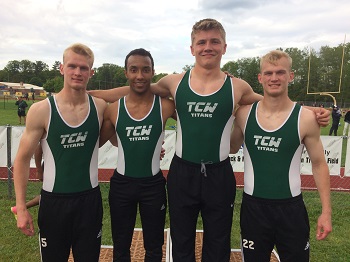 Twins Donovan and Dalton Michael lead off the relay, followed by Lukas Sawusch and Erik LaBonte. Dalton Michael was the state’s Mr. Soccer in the fall.
“We’re all multi-sport athletes,” LaBonte said. “We’ve been working together the whole (spring). We’re getting better.”
The Titans placed seventh in the relay a year ago, but Donovan Michael is the only returnee. Dalton missed his junior season of track with a dislocated knee. LaBonte was bothered by a hip injury.
But that’s in the past.
“We’re coming into (Saturday) knowing we’re a good team,” Donovan Michael said. “If we have a good day, we could do really well.”
Coach Tom Brown said the Titans will need a school record-breaking performance to be in the hunt. The 42.63 in the Regional tied the school mark.
“I think we’ll have to run in the 41s,” Brown said. “That’s something Rockford did (41.6 at the Michigan Interscholastic Track Coaches Association state team meet last weekend).”
Detroit Cass Tech, led by three Big Ten football recruits, won the 400 relay last June in 42.26.
“I think we can go faster,” Sawusch said. “Our handoffs haven’t been great, so we need to work on that this week.”
Focusing on the exchange zone has been a point of emphasis in practice.
“The 4X1 is all about handoffs,” Brown said.
The Titans believe they have the speed.
“We’ve had 22 kids in school history run sub-11.3 – 18 different kids in the last seven years,” assistant coach Jason Morrow said. “The kids have worked hard at it.”
LaBonte, who also plays football, is the lone underclassmen in the group. Sawusch is headed to Spring Arbor to run track. The Michaels will play soccer at Western Michigan University. Dalton, who earned All-American honors from the National Soccer Coaches Association, became the second Titan to win Mr. Soccer, after Casey Townsend earned the honor in 2006 and 2007. Dalton had 29 goals and eight assists this past fall for West. Donovan added 20 goals and 20 assists.
What would it be like to add a Division 1 championship medal in track to his Mr. Soccer award?
“It would be a dream come true,” Dalton Michael said. “It would be one to remember.”
 Dennis Chase worked 32 years as a sportswriter at the Traverse City Record-Eagle, including as sports editor from 2000-14. He can be reached at [email protected] with story ideas for Manistee, Wexford, Missaukee, Roscommon, Ogemaw, Iosco, Alcona, Oscoda, Crawford, Kalkaska, Grand Traverse, Benzie, Leelanau, Antrim, Otsego, Montmorency, Alpena, Presque Isle, Cheboygan, Charlevoix and Emmet counties.
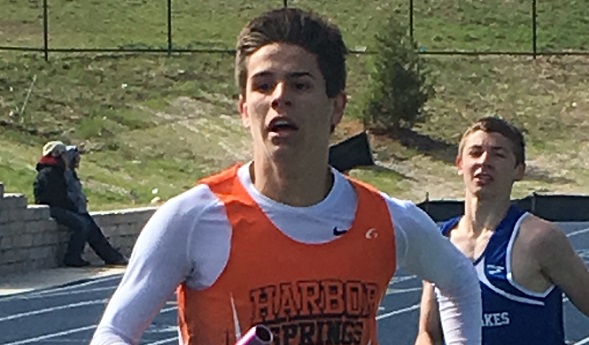
PHOTOS: (Top) Harbor Springs’ Jeremy Kloss carries the baton during a relay this season. (Middle top) Gaylord’s Casey Korte lands a long jump. (Middle below) Benzie Central’s Braydon Huddleston. (Below) Traverse City West’s 400 relay, from left: Dalton Michael, Lukas Sawusch, Erik LaBonte, Donovan Michael. (Top photo courtesy of the Kloss family, middle top photo courtesy of the Gaylord Herald Times.)