


MHSA(Q&)A: Gibraltar Carlson cheer coach Christina Wilson
February 17, 2012
 After cheering through middle and high school, Gibraltar Carlson competitive cheer coach Christina Wilson started coaching the Marauders’ middle school team the season after she graduated from Carlson High in 2001. She took over the varsity team in 2007 – and has accomplished in a short time what many coaches hope for over decades.
Carlson has won three of the last four MHSAA Division 2 championships – also finishing runner-up in 2010 – and is ranked No. 1 in its division heading into District competition this weekend. The Marauders have had a strong program throughout the history of competitive cheer as an MHSAA sport – they won the Class B championship in 1995 under Pat Christiansen and finished runners-up three straight seasons after that – but are on a run unequaled over the last five seasons.
Bowling Green, Eastern Michigan and Oakland’s cheer teams now boast former Carlson athletes, and all of this success could be just the start – Wilson may have accomplished a lot early in her career, but she said she hopes to keep the Marauders rolling for years to come.
What kind of things did you learn from your high school coach that you still teach today?
As soon as I started coaching middle school – we also got a new coach at the varsity level as well, so we had new coaching throughout the program at that time – I took and got the resources from our former coach in ’95 (Pat Christiansen) and started using all her resources. Everything she implemented and used for her teams, I took and continue to use today
Her daughter (Tami) coached with her in ’95 when we won the state championship, and she recently came back in 2010 as one of our assistants. She brought back that mentality of ’95 of working hard … the harder the practices the more successful you’ll be … make practices count enough so on Saturdays you can be as prepared as you can be … and the importance of making of making good decisions, in practice and outside sports as well.
Your program had success previously. But what happened to take Gibraltar Carlson to the next level?
I started coaching middle school, and by the time I moved up to varsity all (my) rules and procedures, the kids were used to it and it was (the same) throughout the program. It was becoming a program-wide thing to become excellent. It wasn’t just team by team, and I think that helped. We hold our kids to really high standards, and we’re expected to reach our goals and expectations.
What is the one big thing your athletes take away after four years of being part of your program?
We have the mementos and the championship rings and those things. But I think it’s a sense of pride. It gives them a sense of self. They know they can have goals, and if they work hard they can achieve those goals. If they put their minds to something, it’s something they can grasp if they work hard. I think that whole mentality of working hard, pursuing goals and teamwork is instilled right from the get-go, and something they take with them when they leave the program.
How do you stay ahead of the competition?
It’s not easy. We go to several camps; there’s a champion cheerleading camp we go to every summer. We work with college teams too; they come and show us things they do and teach us things. We take some kids every once in a while to out-of-state clinics (Kentucky, Bowling Green, etc.). We really try a diversity of things to get the girls out there and experiencing things. The techniques and ideas, it’s all about seeing something and then adding that to imagination to come up with whatever knows what.
Why are your teams so consistent?
We hold them to high expectations. We have gymnastics classes that they regularly attend, and on their own they go to the gymnastics facility once or twice a week extra on top of that to stay on top of their skills stay among the best athletes in state. One thing we do every year is we create a huge goal board. What we do after we start competing, is every Monday we check off what we’ve completed on the goal board. It’s not just a mental aspect, but it’s visual. Every week focus on something we try to achieve.
What do you enjoy most about coaching?
I love working with the kids. They’re funny. Practice is something new every day; you never know what you’re going to get. It’s so much fun. (And) competing is fun. I like the aspect of competition, the intensity of it. That’s lots of fun too. Winning is fun.
This is the sport Gibraltar Carlson has become known for, the one in which it’s had the most success lately.
It’s starting to grow. People look at cheerleading like, “Oh, it’s cheerleading.” We are definitely gaining the respect of other coaches and other programs, other sports and teachers and the student body. The really cool thing is when people start to look at the sport and realize how physically demanding it is. It makes us feel good to hear when other coaches say they think maybe the cheerleaders might be some of the best athletes in this school.
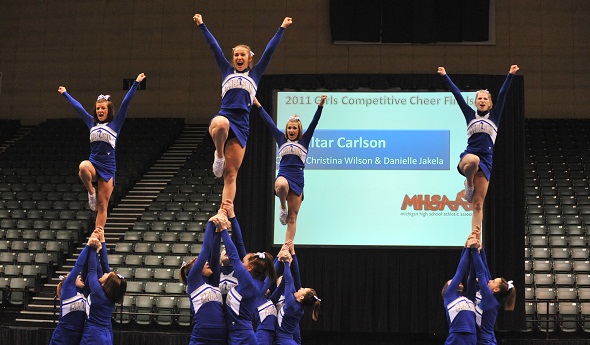 PHOTO from last season's MHSAA Division 2 Final at the Grand Rapids DeltaPlex.
Mostly-New Carlson, Same Finals Result
March 7, 2015
By Dean Holzwarth
Special for Second Half
GRAND RAPIDS – The return of only two seniors and the addition of a new coach made some wonder if the Gibraltar Carlson competitive cheer team could keep its string of consecutive MHSAA Division 2 titles intact.
The Marauders put those questions to rest by delivering another sterling performance with a squad comprised of mostly underclassmen.
Gibraltar Carlson won its fifth straight MHSAA Finals on Saturday at The DeltaPlex with a three-round total of 784.88.
It prevailed over runner-up DeWitt (778.36), which edged third-place and four-time reigning runner-up Dearborn Divine Child (778.24) by 12 hundredths of a point.
“There was lot of pressure, especially this year because we only had two seniors,” senior Sheridan Skopczynski said. “You don’t want to be the seniors that lose it for everyone, and we had a streak going. We love the pressure and we had a lot of people to prove wrong this year. We pushed through every single day and we knew we could do it.”
The Marauders’ other senior, Kersten Gant, said it was vital to keep the tradition going despite losing several key seniors from a year ago.
“You never want to disappoint the seniors from before, and you always have a reputation to uphold,” she said.
“Everybody really counts on you every year, and the younger girls look up to you.”
First-year coach Aryn Ziesmer took over the reins of the perennial state powerhouse after previously coaching at Southgate Anderson.
“I came from the three-time Division 1 state champions, so I kind of knew going into how to get that out of them,” Ziesmer said. “We won Districts, we won Regionals and this was just another day on a bigger caliber. If you go in as the defending Regional champions it makes your confidence that much higher.”
The addition of a talented freshman group helped propel the Marauders. Eleven freshmen took the floor Saturday for the first time on the biggest stage.
In fact, only three girls had ever competed at the Finals previously.
“Everybody always says how do you do it with 11 freshmen, but they want it with everything they have in them,” Ziesmer said. “Our freshmen are the heart of this team.”
Skopczynski said it took time for the freshmen to become acclimated to a new environment.
“Those freshmen, it took them a month or so to get their confidence up, but once we got it going we were on fire,” she said. “They’re just great and such confident performers. I can’t wait to see what these next three years hold for them.”
Gant has been on the team since she was a freshman. She was overcome with emotion after realizing her senior year would end with another MHSAA Finals crown.
“Oh, it feels great,” Gant said. “This is my fourth title, and I’m so happy that I got to share it with all the freshmen and everyone else. I’m so proud of them.”
Gibraltar Carlson tallied the high score in Round 1 with a 235.2, while Allen Park (232.8) edged Divine Child (232.5) and was in second place.
 Divine Child was superb in Round 2 and posted a score of 230.64 to close the gap heading into the final round.
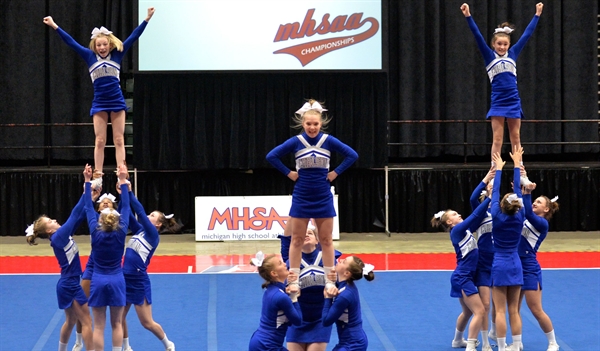
Gibraltar Carlson led Divine Child by less than two points entering Round 3, but produced a high score of 319.8 to seal it.
“We have a more difficult Round 3, and we definitely don’t play it safe,” Ziesmer said “There is a lot of room for error, and the fact that they pulled it off was why we were rewarded with such a high score.”
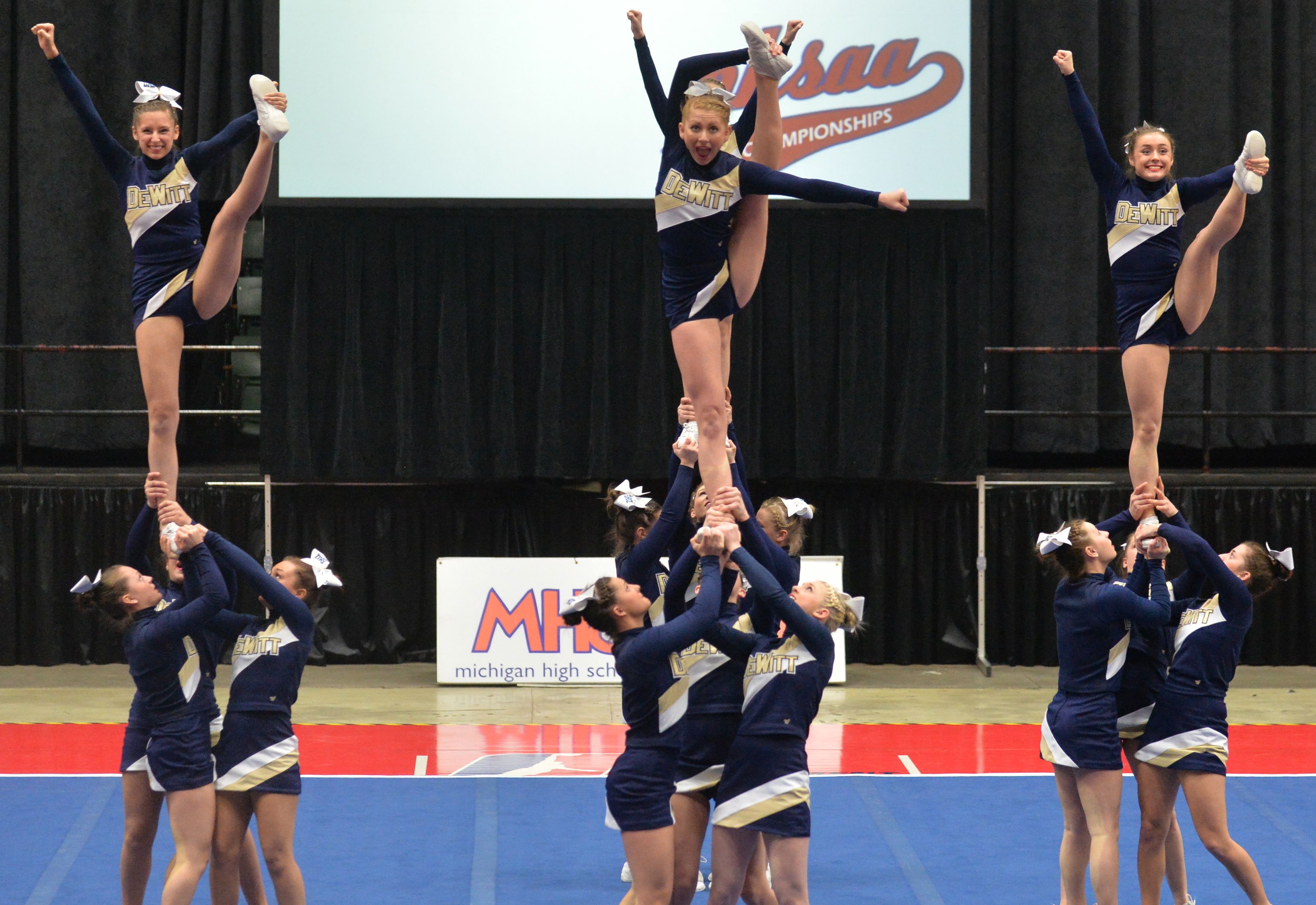
DeWitt pulled off the second-highest score (778.36) in Round 3 to notch its first runner-up finish since 2007.
“Our Round 3 has kind of been our bread and butter all season long,” Panthers coach Candace Heskitt said. “The girls are most comfortable in Round 3, and when they get to do it, that’s their time to shine. They feel at home.”
DeWitt’s roster included only four seniors, but Heskitt said a number of Panthers have been cheering together for many years.
“There’s a core group that have been together for several years, and I think that brings a strength to the team that we have not always had,” she said. “These girls work so hard and they’ve worked hard as a group, which has made it that sweeter.
“Obviously, everybody here is chasing first place and a state title, but before we took the floor the one thing I said was, ‘I want you to walk off the floor feeling like you did your best and had an amazing day’, and that took priority. The girls did a great job.”
PHOTOS: (Top) Gibraltar Carlson performs its routine during Round 3 of Saturday's Division 2 Final. (Middle) DeWitt also competes in Round 3 on the way to finishing runner-up at the Grand Rapids DeltaPlex.