


MHSA(Q&)A: Gibraltar Carlson cheer coach Christina Wilson
February 17, 2012
 After cheering through middle and high school, Gibraltar Carlson competitive cheer coach Christina Wilson started coaching the Marauders’ middle school team the season after she graduated from Carlson High in 2001. She took over the varsity team in 2007 – and has accomplished in a short time what many coaches hope for over decades.
Carlson has won three of the last four MHSAA Division 2 championships – also finishing runner-up in 2010 – and is ranked No. 1 in its division heading into District competition this weekend. The Marauders have had a strong program throughout the history of competitive cheer as an MHSAA sport – they won the Class B championship in 1995 under Pat Christiansen and finished runners-up three straight seasons after that – but are on a run unequaled over the last five seasons.
Bowling Green, Eastern Michigan and Oakland’s cheer teams now boast former Carlson athletes, and all of this success could be just the start – Wilson may have accomplished a lot early in her career, but she said she hopes to keep the Marauders rolling for years to come.
What kind of things did you learn from your high school coach that you still teach today?
As soon as I started coaching middle school – we also got a new coach at the varsity level as well, so we had new coaching throughout the program at that time – I took and got the resources from our former coach in ’95 (Pat Christiansen) and started using all her resources. Everything she implemented and used for her teams, I took and continue to use today
Her daughter (Tami) coached with her in ’95 when we won the state championship, and she recently came back in 2010 as one of our assistants. She brought back that mentality of ’95 of working hard … the harder the practices the more successful you’ll be … make practices count enough so on Saturdays you can be as prepared as you can be … and the importance of making of making good decisions, in practice and outside sports as well.
Your program had success previously. But what happened to take Gibraltar Carlson to the next level?
I started coaching middle school, and by the time I moved up to varsity all (my) rules and procedures, the kids were used to it and it was (the same) throughout the program. It was becoming a program-wide thing to become excellent. It wasn’t just team by team, and I think that helped. We hold our kids to really high standards, and we’re expected to reach our goals and expectations.
What is the one big thing your athletes take away after four years of being part of your program?
We have the mementos and the championship rings and those things. But I think it’s a sense of pride. It gives them a sense of self. They know they can have goals, and if they work hard they can achieve those goals. If they put their minds to something, it’s something they can grasp if they work hard. I think that whole mentality of working hard, pursuing goals and teamwork is instilled right from the get-go, and something they take with them when they leave the program.
How do you stay ahead of the competition?
It’s not easy. We go to several camps; there’s a champion cheerleading camp we go to every summer. We work with college teams too; they come and show us things they do and teach us things. We take some kids every once in a while to out-of-state clinics (Kentucky, Bowling Green, etc.). We really try a diversity of things to get the girls out there and experiencing things. The techniques and ideas, it’s all about seeing something and then adding that to imagination to come up with whatever knows what.
Why are your teams so consistent?
We hold them to high expectations. We have gymnastics classes that they regularly attend, and on their own they go to the gymnastics facility once or twice a week extra on top of that to stay on top of their skills stay among the best athletes in state. One thing we do every year is we create a huge goal board. What we do after we start competing, is every Monday we check off what we’ve completed on the goal board. It’s not just a mental aspect, but it’s visual. Every week focus on something we try to achieve.
What do you enjoy most about coaching?
I love working with the kids. They’re funny. Practice is something new every day; you never know what you’re going to get. It’s so much fun. (And) competing is fun. I like the aspect of competition, the intensity of it. That’s lots of fun too. Winning is fun.
This is the sport Gibraltar Carlson has become known for, the one in which it’s had the most success lately.
It’s starting to grow. People look at cheerleading like, “Oh, it’s cheerleading.” We are definitely gaining the respect of other coaches and other programs, other sports and teachers and the student body. The really cool thing is when people start to look at the sport and realize how physically demanding it is. It makes us feel good to hear when other coaches say they think maybe the cheerleaders might be some of the best athletes in this school.
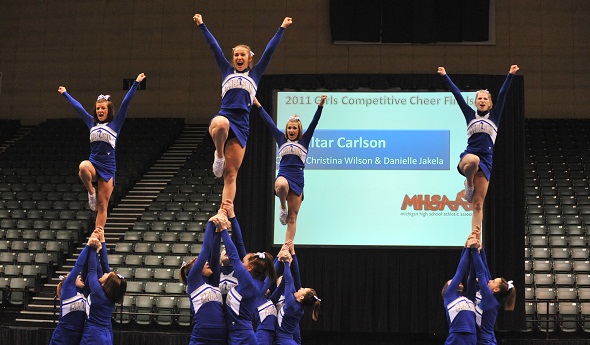 PHOTO from last season's MHSAA Division 2 Final at the Grand Rapids DeltaPlex.
The Center for D4 Cheer Champions
March 2, 2013
By Dean Holzwarth
Special to Second Half
GRAND RAPIDS – The Michigan Center competitive cheer team didn’t perform to its full potential in Round 3 of the MHSAA Division 4 Final.
A strong Round 2 performance prior to that more than made up for it.
The Cardinals sputtered in their final round Saturday afternoon at the DeltaPlex, but it didn’t prevent them from pulling off the three-peat.
Michigan Center won its third straight MHSAA Division 4 crown by less than four points over runner-up Pewamo Westphalia.
The Cardinals tallied a three-round score of 731.26, while the Pirates made a late charge and finished with a 727.52.
“If it wasn’t for having such a strong Round 1 and Round 2 score, we wouldn’t have won this competition,” Michigan Center coach Jessica Trefry said. “We struggled a little bit in Round 3, and unfortunately it wasn’t as high as we hoped to be. But as a whole, we did enough to get it done.”
Michigan Center, which also won the title in 2009 before its current run, took a commanding 11-point lead following a dominating Round 2 that has been its trademark.
The Cardinals, who didn’t get outscored in Round 2 all season, registered a score of 219.96 to provide a much-needed cushion entering the final round.
“Round 2 has been a strength of ours all year, and my girls are incredible athletes and are strong with their skills in that round,” Trefry said. “I tell them that no one can out-do them in that round, and it’s true. It is an amazing group that is so in sync and powerful.”
Michigan Center had an early fall in Round 3, and its score (288.1) was the second lowest of the eight teams.
The team, however, recovered from the early miscue.
“I did take a fall, but it didn’t matter because I knew the rest of the round I had to stick everything perfectly,” said Michigan Center’s Megan Shown, the team’s lone senior. “In every round I knew we could dominate in, and obviously we did. This is amazing, three of them in a row back-to-back-to-back. I can’t believe it. I’m a senior, so it’s the best way to go out.”
Pewamo-Westphalia was seeking its ninth MHSAA title, and first since 2010, but wound up with a runner-up finish for the third straight year.
“It was hard to come back from that difference in Round 2, but they did amazing,” Pirates coach Staci Myers said. “It is the best they’ve ever done in all three rounds, and I couldn’t be prouder. We were excited to be here, and to come out with a medal and second place.”
Pewamo Westphalia narrowed the gap on Michigan Center by delivering the second-highest Round 3 score.
“They came out and hit Round 3, and I couldn’t ask them to do anymore,” Myers said. “It was the best they have performed it this year, and we were able to stay in second.”
Michigan Center defended despite graduating nine seniors from last year’s squad, and with the return of all but one for next season, the future remains bright.
“We returned some strong athletes, and they had this in their mind from the very beginning,” Trefry said.
“This was their goal, to be here and win it again. I have a big group of juniors, and now they want to get it done again next year. It gets harder and harder every year, but I’m proud of this group and the effort they’ve put in this year. I’ve enjoyed this year.”
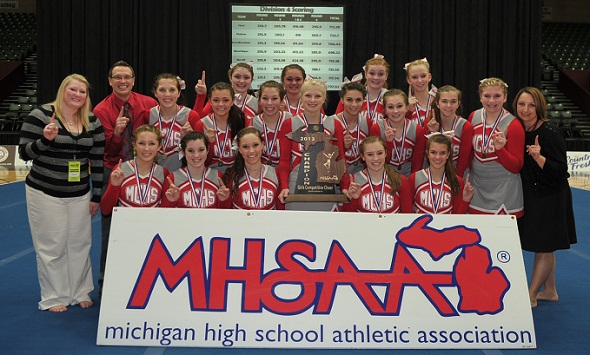
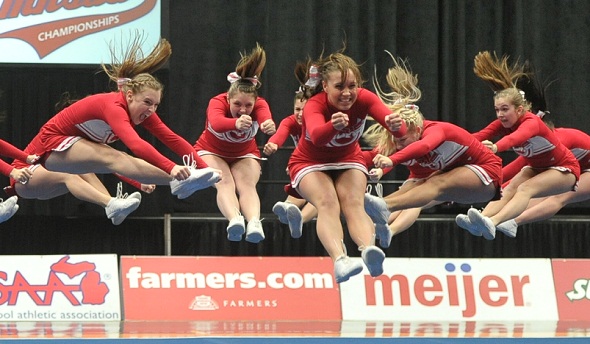
PHOTOS: (Top) Michigan Center competes during Saturday's Division 4 Final at the DeltaPlex. (Bottom) Michigan Center poses with its latest MHSAA championship trophy. (Photos by Hockey Weekly Action Photos.)