

Be the Referee: Field Hockey Substitutions
By
Paige Winne
MHSAA Director of Brand Management
October 27, 2026
Be The Referee is a series of short messages designed to help educate people on the rules of different sports, to help them better understand the art of officiating, and to recruit officials.
Below is this week's segment – Field Hockey Substitutions - Listen
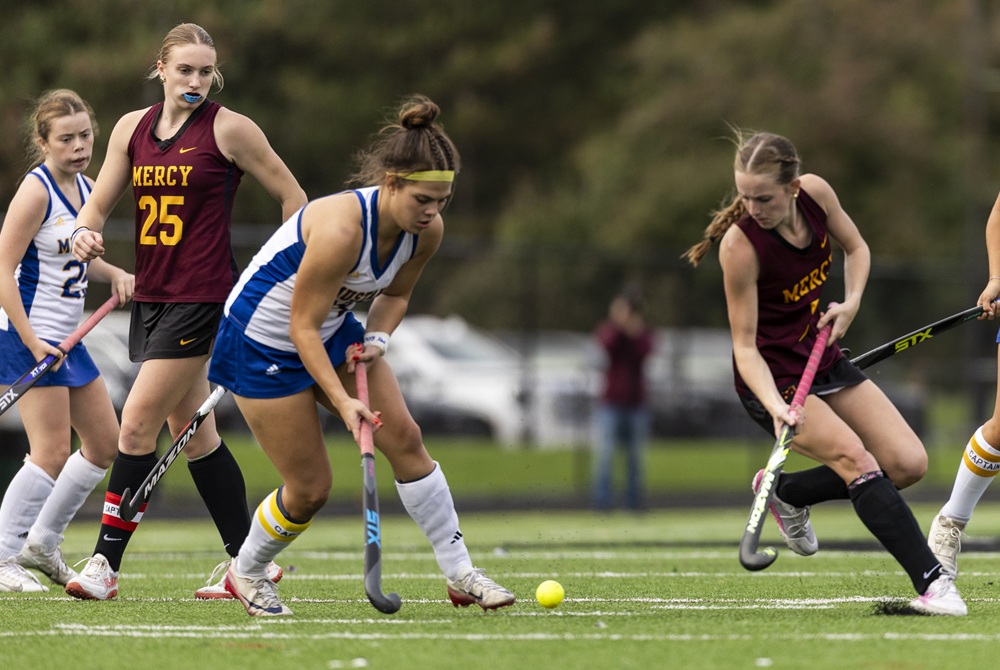
We’re on the pitch today for a field hockey “You Make the Call.”
The white team is awarded a penalty corner. During the penalty corner, a red team substitute enters the field but does not participate in or affect play.
Should the official stop play immediately or allow play to continue?
If you said allow play to continue, you are correct. Since the illegal substitute has not participated in or affected play, stopping play immediately would give the defending team an unfair advantage by interrupting the attacking team's scoring opportunity.
Under NFHS Rule 4-4-3, substitutions are not permitted during a penalty corner, except to replace an ill, injured, suspended or disqualified goalkeeper. Officials must recognize the violation and know when to hold the whistle to allow for advantage.
Previous 2026-27 editions
Oct. 20: Foot Save in Volleyball - Listen
Oct. 13: Soccer Advantage - Listen
Oct. 6: Defensive Holding - Listen
Sept. 29: Minimum Number of Volleyball Players - Listen
Sept 22: Soccer Changes - Listen
Sept: 15: Dead Ball Penalty - Listen
Sept. 8: Libero Ejected - Listen
Sept. 1: Soccer Foul After Shot on Goal - Listen
Aug. 25: Fumble Out of Bounds - Listen
(Photo by KMS Photography.)

“Who Needs This?”
May 24, 2013
One of the best barometers we have for informing us of the health of Michigan’s economy is to examine the number of registrations to be an MHSAA official. When the economy is poor, registrations trend upward; when the economy is improving, registrations decline.
Well, business must be booming in Michigan! Since the 2007-08 school year we’ve fallen almost 2,000 registrations.
Some of this decline can be explained away by the fact that registrations spiked upward when we allowed some free registrations in volleyball and basketball following the 2007 court-ordered changes in the girls volleyball and basketball seasons. But most of the recent decline – certainly the 1,000 decline of the past two years – is unrelated to discontinuing those promotional efforts; and it’s unrelated to a very reluctant resurgence in Michigan’s economy.
What is at work here now are two newer forces that frustrate efforts to maintain a pool of officials that is adequate to handle all the contests of a broad and deep interscholastic athletic program, and to handle those contests well:
- The first is the rise of social media and “instant criticism.” Spectators not only can critique calls before the official gets home from the game, those spectators can do so during the game. Their biased comments – and photos – can go worldwide before the official has left the venue! Really, who needs this? There have got to be less stressful hobbies.
- The second factor is the increased dependence on assigners. As local school athletic directors’ jobs became larger and more complicated, and as they were often given less time to do those jobs, more have had to turn to local assigners who will hire contest officials for groups of schools in one or more sports. As assigners built their little kingdoms, new officials have found it harder to break in and obtain a rewarding number of assignments. Many officials who have found themselves out of sorts with a local assigner have said, “Really, who needs this?” They find more fulfilling ways to spend their time.
The fact is that school-based sports – educational athletics – needs officials. We need them.
We need more officials and we especially need more young officials. Officials are vital members of the team that is necessary to provide a school-based sports program that actually does what it says it does – and that is to teach life lessons, including fair play and sportsmanship.