

1st & Goal: 2026 11-Player Semifinals Preview
By
Geoff Kimmerly
MHSAA.com senior editor
November 20, 2026
Seven of last season’s eight MHSAA 11-Player Football Finals champions have reached this year’s Semifinals – but that’s hardly a guarantee they’ll stroll right into playing at Ford Field again next weekend.
 Saturday’s 16 Semifinals are filled with programs that are plenty familiar with playing at this late November date. And those that are not have accomplished more than enough this fall to feel confident they can keep the run rolling all the way to Detroit.
Here's a glance at all 16 games, with all set to kick off at 1 p.m. unless noted. All games can be watched on the NFHS Network at the links provided.
Division 1
Detroit Catholic Central (11-1) vs. East Kentwood (12-0) at Jackson WATCH
This is a rematch of a 2025 Semifinal won by reigning Division 1 champion DCC 46-6. Shamrocks senior quarterback Duke Banta returned from injury last week, and they also can turn to senior running back Ryan Jaafar (1,169 yards/12 touchdowns rushing) in the ground game. East Kentwood has plenty of air power with senior quarterback Colin O’Connor throwing for 2,750 yards and 33 touchdowns, finding senior receiver Steph Jones for 1,206 yards and 18 scores.
Detroit Cass Tech (12-0) vs. Romeo (12-0) at Troy Athens WATCH
Cass Tech is playing to make a third straight Finals trip to Ford Field, and junior quarterback Donald Tabron II has continued to set the pace throwing for 2,133 yards and 30 touchdowns this fall. Romeo is coming off its first Regional title since 2016 and is fueled by a rushing attack averaging 276 yards per game. Senior running back Landen Fetty is averaging 11.1 per carry with 947 total and 15 touchdowns on the ground.
Division 2
Muskegon Mona Shores (11-1) vs. Milford (11-1) at Battle Creek Harper Creek WATCH
Milford is playing in its first Semifinal after avenging a Week 4 31-point loss to South Lyon to claim a Regional title. Senior quarterback Hudson Smith has thrown for 1,791 of the team’s 2,602 passing yards and 14 of the team’s 26 touchdowns through the air. Mona Shores is coming off its first Regional title since 2020 and features a pair of accomplished rushers in senior running back Kevin White (1,174 yards/15 TDs) and junior quarterback Owen Terpstra (1,369/23).
Orchard Lake St. Mary’s (9-3) vs. Grosse Pointe South (11-1) at Novi WATCH
Reigning champion St. Mary’s has enjoyed another massive season from senior quarterback Jabin Gonzales, who has thrown for 2,456 yards and 33 touchdowns and run for seven scores. Grosse Pointe South senior quarterback Sam Rouleau is a serious two-way threat as well, throwing for 2,185 yards and 25 touchdowns and running for 733 yards and 14 scores.
Division 3
Zeeland West (10-2) vs. DeWitt (10-2) at Caledonia WATCH
This is a rematch of a 2024 Semifinal won by West, and after losing that day the Panthers marched to last season’s Division 3 championship. Senior quarterback Griffin Braman has taken the reins of the DeWitt offense throwing for 1,581 yards and 19 scores and running for 1,160 yards and 19 touchdowns. West’s rushing attack is chewing up yards again, totaling 4,236 to this point led by senior running back Brandon Holman (1,378/20 TDs) and junior back Kenny Howe (1,057/10).
Chelsea (12-0) vs. Harper Woods (10-2) at Ypsilanti Lincoln WATCH
These two opened the season together, with Chelsea winning their Week 1 matchup 29-20. The Bulldogs also have topped 4,000 yards rushing with senior running back Gibby Ichesco gaining 1,523 with 21 touchdowns and junior quarterback Jax Ichesco 1,226 and 19, respectively. Senior Dakota Guerrant and junior Deandre Bidden are one of the most talented receiving tandems in the state, with Guerrant leading Harper Woods in both rushing with 772 yards and 18 touchdowns and receiving with 976 yards and 12 scores, and Bidden following with 698 yards and 11 scores rushing and 603 and eight, respectively, receiving.
Division 4
Grand Rapids South Christian (11-1) vs. Grand Rapids Kenowa Hills (11-1) at Rockford WATCH
These past league rivals will face off for the first time since 2023, with Kenowa Hills riding an 11-game winning streak after losing its season opener to DeWitt. There may not be a more balanced offense in the state as the Knights have run for 2,634 yards and thrown for 2,632, led by senior running back Lundon Hampton (1,740 yards/36 TDs rushing) and senior quarterback Grayson Fellows (2,588/25 passing). Senior quarterback Austin Burgess is a dual-threat standout leading South Christian’s multi-faceted attack with 903 yards and 11 touchdowns passing and 11 touchdowns rushing as well.
Detroit Country Day (9-3) vs. Dearborn Divine Child (11-1) at Rochester Adams WATCH
Reigning Division 4 champion Divine Child has won all three meetings with Country Day since they began playing annually in 2024, including 14-7 in Week 3 now that both are part of the Catholic High School League AA. Junior quarterback Drew Sheridan led last year’s Falcons title march and has thrown for 3,315 yards and 34 touchdowns. Country Day is back in the Semifinals for the first time since 2022 and after missing the playoffs the last three seasons. Junior Jacob Patton has run for 1,454 yards and 24 scores.
Division 5
Ogemaw Heights (10-2) vs. Grand Rapids West Catholic (10-2) at Big Rapids WATCH
This is another Semifinal rematch from a year ago, won then by West Catholic 34-24 on the way to claiming the Division 5 title. Senior running back Collin Abram has shouldered the majority of the Falcons’ rushing attack with 1,576 yards and 28 touchdowns. Junior Brenson Keith has done the same for Ogemaw Heights, piling up 2,080 yards on the ground.
Monroe Jefferson (11-1) vs. Frankenmuth (11-1) at Rochester Hills Stoney Creek WATCH
Jefferson is making a return trip to the Semifinals, and senior quarterback Luke Beaudrie has been among constants during the program’s emergence. The Bears are a combined 22-3 over the last two seasons. Frankenmuth is seeking to reach Ford Field for the fourth time over seven seasons, piloted this time by junior quarterback Noah Main, who has thrown for 1,625 yards and 19 touchdowns and run for 794 yards and 18 scores.
Division 6
Kingsley (12-0) vs. Almont (12-0) at Clare WATCH
These two last faced off in the 2023 Division 6 championship game, won by Kingsley, and the rematch might ride on which team’s defense slows down the opposing attack. Senior running back Perry Smith averages nearly 10 yards per carry for the Stags, while senior running back Brody Corneau (1,331 yards/22 TDs) has carried a significant share of the load in getting the Pirates back to the Semifinals for the second straight season and third time in four years.
Detroit Edison (11-1) vs. Jackson Lumen Christi (10-2) at Westland John Glenn WATCH
These two also met in a season opener, with Lumen Christi winning 39-21. The Titans are seeking to extend a four-year Finals title streak, and the win in this Semifinal will tie head coach Herb Brogan with Farmington Hills Harrison’s John Herrington for the state’s all-time lead in football coaching victories at 443. Edison will work to push that achievement to next season, and has given up more than 20 points only once since that Week 1 loss.
Division 7
Ithaca (11-1) vs. Menominee (11-1) a Gaylord (2 p.m.) WATCH
Ithaca has made its reputation over the years for high-scoring offense, but the story this season really has been its defense, which has given up 80 points all season. That said, senior quarterback Gibson Rondy has thrown for 2,510 yards and 32 touchdowns and run for 709 and seven scores. Menominee has won 25 of its last 26 games – including last year’s Final – and senior Jackson Myszak has taken on a starring role running for 1,377 yards and 24 scores for an offense that has reached 38 points nine times.
Ottawa Lake Whiteford (10-2) vs. Ravenna (10-2) at Mattawan WATCH
Ravenna’s first Semifinal trip since 2010 has included avenging a regular-season loss to North Muskegon, while Whiteford has reached this round for the first time since 2023 thanks in part to avenging its season-opening defeat to Monroe St. Mary Catholic Central. Ravenna’s attack runs through junior halfback Brady Kachinski (1,123 yards/15 TDs rushing) and senior halfback Jaxson Wilburn (909/15 rushing), while Whiteford has enjoyed a stat-packing performance from senior Brek Ruddy (2,136 yards/33 TDs rushing, 422 yards/4 TDs receiving).
Division 8
Beal City (12-0) vs. New Lothrop (11-1) at Alma WATCH
This will be Beal City’s fourth Semifinal this decade, and the Aggies have wins over Ravenna and Ithaca in addition to winning all three of their playoff games by at least 29 points. Ten players have run for at least one touchdowns for Beal City, and senior running back Avery Small is averaging 19 yards per carry as the team’s leading rusher. New Lothrop is a two-point Week 3 loss to Montrose from a perfect season as well, and the Hornets are averaging 42 points per game directed by junior quarterback Karson Agnew (1,654 yards/25 TDs passing, 939 yards/16 TDs rushing).
Madison Heights Madison (10-2) vs. Hudson (11-1) at Redford Union WATCH
Last season’s runner-up Hudson is a win away from playing for the title again and coming off scoring a season-high 61 points last week against Springport. Junior running back Beckett Campbell is over 2,000 yards rushing again for the Tigers, this time with 2,132 and 25 touchdowns on the ground. Madison is back in a Semifinal for the first time since 2018 and has outscored its three playoff opponents by a combined 131-29.
MHSAA.com's weekly “1st & Goal” previews and reviews are powered by MI Student Aid, a division within the Department of Lifelong Education, Advancement, and Potential (MiLEAP). MI Student Aid encourages students to pursue postsecondary education by providing access to student financial resources and information. MI Student Aid administers the state’s scholarship and grant programs that help make college Accessible, Affordable and Attainable for you. Click to connect with MI Student Aid and find more information on Facebook and Twitter @mistudentaid.
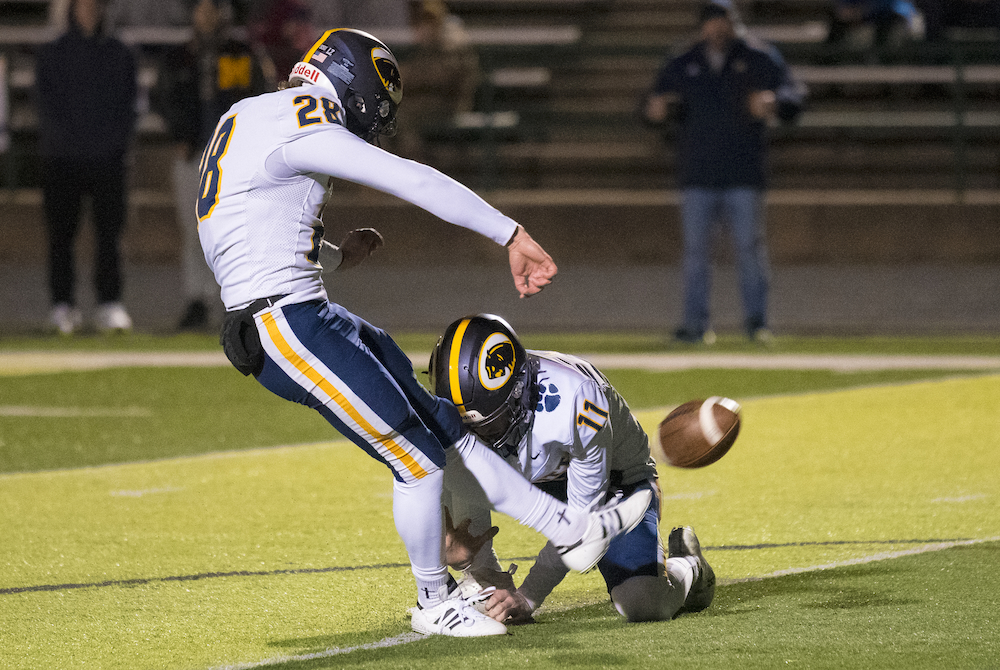
PHOTO DeWitt kicker Vincent Rose (28) steps into an extra-point attempt, held by teammate Isaac Bean. (Photo by TCP Photography.)
Culmination of Ideas, Cooperation Lead to Creation of MHSAA Football Playoffs
By
Ron Pesch
MHSAA historian
August 26, 2022
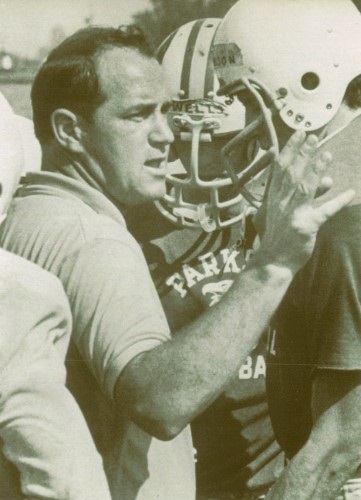
In November of 1972, Dave Driscoll, football coach at Jackson Parkside, was talking by phone with Larry Paladino of The Associated Press about the goals of the recently-formed Michigan High School Football Coaches Association (MHSFCA).
“Football has been around a long time in Michigan, and we just haven’t moved forward as other sports have. Now with an organization to speak and help us, I think we will see some real movement …”
Driscoll, president of the MHSFCA, was pitching the idea of a football postseason in Michigan – a goal of the young organization.
“It took us a couple of years to get it done,” recalled Driscoll, now age 86 and still in the Jackson area. “The first year or two was a challenge because that’s when you’re instituting something. But it has turned out to be a very progressive, positive influence in the state.”
A Postseason
Michigan was one of only 20 states that did not conduct a football playoff, and the sport was the only one sponsored by the MHSAA that did not have a tournament to determine champions. Newspaper ranking systems, in use since the early 1940s in Michigan, were the method by which football teams were awarded “state titles.” Prior to that, schools with undefeated marks against in-state opponents could make a rightful claim to a championship. Because there was no postseason system in place for teams to square off, those are referred to as “mythical” titles.
A state gridiron playoff had been discussed for many years. But, as a cold weather state, few could see a way to devise an equitable system to accomplish the task. With basketball, every high school squad qualified for the annual MHSAA Tournament. Logistically and geographically, the concept of a football postseason presented numerous challenges. Unpredictable late fall weather meant the season could be expanded by only a couple of weeks. That limited the number of teams that could be involved.
 Yet Colorado and Massachusetts, both with weather that could replicate Michigan’s in late autumn, hosted football postseasons.
“They just extend the season by two weeks,” said Driscoll, the MHSFCA spokesperson at the time. “They divide the state by regions. If you win a region, you have a semifinal game the next week, then a final a week after that in each class.”
The MHSFCA, broken into 18 regions across the Upper and Lower Peninsulas, recognized that was far too many to work within a two-week playoff system. So, determining the teams that would participate in the tournament was a major concern.
“Ohio rates its teams by computer. Pennsylvania has a system for it. … Our association would have to investigate these and come up with the best one for our situation,” Driscoll said.
Only eight months old, the MHSFCA planned to present its research, and a possible approach, to the Michigan High School Athletic Association. Driscoll had spoken to both Allen W. Bush, MHSAA executive director, and Vern Norris, associate director, about the goal.
“They’re listening,” he told the press. “If we can come up with a feasible plan, I think they’re willing to listen. We hope to have playoffs in two or three years.”
So the MHSFCA went to work, scheduling meetings around the state – talking with, and listening to, membership.
“We’re not going to press for any certain system at this time. It will take time to work out the details. We just want to sell the idea,” Driscoll said.
The MHSFCA recognized it could take a while.
“Iowa had to present the playoff five years before it was approved,” noted Driscoll.
While the administrative wheels turned, the MHSFCA worked on developing a point system designed to reward teams based on strength of schedule. The goal was to create a test – ideally during the 1973 season – designed to prove the concept, with the hope for an actual playoff in the fall of 1974.
One thing almost certain to occur, if a system could be developed, would be a recasting of those newspaper rankings.
“Indiana had a dry run on their (proposed) playoffs last year and four of the top five teams in the football polls did not make the playoffs on a point system.”
“No matter how honestly polls are conducted,” stated Jim DeLand of the Benton Harbor Herald-Palladium in April 1973, “they inevitably favor unbeaten teams with an easier schedule over teams with a tougher schedule, and say, one loss.”
Financing the Idea
According to the coaches’ group, most football playoffs in other states had been self-supporting and profitable. “Ohio played its semifinals in a doubleheader at the Ohio State stadium last fall and drew 20-some thousand people,” noted Ike Muhlenkamp, coach at St. Joseph High School and Region 5 director of the MHSFCA, in conversation with DeLand. That additional revenue, he noted, could be used to support other things that were coming along, like girls athletics.
MHSFCA regional directors conducted meetings around the state in April 1973 to explain the proposal.
The idea was to use a point system to determine which teams would qualify for play. A school’s classification – Class A, B, C, or D – determined by enrollment size, would be used here as well. Just like basketball, four schools would emerge as champions at the end of the tournament.
“It’s complicated … complicated,” said Bush about the proposal to institute a football playoff just prior to a May pitch by the coaches to the MHSAA Representative Council. “There’s a tremendous mass of bookkeeping involved. Other states are doing it, and we can’t turn our backs on it, but I don’t anticipate it happening this year.”
The Council was receptive to the idea, but it needed examination and testing. The Council called for the assembly of a “Blue-Ribbon panel” of superintendents, principals, athletic directors and coaches from around the state to determine the potential of a football postseason and to explore and address the challenges. Harley Pierce, Sturgis football coach, was named chairman of the committee.
“We’d like to see it operate on paper first,” Driscoll told Dean Howe of the Flint Journal. “That way, we’d know approximately how the real thing would operate.”
“Right now, the Blue-Ribbon committee is studying three point systems, ones used in Ohio, Virginia, and Iowa,” noted Howe. “In Ohio, ratings are done strictly by computer. It costs $5,000 a season to use the computer system.”
In October, the Council asked that the proposed point system be refined.
A key component, as envisioned by the MHSFCA, was to create a system that factored in the quality of competition played by a team during the regular season.
“A team with an 8-1 record might be picked over a 9-0 club by season’s end if that team had played much better competition,” explained Howe.
A special questionnaire was distributed by the MHSAA in February 1974. “By almost a 5 to 1 margin, prep coaches throughout the state supported the playoff,” stated Bob Gross in the Lansing State Journal.
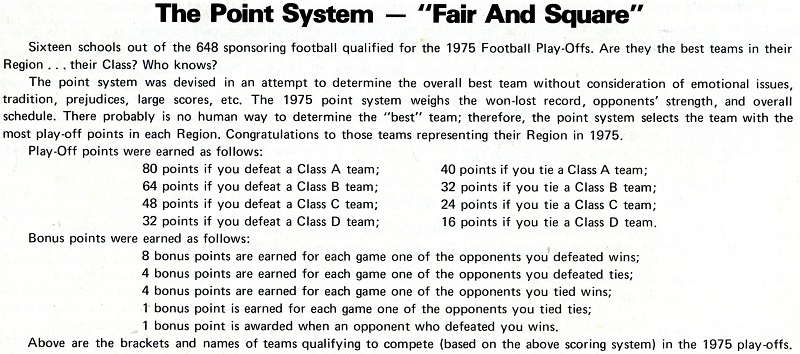 Under the refined system, football game results would be gathered and run through a formula that awarded points based on wins and ties constructed around enrollment classifications, and bonus points for the results of games played by your opponents. League affiliation and margin of victory held no bearing on playoff points awarded.
In May, the Representative Council, acting on the strong support by coaches for a football tournament, instructed staff at the MHSAA to conduct a sample playoff, on paper, during the 1974 season. The approach would serve as a testing ground – a place to run the idea around the track with live data.
The reality of an actual postseason was still, at minimum, a year away. If all worked as intended, the hope was for an actual tournament in 1975 and 1976, with a re-evaluation of the system to follow. But obstacles remained.
“Weather, playing conditions, sites, records of teams and you name it, we’re faced with just about everything when it comes to something like this,” said Bush. “Teams in the U.P. start the regular season two weeks early so naturally they’re finished by the time teams in the Lower Peninsula are in their sixth and seventh games.” If a U.P. team qualified for the proposed tournament, “they’d have to wait two weeks at least to prepare for a playoff.”
In the end, the idea would still need approval by the Association of Secondary School Principals, which had the “final word on all athletic policies.”
“The coaches are on one side of the fence and administrators (on) the other,” Bush continued. “(T)here’s still a lot of work to do before we actually have a playoff.”
Paper and Pencil
University of Michigan’s Bo Schembechler endorsed the idea and stated in a letter to the MHSFCA that he’d like to see the title game played at U-M. Within, he addressed a concern expressed in some administrative circles. At the time, 652 schools in Michigan played football.
“The fact is that only 16 schools will have an extended season,” stated Schembechler. “There should be little, if any, effect on the basic philosophy of scholastic emphasis.”
Michigan State football coach Denny Stolz also wrote a letter to the group stating he, too, favored the playoff system.
Labeled the “Paper Playoffs,” the proof of concept was handled in the old-fashioned manner, as according to Bush, a computer would not be used for point calculations. It would cost too much.
Instead, at schools that believed they deserved consideration, athletic directors were to fill out a rating form after the season’s sixth game with appropriate information about the results of games played. School principals were to sign the form and mail it to the MHSAA. A single MHSAA staff member each week would then manually “tabulate the results and determine the top teams in each class of four regions” and release them for publication.
The resulting rank of teams was expected to be controversial by both the MHSAA and the MHSFCA. Smaller schools beating teams above their enrollment classification would benefit from the system. Larger schools facing smaller schools would receive fewer points for a win than they would by defeating a team within their own classification. As predicted, an undefeated season was no guarantee of a place within the 16-team field of qualifiers.
“After the formula was devised, the coaches applied it to the top teams in the 1973 Class A poll,” stated Dave Matthews in a State Journal article that appeared just prior to the start of the 1974 season. Saginaw Arthur Hill – undefeated, untied, and unscored upon across nine games – had been named state champion in every state newspaper poll. The Lumberjacks had outscored their opponents, 443-0, but would have finished third in their region in the playoff rankings behind both Flint Southwestern (8-1) and East Lansing (9-0). Simply put, Arthur Hill would not have qualified for the playoffs. Based on the formula, both Southwestern and East Lansing had played more challenging schedules than Arthur Hill.
Controversy
Results needed for the first tabulation following the Week 6 games were slow in arriving. As of the Tuesday following the game, the MHSAA had received only 60 forms. With Wednesday as the cutoff date, the first round of calculations didn’t include teams – like undefeated South Haven – that appeared in the weekly newspaper polls. (South Haven’s form didn’t arrive until after the deadline). That illustrated the need for timely reporting.
Comparisons between the press polls and the “paper playoff” rankings were common, and by season’s end, they illustrated the seismic shift that was approaching – and a call for action.
“Football games aren’t won or lost on paper. Neither are state championships,” wrote Roger Neumann in the State Journal in early November as the season headed for its conclusion. “That’s why most mid-Michigan prep coaches are anxious to see the state’s experimental ‘paper playoffs’ taken a step further and put on the gridiron.”
While it appeared a large majority of coaches – and school administrators – favored moving forward, support for the proposed system certainly wasn’t unanimous.
East Lansing coach Jeff Smith questioned the approach.
‘I’m still for a playoff,’ Smith told Neumann. ‘‘But I have some reservations. I’m not sure that the No. 1 team in each region is the best team.” While Smith admitted he didn’t have an answer on how to improve upon the suggested point system in place, he offered a suggestion.
“If we’re going to do this, I think we should do it right and have eight teams in the playoffs (per classification). Eight teams would be more representative. You’d still be going with the elite of the state.”
Smith noted an expanded playoff with three rounds could still be accomplished within two weeks as the MHSAA allowed teams to play every five days.
“With or without such a change, however, Smith said he’d vote for a true playoff, adding, ‘Any playoff is better than no playoff at all. Once you’ve got it, you can always make changes later,” reported Neumann.
The final AP polls, released Tuesday, Nov. 12, showed Birmingham Brother Rice, Muskegon Catholic Central, Hudson, and Traverse City St. Francis as respective state champions in Classes A, B, C, and D, respectively. United Press International (UPI) differed in only Class C, with Battle Creek St. Philip as the top-ranked team, just five points ahead of Hudson.
According to the final “paper playoff” rankings, only Muskegon Catholic and St. Philip would have qualified for postseason play.
Approved
“It’ll be the principals who’ll really decide if there’ll be playoffs,” said Dick Comar, publicity director for the MHSFCA in late January of 1975. The principals were to receive a questionnaire within a week asking their opinion on the proposal. They had until Feb. 24 to cast their vote.
The results of the survey would be presented to the MHSAA Representative Council at its March 21 meeting in Ann Arbor (coinciding with the annual basketball championships at U-M’s Crisler Arena), with a final decision concerning the issue “at that meeting or at their meeting in May.”
On March 22, Bush announced the proposal had passed, indicating that 73 percent of high schools that had responded to the survey had voted in favor of postseason play. Michigan would have a football tournament. Sites and dates were to be determined. The Council requested that semifinal games be played on high school fields, and that, if possible, the final-round contests be played on artificial turf.
By May, the MHSAA had contracted ESR Corporation, a data processing firm in Lansing, to handle the input of weekly game results. Using the same formula developed and tested, ESR would be responsible for calculating point totals to determine the state’s best teams by Class and region.
Norris called the plan “a combination of the best features already in use in Ohio, Iowa, and West Virginia.” He credited former Alpena coach Art Gillespie with doing much of the work for “carrying the ball through the preparation stages.”
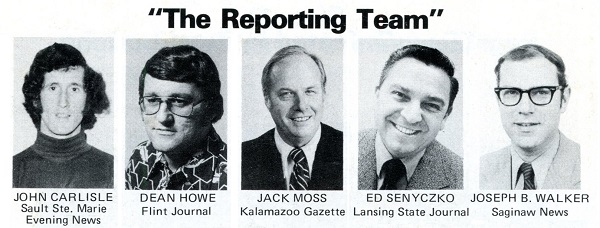
Five members of the media – Howe of the Flint Journal, Jack Moss of the Kalamazoo Gazette, Joe Walker of the Saginaw News, Ed Senyczko of the State Journal, and John Carlisle of the Sault Ste. Marie Evening News – were tasked with capturing the results of games played by 679 schools, including 28 from outside of Michigan, and mailing the results to the MHSAA.
“We’re not interested in the score,” said Bush. “We want to know if a team won, lost, tied, or did not play.”
 In August, the MHSAA announced that state title games would be played at two sites on Saturday, Nov. 22. Western Michigan University would host the Class A and D games, while Class B and C were slated for Central Michigan University.
The four regions used to divide up the state for the annual basketball tournament also were used as the regions for football.
In September, with the results of the season’s first games – played by the state’s Upper Peninsula teams – fed into ESR’s computers, Bush was clear that the final playoff rankings would cause controversy.
“It’s not necessarily the four best teams in the state that will compete in the semifinals,” he said, “but the best in each region.”
The result was both popular and controversial. The papers continued their weekly football polls. The first MHSAA rankings were not released until Oct 8.
UPI was unimpressed: “If the playoffs were held this weekend – which they are not – not a single one of the teams UPI has rated first in the four classes would qualify.”
Hal Schram of the Detroit Free Press expressed a similar emotion.
“The first computerized points were announced last week and there were glaring differences between the media polls and the MHSAA system,” he wrote.
“’There is no reason to attempt a state football championship, and extend the season two more weeks, when you’re inviting only four teams in each class to perform,’ said Joe Vanderhof, veteran sportswriter of the Grand Rapids Press.
Skepticism continued as the weeks went on, culminating in joy for 16 schools – but disappointment for many others – when the final MHSAA rankings were released Nov. 9.
Norway, undefeated in nine games, was the first to experience heartbreak, as U.P. teams finished their season earlier than others. Tied with Ishpeming in the Region 4 Class C rankings, the Knights lost the playoff spot by a tie-breaking formula. Since the two schools had not played each other, a second method was employed to break the deadlock. The summed win-loss percentage of each school’s opponents was compared, with Ishpeming coming out two-tenths of a percent higher. Two of Norway’s top challengers had not played a ninth game. If either had at least tied another contest, Norway would have slipped ahead in the rankings.
“We’ve been ranked … in the AP ahead of Ishpeming all year,” stated Knights coach Bob Giannunzio. “This is hard to swallow.”
Jim Crowley, coach of Jackson Lumen Christi, was also among the disappointed: “You do everything you can and still don’t make it. Undefeated, the team finished No. 1 in Class B according to UPI.”
“But had it not been Lumen Christi,” noted UPI writer Richard Shook, “then it would have been Dearborn Divine Child (missing out). They were both in the same playoff region.”
Trenton in Class A, Divine Child in Class B, Hudson in Class C and North Adams in Class D finished on top in the final AP poll. Only Trenton did not qualify for the postseason. Traverse City topped Trenton in the final UPI and Free Press polls and did qualify. Lumen Christi finished No. 1 in Class B, Hudson in Class C, and Crystal Falls Forest Park – another qualifier – finished on top in Class D in the Free Press.
“I’ve got the best football team in the state,” Trenton coach Jack Castignola told Schram. “I’ve got at least two future Big Ten players. We had three goals at the opening of practice in August, to go unbeaten, win the conference and the state. We’ve been deprived of reaching our final goal and there’s nothing we can do about it. Corrections are going to have to be made in future years.”
Flint Ainsworth, with a 7-2-0 record, ranked 14th in the UPI poll, was the only team unranked and without even honorable mention in the AP poll to qualify for the tournament.
Livonia Franklin, Divine Child, Ishpeming, and Forest Park emerged as the MHSAA’s first gridiron champions. Since that time, various alterations have been made to the football playoffs. Seasons now begin sooner, many more teams qualify for the postseason, and, beginning in 1976, championship games were moved indoors. Today, 10 teams – eight 11-player squads and two 8-player teams – will be awarded titles come November.
But it was the efforts and collaboration of many that got us here.
“There were a lot of great people involved,” said Driscoll, reflecting on those efforts some 50 years later, and emphasizing that he was only one of many individuals on the same team, uniting behind a goal. “We got great cooperation. We had some super coaches and … some administrators that were not afraid to step forward and say, ‘Hey! These are good people and I know if they do it, they’ll do it the right way.’”
 Ron Pesch has taken an active role in researching the history of MHSAA events since 1985 and began writing for MHSAA Finals programs in 1986, adding additional features and "flashbacks" in 1992. He inherited the title of MHSAA historian from the late Dick Kishpaugh following the 1993-94 school year, and resides in Muskegon. Contact him at [email protected] with ideas for historical articles.
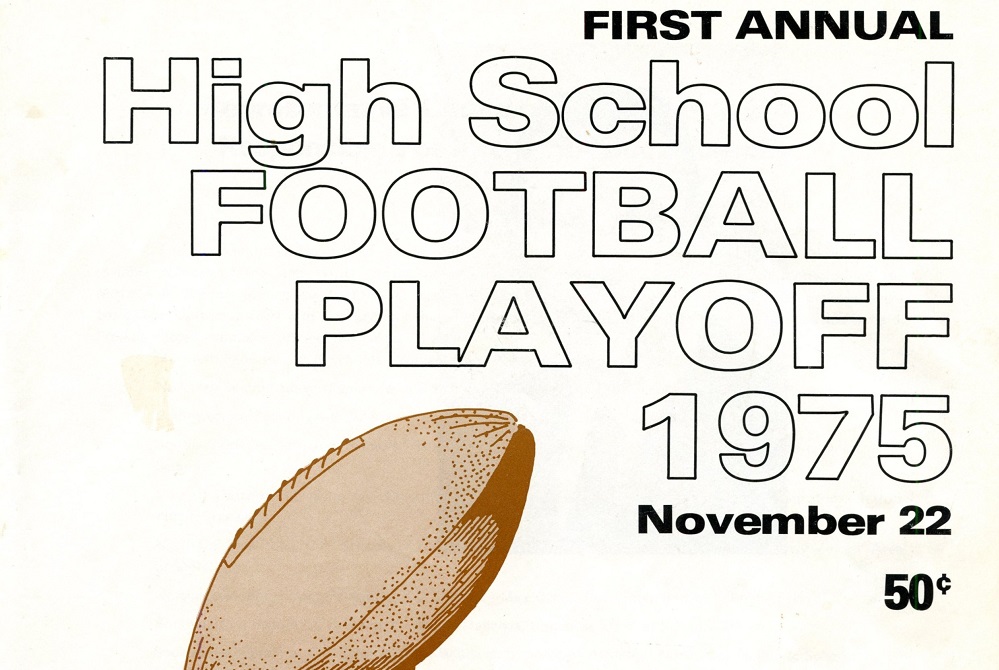
PHOTOS (Top) The MHSAA program greets fans for the first Football Finals. (2) Jackson Parkside coach Dave Driscoll talks with one of his players in 1971. (3) A points system was created to determine the field for the first MHSAA Football Playoffs in 1975. (4) Media members were responsible for collecting scores for the MHSAA to tabulate playoff rankings. (Photos gathered by Ron Pesch.)