

1st & Goal: 2026 11-Player Semifinals Preview
By
Geoff Kimmerly
MHSAA.com senior editor
November 20, 2026
Seven of last season’s eight MHSAA 11-Player Football Finals champions have reached this year’s Semifinals – but that’s hardly a guarantee they’ll stroll right into playing at Ford Field again next weekend.
 Saturday’s 16 Semifinals are filled with programs that are plenty familiar with playing at this late November date. And those that are not have accomplished more than enough this fall to feel confident they can keep the run rolling all the way to Detroit.
Here's a glance at all 16 games, with all set to kick off at 1 p.m. unless noted. All games can be watched on the NFHS Network at the links provided.
Division 1
Detroit Catholic Central (11-1) vs. East Kentwood (12-0) at Jackson WATCH
This is a rematch of a 2025 Semifinal won by reigning Division 1 champion DCC 46-6. Shamrocks senior quarterback Duke Banta returned from injury last week, and they also can turn to senior running back Ryan Jaafar (1,169 yards/12 touchdowns rushing) in the ground game. East Kentwood has plenty of air power with senior quarterback Colin O’Connor throwing for 2,750 yards and 33 touchdowns, finding senior receiver Steph Jones for 1,206 yards and 18 scores.
Detroit Cass Tech (12-0) vs. Romeo (12-0) at Troy Athens WATCH
Cass Tech is playing to make a third straight Finals trip to Ford Field, and junior quarterback Donald Tabron II has continued to set the pace throwing for 2,133 yards and 30 touchdowns this fall. Romeo is coming off its first Regional title since 2016 and is fueled by a rushing attack averaging 276 yards per game. Senior running back Landen Fetty is averaging 11.1 per carry with 947 total and 15 touchdowns on the ground.
Division 2
Muskegon Mona Shores (11-1) vs. Milford (11-1) at Battle Creek Harper Creek WATCH
Milford is playing in its first Semifinal after avenging a Week 4 31-point loss to South Lyon to claim a Regional title. Senior quarterback Hudson Smith has thrown for 1,791 of the team’s 2,602 passing yards and 14 of the team’s 26 touchdowns through the air. Mona Shores is coming off its first Regional title since 2020 and features a pair of accomplished rushers in senior running back Kevin White (1,174 yards/15 TDs) and junior quarterback Owen Terpstra (1,369/23).
Orchard Lake St. Mary’s (9-3) vs. Grosse Pointe South (11-1) at Novi WATCH
Reigning champion St. Mary’s has enjoyed another massive season from senior quarterback Jabin Gonzales, who has thrown for 2,456 yards and 33 touchdowns and run for seven scores. Grosse Pointe South senior quarterback Sam Rouleau is a serious two-way threat as well, throwing for 2,185 yards and 25 touchdowns and running for 733 yards and 14 scores.
Division 3
Zeeland West (10-2) vs. DeWitt (10-2) at Caledonia WATCH
This is a rematch of a 2024 Semifinal won by West, and after losing that day the Panthers marched to last season’s Division 3 championship. Senior quarterback Griffin Braman has taken the reins of the DeWitt offense throwing for 1,581 yards and 19 scores and running for 1,160 yards and 19 touchdowns. West’s rushing attack is chewing up yards again, totaling 4,236 to this point led by senior running back Brandon Holman (1,378/20 TDs) and junior back Kenny Howe (1,057/10).
Chelsea (12-0) vs. Harper Woods (10-2) at Ypsilanti Lincoln WATCH
These two opened the season together, with Chelsea winning their Week 1 matchup 29-20. The Bulldogs also have topped 4,000 yards rushing with senior running back Gibby Ichesco gaining 1,523 with 21 touchdowns and junior quarterback Jax Ichesco 1,226 and 19, respectively. Senior Dakota Guerrant and junior Deandre Bidden are one of the most talented receiving tandems in the state, with Guerrant leading Harper Woods in both rushing with 772 yards and 18 touchdowns and receiving with 976 yards and 12 scores, and Bidden following with 698 yards and 11 scores rushing and 603 and eight, respectively, receiving.
Division 4
Grand Rapids South Christian (11-1) vs. Grand Rapids Kenowa Hills (11-1) at Rockford WATCH
These past league rivals will face off for the first time since 2023, with Kenowa Hills riding an 11-game winning streak after losing its season opener to DeWitt. There may not be a more balanced offense in the state as the Knights have run for 2,634 yards and thrown for 2,632, led by senior running back Lundon Hampton (1,740 yards/36 TDs rushing) and senior quarterback Grayson Fellows (2,588/25 passing). Senior quarterback Austin Burgess is a dual-threat standout leading South Christian’s multi-faceted attack with 903 yards and 11 touchdowns passing and 11 touchdowns rushing as well.
Detroit Country Day (9-3) vs. Dearborn Divine Child (11-1) at Rochester Adams WATCH
Reigning Division 4 champion Divine Child has won all three meetings with Country Day since they began playing annually in 2024, including 14-7 in Week 3 now that both are part of the Catholic High School League AA. Junior quarterback Drew Sheridan led last year’s Falcons title march and has thrown for 3,315 yards and 34 touchdowns. Country Day is back in the Semifinals for the first time since 2022 and after missing the playoffs the last three seasons. Junior Jacob Patton has run for 1,454 yards and 24 scores.
Division 5
Ogemaw Heights (10-2) vs. Grand Rapids West Catholic (10-2) at Big Rapids WATCH
This is another Semifinal rematch from a year ago, won then by West Catholic 34-24 on the way to claiming the Division 5 title. Senior running back Collin Abram has shouldered the majority of the Falcons’ rushing attack with 1,576 yards and 28 touchdowns. Junior Brenson Keith has done the same for Ogemaw Heights, piling up 2,080 yards on the ground.
Monroe Jefferson (11-1) vs. Frankenmuth (11-1) at Rochester Hills Stoney Creek WATCH
Jefferson is making a return trip to the Semifinals, and senior quarterback Luke Beaudrie has been among constants during the program’s emergence. The Bears are a combined 22-3 over the last two seasons. Frankenmuth is seeking to reach Ford Field for the fourth time over seven seasons, piloted this time by junior quarterback Noah Main, who has thrown for 1,625 yards and 19 touchdowns and run for 794 yards and 18 scores.
Division 6
Kingsley (12-0) vs. Almont (12-0) at Clare WATCH
These two last faced off in the 2023 Division 6 championship game, won by Kingsley, and the rematch might ride on which team’s defense slows down the opposing attack. Senior running back Perry Smith averages nearly 10 yards per carry for the Stags, while senior running back Brody Corneau (1,331 yards/22 TDs) has carried a significant share of the load in getting the Raiders back to the Semifinals for the second straight season and third time in four years.
Detroit Edison (11-1) vs. Jackson Lumen Christi (10-2) at Westland John Glenn WATCH
These two also met in a season opener, with Lumen Christi winning 39-21. The Titans are seeking to extend a four-year Finals title streak, and the win in this Semifinal will tie head coach Herb Brogan with Farmington Hills Harrison’s John Herrington for the state’s all-time lead in football coaching victories at 443. Edison will work to push that achievement to next season, and has given up more than 20 points only once since that Week 1 loss.
Division 7
Ithaca (11-1) vs. Menominee (11-1) a Gaylord (2 p.m.) WATCH
Ithaca has made its reputation over the years for high-scoring offense, but the story this season really has been its defense, which has given up 80 points all season. That said, senior quarterback Gibson Rondy has thrown for 2,510 yards and 32 touchdowns and run for 709 and seven scores. Menominee has won 25 of its last 26 games – including last year’s Final – and senior Jackson Myszak has taken on a starring role running for 1,377 yards and 24 scores for an offense that has reached 38 points nine times.
Ottawa Lake Whiteford (10-2) vs. Ravenna (10-2) at Mattawan WATCH
Ravenna’s first Semifinal trip since 2010 has included avenging a regular-season loss to North Muskegon, while Whiteford has reached this round for the first time since 2023 thanks in part to avenging its season-opening defeat to Monroe St. Mary Catholic Central. Ravenna’s attack runs through junior halfback Brady Kachinski (1,123 yards/15 TDs rushing) and senior halfback Jaxson Wilburn (909/15 rushing), while Whiteford has enjoyed a stat-packing performance from senior Brek Ruddy (2,136 yards/33 TDs rushing, 422 yards/4 TDs receiving).
Division 8
Beal City (12-0) vs. New Lothrop (11-1) at Alma WATCH
This will be Beal City’s fourth Semifinal this decade, and the Aggies have wins over Ravenna and Ithaca in addition to winning all three of their playoff games by at least 29 points. Ten players have run for at least one touchdowns for Beal City, and senior running back Avery Small is averaging 19 yards per carry as the team’s leading rusher. New Lothrop is a two-point Week 3 loss to Montrose from a perfect season as well, and the Hornets are averaging 42 points per game directed by junior quarterback Karson Agnew (1,654 yards/25 TDs passing, 939 yards/16 TDs rushing).
Madison Heights Madison (10-2) vs. Hudson (11-1) at Redford Union WATCH
Last season’s runner-up Hudson is a win away from playing for the title again and coming off scoring a season-high 61 points last week against Springport. Junior running back Beckett Campbell is over 2,000 yards rushing again for the Tigers, this time with 2,132 and 25 touchdowns on the ground. Madison is back in a Semifinal for the first time since 2018 and has outscored its three playoff opponents by a combined 131-29.
MHSAA.com's weekly “1st & Goal” previews and reviews are powered by MI Student Aid, a division within the Department of Lifelong Education, Advancement, and Potential (MiLEAP). MI Student Aid encourages students to pursue postsecondary education by providing access to student financial resources and information. MI Student Aid administers the state’s scholarship and grant programs that help make college Accessible, Affordable and Attainable for you. Click to connect with MI Student Aid and find more information on Facebook and Twitter @mistudentaid.
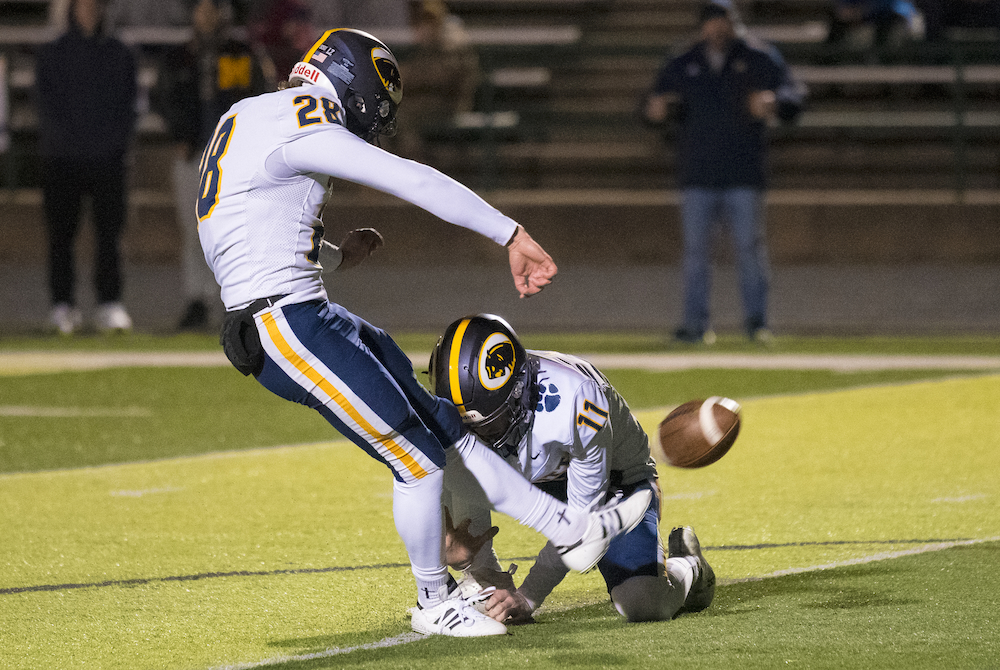
PHOTO DeWitt kicker Vincent Rose (28) steps into an extra-point attempt, held by teammate Isaac Bean. (Photo by TCP Photography.)
Football Fridays: Welcome to Our House
October 27, 2017
The latest issue of "benchmarks" focused on the nation's most participated in and attended high school sport, football, and efforts to keep Fridays reserved for games at the high school level. Below is an opening editorial by MHSAA Executive Director Jack Roberts, followed by the magazine's cover story published earlier this fall.
By John E. “Jack” Roberts
MHSAA Executive Director
There is no less opportunity to help student-athletes mature into positive people in one sport than another or on one day or night of the week compared to others. That is an unshakable truth of educational athletics.
But that truth has not diminished the efforts of the Michigan High School Athletic Association, time and again for decades, to protest encroachment on Friday night high school football by both professional and college sports. The reasons go far beyond football and Friday nights.
Done right, as it very often is in very many Michigan communities, Friday night is a festival that engages far more than the football team and its fans. It is a forum for showcasing a variety of school activities:
• A volleyball-football doubleheader with a community barbeque in between.
• A cross country run starting and/or ending at the football stadium with the roar of the crowd.
• A showcase for the marching band and a variety of other musical groups to perform, as well as cheerleaders and pompon squads.
• An opportunity for all school groups to provide information booths so students and parents may become aware of these student programs and initiatives.
• An opportunity to announce results of golf, tennis and swimming meets and provide the upcoming schedule of events, both athletic and non-athletic.
Done right, 30 to 70 percent or more of a school’s student body has an active part at most Friday night football games.
It has been said that the interscholastic athletic program provides a window to the entire school – to what it stands for and how it operates. If so, then Friday night football games are the front porch – a place for the entire school body and surrounding community to feel welcomed and to become more engaged.
By Rob Kaminski
MHSAA benchmarks editor
At a time when so many everyday distractions, mediums and changing ideals tear at the fabric of a cohesive society, school sports still offers a huge slice of Americana that continues to bond neighbors and promote community like few others can: high school football on Friday nights.
And now, that, too, is being threatened. Once “the only game in town,” prep football lights shone brightest on local kids playing on nearby fields while generating business for merchants on Main Street and providing inexpensive family entertainment. Friday nights were reserved for high schools.
 In recent years, however, the lure of TV dollars led to a wave of universities which could not compete with the perennial powerhouses for exposure on Saturdays, shifting games to all nights of the week. For the most part, they steered clear of Fridays, respecting the hand that feeds their programs.
Not so anymore.
ESPN began to schedule and televise NCAA Friday night games in 2002, and last November things really hit home when the Big Ten announced a slate of games for Friday nights this fall.
Protecting Friday nights is paramount, and as the following illustrates, the MHSAA is not alone in its fight.
It’s difficult to project the effect that such scheduling will have on MHSAA football games, but to borrow an axiom from the go-to book of coaches quotes, it will be prudent to take things one play at a time, one week at a time.
“The Big Ten Conference and other collegiate leagues enjoy high school football within their shadows; but the foray into Friday nights can be problematic,” said MHSAA Executive Director Jack Roberts.
“With lengthier seasons which now reach 12 games – and 13 weeks if there is a bye week – the collegiate seasons extend well into postseason play for the MHSAA and other state associations. Clearly there is a concern when some traditional collegiate rivalries occupy the same dates as high school championships.”
It looked like things would become much worse this year. Originally, Michigan State was scheduled to play at Northwestern on Oct. 27, potentially keeping countless Green and White enthusiasts in front of their televisions during the most pivotal financial weekend of the fall for the MHSAA: the first Friday of the Football Playoffs.
That game was moved to Saturday due to “unintended consequences” had the game remained on Friday. Northwestern also had a Friday tilt against Maryland moved to a Saturday.
So, already things have changed since the first announcement of Friday games by the Big Ten last November.
While there are six Friday games on the Big Ten docket for this Fall, five were in September, including two on Labor Day weekend.
Labor Day Friday games have played out in the MHSAA’s back yard for quite some time, as MSU often hosted such season-opening contests. Those games, however, seldom created conflicts due to most high schools playing on Thursdays leading into the holiday weekend.
This year was no different, with 215 games involving MHSAA schools being played on Thursday, Aug. 31, compared to 58 on Friday, Sept. 1, and five on Saturday, Sept. 2.
Further, it should be noted that neither the University of Michigan nor MSU has a Friday night game this fall, largely because administrators at those schools voiced strong objections to hosting any of the Friday night contests.
Similar sentiments are shared throughout the league.
“I'm very concerned about (Friday night games),” said first-year Indiana University Head Coach Tom Allen at the Big Ten preseason media gathering this summer. “I'm not going to sit here and try and make a big issue in terms of what I think. My history as a high school coach for 15 years is strong. It's who I am, it's how I started, and it's been so many years.
"I think that's a special night. I don't like playing games on Friday night. I think that's high school night. It's not always my decision. But I'm not going to just not tell you what I believe.”
During a May conference involving administrators from Midwest high school associations and the Big Ten, several collegiate stakeholders voiced opinions favoring the high school spotlight on Friday nights.
 MSU Athletic Director Mark Hollis made it known that his school would agree to Friday nights only on Labor Day or Thanksgiving weekends. Michigan Head Coach Jim Harbaugh proclaimed to local radio stations that day that, “I'm for traditional Saturdays. Friday is for high school games.”
Decades ago, a million dollar offer by the NCAA to the National Federation of State High School Associations (NFHS) which would have allowed for televised collegiate games on Friday nights was turned down.
Additionally, the NFL is barred by law from televising games on Fridays and Saturdays from mid-September through mid-December to avoid conflict with high school or NCAA games.
The landscape began to change with the formation of the College Football Association, a group formed by many of the American colleges with top-level college football programs in order to negotiate contracts with TV networks to televise football games. It was formed in 1977 by 63 schools from most of the major college football conferences and also select schools whose football programs were independent of any conference.
By 1982, a CFA legal challenge led to a 1984 Federal court decision that dissolved the NCAA’s exclusive control over television rights, allowing athletic conferences, independent schools and others to bargain for contracts.
As games now run rampant across TV screens and weekly calendars like tumbleweeds in the wild, wild west, could there finally be enough backlash to lasso this runaway horse?
The American Football Coaches Association – comprised of coaches from high schools to the pro ranks – unanimously opined in January at its annual convention that the NCAA should refrain from scheduling Friday night contests.
AFCA Executive Director Todd Berry issued a strong statement at the winter meeting, saying, “It was unanimous among all levels of coaches that the AFCA is in support of protecting Friday night for our high schools. We recognize the impact of having college football games on Friday night for our spectators, along with those viewing on television, can be significant. The AFCA feels very strongly that Friday night should be protected, not just for football, because the revenues generated by those high school football game ticket sales impact everything at those high schools such as other sports and organizations.”
That rings true not only from school to school, but also across state associations around the country which, like the MHSAA, depend upon football tournament attendance as one of the main sources of income from which to fund other programs throughout the year.
While the Big Ten’s announcement to increase Friday night television appearances has just recently brought glaring attention to the subject here at home, the unpopular trend has been affecting areas around the country for years.
The year 2001 was a landmark year of sorts for collegiate football telecasts, when the Mountain West Conference, Conference USA and the Mid-American Conference sought to gain exposure by scheduling Friday night contests. While it was long after the deregulation of 1984 and faced opposition from larger conferences such as the SEC, there was no legal ground to stand on for conferences then wishing to ban Friday night telecasts.
Even the larger conferences then – in certain extenuating circumstances – began to utilize Friday nights as an option.
In 2003, the Michigan-Minnesota football game was moved to Friday night to avoid a potential conflict with Major League Baseball as the Minnesota Twins could have hosted a playoff game on that particular Saturday.
At the time, Big Ten Commissioner Jim Delaney said, “The Conference and the Administrators Council regret having to reschedule football games to a Friday night. The Big Ten continues to support the protection of Friday night as a traditional high school football playing date.”
 One year later, a high-profile contest between Florida State and Miami was moved to Friday night when several storms hit the area. The problem was no one from the universities or the Atlantic Coast Conference bothered to inform the Florida High School Athletic Association ahead of time.
“In our opinion, (the decision) demonstrates their complete lack of sensitivity to our high school athletic programs, many of which are reeling financially due to the effects of hurricanes Charley and Frances,” said then-FHSAA Commissioner Robert Hughes said. “Most of our schools depend on the revenue from home football games to fund their entire athletic programs throughout the school year. Now, we find out that our schools will have to compete for an audience with the primetime telecast of arguably the biggest college football game that will played this year in this state.”
After watching an increasing number of games fill the prime Saturday slots and spill onto other days of the week, the Big Ten decided to modify its “Fridays are for high schools” stance, embarking on a path that will last until at least 2022.
The news release accompanying the decision stated that the conference “appreciates the significance of high school football within the region and has worked to minimize the impact of this initiative by limiting the number of Friday night games. Overall, these games represent approximately six percent of Big Ten home games annually, and no institution will host more than one game in any given year.”
It’s that top-down communication that doesn’t sit well with those involved in high school sports, the very level that the colleges count on to supply the talent pool. In that regard, the Friday night collegiate games don’t make sense.
“We have so many more teams in the Big Ten, that trying to find those windows that allow you to get that exposure for the whole league is important,” MSU’s Hollis has told reporters.
It’s not just the college football power conferences that have an effect on high school gridirons. Any city or town which includes a college campus shares a similar fan base.
With the MAC playing on any given night of the week for the last couple of decades, high schools in those cities have tried to adjust. After mixed results, however, some schools are simply standing their ground.
“Both (Mt. Pleasant) Sacred Heart and Mt. Pleasant High have avoided the same night as CMU Football over the years,” said Mt. Pleasant Athletic Director Jim Conway. “As of this year, though, both schools have elected to not change schedules based on the CMU schedule. Altering our schedules over the years has had a great effect on the visiting teams and their fan base coming to our sites.”
Further south, Middle Tennessee State University plays rival Western Kentucky on the same Friday as the TSSAA state high school football quarterfinals this fall. Additionally, a home game with Marshall was moved to another Friday night.
“My belief is that college coaches want to keep Fridays for high school only. But they are going to play when TV tells you to,” local high school coach Kevin Creasy, whose team plays that night, said in a story from the Murfreesboro Daily News Journal. “If TV said to us they want us to play on Saturday, we would. College coaches don’t want to play on Friday, but they do want their team to be on TV.”
Yet, it will be difficult for prep players to watch prospective colleges when they are busy playing. It also will minimize the number of live looks afforded college coaches for their recruits.
SBNATION.com writer Alex Kirshner surmised in an article last fall that, “If high school coaches are unified in opposition to something, college football programs have little choice but to listen. Taking a stand against your own state’s high school coaches is a horrible recruiting strategy.
“Friday night games in September and October mean recruits typically can’t visit for college games, because they’re busy playing.”
For those fans who prefer the college game, travel would be more difficult on Fridays, and/or would force many to take time off work to make their destinations by kickoff, versus driving just a few miles to root for the local high school team.
In that regard, logistics favor the high schools when it comes to “butts in the seats.” But, the proliferation of television provides an ample excuse for those more inclined to click remotes rather than drive to games of any level.
 “Any diversion from the traditional Friday night football has a direct impact on high school game attendance. High-profile collegiate games clearly will allow people to sit home in comfortable climate and watch football. This is not good for local games,” Conway said.
Losing any number of spectators can be felt throughout athletic departments and booster clubs which count on fall Fridays as a main source of revenue for their overall programs. With most schools having just four or five home football games per year, it’s vital to make the most of them financially.
“When CMU plays on the same night here, it takes away some fundraising opportunities for some of our teams and Booster Clubs,” Conway said. “Obviously it puts our local fan base in a position where they have to decide which game to attend, but also many people who volunteer for our Booster Club and our event staff are paid to work on crews at CMU games. The result is both the high schools and CMU trying to replace game management personnel, as many of us work the high school events and CMU Football.”
Executive Director of the Michigan High School Football Coaches Association Larry Merx believes that in many cases the prep and collegiate followings are different, but agrees with Conway for those locations which share geographic boundaries.
“I think high school football fans will stay with the high school game,” Merx said. “But, especially in and near college towns, many high school fans have work or other support responsibilities related to college games and will have to make some decisions.”
Fridays also provided a special stage for thousands of contest officials across the country. For the vast majority, working a regular schedule of high school varsity football games is the reward for countless hours and preparation.
For the select few fortunate enough to reach higher levels in the avocation, college opportunities and pay will trump Friday nights every time.
There is a vast pool of officials capable of working each week, but the absence of such veteran officials results in missed training opportunities as a new crop of officials is brought forward. In football more than most sports, there are limited chances for live officials training outside the school season.
“I’ve done college games on Saturday and high school games on the same Friday,” said NFL back judge Tony Steratore in a recent Referee magazine story. “Many officials do this, but I have to tell you something, if you’re going to do this you have to bring your ‘A-game’ to Friday night as much as you bring it to Saturday. If you don’t, you’re doing yourself and the game a disservice. When it comes down to it, if you can’t guarantee both games are getting equal attention, then you have to choose one or the other.”
When the games are both on Friday it’s a no brainer for the official faced with the choice.
For spectators, the choice often isn’t as clear-cut. That’s where school sports leaders – from the NFHS to the state high school associations to athletic administrators and coaches – must continue to promote the grand scenes that take place right down the street from their neighbors on Friday nights in the fall.
Portrayed in that light, scholastic sports leaders have an easy product to sell.
“Local high school games bring complete amateurism to the sport of football,” Conway said. “The band plays while moms and dads pop the popcorn and grill the hot dogs. Good high school games last no more than two-and-a-half hours, which is preferred to the length of collegiate games.”
It’s the perfect mix for a Friday night in the fall.
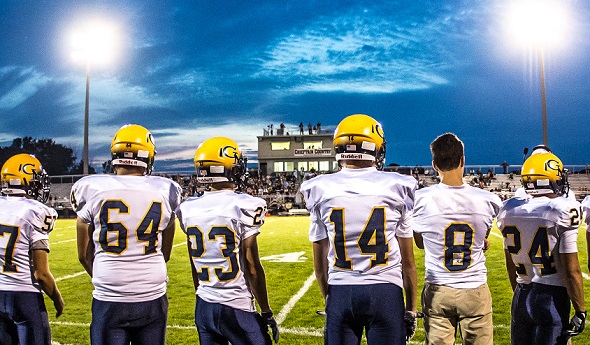
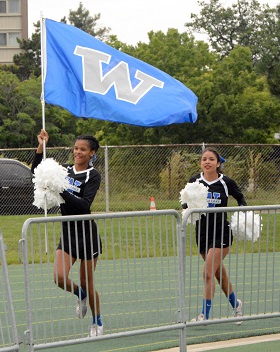
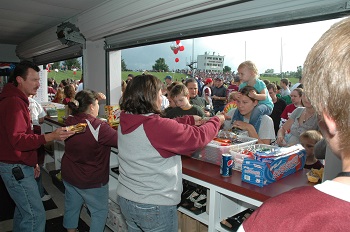
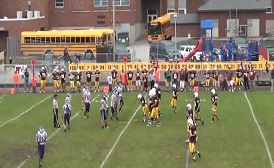
PHOTOS: (Top) Grand Ledge players man the sideline during a home game. (Top middle) The St. Johns' marching band takes the field. (Middle) Walled Lake Western cheerleaders run their flag around the stadium. (Middle below) Watervliet's concession stand feeds the crowd. (Below) Menominee's game provides the true scholastic vibe, complete with school buses parked in the background. (File photos.)