

1st & Goal: 2026 Playoffs Week 3 Preview
By
Geoff Kimmerly
MHSAA.com senior editor
November 12, 2026
There are only 64 teams remaining in the 11-Player Football Playoffs, and most have been here before – so it’s not shocking at this late date that those remaining may have seen each other in the not-so-distant past.
 Six of the eight 11-Player Regional Finals we highlight below are rematches from last season’s playoffs, and a handful of other matchups this weekend will see teams meet again either after facing off in the postseason last year or in league play earlier this fall.
That familiarity with the competition doesn’t transfer over to this weekend’s eight 8-Player Semifinals participants. But half those remaining teams have played in Finals at Superior Dome over the last two years and two more have made the trip to Marquette this decade – so the majority have experienced at least a little of what’s next if they prevail.
Games listed below are Friday unless noted. Tickets can be purchased at GoFan.co, and all 36 will be streamed live as well on the NFHS Network.
8-Player Division 1
Deckerville (10-1) vs. Pickford (9-2) – Saturday at Cadillac WATCH
After avenging its lone loss of the season last week against Dryden, the Eagles will play in a Semifinal for the fourth straight season in a rematch of the 2024 Division 1 Final won by Deckerville 30-28. Pickford missed the Semifinals last season but is back for the third time in four years and led by another dual-threat quarterback in senior Carter Rye (1,279 yards/16 TDs passing, 727 yards/9 TDs rushing).
Colon (10-1) vs. Blanchard Montabella (10-1) – Saturday at Greenville WATCH
Colon’s return to contention after three years missing the playoffs has seen the Magi win 14 of their last 15 games going back to last season, with the only loss along the way to Mendon – which is playing in a Division 2 Semifinal this weekend. Montabella is seeking to add the crowning step to this playoff run after finishing Division 1 runner-up a year ago, led in part by some of last year’s standouts including senior quarterback Gabe Kauffman, receiver Austin Jensen and defensive back Noah Carlson.
8-Player Division 2
Gaylord St. Mary (11-0) vs. Portland St. Patrick (11-0) – Saturday at Cadillac WATCH
Gaylord St. Mary’s first run to the Semifinals since 2002 in 11-player has been a product of dominance on both sides of the ball – and it’s impossible to overlook either. The offense has topped 50 points seven times in 10 games (one win came by forfeit) and the defense has allowed 34 points total. St. Patrick is the reigning Division 2 champion and may provide the Snowbirds with their toughest challenge to date – although there is an intriguing mutual opponent to consider, with St. Pat a 10-point winner over Pickford in Week 6 and St. Mary a 42-0 winner over Pickford in Week 8.
Britton Deerfield (9-2) vs. Mendon (11-0) – Saturday at Ypsilanti Lincoln WATCH
Mendon is seeking to return to the Finals for the first time since 2022 and once again can run the ball with anyone in the state with seniors Zak Iobe (1,299 yards, 29 touchdowns) and Xavior Zinsmaster (1,090 yards, 20 TDs) and junior Logan Stuart (699 yards, 12 TDs) all averaging more than nine yards per carry. Britton Deerfield, also playing in its second Semifinal over the last three seasons, fell to Mendon by only four points when they last played a year ago and can also chew up yards on the ground led by senior Trevor Karpinski (1,347 yards, 20 touchdowns, 11.2 yards per carry).
11-Player Division 1
Detroit Catholic Central (10-1) at Clarkston (10-1) WATCH
This is a rematch of a 2025 Regional Final won by eventual Division 1 champion DCC 42-13, and Clarkston’s only loss since was in Week 8 to Harper Woods, which is still playing in Division 3. The Shamrocks’ only loss over the last two seasons came Week 9 to Bloomfield Hills Brother Rice, still alive in Division 2. The Shamrocks have navigated the last five weeks without injured starting quarterback Duke Banta, with Peyton Sofran stepping in to impressively shoulder the load.
Other Regional Finals FRIDAY Northville (9-2) at Detroit Cass Tech (11-0) WATCH, Rochester Hills Stoney Creek (9-2) at Romeo (11-0) WATCH. SATURDAY Portage Central (10-1) at East Kentwood (11-0) WATCH.
11-Player Division 2
Orchard Lake St. Mary’s (8-3) at Bloomfield Hills Brother Rice (9-2) WATCH
These Catholic High School League Central rivals met in Week 5, with reigning Division 2 champion St. Mary’s posting a 48-20 victory. The Eaglets’ only losses this fall are by a combined 16 points, and while they took two (to Toledo Central Catholic and Detroit Catholic Central) after the win over the Warriors, they’ve also come back with two resounding victories to open the playoffs. But Brother Rice’s performance since that first OLSM meeting also has been notable; the Warriors also lost to TCC but defeated DCC to finish the regular season, and they’re no doubt recalling last season when they defeated St. Mary’s in league play but lost the District Final rematch.
Other Regional Finals FRIDAY Muskegon Mona Shores (10-1) at Byron Center (9-2) WATCH, South Lyon (9-2) at Milford (10-1) WATCH, Livonia Franklin (9-2) at Grosse Pointe South (10-1) WATCH.
11-Player Division 3
DeWitt (9-2) at Mount Pleasant (10-1) WATCH
This is a rematch of last season’s Division 3 championship game, won by DeWitt 54-20, and while the Panthers have a pair of losses this time both came to league champions. Those defeats, to Mason and Grand Ledge, were the only two games DeWitt didn’t score at least 44 points this season. Mount Pleasant’s strength also has been its ability to score points; the Oilers have won all of their games (except for a loss to Traverse City West) by double digits and outlasted Cadillac 56-41 last week.
Other Regional Finals FRIDAY Middleville Thornapple Kellogg (8-3) at Zeeland West (9-2) WATCH, Mason (10-1) at Chelsea (11-0) WATCH, Warren De La Salle Collegiate (7-4) at Harper Woods (9-2) WATCH.
11-Player Division 4
Dearborn Divine Child (10-1) at Goodrich (11-0) WATCH
This is also a rematch from last season’s playoffs, as Divine Child edged the Martians 10-7 in a Division 4 Semifinal on the way to winning the title the following weekend. Divine Child has lost only once since, to Division 3 Regional finalist Warren De La Salle Collegiate in Week 8. Goodrich’s perfect run to this point has included nine games scoring at least 42 points but perhaps more notably eight games giving up seven points or fewer. The offense had succeeded similarly before being shut down by the Falcons a year ago, but the Martians’ defense has taken another step this fall.
Other Regional Finals FRIDAY Hudsonville Unity Christian (7-4) at Grand Rapids Kenowa Hills (10-1) WATCH, Portland (11-0) at Grand Rapids South Christian (10-1) WATCH, Detroit Country Day (8-3) at Macomb Lutheran North (10-1) WATCH.
11-Player Division 5
Saginaw Swan Valley (10-1) at Frankenmuth (10-1) WATCH
This longtime rivalry has really caught fire again the last two seasons, and Frankenmuth’s 41-22 Week 8 victory decided the Tri-Valley Conference Red championship in favor of the Eagles. Frankenmuth already has won one rematch this playoffs, downing Armada last week after also defeating the Tigers in Week 9, but must remain wary of a Vikings defense that held its four other playoff opponents this fall to an average of 9.8 points per game.
Other Regional Finals FRIDAY Negaunee (7-4) at Ogemaw Heights (9-2) WATCH, Romulus Summit Academy (8-3) at Monroe Jefferson (10-1) WATCH. SATURDAY Berrien Springs (9-1) at Grand Rapids West Catholic (9-2) WATCH.
11-Player Division 6
Marine City (11-0) at Almont (11-0) WATCH
These lower Thumb powers have met only three times during the playoff era, all since 2015, and with Almont winning all three meetings including last year’s 27-0 in a District Final. But the scenario is a little different for Marine City this time around. The Mariners entered the 2025 meeting having lost two of their last three games, and this time they are undefeated and coming off downing Mid-Michigan Activities Conference champion Montrose to advance. Almont, meanwhile, finds itself in a familiar place coming off a third-straight perfect regular season and entering this matchup having scored 41 or more points in four straight wins.
Other Regional Finals FRIDAY Sanford Meridian (11-0) at Kingsley (11-0) WATCH, Belding (9-2) at Jackson Lumen Christi (9-2) WATCH. SATURDAY Ecorse (10-1) at Detroit Edison (10-1) WATCH.
11-Player Division 7
Ithaca (10-1) at Pewamo-Westphalia (10-0) WATCH
P-W’s road to get here turned east instead of west this season, but the Pirates have arrived in a rematch as well after defeating Ithaca 42-21 in a Regional Final a year ago. The bracket this time saw both P-W and the Yellowjackets take on some of the best from the Thumb and Saginaw over the first two rounds. Ithaca found its stride again after losing to Beal City in Week 9, impressively downing previously undefeated Millington 39-16 last week, and that also was the Yellowjackets’ eighth win this season over a playoff team. The Pirates have faced a similarly rigorous slate, defeating seven playoff teams while playing one fewer game.
Other Regional Finals FRIDAY Jonesville (7-4) at Ottawa Lake Whiteford (9-2) WATCH. SATURDAY Charlevoix (8-2) at Menominee (10-1) WATCH, Ravenna (9-2) at North Muskegon (10-1) WATCH.
11-Player Division 8
Clarkston Everest Collegiate (10-1) at Madison Heights Madison (9-2) – Saturday WATCH
Madison is playing in a Regional Final for the second straight season, and after advancing last year with a 22-17 District Final win over Everest. The Eagles’ only losses this fall were to Division 4 Macomb Lutheran North and Division 6 Ecorse – both playing for Regional titles as well this week – and they defeated six playoff teams on the way back to this round. Everest is undefeated since falling to another Division 8 Regional finalist Ubly in Week 1, and downed another league champion Royal Oak Shrine Catholic last week for the second time in three weeks – the only losses Shrine took this fall.
Other Regional Finals FRIDAY Ubly (8-3) at New Lothrop (10-1) WATCH, Springport (10-1) at Hudson (10-1) WATCH. SATURDAY Bark River-Harris (9-2) at Beal City (11-0) WATCH.
MHSAA.com's weekly “1st & Goal” previews and reviews are powered by MI Student Aid, a division within the Department of Lifelong Education, Advancement, and Potential (MiLEAP). MI Student Aid encourages students to pursue postsecondary education by providing access to student financial resources and information. MI Student Aid administers the state’s scholarship and grant programs that help make college Accessible, Affordable and Attainable for you. Click to connect with MI Student Aid and find more information on Facebook and Twitter @mistudentaid.
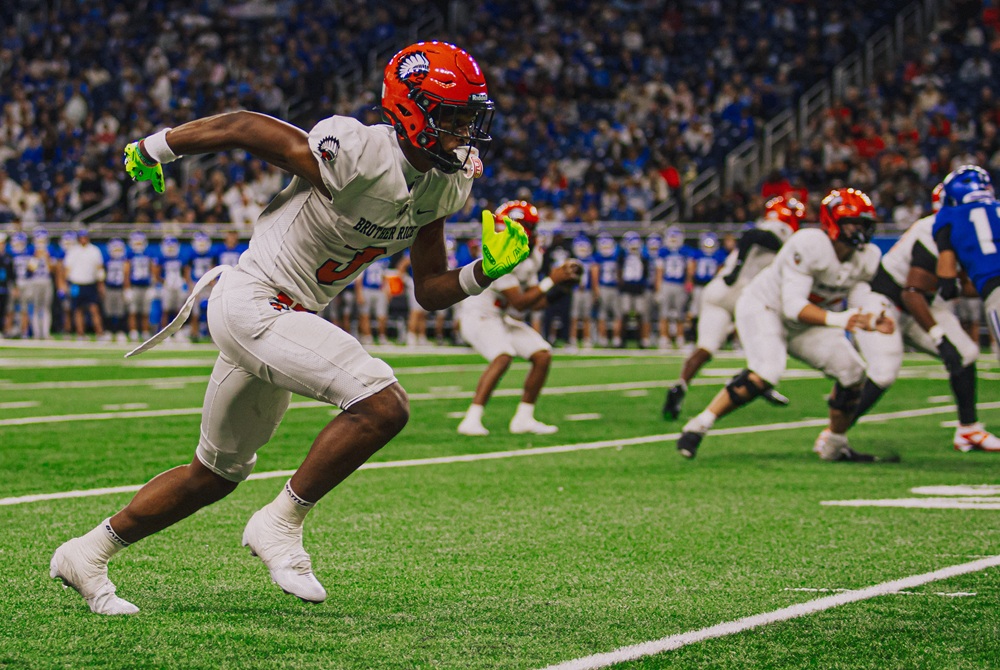
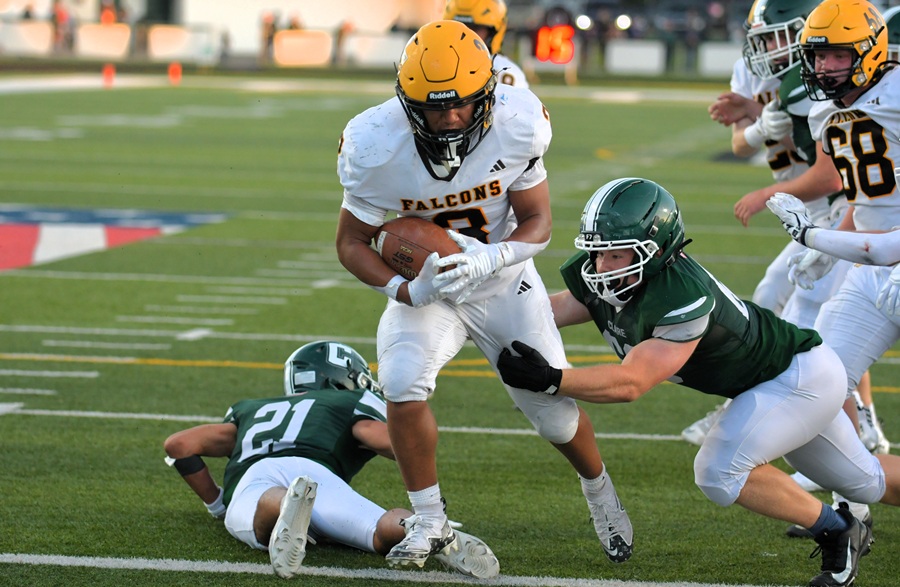
PHOTOS (Top) Bloomfield Hills Brother Rice's Tyler Trusel (3) breaks from the line during his team's Week 9 win over Detroit Catholic Central. (Middle) Corbin Kanitz (3) smashes into the end zone for a score in Ogemaw Heights' Week 3 victory over Clare. (Brother Rice/DCC photo by Olivia B. Photography. Ogemaw Heights/Clare photo by High School Sports Scene.)
Football Fridays: Welcome to Our House
October 27, 2017
The latest issue of "benchmarks" focused on the nation's most participated in and attended high school sport, football, and efforts to keep Fridays reserved for games at the high school level. Below is an opening editorial by MHSAA Executive Director Jack Roberts, followed by the magazine's cover story published earlier this fall.
By John E. “Jack” Roberts
MHSAA Executive Director
There is no less opportunity to help student-athletes mature into positive people in one sport than another or on one day or night of the week compared to others. That is an unshakable truth of educational athletics.
But that truth has not diminished the efforts of the Michigan High School Athletic Association, time and again for decades, to protest encroachment on Friday night high school football by both professional and college sports. The reasons go far beyond football and Friday nights.
Done right, as it very often is in very many Michigan communities, Friday night is a festival that engages far more than the football team and its fans. It is a forum for showcasing a variety of school activities:
• A volleyball-football doubleheader with a community barbeque in between.
• A cross country run starting and/or ending at the football stadium with the roar of the crowd.
• A showcase for the marching band and a variety of other musical groups to perform, as well as cheerleaders and pompon squads.
• An opportunity for all school groups to provide information booths so students and parents may become aware of these student programs and initiatives.
• An opportunity to announce results of golf, tennis and swimming meets and provide the upcoming schedule of events, both athletic and non-athletic.
Done right, 30 to 70 percent or more of a school’s student body has an active part at most Friday night football games.
It has been said that the interscholastic athletic program provides a window to the entire school – to what it stands for and how it operates. If so, then Friday night football games are the front porch – a place for the entire school body and surrounding community to feel welcomed and to become more engaged.
By Rob Kaminski
MHSAA benchmarks editor
At a time when so many everyday distractions, mediums and changing ideals tear at the fabric of a cohesive society, school sports still offers a huge slice of Americana that continues to bond neighbors and promote community like few others can: high school football on Friday nights.
And now, that, too, is being threatened. Once “the only game in town,” prep football lights shone brightest on local kids playing on nearby fields while generating business for merchants on Main Street and providing inexpensive family entertainment. Friday nights were reserved for high schools.
 In recent years, however, the lure of TV dollars led to a wave of universities which could not compete with the perennial powerhouses for exposure on Saturdays, shifting games to all nights of the week. For the most part, they steered clear of Fridays, respecting the hand that feeds their programs.
Not so anymore.
ESPN began to schedule and televise NCAA Friday night games in 2002, and last November things really hit home when the Big Ten announced a slate of games for Friday nights this fall.
Protecting Friday nights is paramount, and as the following illustrates, the MHSAA is not alone in its fight.
It’s difficult to project the effect that such scheduling will have on MHSAA football games, but to borrow an axiom from the go-to book of coaches quotes, it will be prudent to take things one play at a time, one week at a time.
“The Big Ten Conference and other collegiate leagues enjoy high school football within their shadows; but the foray into Friday nights can be problematic,” said MHSAA Executive Director Jack Roberts.
“With lengthier seasons which now reach 12 games – and 13 weeks if there is a bye week – the collegiate seasons extend well into postseason play for the MHSAA and other state associations. Clearly there is a concern when some traditional collegiate rivalries occupy the same dates as high school championships.”
It looked like things would become much worse this year. Originally, Michigan State was scheduled to play at Northwestern on Oct. 27, potentially keeping countless Green and White enthusiasts in front of their televisions during the most pivotal financial weekend of the fall for the MHSAA: the first Friday of the Football Playoffs.
That game was moved to Saturday due to “unintended consequences” had the game remained on Friday. Northwestern also had a Friday tilt against Maryland moved to a Saturday.
So, already things have changed since the first announcement of Friday games by the Big Ten last November.
While there are six Friday games on the Big Ten docket for this Fall, five were in September, including two on Labor Day weekend.
Labor Day Friday games have played out in the MHSAA’s back yard for quite some time, as MSU often hosted such season-opening contests. Those games, however, seldom created conflicts due to most high schools playing on Thursdays leading into the holiday weekend.
This year was no different, with 215 games involving MHSAA schools being played on Thursday, Aug. 31, compared to 58 on Friday, Sept. 1, and five on Saturday, Sept. 2.
Further, it should be noted that neither the University of Michigan nor MSU has a Friday night game this fall, largely because administrators at those schools voiced strong objections to hosting any of the Friday night contests.
Similar sentiments are shared throughout the league.
“I'm very concerned about (Friday night games),” said first-year Indiana University Head Coach Tom Allen at the Big Ten preseason media gathering this summer. “I'm not going to sit here and try and make a big issue in terms of what I think. My history as a high school coach for 15 years is strong. It's who I am, it's how I started, and it's been so many years.
"I think that's a special night. I don't like playing games on Friday night. I think that's high school night. It's not always my decision. But I'm not going to just not tell you what I believe.”
During a May conference involving administrators from Midwest high school associations and the Big Ten, several collegiate stakeholders voiced opinions favoring the high school spotlight on Friday nights.
 MSU Athletic Director Mark Hollis made it known that his school would agree to Friday nights only on Labor Day or Thanksgiving weekends. Michigan Head Coach Jim Harbaugh proclaimed to local radio stations that day that, “I'm for traditional Saturdays. Friday is for high school games.”
Decades ago, a million dollar offer by the NCAA to the National Federation of State High School Associations (NFHS) which would have allowed for televised collegiate games on Friday nights was turned down.
Additionally, the NFL is barred by law from televising games on Fridays and Saturdays from mid-September through mid-December to avoid conflict with high school or NCAA games.
The landscape began to change with the formation of the College Football Association, a group formed by many of the American colleges with top-level college football programs in order to negotiate contracts with TV networks to televise football games. It was formed in 1977 by 63 schools from most of the major college football conferences and also select schools whose football programs were independent of any conference.
By 1982, a CFA legal challenge led to a 1984 Federal court decision that dissolved the NCAA’s exclusive control over television rights, allowing athletic conferences, independent schools and others to bargain for contracts.
As games now run rampant across TV screens and weekly calendars like tumbleweeds in the wild, wild west, could there finally be enough backlash to lasso this runaway horse?
The American Football Coaches Association – comprised of coaches from high schools to the pro ranks – unanimously opined in January at its annual convention that the NCAA should refrain from scheduling Friday night contests.
AFCA Executive Director Todd Berry issued a strong statement at the winter meeting, saying, “It was unanimous among all levels of coaches that the AFCA is in support of protecting Friday night for our high schools. We recognize the impact of having college football games on Friday night for our spectators, along with those viewing on television, can be significant. The AFCA feels very strongly that Friday night should be protected, not just for football, because the revenues generated by those high school football game ticket sales impact everything at those high schools such as other sports and organizations.”
That rings true not only from school to school, but also across state associations around the country which, like the MHSAA, depend upon football tournament attendance as one of the main sources of income from which to fund other programs throughout the year.
While the Big Ten’s announcement to increase Friday night television appearances has just recently brought glaring attention to the subject here at home, the unpopular trend has been affecting areas around the country for years.
The year 2001 was a landmark year of sorts for collegiate football telecasts, when the Mountain West Conference, Conference USA and the Mid-American Conference sought to gain exposure by scheduling Friday night contests. While it was long after the deregulation of 1984 and faced opposition from larger conferences such as the SEC, there was no legal ground to stand on for conferences then wishing to ban Friday night telecasts.
Even the larger conferences then – in certain extenuating circumstances – began to utilize Friday nights as an option.
In 2003, the Michigan-Minnesota football game was moved to Friday night to avoid a potential conflict with Major League Baseball as the Minnesota Twins could have hosted a playoff game on that particular Saturday.
At the time, Big Ten Commissioner Jim Delaney said, “The Conference and the Administrators Council regret having to reschedule football games to a Friday night. The Big Ten continues to support the protection of Friday night as a traditional high school football playing date.”
 One year later, a high-profile contest between Florida State and Miami was moved to Friday night when several storms hit the area. The problem was no one from the universities or the Atlantic Coast Conference bothered to inform the Florida High School Athletic Association ahead of time.
“In our opinion, (the decision) demonstrates their complete lack of sensitivity to our high school athletic programs, many of which are reeling financially due to the effects of hurricanes Charley and Frances,” said then-FHSAA Commissioner Robert Hughes said. “Most of our schools depend on the revenue from home football games to fund their entire athletic programs throughout the school year. Now, we find out that our schools will have to compete for an audience with the primetime telecast of arguably the biggest college football game that will played this year in this state.”
After watching an increasing number of games fill the prime Saturday slots and spill onto other days of the week, the Big Ten decided to modify its “Fridays are for high schools” stance, embarking on a path that will last until at least 2022.
The news release accompanying the decision stated that the conference “appreciates the significance of high school football within the region and has worked to minimize the impact of this initiative by limiting the number of Friday night games. Overall, these games represent approximately six percent of Big Ten home games annually, and no institution will host more than one game in any given year.”
It’s that top-down communication that doesn’t sit well with those involved in high school sports, the very level that the colleges count on to supply the talent pool. In that regard, the Friday night collegiate games don’t make sense.
“We have so many more teams in the Big Ten, that trying to find those windows that allow you to get that exposure for the whole league is important,” MSU’s Hollis has told reporters.
It’s not just the college football power conferences that have an effect on high school gridirons. Any city or town which includes a college campus shares a similar fan base.
With the MAC playing on any given night of the week for the last couple of decades, high schools in those cities have tried to adjust. After mixed results, however, some schools are simply standing their ground.
“Both (Mt. Pleasant) Sacred Heart and Mt. Pleasant High have avoided the same night as CMU Football over the years,” said Mt. Pleasant Athletic Director Jim Conway. “As of this year, though, both schools have elected to not change schedules based on the CMU schedule. Altering our schedules over the years has had a great effect on the visiting teams and their fan base coming to our sites.”
Further south, Middle Tennessee State University plays rival Western Kentucky on the same Friday as the TSSAA state high school football quarterfinals this fall. Additionally, a home game with Marshall was moved to another Friday night.
“My belief is that college coaches want to keep Fridays for high school only. But they are going to play when TV tells you to,” local high school coach Kevin Creasy, whose team plays that night, said in a story from the Murfreesboro Daily News Journal. “If TV said to us they want us to play on Saturday, we would. College coaches don’t want to play on Friday, but they do want their team to be on TV.”
Yet, it will be difficult for prep players to watch prospective colleges when they are busy playing. It also will minimize the number of live looks afforded college coaches for their recruits.
SBNATION.com writer Alex Kirshner surmised in an article last fall that, “If high school coaches are unified in opposition to something, college football programs have little choice but to listen. Taking a stand against your own state’s high school coaches is a horrible recruiting strategy.
“Friday night games in September and October mean recruits typically can’t visit for college games, because they’re busy playing.”
For those fans who prefer the college game, travel would be more difficult on Fridays, and/or would force many to take time off work to make their destinations by kickoff, versus driving just a few miles to root for the local high school team.
In that regard, logistics favor the high schools when it comes to “butts in the seats.” But, the proliferation of television provides an ample excuse for those more inclined to click remotes rather than drive to games of any level.
 “Any diversion from the traditional Friday night football has a direct impact on high school game attendance. High-profile collegiate games clearly will allow people to sit home in comfortable climate and watch football. This is not good for local games,” Conway said.
Losing any number of spectators can be felt throughout athletic departments and booster clubs which count on fall Fridays as a main source of revenue for their overall programs. With most schools having just four or five home football games per year, it’s vital to make the most of them financially.
“When CMU plays on the same night here, it takes away some fundraising opportunities for some of our teams and Booster Clubs,” Conway said. “Obviously it puts our local fan base in a position where they have to decide which game to attend, but also many people who volunteer for our Booster Club and our event staff are paid to work on crews at CMU games. The result is both the high schools and CMU trying to replace game management personnel, as many of us work the high school events and CMU Football.”
Executive Director of the Michigan High School Football Coaches Association Larry Merx believes that in many cases the prep and collegiate followings are different, but agrees with Conway for those locations which share geographic boundaries.
“I think high school football fans will stay with the high school game,” Merx said. “But, especially in and near college towns, many high school fans have work or other support responsibilities related to college games and will have to make some decisions.”
Fridays also provided a special stage for thousands of contest officials across the country. For the vast majority, working a regular schedule of high school varsity football games is the reward for countless hours and preparation.
For the select few fortunate enough to reach higher levels in the avocation, college opportunities and pay will trump Friday nights every time.
There is a vast pool of officials capable of working each week, but the absence of such veteran officials results in missed training opportunities as a new crop of officials is brought forward. In football more than most sports, there are limited chances for live officials training outside the school season.
“I’ve done college games on Saturday and high school games on the same Friday,” said NFL back judge Tony Steratore in a recent Referee magazine story. “Many officials do this, but I have to tell you something, if you’re going to do this you have to bring your ‘A-game’ to Friday night as much as you bring it to Saturday. If you don’t, you’re doing yourself and the game a disservice. When it comes down to it, if you can’t guarantee both games are getting equal attention, then you have to choose one or the other.”
When the games are both on Friday it’s a no brainer for the official faced with the choice.
For spectators, the choice often isn’t as clear-cut. That’s where school sports leaders – from the NFHS to the state high school associations to athletic administrators and coaches – must continue to promote the grand scenes that take place right down the street from their neighbors on Friday nights in the fall.
Portrayed in that light, scholastic sports leaders have an easy product to sell.
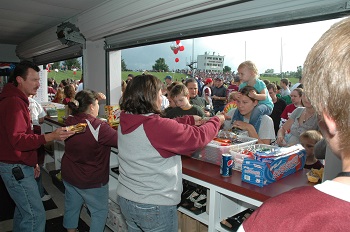
“Local high school games bring complete amateurism to the sport of football,” Conway said. “The band plays while moms and dads pop the popcorn and grill the hot dogs. Good high school games last no more than two-and-a-half hours, which is preferred to the length of collegiate games.”
It’s the perfect mix for a Friday night in the fall.
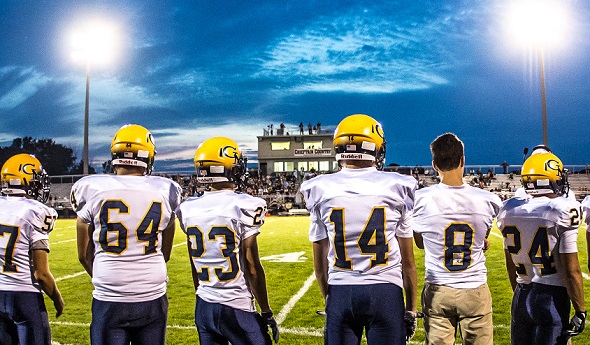
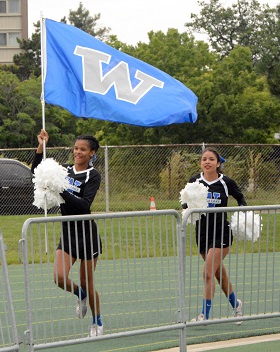
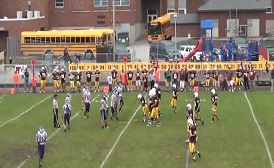
PHOTOS: (Top) Grand Ledge players man the sideline during a home game. (Top middle) The St. Johns' marching band takes the field. (Middle) Walled Lake Western cheerleaders run their flag around the stadium. (Middle below) Watervliet's concession stand feeds the crowd. (Below) Menominee's game provides the true scholastic vibe, complete with school buses parked in the background. (File photos.)