

1st & Goal: 2026 Week 2 Review
By
Geoff Kimmerly
MHSAA.com senior editor
September 8, 2026
Two three-overtime games and one four-overtime record setter would have been enough to kick off the story of this season’s Week 2.
 Add in a few dramatic comebacks, wins over five 2025 Finals champions and a few more rivalry nail-biters, and we’re still only getting started unfolding the emerging stories of this fall – but there certainly are plenty to tell.
Bay & Thumb
HEADLINER Almont 14, Armada 0 Almont (2-0) ran its Blue Water Area Conference winning streak to 25, and even though it was the league opener took what might be a massive step toward running its BWAC championship streak to four. Also notable, the shutout lowered Almont’s points-allowed average against league teams during that run to 13.8 ppg. Click for more from the Port Huron Times Herald.
Watch list Saginaw Swan Valley 16, Freeland 6 Swan Valley is 2-0 for the first time since 2018, and by defeating the Falcons to start the Tri-Valley Conference Red schedule assumes the role as top contender to take on reigning champion Frankenmuth after finishing second to the Eagles last season. They play in Week 8.
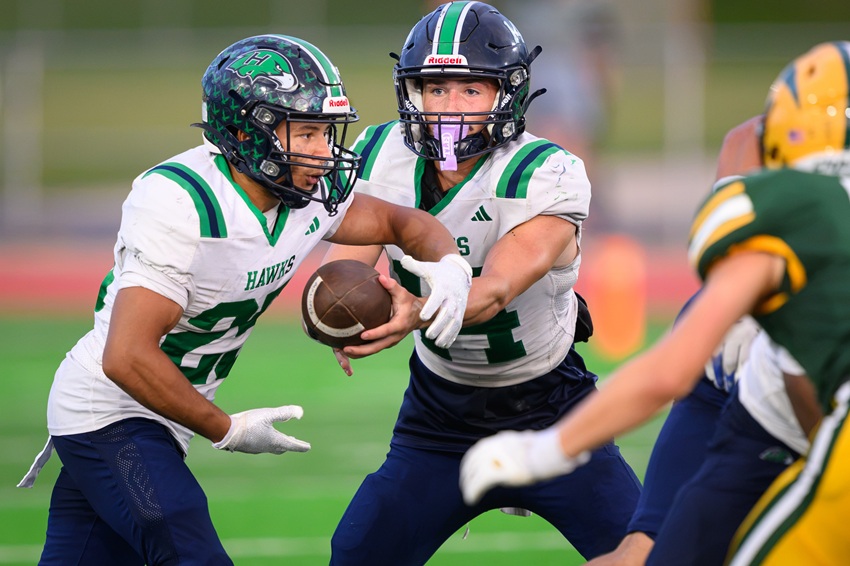
On the move Caro 28, Harbor Beach 6 The Tigers are 2-0 for the first time since 2009 after giving up just six points for the second-straight week – this time against the reigning Division 8 champion Pirates (0-2). Fenton 27, Haslett 20 These two have split their meetings over the last four seasons, the last three all decided by seven points or fewer. Saginaw Heritage 32, Midland Dow 30 The Hawks (1-1) avenged last season’s 15-point loss to Dow (1-1) and bounced back from a 10-point Week 1 defeat against Mount Pleasant.
Greater Detroit
HEADLINER Detroit Martin Luther King 44, Orchard Lake St. Mary’s 42 (3OT) This matchup between statewide giants didn’t disappoint. Neither team scored during the final eight minutes of regulation, which ended in a 22-22 deadlock, but the Crusaders (2-0) emerged with a 2-point conversion after doubling their score during overtime. Click for more from the Detroit News.
TRIPLE OVERTIME MADNESS. 😱
Detroit King punches in the two-point conversion to win an absolute thriller over Orchard Lake St. Mary’s, 44-42.
Powered by @CallSam pic.twitter.com/3RBxBy8Muj— STATE CHAMPS! Michigan (@statechampsmich) September 5, 2026
Watch list Detroit Catholic Central 56, Davison 14 The reigning Division 1 champion Shamrocks (2-0) have topped 50 points in both of their first two games, this one especially impressive over a Davison team (1-1) that went 8-2 last season.
On the move Rochester Adams 21, Rochester 19 The Falcons (1-1) scored with 15 seconds to play to reach the doorstep of a first win over Adams since 1996, but the Highlanders (1-1) stopped the 2-point conversion try to tie. Wyandotte Roosevelt 35, Trenton 21 With its first win over Trenton (1-1) since 2019, Roosevelt (2-0) likely shook up the Downriver League a bit as it looks to get back to its successful past. Detroit Cass Tech 48, Grandville 21 The Technicians (2-0) spread the scoring wealth, but Julian Taylor led with three touchdowns on the ground as Cass Tech built on last season’s three-point win over Grandville (1-1).
Mid-Michigan
HEADLINER Mason 30, DeWitt 17 The Lansing area’s current power matchup played out in another headlining chapter as Mason (2-0) evened the recent series at 2-2 by handing the reigning Division 3 champion Panthers (1-1) their first loss since the 2024 Semifinals. The Bulldogs, who also gave DeWitt its closest game a year ago, led this one 27-0 at halftime. Click for more from the Lansing State Journal.
Watch list New Lothrop 23, Durand 14 The Hornets (2-0) ended a two-game skid against Durand (1-1) as they look to contend again in the Mid-Michigan Activities Conference after finishing fourth, tied for sixth, second and third over the last four seasons.
On the move Howell 41, Belleville 31 The Highlanders (2-0) are back to piling up points this season with a combined 90 over two games. These two could meet again as they’ll begin league play this week in opposing divisions of the Kensington Lakes Activities Association. Hastings 50, Williamston 21 The Saxons (1-1) bounced back from a Week 1 loss and avenged last year’s seven-point defeat against the Hornets (1-1) in a matchup of playoff regulars. Pewamo-Westphalia 35, Ottawa Lake Whiteford 0 The Pirates (2-0) are quickly making an impression, especially defensively as they’ve given up a combined nine points over the last two weeks to opponents that finished a combined 15-6 a year ago.
Northern Lower Peninsula
HEADLINER Ogemaw Heights 33, Traverse City St. Francis 13 Ogemaw Heights (2-0) has had plenty of major moments over the last few seasons, but this fall’s start might end up ranking high among them especially if the Falcons continue to build on last year’s Division 5 Semifinals march. Their only regular-season loss last season came against St. Francis (1-1) in Week 2. Click for more from the Traverse City Record-Eagle.
Watch list Johannesburg-Lewiston 14, Benzie Central 8 The Cardinals (2-0) already have surpassed last season’s win total and with one more victory will guarantee their best finish since 2020.
On the move Gaylord 35, Escanaba 25 After opening this season with a one-score loss to North Branch, reigning Big North Conference champion Gaylord (1-1) bounced back with a nice win over last year’s BNC runner-up. Cadillac 34, Alpena 21 The Vikings (1-1) also bounced back from a Week 1 loss to kick off BNC play as they look to rebound from a tough 2025. Charlevoix 28, Boyne City 12 The Rayders (2-0) opened play in the new Northern Shores Conference the best way, especially heading into this week’s mega matchup with Kingsley that could eventually decide the league title.
Southeast & Border
HEADLINER Brooklyn Columbia Central 34, Michigan Center 14 Columbia Central (2-0) nearly won the Cascades Conference West a year ago after starting the fall 0-2, and anticipation is growing for the upcoming league schedule especially with the Golden Eagles winning this one over last season’s Cascades East champion. This also avenged last year’s 49-14 loss to the Cardinals (1-1). Click for more from the Jackson Citizen Patriot.
Watch list Jonesville 64, Leslie 62 (3OT) This tied for the fifth highest-scoring overtime game in MHSAA history, and Leslie (1-1) has piled up a combined 119 points over its first two games with the Comets (2-0) just slightly behind with a combined 98.
On the move Monroe St. Mary Catholic Central 29, Flat Rock 19 These were two of four teams the Huron League sent to the playoffs last season, and this was a key win for the Falcons (2-0) after finishing last year as one of three co-champions as well. Ypsilanti Community 12, Ypsilanti Lincoln 7 After falling by just a point in this rivalry matchup a year ago, YCS (1-1) defeated Lincoln (0-2) for the first time since 2019. Union City 41, Reading 8 Union City (2-0) quickly has moved into the lead pack in the Big 8 Conference and done so impressively outscoring its first two opponents by a combined 89-8.
Southwest Corridor
HEADLINER Battle Creek Central 31, Lansing Everett 26 The Bearcats are 2-0 for the first time since 2018 thanks to avenging last season’s loss to the Vikings by nearly the same score. They’ll seek to avenge a second 2025 defeat in a row this week against Mattawan. Click for more from the Battle Creek Enquirer.
Watch list Stevensville Lakeshore 21, Niles 16 Lakeshore is 2-0 coming off back-to-back three-win seasons and downed the Vikings (2-0) after being shut out by Niles both of the last two years.
On the move Sturgis 27, Battle Creek Pennfield 8 After falling by just a point in its season opener, Sturgis (1-1) earned its first victory since Week 8 of 2023 and after falling to Pennfield (0-2) by 22 a year ago. Battle Creek Harper Creek 19, Cedar Springs 0 The Beavers (2-0) begin Interstate 8 Athletic Conference play this week and have yet to allow a point this fall. Portage Central 42, Grand Rapids Forest Hills Central 21 After opening with a loss to Ohio power Toledo Central Catholic, Portage Central (1-1) rebounded just in time for this week’s rivalry matchup with Portage Northern.
Upper Peninsula
HEADLINER Menominee 49, Marquette 19 These longtime rivals met again for the first time since 2022, and four years later the Maroons avenged a loss to the Sentinels in that most recent matchup. Dylan Beal threw five passes to help the reigning Division 7 champions run their winning streak to 16. Click for more from the Eagle Herald.
Watch list Hancock 58, West Iron County 0 The Bulldogs (1-1) have totaled one win each of the last three seasons and lost to West Iron by 10 points to finish last fall. But this big victory certainly is a positive sign with two more league opponents Manistique and Gwinn up next.
On the move L’Anse 35, Manistique 22 The Purple Hornets (2-0) are off to another fast start as they look to build on last year’s playoff return. Calumet 27, Ishpeming Westwood 8 Calumet (2-0) has especially shined on defense so far, holding its first two opponents to one touchdown apiece and with high-scoring Negaunee up next. Negaunee 42, Gladstone 6 The Miners (2-0) found their stride especially defensively as they prepped for a much-anticipated matchup this week against the Copper Kings – who defeated Negaunee a year ago.
West Michigan
HEADLINER East Kentwood 42, Byron Center 14 Just like a year ago, East Kentwood (2-0) is off to a dominating start on both sides of the ball, up to a combined 97 points scored over two games and giving up just these 14 over the first two weeks. Byron Center (1-1) scored the only points of the first quarter, but East Kentwood erupted for 28 straight to build its lead. Click for more from WZZM.
East Kentwood (@EastKentwoodFB) is making some noise early. 👀🔥
The Falcons roll past Byron Center, 42-14, and keep their strong start going.
Powered by @LawrenceTechU pic.twitter.com/31KgLJlHF2— STATE CHAMPS! Michigan (@statechampsmich) September 7, 2026
Watch list Coopersville 41, Grand Rapids West Catholic 21 Coopersville is 2-0 after starting 0-3 last season and still reaching the Division 3 District Finals. Both wins this fall avenged 2025 losses, including this one after the Broncos fell last year to the eventual Division 5 champion Falcons by 20.
On the move Ravenna 28, Oakridge 27 Oakridge (0-2) rallied late to get within a point, but Ravenna (1-1) held on with a 2-point conversion stop to win this rivalry matchup for the second-straight season. Lowell 35, St. Joseph 34 The Red Arrows were able to come all the way back, scoring 21 unanswered points to move to 1-1 and send the Bears to the same. Rockford 42, Muskegon 6 The Rams (1-1) rebounded from a Week 1 loss to Saline for a fourth-straight win over Muskegon (0-2) since those two renewed their rivalry in 2023.
8-Player
HEADLINER Blanchard Montabella 52, Portland St. Patrick 24 Montabella faced both of last season’s 8-Player Finals champions to start this fall and has emerged 2-0 with a combined margin of victory of 113-36. This one also avenged the Mustangs’ 26-point loss to the eventual Division 2-winning Shamrocks from a year ago. Click for more from the Mount Pleasant Morning Sun.
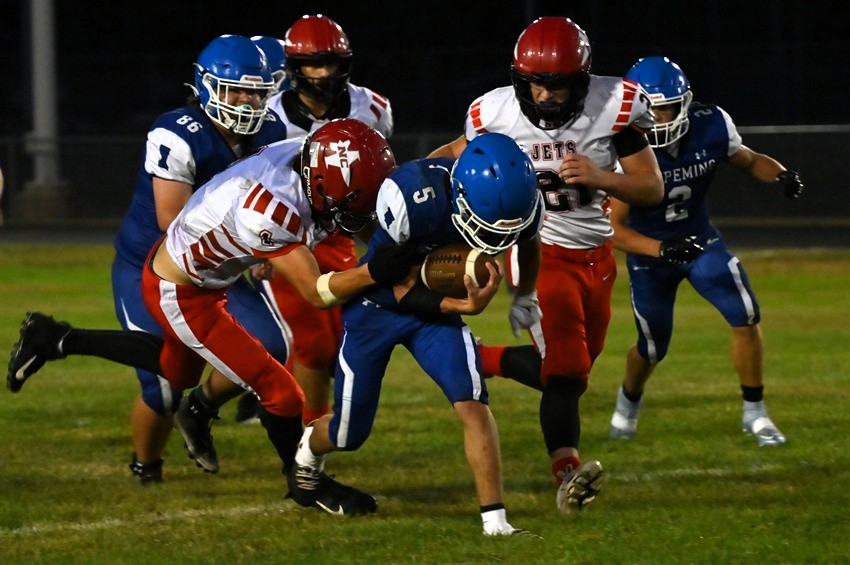
Watch list Ishpeming 50, Powers North Central 22 The Hematites fell back to two wins last season, although with a series of close defeats, and can definitely build on this triumph over the Jets, one of the most consistently successful 8-player programs with 11 straight playoff seasons.
On the move Fulton 70, St. Charles 68 (4OT) This easily set the record for highest-scoring overtime game in MHSAA 8-player history, a combined 12 points higher than the previous record holders. Merrill 54, Morrice 7 The Vandals (2-0) are off to a nice start with a combined 94-15 score over opponents that finished a combined 14-5 a year ago. Climax-Scotts 36, Britton Deerfield 26 The Panthers’ followed a solid Week 1 win over Concord with an even louder statement as Climax-Scotts (2-0) became one of only five teams to hold the Patriots (1-1) under 40 points since the start of 2024.
MHSAA.com's weekly “1st & Goal” previews and reviews are powered by MI Student Aid, a division within the Department of Lifelong Education, Advancement, and Potential (MiLEAP). MI Student Aid encourages students to pursue postsecondary education by providing access to student financial resources and information. MI Student Aid administers the state’s scholarship and grant programs that help make college Accessible, Affordable and Attainable for you. Click to connect with MI Student Aid and find more information on Facebook and Twitter @mistudentaid.
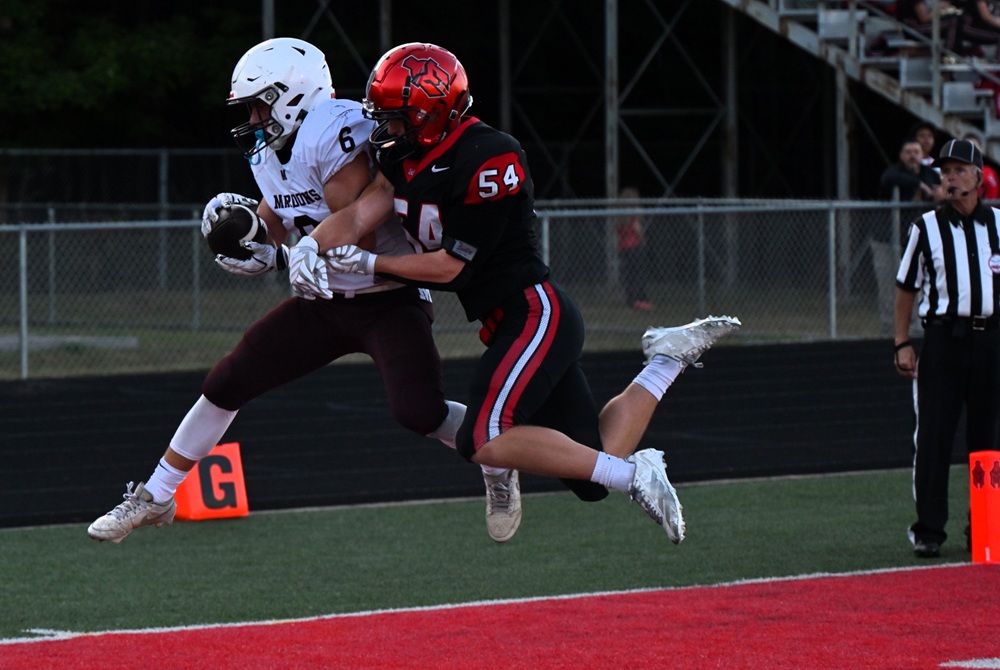
PHOTOS (Top) Menominee's Jackson Myszak is able to hold onto the ball to score a 2-point conversion while closely covered by Marquette's Josiah Youngren. (Middle) Saginaw Heritage senior running back Daijon Wynn takes a handoff from quarterback Anthony Fries during the first quarter of the Hawks’ eventual victory over Midland Dow. (Below) Ishpeming's Kian Gauthier (5) is able to find a hole before he gets tackled by North Central's Pryar LaBonte. (Menominee/Marquette and Ishpeming/North Central photos by Cara Kamps. Heritage/Dow by Kolleth Photo.)
Culmination of Ideas, Cooperation Lead to Creation of MHSAA Football Playoffs
By
Ron Pesch
MHSAA historian
August 26, 2022
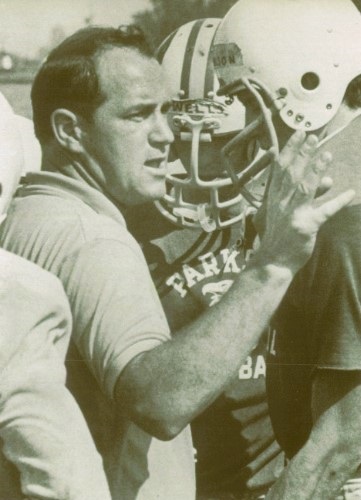
In November of 1972, Dave Driscoll, football coach at Jackson Parkside, was talking by phone with Larry Paladino of The Associated Press about the goals of the recently-formed Michigan High School Football Coaches Association (MHSFCA).
“Football has been around a long time in Michigan, and we just haven’t moved forward as other sports have. Now with an organization to speak and help us, I think we will see some real movement …”
Driscoll, president of the MHSFCA, was pitching the idea of a football postseason in Michigan – a goal of the young organization.
“It took us a couple of years to get it done,” recalled Driscoll, now age 86 and still in the Jackson area. “The first year or two was a challenge because that’s when you’re instituting something. But it has turned out to be a very progressive, positive influence in the state.”
A Postseason
Michigan was one of only 20 states that did not conduct a football playoff, and the sport was the only one sponsored by the MHSAA that did not have a tournament to determine champions. Newspaper ranking systems, in use since the early 1940s in Michigan, were the method by which football teams were awarded “state titles.” Prior to that, schools with undefeated marks against in-state opponents could make a rightful claim to a championship. Because there was no postseason system in place for teams to square off, those are referred to as “mythical” titles.
A state gridiron playoff had been discussed for many years. But, as a cold weather state, few could see a way to devise an equitable system to accomplish the task. With basketball, every high school squad qualified for the annual MHSAA Tournament. Logistically and geographically, the concept of a football postseason presented numerous challenges. Unpredictable late fall weather meant the season could be expanded by only a couple of weeks. That limited the number of teams that could be involved.
 Yet Colorado and Massachusetts, both with weather that could replicate Michigan’s in late autumn, hosted football postseasons.
“They just extend the season by two weeks,” said Driscoll, the MHSFCA spokesperson at the time. “They divide the state by regions. If you win a region, you have a semifinal game the next week, then a final a week after that in each class.”
The MHSFCA, broken into 18 regions across the Upper and Lower Peninsulas, recognized that was far too many to work within a two-week playoff system. So, determining the teams that would participate in the tournament was a major concern.
“Ohio rates its teams by computer. Pennsylvania has a system for it. … Our association would have to investigate these and come up with the best one for our situation,” Driscoll said.
Only eight months old, the MHSFCA planned to present its research, and a possible approach, to the Michigan High School Athletic Association. Driscoll had spoken to both Allen W. Bush, MHSAA executive director, and Vern Norris, associate director, about the goal.
“They’re listening,” he told the press. “If we can come up with a feasible plan, I think they’re willing to listen. We hope to have playoffs in two or three years.”
So the MHSFCA went to work, scheduling meetings around the state – talking with, and listening to, membership.
“We’re not going to press for any certain system at this time. It will take time to work out the details. We just want to sell the idea,” Driscoll said.
The MHSFCA recognized it could take a while.
“Iowa had to present the playoff five years before it was approved,” noted Driscoll.
While the administrative wheels turned, the MHSFCA worked on developing a point system designed to reward teams based on strength of schedule. The goal was to create a test – ideally during the 1973 season – designed to prove the concept, with the hope for an actual playoff in the fall of 1974.
One thing almost certain to occur, if a system could be developed, would be a recasting of those newspaper rankings.
“Indiana had a dry run on their (proposed) playoffs last year and four of the top five teams in the football polls did not make the playoffs on a point system.”
“No matter how honestly polls are conducted,” stated Jim DeLand of the Benton Harbor Herald-Palladium in April 1973, “they inevitably favor unbeaten teams with an easier schedule over teams with a tougher schedule, and say, one loss.”
Financing the Idea
According to the coaches’ group, most football playoffs in other states had been self-supporting and profitable. “Ohio played its semifinals in a doubleheader at the Ohio State stadium last fall and drew 20-some thousand people,” noted Ike Muhlenkamp, coach at St. Joseph High School and Region 5 director of the MHSFCA, in conversation with DeLand. That additional revenue, he noted, could be used to support other things that were coming along, like girls athletics.
MHSFCA regional directors conducted meetings around the state in April 1973 to explain the proposal.
The idea was to use a point system to determine which teams would qualify for play. A school’s classification – Class A, B, C, or D – determined by enrollment size, would be used here as well. Just like basketball, four schools would emerge as champions at the end of the tournament.
“It’s complicated … complicated,” said Bush about the proposal to institute a football playoff just prior to a May pitch by the coaches to the MHSAA Representative Council. “There’s a tremendous mass of bookkeeping involved. Other states are doing it, and we can’t turn our backs on it, but I don’t anticipate it happening this year.”
The Council was receptive to the idea, but it needed examination and testing. The Council called for the assembly of a “Blue-Ribbon panel” of superintendents, principals, athletic directors and coaches from around the state to determine the potential of a football postseason and to explore and address the challenges. Harley Pierce, Sturgis football coach, was named chairman of the committee.
“We’d like to see it operate on paper first,” Driscoll told Dean Howe of the Flint Journal. “That way, we’d know approximately how the real thing would operate.”
“Right now, the Blue-Ribbon committee is studying three point systems, ones used in Ohio, Virginia, and Iowa,” noted Howe. “In Ohio, ratings are done strictly by computer. It costs $5,000 a season to use the computer system.”
In October, the Council asked that the proposed point system be refined.
A key component, as envisioned by the MHSFCA, was to create a system that factored in the quality of competition played by a team during the regular season.
“A team with an 8-1 record might be picked over a 9-0 club by season’s end if that team had played much better competition,” explained Howe.
A special questionnaire was distributed by the MHSAA in February 1974. “By almost a 5 to 1 margin, prep coaches throughout the state supported the playoff,” stated Bob Gross in the Lansing State Journal.
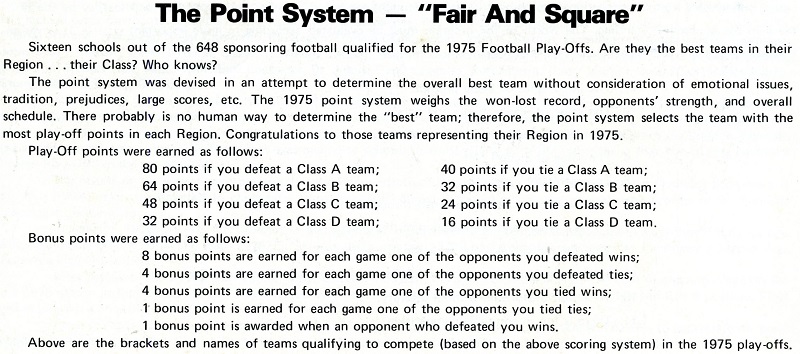 Under the refined system, football game results would be gathered and run through a formula that awarded points based on wins and ties constructed around enrollment classifications, and bonus points for the results of games played by your opponents. League affiliation and margin of victory held no bearing on playoff points awarded.
In May, the Representative Council, acting on the strong support by coaches for a football tournament, instructed staff at the MHSAA to conduct a sample playoff, on paper, during the 1974 season. The approach would serve as a testing ground – a place to run the idea around the track with live data.
The reality of an actual postseason was still, at minimum, a year away. If all worked as intended, the hope was for an actual tournament in 1975 and 1976, with a re-evaluation of the system to follow. But obstacles remained.
“Weather, playing conditions, sites, records of teams and you name it, we’re faced with just about everything when it comes to something like this,” said Bush. “Teams in the U.P. start the regular season two weeks early so naturally they’re finished by the time teams in the Lower Peninsula are in their sixth and seventh games.” If a U.P. team qualified for the proposed tournament, “they’d have to wait two weeks at least to prepare for a playoff.”
In the end, the idea would still need approval by the Association of Secondary School Principals, which had the “final word on all athletic policies.”
“The coaches are on one side of the fence and administrators (on) the other,” Bush continued. “(T)here’s still a lot of work to do before we actually have a playoff.”
Paper and Pencil
University of Michigan’s Bo Schembechler endorsed the idea and stated in a letter to the MHSFCA that he’d like to see the title game played at U-M. Within, he addressed a concern expressed in some administrative circles. At the time, 652 schools in Michigan played football.
“The fact is that only 16 schools will have an extended season,” stated Schembechler. “There should be little, if any, effect on the basic philosophy of scholastic emphasis.”
Michigan State football coach Denny Stolz also wrote a letter to the group stating he, too, favored the playoff system.
Labeled the “Paper Playoffs,” the proof of concept was handled in the old-fashioned manner, as according to Bush, a computer would not be used for point calculations. It would cost too much.
Instead, at schools that believed they deserved consideration, athletic directors were to fill out a rating form after the season’s sixth game with appropriate information about the results of games played. School principals were to sign the form and mail it to the MHSAA. A single MHSAA staff member each week would then manually “tabulate the results and determine the top teams in each class of four regions” and release them for publication.
The resulting rank of teams was expected to be controversial by both the MHSAA and the MHSFCA. Smaller schools beating teams above their enrollment classification would benefit from the system. Larger schools facing smaller schools would receive fewer points for a win than they would by defeating a team within their own classification. As predicted, an undefeated season was no guarantee of a place within the 16-team field of qualifiers.
“After the formula was devised, the coaches applied it to the top teams in the 1973 Class A poll,” stated Dave Matthews in a State Journal article that appeared just prior to the start of the 1974 season. Saginaw Arthur Hill – undefeated, untied, and unscored upon across nine games – had been named state champion in every state newspaper poll. The Lumberjacks had outscored their opponents, 443-0, but would have finished third in their region in the playoff rankings behind both Flint Southwestern (8-1) and East Lansing (9-0). Simply put, Arthur Hill would not have qualified for the playoffs. Based on the formula, both Southwestern and East Lansing had played more challenging schedules than Arthur Hill.
Controversy
Results needed for the first tabulation following the Week 6 games were slow in arriving. As of the Tuesday following the game, the MHSAA had received only 60 forms. With Wednesday as the cutoff date, the first round of calculations didn’t include teams – like undefeated South Haven – that appeared in the weekly newspaper polls. (South Haven’s form didn’t arrive until after the deadline). That illustrated the need for timely reporting.
Comparisons between the press polls and the “paper playoff” rankings were common, and by season’s end, they illustrated the seismic shift that was approaching – and a call for action.
“Football games aren’t won or lost on paper. Neither are state championships,” wrote Roger Neumann in the State Journal in early November as the season headed for its conclusion. “That’s why most mid-Michigan prep coaches are anxious to see the state’s experimental ‘paper playoffs’ taken a step further and put on the gridiron.”
While it appeared a large majority of coaches – and school administrators – favored moving forward, support for the proposed system certainly wasn’t unanimous.
East Lansing coach Jeff Smith questioned the approach.
‘I’m still for a playoff,’ Smith told Neumann. ‘‘But I have some reservations. I’m not sure that the No. 1 team in each region is the best team.” While Smith admitted he didn’t have an answer on how to improve upon the suggested point system in place, he offered a suggestion.
“If we’re going to do this, I think we should do it right and have eight teams in the playoffs (per classification). Eight teams would be more representative. You’d still be going with the elite of the state.”
Smith noted an expanded playoff with three rounds could still be accomplished within two weeks as the MHSAA allowed teams to play every five days.
“With or without such a change, however, Smith said he’d vote for a true playoff, adding, ‘Any playoff is better than no playoff at all. Once you’ve got it, you can always make changes later,” reported Neumann.
The final AP polls, released Tuesday, Nov. 12, showed Birmingham Brother Rice, Muskegon Catholic Central, Hudson, and Traverse City St. Francis as respective state champions in Classes A, B, C, and D, respectively. United Press International (UPI) differed in only Class C, with Battle Creek St. Philip as the top-ranked team, just five points ahead of Hudson.
According to the final “paper playoff” rankings, only Muskegon Catholic and St. Philip would have qualified for postseason play.
Approved
“It’ll be the principals who’ll really decide if there’ll be playoffs,” said Dick Comar, publicity director for the MHSFCA in late January of 1975. The principals were to receive a questionnaire within a week asking their opinion on the proposal. They had until Feb. 24 to cast their vote.
The results of the survey would be presented to the MHSAA Representative Council at its March 21 meeting in Ann Arbor (coinciding with the annual basketball championships at U-M’s Crisler Arena), with a final decision concerning the issue “at that meeting or at their meeting in May.”
On March 22, Bush announced the proposal had passed, indicating that 73 percent of high schools that had responded to the survey had voted in favor of postseason play. Michigan would have a football tournament. Sites and dates were to be determined. The Council requested that semifinal games be played on high school fields, and that, if possible, the final-round contests be played on artificial turf.
By May, the MHSAA had contracted ESR Corporation, a data processing firm in Lansing, to handle the input of weekly game results. Using the same formula developed and tested, ESR would be responsible for calculating point totals to determine the state’s best teams by Class and region.
Norris called the plan “a combination of the best features already in use in Ohio, Iowa, and West Virginia.” He credited former Alpena coach Art Gillespie with doing much of the work for “carrying the ball through the preparation stages.”
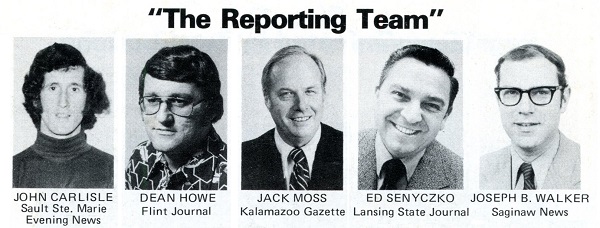
Five members of the media – Howe of the Flint Journal, Jack Moss of the Kalamazoo Gazette, Joe Walker of the Saginaw News, Ed Senyczko of the State Journal, and John Carlisle of the Sault Ste. Marie Evening News – were tasked with capturing the results of games played by 679 schools, including 28 from outside of Michigan, and mailing the results to the MHSAA.
“We’re not interested in the score,” said Bush. “We want to know if a team won, lost, tied, or did not play.”
 In August, the MHSAA announced that state title games would be played at two sites on Saturday, Nov. 22. Western Michigan University would host the Class A and D games, while Class B and C were slated for Central Michigan University.
The four regions used to divide up the state for the annual basketball tournament also were used as the regions for football.
In September, with the results of the season’s first games – played by the state’s Upper Peninsula teams – fed into ESR’s computers, Bush was clear that the final playoff rankings would cause controversy.
“It’s not necessarily the four best teams in the state that will compete in the semifinals,” he said, “but the best in each region.”
The result was both popular and controversial. The papers continued their weekly football polls. The first MHSAA rankings were not released until Oct 8.
UPI was unimpressed: “If the playoffs were held this weekend – which they are not – not a single one of the teams UPI has rated first in the four classes would qualify.”
Hal Schram of the Detroit Free Press expressed a similar emotion.
“The first computerized points were announced last week and there were glaring differences between the media polls and the MHSAA system,” he wrote.
“’There is no reason to attempt a state football championship, and extend the season two more weeks, when you’re inviting only four teams in each class to perform,’ said Joe Vanderhof, veteran sportswriter of the Grand Rapids Press.
Skepticism continued as the weeks went on, culminating in joy for 16 schools – but disappointment for many others – when the final MHSAA rankings were released Nov. 9.
Norway, undefeated in nine games, was the first to experience heartbreak, as U.P. teams finished their season earlier than others. Tied with Ishpeming in the Region 4 Class C rankings, the Knights lost the playoff spot by a tie-breaking formula. Since the two schools had not played each other, a second method was employed to break the deadlock. The summed win-loss percentage of each school’s opponents was compared, with Ishpeming coming out two-tenths of a percent higher. Two of Norway’s top challengers had not played a ninth game. If either had at least tied another contest, Norway would have slipped ahead in the rankings.
“We’ve been ranked … in the AP ahead of Ishpeming all year,” stated Knights coach Bob Giannunzio. “This is hard to swallow.”
Jim Crowley, coach of Jackson Lumen Christi, was also among the disappointed: “You do everything you can and still don’t make it. Undefeated, the team finished No. 1 in Class B according to UPI.”
“But had it not been Lumen Christi,” noted UPI writer Richard Shook, “then it would have been Dearborn Divine Child (missing out). They were both in the same playoff region.”
Trenton in Class A, Divine Child in Class B, Hudson in Class C and North Adams in Class D finished on top in the final AP poll. Only Trenton did not qualify for the postseason. Traverse City topped Trenton in the final UPI and Free Press polls and did qualify. Lumen Christi finished No. 1 in Class B, Hudson in Class C, and Crystal Falls Forest Park – another qualifier – finished on top in Class D in the Free Press.
“I’ve got the best football team in the state,” Trenton coach Jack Castignola told Schram. “I’ve got at least two future Big Ten players. We had three goals at the opening of practice in August, to go unbeaten, win the conference and the state. We’ve been deprived of reaching our final goal and there’s nothing we can do about it. Corrections are going to have to be made in future years.”
Flint Ainsworth, with a 7-2-0 record, ranked 14th in the UPI poll, was the only team unranked and without even honorable mention in the AP poll to qualify for the tournament.
Livonia Franklin, Divine Child, Ishpeming, and Forest Park emerged as the MHSAA’s first gridiron champions. Since that time, various alterations have been made to the football playoffs. Seasons now begin sooner, many more teams qualify for the postseason, and, beginning in 1976, championship games were moved indoors. Today, 10 teams – eight 11-player squads and two 8-player teams – will be awarded titles come November.
But it was the efforts and collaboration of many that got us here.
“There were a lot of great people involved,” said Driscoll, reflecting on those efforts some 50 years later, and emphasizing that he was only one of many individuals on the same team, uniting behind a goal. “We got great cooperation. We had some super coaches and … some administrators that were not afraid to step forward and say, ‘Hey! These are good people and I know if they do it, they’ll do it the right way.’”
 Ron Pesch has taken an active role in researching the history of MHSAA events since 1985 and began writing for MHSAA Finals programs in 1986, adding additional features and "flashbacks" in 1992. He inherited the title of MHSAA historian from the late Dick Kishpaugh following the 1993-94 school year, and resides in Muskegon. Contact him at [email protected] with ideas for historical articles.
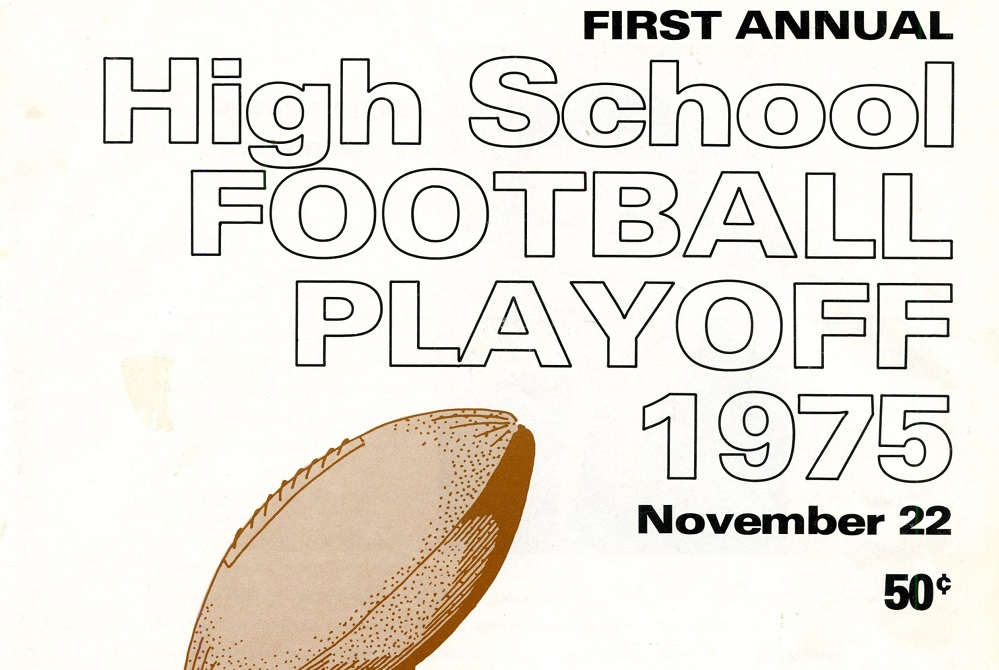
PHOTOS (Top) The MHSAA program greets fans for the first Football Finals. (2) Jackson Parkside coach Dave Driscoll talks with one of his players in 1971. (3) A points system was created to determine the field for the first MHSAA Football Playoffs in 1975. (4) Media members were responsible for collecting scores for the MHSAA to tabulate playoff rankings. (Photos gathered by Ron Pesch.)