

1st & Goal: Week 6 Preview
October 1, 2020
By Geoff Kimmerly
Second Half editor
We may have only just begun this abbreviated Michigan high school football season, but this weekend we’ll reach the midway point – and the beginning of another October full of opportunities.
Every game matters even more with a six-game schedule, and early league leaders are meeting everywhere over the next two days – including in five leagues in the Grand Rapids/Muskegon areas alone.
Below is a quick look at some of the especially intriguing matchups. Check out the MHSAA Score Center beforehand for kickoff times and locations of all games, and come back Friday and Saturday for scores as they’re reported.
This week’s broadcast schedule includes 48 varsity football games on MHSAA.tv; click the link for listings.
Bay & Thumb
Mount Pleasant (2-0) at Midland (2-0)
Seven of the last 10 meetings between these Saginaw Valley League Blue foes have been decided by eight points or fewer, including Midland’s 22-21 win a year ago that helped the Chemics to a shared conference title. Along with matchups both still face with Midland Dow, tonight’s should significantly shape this season’s league race.
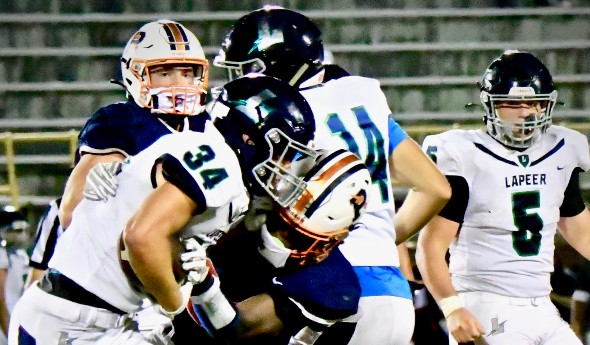
Keep an eye on these: FRIDAY New Lothrop (2-0) at Montrose (2-0), Grand Blanc (1-1) at Lapeer (2-0), Midland Bullock Creek (1-1) at Hemlock (2-0). SATURDAY Croswell-Lexington (2-0) at North Branch (2-0).
Greater Detroit
West Bloomfield (2-0) at Clarkston (2-0)
The Wolves quickly are making last season’s uncharacteristic 3-6 finish – their first below .500 since 2002 – a distant memory, but this matchup will allow them the opportunity to avenge a 2019 loss for the first time. West Bloomfield claimed last year’s matchup 24-0 on the way to finishing 10-2, and more interestingly hasn’t lost a game by more than seven points since 2016. With both programs surging again, we could be in for another close contest.
Keep an eye on these: FRIDAY Detroit Denby (2-0) at Detroit Martin Luther King (1-1), North Farmington (1-1) at Birmingham Groves (1-1), Clinton Township Chippewa Valley (1-1) at Sterling Heights Stevenson (2-0). SATURDAY Warren De La Salle Collegiate (1-1) at Detroit Catholic Central (2-0).
Mid-Michigan
Lansing Catholic (2-0) at Portland (1-1)
Lansing Catholic rode last year’s first win in this rivalry since 2015 all the way to the Division 5 championship, and the Cougars have tuned up on both sides of the ball outscoring their first two opponents by a combined 85-3. The Raiders will hope for a result similar to last year’s first meeting with Lansing Catholic, a 21-20 win, before they fell 21-0 in that District Final rematch. Portland last week bounced back with a shutout of Charlotte after falling big in its opener to DeWitt.
Keep an eye on these: FRIDAY Reed City (2-0) at Central Montcalm (2-0), Canton (2-0) at Brighton (1-1), Stockbridge (1-1) at Lake Odessa Lakewood (1-1), Ortonville Brandon (2-0) at Corunna (1-1).
Northern Lower Peninsula
Kingsley (2-0) at Traverse City St. Francis (1-1)
The Stags ended their six-game losing streak to St. Francis last season with a 26-7 victory that eventually decided the Northern Michigan Football League Legends title. Kingsley hasn’t slowed down, running its regular-season winning streak to 16 last week. But St. Francis’ 14-7 loss to new league member Sault Ste. Marie in the season opener is looking even better after the Sault’s win over Marquette, and the Gladiators still have reason to hope for at least a three-way tie for the Legends championship.
Keep an eye on these: FRIDAY Traverse City Central (2-0) at Cadillac (2-0), Harbor Springs (2-0) at Manistee (2-0), Frankfort (1-1) at Johannesburg-Lewiston (2-0), Charlevoix (2-0) at Boyne City (1-1).
Southeast & Border
Clinton (2-0) at Blissfield (2-0)
Reshuffling among southeastern Lower Peninsula leagues took these teams’ regular Week 2 nonconference meeting up a few levels. It already was a solid nonleague matchup – they’ve played regularly since 2012 and split the last four meetings with Clinton winning last season 45-13. Now they find themselves tied for the early lead in the Lenawee County Athletic Association, with Blissfield coming off a 31-14 win over reigning champion Hillsdale last week.
Keep an eye on these: FRIDAY Saline (2-0) at Monroe (2-0), Hillsdale (1-1) at Ida (1-1), Battle Creek Harper Creek (1-1) at Jackson Lumen Christi (1-1). SATURDAY Schoolcraft (2-0) at Chelsea (2-0).
Southwest Corridor
Cassopolis (2-0) at Centreville (2-0)
The Rangers are up to 26-1 in league play since the Southwest 10 Conference was formed in 2017, and that means even more considering five of the remaining six 11-player football members made the playoffs in 2019. Cassopolis’ closest league win last year was 15-0 over Centreville, which has continued its rejuvenation and could have its sights set on more after losing four games in 2019 by a combined 28 points. The Bulldogs avenged one of those defeats downing White Pigeon 14-8 last week.
Keep an eye on these: FRIDAY Sturgis (2-0) at Paw Paw (2-0), Portage Central (0-2) at St. Joseph (2-0), Constantine (1-1) at Watervliet (2-0), Stevensville Lakeshore (1-1) at Battle Creek Central (1-1).
Upper Peninsula
Gladstone (1-0) at Sault Ste. Marie (2-0)
Gladstone provided an uplifting story last weekend, coming off short prep time to edge Negaunee 22-20 and after also missing out on opening weekend. Next up is the team generating the most buzz in the Upper Peninsula. Sault Ste. Marie has wins over Traverse City St. Francis and Marquette – and will be looking to avenge last season’s 20-8 loss to the Braves.
Keep an eye on these: FRIDAY Marquette (1-1) at Kingsford (2-0), L'Anse (1-1) at Negaunee (1-1), Menominee (1-1) at Escanaba (0-0), Norway (0-2) at Bark River-Harris (0-2).
West Michigan
Zeeland East (2-0) at Zeeland West (2-0)
This next-door showdown always means a lot. It might mean even more now that Muskegon Mona Shores and Muskegon High have joined the Zeeland schools to make what was a strong Ottawa-Kent Conference Green now one of the most powerful football leagues in the state. West won both meetings last year, by 20 and then 31 points in a Division 3 playoff opener.
Keep an eye on these: FRIDAY Cedar Springs (2-0) at Grand Rapids Catholic Central (2-0), Grand Rapids Forest Hills Central (2-0) at Byron Center (2-0), Grandville (2-0) at Hudsonville (2-0), North Muskegon (2-0) at Whitehall (2-0).
8-Player
Whittemore-Prescott (2-0) at Gaylord St. Mary (2-0)
Whittemore-Prescott was a late addition to 8-player before the start of this fall. But it looks like the Cardinals made a sound decision. Their two wins in two weeks equal their total for the entire 2019 season. That said, St. Mary certainly will be W-P’s biggest challenge to date. The Snowbirds have put 111 points on the board over just two games and could be prepping for a serious run in their second season of this format.
Keep an eye on these: FRIDAY Adrian Lenawee Christian (2-0) at Climax-Scotts (2-0), Brethren (1-1) at Mesick (1-1), Indian River Inland Lakes (2-0) at Onekama (1-1). SATURDAY Hillman (1-1) at Portland St. Patrick (2-0).
PHOTO: Lapeer is looking to improve to 3-0 after downing Flint Powers Catholic 36-21 last week. (Photo by Terry Lyons.)
Three Rivers Takes Run at District Together
October 31, 2017
By Wes Morgan
Special for Second Half
J.J. Wagner is economical with his words, stoic on the sideline, and not preoccupied with statistical trends. All he really asks of his Three Rivers football players is to play and sacrifice for one another.
 It’s been a pretty good recipe throughout his 13-year tenure as the head varsity coach of the Wildcats, at least in the years when the players truly held up their end of the bargain. With an 82-50 career record since 2005, Wagner has seen what can happen when everyone is pulling in the same direction, like a 13-0 run that ended with a loss in the 2009 Division 4 Final.
He’s also witnessed how complacency can cut a program right back down, as was the case in 2010 when an experienced Three Rivers squad went 4-5 and missed the postseason.
The Wildcats have been noticeably hungrier the last two years, with a 7-3 mark in 2016 and an 8-2 record this year as they prepare for Friday’s Division 4 District championship game against Edwardsburg.
Eleven games into the year, Three Rivers has been unable to break out of a Wolverine Conference bubble. The Wildcats went 7-2 in the league, with losses to Dowagiac (Week 2) and Vicksburg (Week 9). Revenge was sweet last Friday as Three Rivers beat Vicksburg in the Pre-District game (20-10).
Now, the difficult task of beating the league’s most dominant team for the second time in one year is what’s required to move on in the playoffs. If Three Rivers can beat the Eddies (after also doing so 21-18 in Week 7), there’s a chance they’ll face Wolverine Conference member Plainwell in the Regional Round.
“You get through the Wolverine (schedule) and then you’re suddenly in a mini Wolverine tournament,” Wagner joked.
There are no secrets in terms of playoff prep against such familiar foes, so it’s all about the basics.
“Our offense has been moving the sticks, our defense has been playing well, our special teams have played well and we play well when we don’t turn the ball over,” he said.
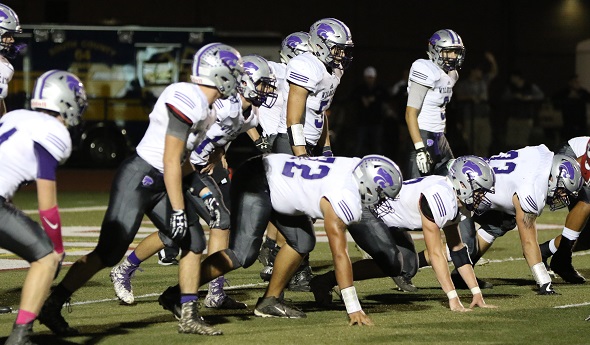
Having played for perennial power Mendon, where he registered 253 tackles as an outside linebacker during the 1987-89 seasons, Wagners’ emphasis on that side of the ball has been a hallmark of the 2017 campaign. Three Rivers has only allowed 11.7 points and 203 yards per game. The Wildcats have stopped opponents on third down 79.8 percent of the time.
A lot of that has to do with big and athletic senior defensive end Tirrell Hausmanis (6-foot-4, 245 pounds), senior defensive tackle Tyler Moore (5-11, 235) and the linebacker duo of senior Chris Morrill (5-10, 160) and Traven Van Oss (6-1, 165). That group alone has accounted for 34.5 tackles for loss this season. Morrill and Van Oss are tied for a team-best 61 tackles.
“Anytime you’re playing good defense, you can take a few more chances on offense,” Wagner said. “I don’t know how many times we’ve gone for it on fourth down this year, but it’s probably more than most (years). You can take a chance at midfield or the 40 that maybe you wouldn’t normally.”
Perhaps no player has embraced Wagner’s rule of doing what’s best for the team more than Hausmanis, who likely would have garnered a lot more attention from college coaches had he stayed at tight end. Instead, he’s anchored both lines the past two seasons.
“We all just do our jobs,” he said. “This happened and we weren’t big enough (on the offensive line) for me to play tight end. They needed me at tackle. At first I didn’t really like it, but I had to get used to it because it was what was best for the team. It helped us succeed and win, so I had to do it.”
 His defensive stats might not seem that impressive — 30 tackles with two sacks — but it’s what he’s capable of that impacts the game so severely.
“It helps when you know people are going to run away from (Hausmanis), so you can stunt and play games on the other side that can mess with their protections and blocking schemes,” Wagner said.
Wagner admitted he’s not big on stats, but for those who were wondering about how many times the offense has felt comfortable gambling on fourth down because of a belief in the defense, it’s 27. The Wildcats have converted 15 times (55.6 percent).
Other than knowing the defense could likely bail it out if needed, there’s been plenty of confidence in the offense under the leadership of junior quarterback Jalen Heivilin.
With a 22-6 touchdown-to-interception ratio, an average of 214.6 passing yards per game and a completion rate of 61 percent, the first-year starter has settled in nicely. Classmate Gavin Charvat has been Heivilin’s favorite target as the two have connected 42 times for 562 yards and six touchdowns. Bryce Morlan was next in line with 32 receptions for 549 yards and a team-high 11 TDs, but the senior went down in Week 9 with a torn anterior cruciate ligament. Fortunately for the Wildcats they also have reliable receivers in Jett Haifley and Zac Meyer; each has hauled in 23 passes for around 400 yards.
“When we play mistake-free, which is what we harp on, and eliminate pre- and post-snap penalties, you can win a lot of games,” Wagner said. “That’s what we focus on every week. If you can do that, you’re going to keep yourself in a lot of games.”
That was exactly the difference in Three Rivers’ home win against Edwardsburg on Oct. 6, which snapped a 34-game Wolverine Conference winning streak by the Eddies.
“We have to play with that same energy and effort (against Edwardsburg),” Wagner added. “In both of our losses, we came out kind of flat. If I knew why, we wouldn’t do it. We think we can go in there (at Edwardsburg) and play them tough again. It boiled down to mistakes in that (first meeting). We made our extra points, and we held them on all theirs. If we go in there with the same discipline, there’s no reason we can’t beat them again.”
 Wes Morgan has reported for the Kalamazoo Gazette, ESPN and ESPNChicago.com, 247Sports and Blue & Gold Illustrated over the last 12 years and is the publisher of JoeInsider.com. He can be reached at [email protected] with story ideas for Berrien, Cass, St. Joseph and Branch counties.
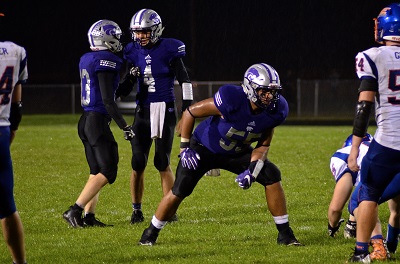
PHOTOS: (Top) Three Rivers’ defense lines up for a play; it’s been stifling this season giving up only 11.7 points per game. (Middle) Receiver Nolan Mark and quarterback Jalen Heivilin (4) talk things over against Edwardsburg. (Photos courtesy of JoeInsider.com.)