

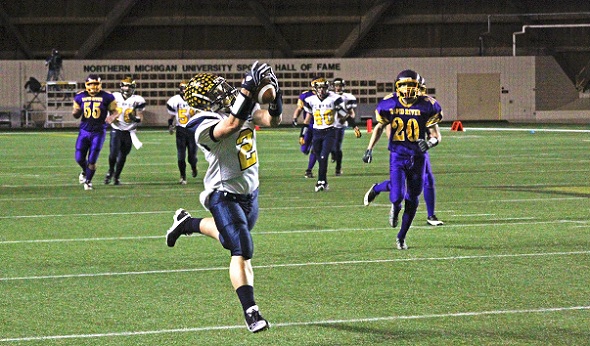
2011 8-Player Final: Carsonville-Port Sanilac Wins Inaugural Title
December 16, 2011
MARQUETTE – Carsonville-Port Sanilac sophomore Dan Rickett emerged from his team’s final huddle of this season, pulled close to an assistant coach and said, “This one says MHSAA this time.”
His Tigers also celebrated a championship last season – a perfect season in fact, but unofficial title because the MHSAA has not yet instituted playoffs for the now 3-year-old sport.
This year, the first playoffs were held. And that made Friday’s 59-20 win over Rapid River at the Superior Dome – and the trophy C-PS then received – mean so much more.
The Tigers are the first MHSAA 8-player football champions.
“All the people saying last year was nothing, this will shut them up,” C-PS senior quarterback Hayden Adams said. “It means a lot more because we actually had to make a run in the playoffs. It’s that much harder, and we had to play that much better every game.
“I think we topped it off at the end of the season.”
A total of 1,433 fans – most wearing Rapid River’s purple and yellow – cheered on the teams in the inaugural game. C-PS finished 12-1 overall to move to 21-1 in coach Tim Brabant’s two seasons. The Rockets finished 11-2 in their first season of 8-player.
The sport was added by the MHSAA in 2009 to provide another option for schools with enrollments so small they had difficulty fielding an 11-player squad. Playoffs were added this season after the necessary 20 schools announced they’d be sponsoring 8-player teams.
That was not lost on either team, even for Rapid River in the loss. The Rockets had won one game each of the last two seasons playing 11-player teams.
“We had never played in the postseason at all since I’ve been here,” Rapid River senior running back Jacob Berglund said. “To make it this far, it’s awesome.”
Offense has reigned in the early stages of the MHSAA 8-player game. The Final kept to that standard.
The teams combined for 901 yards. Adams completed 12 of 17 passes for 324 yards and five touchdowns, and ran for 130 more yards and two scores. Two of his scoring passes were to his brother Trevor Adams, also a senior, including a 43-yarder on the second play of the game. Rickett ran for 78 yards and a touchdown on five carries, and also caught six passes for 133 yards and two scores.
The Tigers jumped out to a 19-0 lead and pushed it to 27-6 by the end of the first quarter. But in 8-player football, a 21-point advantage generally is not a safe one.
Rapid River outscored C-PS in the second quarter to get within 39-20 by halftime. After completing just one pass during the first quarter, Rockets sophomore quarterback Jake Pearson threw for 144 yards and two scores during the second.
But then something somewhat unimaginable happened. The Tigers held the Rockets scoreless the rest of the game.
“At halftime we made some adjustments on what we should do when they motioned. We picked it up real fast,” said C-PS senior linebacker Steven Koehler, who finished with a game-high 20 tackles, including 12 solos.
“I think that the fact they had 10 seniors, and the speed. They’re a year older, two years older in some cases,” Rapid River coach Steve Ostrenga listed as reasons his team had difficulties. “You get two more years of development in that respect as far as strength, and their speed was noticeable. I think that was the big key, their speed.”
Half of C-PS’s players were seniors who had served large roles on this and last season’s teams.
“It’s very fun to watch when we have a group of kids who are that athletic, hard working, and very polite. It’s hard for me to send these guys off,” Brabant said. “I get emotional just thinking about it. But … I know they’re going to be very successful in life.”
The Rockets, meanwhile, graduate just seven players, and also had seven freshmen and three sophomores this fall. Said Pearson, “It was a great learning experience. We know what we have to do for next year now.”
“Now all the teams are going to see what we do,” Adams said. “And they’re going to start doing all the things we do.”
A Game for Every Fan: Playoffs Week 2
November 5, 2015
By Geoff Kimmerly
Second Half editor
Emotions run high by nature during the football playoffs. But this weekend’s schedule of 11-player District Finals and 8-player Regional Finals is especially charged.
Rivalry games dominate this second round of the postseason as teams that competed for league titles meet again for another trophy – or in the case of Division 8, contenders for an MHSAA title a few years ago find themselves on the field together again.
See below for some of the most intriguing from this week’s list, and follow all weekend on the MHSAA Score Center for results as they come in and updated brackets. Watch as well four games at once Friday on Fox Sports Detroit’s Prep Zone, and catch another marquee matchup live on MHSAA.tv with subscription. All games below are Friday unless noted.
Division 1
Romeo (9-1) at Lapeer (10-0)
Lapeer is 20-1 in two seasons as a program after the merger of the former Lapeer West and East in 2014. Its lone loss was by three in last fall’s District Final to eventual champion Clarkston – and after the Lightning beat Romeo by eight in the playoff opener. Romeo earned this rematch by ending Clarkston’s reign last week, but its defense – giving up a meager 6.5 points per game – should receive its toughest challenge since Lapeer put up 23 last season.
Others that caught my eye: Brighton (9-1) at Grand Ledge (10-0), Hudsonville (7-3) at Rockford (7-3), Ann Arbor Pioneer (7-3) at Saline (9-0), Utica Eisenhower (7-3) at Macomb Dakota (8-2), Saturday.
Division 2
Muskegon (8-2) at Muskegon Mona Shores (10-0), Saturday
This gets higher billing than the matchup below between undefeated teams because it might be the state’s most anticipated game regardless of division. More than 10,000 fans watched Mona Shores’ 21-18 win over the Big Reds in Week 8, and an additional few thousand are anticipated for Saturday’s 5 p.m. kickoff. Last time, Mona Shores jumped out to a 21-3 third-quarter lead before Muskegon came back with two scores during the fourth. This one should stay closer from the start.
Others that caught my eye: Midland Dow (9-1) at Fenton (9-1), Birmingham Groves (10-0) at Walled Lake Western (10-0), Detroit East English (8-2) at Grosse Pointe South (7-3), Southfield (7-3) at Berkley (8-2).
Division 3
Edwardsburg (10-0) at St. Joseph (9-1)
The Eddies already scored one for the Wolverine B Conference over the Southwestern Michigan Athletic Conference by eliminating Stevensville Lakeshore last week. Now they get SMAC West co-champ St. Joseph, and on the road. The Bears’ only loss this season was to Lakeshore, by a pair of scores in Week 4, but they closed the regular season with three wins over playoff teams over the final month.
Others that caught my eye: Zealand East (7-3) at East Grand Rapids (7-3), St. Johns (7-3) at DeWitt (9-1), Chelsea (9-1) at Trenton (9-1), Vicksburg (8-2) at Coldwater (10-0).
Division 4
Comstock Park (8-2) at Ada Forest Hills Eastern (9-1)
Forest Hills Eastern can take the next step in a record-setting season that’s already seen the Hawks win their most games ever and first in the playoffs – and come within three points of being undefeated. Offense should reign. Forest Hills Eastern runs well and Comstock Park gave up more than 200 yards to Swan Valley’s leading rusher last week, and the Panthers are dangerous throwing and running and could find some gaps in an FHE defense giving up 19 points per game.
Others that caught my eye: Benton Harbor (6-4) at Zeeland West (10-0), Pontiac Notre Dame Prep (8-2) at Richmond (9-1), Big Rapids (7-3) at Remus Chippewa Hills (8-2), Bloomfield Hills Cranbrook Kingswood (9-1) at Detroit Country Day (9-1), Saturday.
Division 5
Lansing Catholic (9-1) at Portland (10-0)
This either will be the first and only loss for a Portland team seeking its second MHSAA championship in four seasons, or final game for a Lansing Catholic group that came within five points of winning Division 5 a year ago – and will graduate University of Minnesota quarterback recruit Tony Poljan. Portland won their regular-season matchup 28-6 in Week 4, but can’t expect the Cougars to repeat an uncharacteristic four turnovers. They’ve both been impressive since; Lansing Catholic entered the postseason with wins over playoff teams Ann Arbor Gabriel Richard and Monroe St. Mary Catholic Central by a combined 77-23, while Portland allowed only Marshall to come closer than 22 points and held a record-setting Stockbridge offense to only 18 last week.
Others that caught my eye: Grand Rapids West Catholic (8-2) at Reed City (10-0), Frankenmuth (9-1) at Freeland (10-0), Berrien Springs (9-1) at Buchanan (10-0), Almont (8-2) at Algonac (9-1).
Division 6
Montague (10-0) vs. Grand Rapids NorthPointe Christian (10-0) at Comstock Park
The Wildcats have nearly come all the way back to their former roost among the elite after going 2-7 a year ago. But NorthPointe Christian provides a substantial obstacle as Montague pursues its first District title since 2011. NorthPointe’s only loss in the last 19 games came last season in an MHSAA Semifinal, and it’s giving up only 7.6 points per game.
Others that caught my eye: Sanford Meridian (10-0) at Ithaca (10-0), Jackson Lumen Christi (7-3) at Manchester (9-1), Clinton (10-0) at Madison Heights Madison (9-1), Calumet (8-2) at Boyne City (9-1), Saturday.
Division 7
Flint Beecher (7-2) at New Lothrop (10-0)
Beecher easily is the smallest school on its side of the Genesee Area Conference, the only Class C school in a Red group of otherwise all Class B. This matchup will satisfy some curiosity, as New Lothrop hasn’t lost a game in the Class C-dominated GAC Blue since 2009 – and in Week 8 defeated Flint Hamady 49-0. Beecher just edged Hamady 30-28 to open the playoffs last week.
Others that caught my eye: Saugatuck (10-0) at Pewamo-Westphalia (10-0), Class City (8-2) at Sandusky (10-0), Dansville (9-1) at Homer (8-2), Cassopolis (8-2) at Bridgman (9-1).
Division 8
Muskegon Catholic Central (7-2) at Beal City (9-1), Saturday
One of these two has played in the Division 8 Final the last three seasons, and they met in the 2013 championship game, a 35-12 MCC win. This Crusaders’ team has a much different lineup than the one that won back-to-back championships the last two seasons, but new players gained valuable experience in losses to Division 5 Muskegon Oakridge and Division 4 Detroit Country Day. Beal City has a few who were part of the 2013 loss, setting this up as a potential classic as they seek a different result.
Others that caught my eye: Onekama (9-1) at Frankfort (8-2), Crystal Falls Forest Park (6-3) vs. Bark River-Harris (8-2) at Northern Michigan University's Superior Dome, Ottawa Lake Whiteford (8-2) at Morenci (8-2), St. Ignace (9-1) at Johannesburg-Lewiston (9-1).
8-Player
Lawrence (8-2) at Battle Creek St. Philip (10-0)
St. Philip regained the upper hand on Lawrence in Week 9 after three straight losses – and now has to keep it as the favorite to follow Lawrence as the 8-player champion. St. Philip won that meeting two weeks ago only 47-44 but led by 14 points halfway through the first quarter and by 15 points heading into the fourth. Lawrence obviously can score quickly, meaning this one should again come down to the final minutes.
Other Regional Finals: Rapid River (7-3) at Powers North Central (10-0), Cedarville (8-2) at Posen (10-0), Deckerville (9-1) at Morrice (9-1).
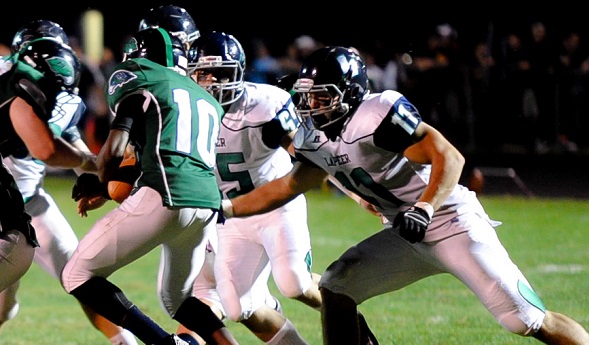
PHOTO: Lapeer has 20 wins over the last two seasons, including against Saginaw Heritage this fall. (Click for more from HighSchoolSportsScene.com.)