

4-Year QB Leads with What He's Learned
October 2, 2020
By Doug Donnelly
Special for Second Half
BLISSFIELD – Gavin Ganun is like a seasoned veteran.
 “I’m really confident now with everything I’m doing,” said the Blissfield quarterback. “I’ve seen a lot of things happen. There’s nothing that surprises me.”
Clinton’s football team might have something to say about that tonight when it travels to Blissfield for a colossal Lenawee County Athletic Association clash.
But there’s no denying that Ganun has seen just about everything by now. He’s making his 37th career start at quarterback for Blissfield and is having a sensational season.
“To me the game feels really slow now,” Ganun said while preparing to face the 2-0 Clinton squad this week. “I have plenty of time to see everything. I can calm myself down in the pocket. Even if there is pressure, I don’t feel it like I used to. I’m not worried about getting hit. I just stand back there, make the reads and find the open receiver.”
This year Ganun has had plenty of open receivers. He has great targets in wide receivers Zack Horky (6-foot-4) and Ty Wyman (6-6) and tight end Nick Ostas (6-2).
“One of them gets open every play,” Ganun said.
Over the first two weeks of the season, Ganun threw for a combined 611 yards and 10 touchdowns – five scores to Horky and three to Wyman – as Blissfield piled up wins over Dundee and reigning LCAA champion Hillsdale.
Ganun has looked great behind a Royals offensive line that has five new starters – tackles Blaine Pifer and Scott Jackson, guards Luke Nofzinger and Ricky Eisenmann and center Henry Smith.
 “It all starts with the line,” Ganun said. “They have come so far. They worked really hard to get better. Their pass blocking has been amazing.”
Ganun has been the starting Blissfield quarterback since game one of his freshman year. He has led Blissfield into the playoffs three straight seasons. For his career, he enters tonight’s game against Clinton with 4,953 passing yards and 56 passing touchdowns.
Ganun was coached his first two seasons by Ryan Love, who is now coaching at Morenci. Ron Estes returned to the Royals’ sideline last year and inherited Ganun as his QB. He couldn’t be happier with his signal-caller.
“There’s no panic in him,” Estes said. “He knows the offense inside and out. He knows what to do when things break down. He knows what to do and when to do it.”
Ganun said Estes gives him a lot of freedom to change the play at the line of scrimmage if he sees something when looking over the defense.
“When I was a freshman, we weren’t doing that,” he said. “But, now, I’m fine to do that anytime. If the defense is running what we think they will run, I don’t have to, but if they change things up, I can change things up.”
Ganun’s audibles have resulted in a couple big plays this season. Horky has caught two touchdown passes in the first quarter of both games.
“We have a good connection,” he said. “We’ve played together so long that we know what each other is going to do before we do it. We’ll just look at each other or say something really quick when we leave the huddle.”
 Clinton, which returned to the LCAA this season after just over a decade as a member of the Tri-County Conference, will be a stiff test for Blissfield. Clinton has been rolling during the first two weeks of the season, piling up more than 900 yards of offense – all on the ground.
Clinton coach Jeremy Fielder has watched a lot of film of Ganun lately and is impressed.
“He’s always been pretty good,” Fielder said. “You see it all with him. He’s an outstanding quarterback.”
Ganun plays three sports for the Royals and has been on varsity for all his entire career. He committed to play college baseball at Bowling Green State University, which announced in the spring that it was dropping baseball before re-examining that decision a month or so later. He’s happy he gets to play for the Falcons.
“I’m super excited,” he said. “I love that place. Everything about it is amazing.”
The Royals are trying to win their first LCAA championship since 2007, the same year Estes guided them to the Division 6 championship game before he stepped away – then returned – as head coach. Ganun knows Clinton stands in the way of that goal.
“It’s going to be very tough,” he said. “They are very physical. Both teams know what the other team wants to do.”
He also knows the Royals are playing at a high level right now.
“We have a great team bond,” he said. “We have been clicking on all cylinders.”
 Doug Donnelly has served as a sports and news reporter and city editor over 25 years, writing for the Daily Chief-Union in Upper Sandusky, Ohio from 1992-1995, the Monroe Evening News from 1995-2012 and the Adrian Daily Telegram since 2013. He's also written a book on high school basketball in Monroe County and compiles record books for various schools in southeast Michigan. E-mail him at [email protected] with story ideas for Jackson, Washtenaw, Hillsdale, Lenawee and Monroe counties.
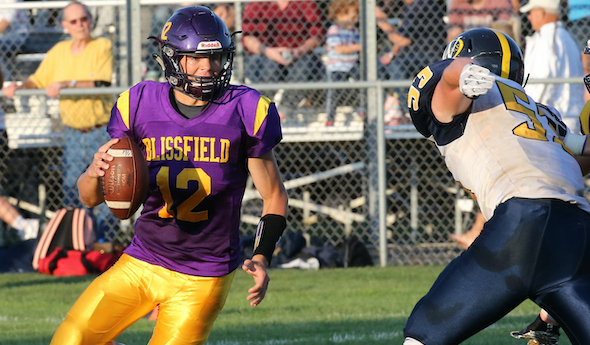
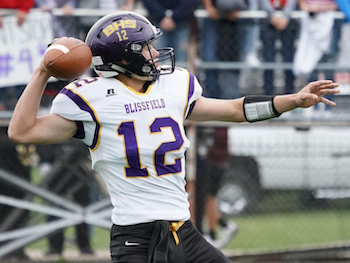
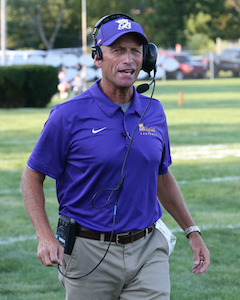
PHOTOS: (Top) Blissfield quarterback Gavin Ganun prepares to take on an Ottawa Lake Whiteford defender during the 2019 season. (Middle) Ganun winds up to pass, also last season. (Below) Ron Estes returned as Blissfield coach in 2019. (Photos by Mike Dickie.)
Byron Brother & Sister Teaming Up Once More
By
Paul Costanzo
Special for MHSAA.com
October 23, 2018
When it was announced Sunday night that Byron was included in the Division 6 playoff bracket, it wasn’t a surprise for the 5-4 Eagles – but it did provide new opportunities.
 An opportunity to play another game. An opportunity to avenge a Week 1 defeat against Flint Hamady. An opportunity to stay together for at least one more week as a team.
In the Marvin household, it provided one other unique opportunity: a chance for senior TJ and his younger sister Sarah, a sophomore, to be teammates on the Eagles’ offensive and defensive lines. Sarah Marvin was a captain on the Eagles’ junior varsity team this year, and is among a group of players moving up to the varsity for the postseason.
“That’s awesome to be able to play football with your sister,” TJ Marvin said. “But to play the same positions and not have to go easy, it’s good, because I can still get a good look.”
It’s the second straight year the Marvins have had this opportunity, and in 2017 they actually were able to line up next to each other late in the Eagles’ loss to Ithaca.
When it comes to practice, being on the same field is nothing new as Byron’s varsity and JV teams often practice together. That means brother and sister – who both play defensive end and offensive tackle -- not only share a field, but also get to square off throughout the season.
“It’s fun,” TJ Marvin said. “It’s cool to be up against your sibling. Caliber of player wise, she lines up just like all the other guys, so I’m still getting a good look. It’s not much different.”
The Marvins get to spend plenty of time together athletically, as both are also throwers on the track & field team, along with Sarah’s twin sister, Becky. Sarah and Becky also get to play basketball for their mother, Theresa, who is the Byron girls varsity basketball coach.
“Everyone in my family knows about throwing,” Sarah said. “All of the sports – you can go home and talk about it, and everyone in your family understands.”
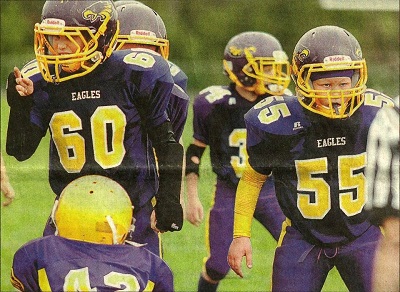
Football is also a family thing, but it’s something special TJ and Sarah share. They started playing while she was in first grade and he was in third, and often times found themselves not only as teammates, but also lined up next to each other on the offensive line.
Starting in the male-dominated sport was something Sarah didn’t think twice about.
“I don’t know if it was something that so much drew me to it. It was just that all of my boy cousins always played,” Sarah Marvin said. “I have (two younger cousins, two younger brothers), an older brother and an older cousin, and we would always rough house.”
Theresa Marvin said her daughter has always loved the game -- whether it be watching or playing -- and became a student of it. TJ agreed.
 “Sometimes I’ll give her tips and stuff, but she is very athletically smart,” TJ Marvin said. “She knows the game, watches a lot of football and she’s very good at big picture plays and seeing what’s going on. Any sport, really, but especially football where there is so much going on, she really analyzes the game.”
While they started playing at the same time, TJ does have plenty of experience he can pass onto his younger sister. Injuries kept him off the field for the majority of his freshman and sophomore seasons, but the 6-foot-3, 235-pound two-way starter was an all-conference selection as a junior. He also is a varsity captain this season.
Sarah Marvin already has established herself as an all-state athlete, finishing third this spring at the Lower Peninsula Division 3 track & field championships in the discus and shot put. She was also an honorable mention all-state selection in basketball during her freshman year.
Throwing appears to be her future as an athlete, and continuing to play football is something they’re taking year by year.
“All through my freshman year I was dead set on it, that I’m going to play all four years,” Sarah Marvin said. “I think that’s changed a little bit. I had a kind of close call where a kid went to make a tackle and I was behind our running back, and he fell right into my knee. So that’s the main thing, is not getting hurt.”
Worrying about getting injured, however, has nothing to do with Sarah’s gender.
“Sometimes I worry about it, but I don’t worry about her anymore than I would other guys on the field,” TJ Marvin said. “I worry about it a little bit with her coming up on varsity where there are much bigger players and it’s a little more intense, but I know what she can do physicality wise and the kind of athlete she is. I worry about her getting hurt, but I worry about every one of my teammates getting hurt.”
Sarah is simply a member of the team, and she says that’s something that resonates through the program.
“Within my grade level and even the grade older, since I’ve played since the first grade, I think they’re just used to it -- we’re definitely just regular teammates,” she said. “They don’t treat me any different than the other kids; they’re just out there to play football. I’d probably be annoyed if they didn’t hit me as hard as they hit everyone else.”
Despite that, the Marvin siblings realize their situation is unique, and they feel fortunate to be able to experience playing together for at least one more week.
“(Getting on the field together) would be a really cool thing to do,” Sarah Marvin said. “Especially in his senior year.”
 Paul Costanzo served as a sportswriter at The Port Huron Times Herald from 2006-15, including three years as lead sportswriter, and prior to that as sports editor at the Hillsdale Daily News from 2005-06. He can be reached at [email protected] with story ideas for Genesee, Lapeer, St. Clair, Sanilac, Huron, Tuscola, Saginaw, Bay, Arenac, Midland and Gladwin counties.
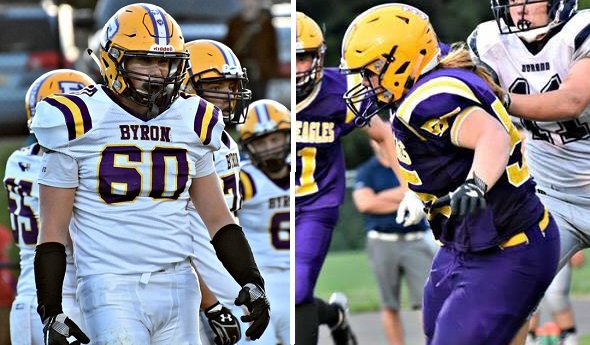
PHOTOS: (Top) TJ, left, and Sarah Marvin take the field for Byron’s varsity and junior varsity teams, respectively, this season. (Middle) TJ and Sarah first teamed up nine years ago when TJ was in 3rd grade and Sarah in 1st. (Photos courtesy of the Marvin family.)