

5-0 Oakridge Healing 2018 Heartbreak
October 2, 2019
By Tom Kendra
Special for Second Half
Muskegon Oakridge had an extra reason to celebrate in the rain on Friday night.
 It was about more than just overcoming sloppy conditions and the never-say-die Montague Wildcats in a matchup of No. 1 vs. No. 2 in The Associated Press’ Division 5 rankings. There was more to it than getting a leg up in the West Michigan Conference race with a thrilling 15-13 overtime win.
This was about overcoming two of the most heartbreaking losses imaginable one year ago – and dedicating the win to those who never got a shot at redemption.
“That win was for those seniors from last year,” said Oakridge running back Leroy Quinn, a four-year starter who rushed for both of his team’s touchdowns and a game-high 144 yards, putting him over 4,000 rushing yards for his career. “I love those guys, and I miss them. We all grieved together last year, and now we’re celebrating for them.”
Oakridge led Montague in their 2018 meeting 24-10 with 3:45 remaining, when the Wildcats roared back with two touchdown passes and then a game-winning, 2-point conversion run by Sebastian Archer with no time on the clock for a 25-24 win.
It was the type of gut-wrenching loss which is hard to shake off.
“It’s a helpless feeling,” said Oakridge senior nose guard and offensive tackle Will Scraver. “The only thing you can do is try to forget and focus on the next game.”
Unfortunately, less than one month later, Oakridge would experience an even more bitter defeat. The Eagles’ second loss had finality as it came in the MHSAA District championship game, as they squandered a seemingly safe 35-8 halftime lead in a stunning 40-37 loss to Hudsonville Unity Christian. Adding salt to the wound was having to sit home and watch Unity then roll over its next three opponents en route to the Division 5 championship.
“Sometimes it’s hard to put those losses behind when you have umpteen people coming up to you at the store or the gas station asking you what the heck happened,” said Harger, who is in his ninth year as the Oakridge coach after serving for 16 years under Jack Schugars, the all-time winningest coach in Muskegon-area football history.
“All we can do, as coaches and players, is to learn from our mistakes and to take care of all the little things so that we win those kind of games.”
Oakridge, 5-0 and now No. 1 in Division 5 in the latest Associated Press poll, has been focused and motivated this fall – starting with a tough road test at Belding and most recently with the big revenge win at Montague.
 Oakridge and Montague were scoreless through three quarters and tied, 7-7, after regulation. Quinn scored from three yards out in overtime, then added what proved to be the game-winning 2-point conversion run. Montague answered with a 10-yard pass from Drew Collins to Brennan Schwarz, but Nate Fair and Corey Vanderputte stuffed the 2-point conversion attempt.
Quinn, a 6-foot-1, 233-pound battering ram, has led the way with 465 rushing yards and eight touchdowns. He now has 4,065 career rushing yards, eclipsing David Nelson’s previous school record, and needs five more rushing TDs to pass Jamie Potts for that school mark.
Quinn’s play thus far has been no surprise, but how quickly others have stepped up in the backfield and on the line is the reason why Oakridge is back to No. 1 in the state.
Junior quarterback Ethen Dailey (5-11, 145) has done a solid job managing the Eagles’ offense, and speedy sophomore Vanderputte has emerged as the breakaway threat.
But it was the play of the offensive line, where Fair is the only returning starter, that keyed the win at Montague.
Oakridge, which lined up in a double tight end, full-house backfield look most of the game and threw only two passes (completing none), finished with a 222-70 edge in rushing yards.
“With the tradition out here, there are always new players ready to step up,” said Fair, who also starts at inside linebacker. “We might not have a lot of big names on the line, but we knew we were going to be good.”
Four of the Eagles’ five interior linemen are seniors, with the lone exception sophomore center Derek Driscoll. The guards are seniors Josh Havermans and Jason Pego and the tackles are Fair and Scraver. Starting at tight end are junior Luke Martin and sophomore Ethan Josza.
Harger is not ready to start talking about avenging last year’s playoff loss, as his team still has tough games remaining at North Muskegon in Week 7 and the final two weeks of the regular season at home against Ravenna and first-time opponent Traverse City St. Francis.
Oakridge could also have a couple of new playoff challenges close to home. While the Eagles appear a lock to be in Division 5, they may be joined by resurgent neighbor Muskegon Orchard View (on the bubble of Division 4 and 5) and Montague (on the Division 5 and 6 bubble).
“Our motto this year is: ‘Exceed Expectations’ and, considering the group we lost last year, these guys have done that so far,” said Harger, who is 75-16 and has made the playoffs in each of his first eight years as head coach.
“This is not a real rah-rah group of kids. I think they just love to play football and with the way last year ended, they are thankful for the opportunity to come out and play again.”
 Tom Kendra worked 23 years at The Muskegon Chronicle, including five as assistant sports editor and the final six as sports editor through 2011. E-mail him at [email protected] with story ideas for Muskegon, Oceana, Mason, Lake, Oceola, Mecosta and Newaygo counties.
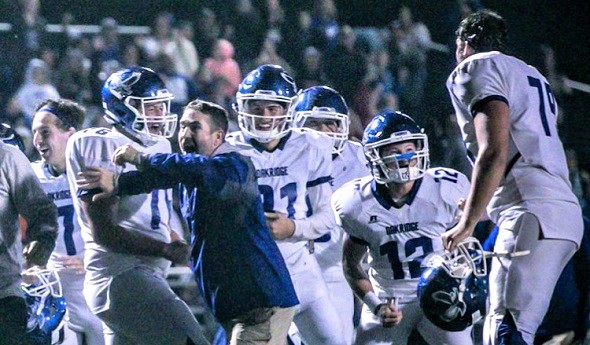
PHOTOS: (Top) The Oakridge sideline celebrates late in the Eagles' 15-13 overtime win at Montague. (Middle) Oakridge senior Leroy Quinn, who became the school's all-time leading career rusher earlier this season, runs through a big hole into the end zone for a touchdown. (Photos by Tim Reilly.)
Performance: Muskegon's La'Darius Jefferson
November 29, 2017
 La’Darius Jefferson
Muskegon senior – Football
Muskegon’s 6-foot-2, 215-pound quarterback ran 32 times for 247 yards and four touchdowns to lead the Big Reds to a 28-10 win over Farmington Hills Harrison in Saturday’s Division 3 Final, earning Jefferson the Michigan Army National Guard “Performance of the Week.” The championship was Muskegon’s first since 2008 and came after the Big Reds fell by a point to Orchard Lake St. Mary’s in the 2016 championship game – when the Eaglets scored with four seconds to play.
Jefferson, who also celebrated his 18th birthday Saturday, finished this season with 2,097 yards and 33 touchdowns rushing and 1,205 yards and 21 touchdowns passing. His rushing touchdown total will make the MHSAA record book, and his performance Saturday earned four entries for accomplishments in a championship game. After splitting time at quarterback as a junior – and running for two touchdowns in the 2016 Final – Jefferson led arguably the best team in the state, regardless of division. The Big Reds scored 722 points, which rank third-most in state history, averaging 51.2 per game, which ranks 10th. Their average margin of victory was 45 points, and they outscored their five playoff opponents by a combined 221-36.
 Individual awards are piling up for Jefferson, who was named Division 3-4 Player of the Year by The Associated Press and statewide Michigan High School Football Player of the Year by MLive. He previously had committed to continue his football and academic careers at University of Central Florida, but has re-opened his recruiting with Michigan State and Georgia Tech among those recruiting him hardest. Jefferson, who also ran track last spring, has big plans aside from football; he carries a 3.4 cumulative grade-point average and is a member of National Honor Society, and he plans to study aerospace engineering wherever he ends up.
Coach Shane Fairfield said: “He is just a selfless kid that loves to win, that loves family. He’s driven by the relationships in his home. And he loves his teammates. And he was more vocal and determined this week to get this win, because his biggest thing is he wants all the kids who aren’t going to have the chance to experience what he’s going to experience after he graduates to have some type of experience that they can say either, ‘Hey, I played with La’Darius’ or ‘I won a state championship when I was in high school.’ And that’s it – he’s very aware of how lucky and fortunate he is to be in the position he is, and he just wants to share that with all of his teammates.”
Performance Point: “It’s amazing. It’s something people dream of,” Jefferson said. “People dream about scoring the last touchdown in their backyard, making the final hoop. It’s a blessing. I’m trying to hold my tears in. We worked so hard to get here. We’ve been gassed and pounded. It’s so special. … This is the best thing that’s ever happened to me besides my family.”
Team of destiny: “It’s something these boys have been dreaming about. I kid you not; I told Eli Jackson, 44, our eighth grade year that we were going to win it. I mean, we’re here.”
Motivated Muskegon: “We had a chip on our shoulder until (the clock) was zero-zero. We weren’t done. We had a chip on our shoulder all year. Everybody we played, we said we’re going to punish. … Everybody doubted us. Everybody said we lost Kalil Pimpleton, one of the best players in the state (who played this fall at Virginia Tech). We lost JaCorey Sullivan (Central Michigan) … Andrew Ward (Nebraska), one of the best defensive players in the state last year. We lost them big boys up front. So we overcame.”
 Checkmate: “I’ve been more humble (this season). I enjoy the moment. I feel like last year it was an amp moment; I wasn’t feeling it. I told myself, it’s all I’ve got. It’s my last job. I go through every day and I do a checklist. As a kid I dreamed about winning player of the year and breaking records and doing all this, and I did all that. The final checklist was win a state championship, and I can go home and check that off.”
Soaring on and off the field: “I know I want to be a successful young man beyond football. I want to go to college and study aerospace engineering, get my degree and help provide for my family. I’ve got goals beyond football. I thought as a kid that football was the only thing that I had, (but) I can do without football. I’m a great student. I work hard; I work my butt off in the classroom. I want to build planes. Who don’t want to build planes? Who don’t want to be like, ‘Oh, La’Darius built this big machine that’s flying?’ It’s cool; it’s unique.”
- Geoff Kimmerly, Second Half editor
Every week during the 2017-18 school year, Second Half and the Michigan Army National Guard will recognize a “Performance of the Week" from among the MHSAA's 750 member high schools.
The Michigan Army National Guard provides trained and ready forces in support of the National Military Strategy, and responds as needed to state, local, and regional emergencies to ensure peace, order, and public safety. The Guard adds value to our communities through continuous interaction. National Guard soldiers are part of the local community. Guardsmen typically train one weekend per month and two weeks in the summer. This training maintains readiness when needed, be it either to defend our nation's freedom or protect lives and property of Michigan citizens during a local natural disaster.
Previous 2017-18 honorees:
November 23: Ashley Turak, Farmington Hills Harrison swimming - Read
November 16: Bryce Veasley, West Bloomfield football - Read
November 9: Jose Penaloza, Holland soccer - Read
November 2: Karenna Duffey, Macomb L'Anse Creuse North cross country - Read
October 26: Anika Dy, Traverse City Central golf - Read
October 19: Andrew Zhang, Bloomfield Hills tennis - Read
October 12: Nolan Fugate, Grand Rapids Catholic Central football - Read
October 5: Marissa Ackerman, Munising tennis - Read
September 28: Minh Le, Portage Central soccer - Read
September 21: Olivia Theis, Lansing Catholic cross country - Read
September 14: Maddy Chinn, Pontiac Notre Dame Prep volleyball - Read
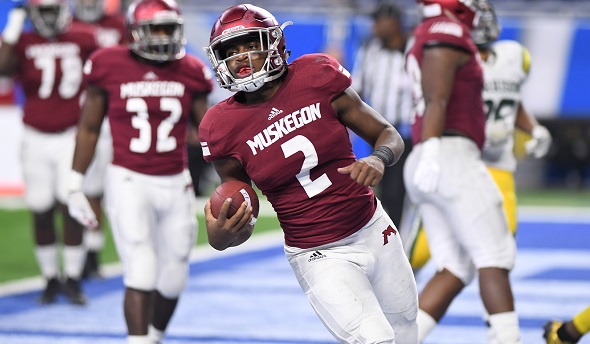
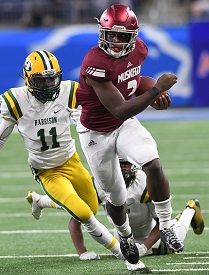
PHOTOS: (Top) La'Darius Jefferson crosses into the end zone for one of his four touchdowns during the Division 3 Final on Saturday at Ford Field. (Middle) Jefferson breaks into an opening while Harrison defenders pursue.