


8-Player Powers Converge in Greenville
November 15, 2012
By Geoff Kimmerly
Second Half editor
Friday’s second-ever MHSAA 8-player football championship game will feature teams representing different stages of the new division’s development.
Coming down from the north is Bellaire, one of the first schools to jump on the new format in 2009 and a major success since doing so. Traveling west from the Thumb is Deckerville, a solid 11-player program in years past that has gotten smaller over the last decade and made the switch this fall.
Together, they should bring an exciting conclusion to the 8-player season at Greenville High School’s recently-built Legacy Field, a tremendous structure comparable to a small college stadium.
Tickets for the 8-player Final cost $8. Can’t make the trip? Watch it live on Fox Sports Detroit Plus (Comcast channel 901, check local listings for other providers). Kickoff is 7 p.m.
Here’s a look at the teams squaring off:
BELLAIRE
Record: 9-3
Coach: Ron Bindi, fifth season (25-24)
League finish: Fourth in Bridge Alliance Conference
Championship history: Has never appeared in an MHSAA Final.
Best wins: 28-16 and 20-16 (Semifinal) over Rapid River, 48-0 over Owendale-Gagetown (Regional Final).
Players to watch: RB/CB Chase Small, 5-8/170, soph. (185 carries, 1,574 yards, 24 TDs rushing); QB Zach Smith, 5-11/158, sr. (29 for 73, 676 yards, 7 TDs passing; 389 yards, 15 TDs rushing); OL/DL Drew Bailey, 6-4/200, sr. (73 tackles), LB/C James Campis, 5-10/195, jr. (171 tackles), SE/CB Wes Villafane, 5-8/151, sr. (14 caches, 514 yards, five TDs, four interceptions).
Outlook: After finishing a combined 1-16 in its final two seasons in 11-player football, Bellaire is 23-8 since making the switch. The Eagles’ quick start included representing their conference against Mid-Michigan 8-Man League winner Carsonville Port-Sanilac in a non-MHSAA championship game at the end of the first 8-player season. This year’s team started 0-2 before hitting its stride. There’s no question Bellaire is a running team, with 3,413 rushing yards this fall led by Small’s 1,574. The team has thrown for 823 yards, with Villafane catching nearly half the team’s passes. Campis and junior Hunter Walsh are the big hitters for a defense giving up only seven points per game during the postseason.
DECKERVILLE
Record/rank: 11-1
Coach: Bill Brown, 20th season (154-60)
League finish: First in North Central Thumb League
Championship history: Has never appeared in an MHSAA Final.
Best wins: 32-12, 48-39 and 42-39 (District Final) over Carsonville-Port Sanilac, 24-18 over Peck, 36-30 (2OT) over Portland St. Patrick (Semifinal).
Players to watch: QB Nick Pagel, 5-10/170, jr. (132 carries, 824 yards, 11 TDs rushing; 31 of 63, 463 yards, six TDs passing), RB Corey Wagester, 6-0/165, sr. (136 carries, 820 yards 12 TDs rushing), FB/LB Chris Wolfe, 5-10/170, sr. (151 carries, 1,580 yards, 14 TDs rushing).
Outlook: This is Deckerville’s first season of 8-player football. But unlike a lot of others that have made the switch, the Eagles had plenty of success in 11-player with four seasons of at least 10 wins beginning in 2000 – when they made the Division 8 Semifinals and fell six points shy of reaching the Pontiac Silverdome. Their lone loss this season came in Week 2 to powerful Cedarville; Deckerville has rolled since although it had two close calls during the playoffs. The Eagles also focus on the run led by two strong backs and two-way quarterbacking threat Pagel, and will have a hefty size advantage thanks to guys like senior Kevin Hammond (6-foot-1/235 pounds), sophomore Cody Mausolf (6-2/240) and senior Zachary Bowerman (6-0/210) up front.
Thank Roosevelt for Football Weekends
December 20, 2013
By Rob Kaminski
MHSAA benchmarks editor
The next time you find yourself immersed in a tense crosstown football rivalry on a Friday night followed by a Saturday pilgrimage to the nearest college campus and a Sunday afternoon with a remote and your favorite snacks and beverages, take a moment to consider what the weekend would be like if it weren’t for Teddy Roosevelt.
The man who became our 26th President shortly after the turn of the 20th Century following the assassination of William McKinley in 1901 was a football fan like you. Maybe more so.
Today’s game of football has reached a critical crossroads. Player size and speed have increased across the board. Savage use of equipment as weapons rather than protective gear has been glorified on television networks and social media. Leaders of the game at all levels have recognized the need for change, employing new rules and widespread educational efforts to aid in preserving the sport.
History, as they say, is repeating itself.
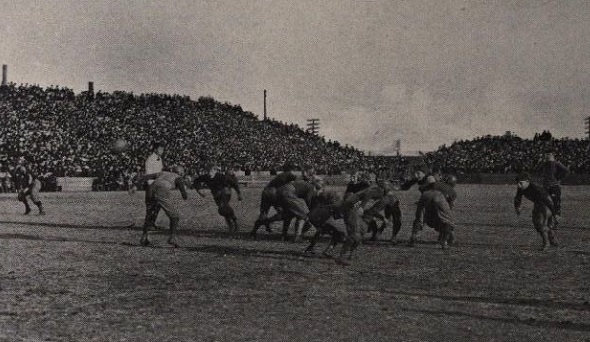
In an ironic twist, it was Roosevelt who saved the then-brutally violent game of football from itself more than 100 years ago. Yes, the same “Rough and Ready Teddy” who led the charge up San Juan Hill during the Spanish-American War and often sparred in the boxing ring while in office from 1901-09 opined that football was becoming so gruesome that he delivered an ultimatum: clean up the game or it would be outlawed.
The Chicago Tribune reported that in 1904 alone, there were 18 football deaths and 159 serious injuries, mostly among prep school players. Football deaths suffered by younger players were reported on a nearly weekly basis, as outraged citizens called on colleges and high schools to banish football outright.
In stepped Roosevelt, who called head coaches and representatives from Harvard, Yale and Princeton – college powers at the time – to the White House in 1905 urging them to eliminate excessive violence and set an example of fair play for the rest of the country. When the casualties actually rose by one during the ensuing season, Roosevelt reacted with greater resolve and convened leading football authorities for the purpose of authoring drastic rules changes. What emerged was an intercollegiate conference which was the predecessor of the NCAA.
Among the most effective changes for the 1906 season were the legalization of the forward pass, the elimination of mass formations, and the creation of a neutral zone. Football fatalities fell to 11 in each of the next two seasons, and severe injuries fell drastically.
Thanks to the introduction of protective equipment and ever-evolving rules changes, football during the 100-plus years to follow has become an exponentially safer game. Yet, the game’s leaders always will need to adjust and react to scrutiny that comes with the territory.
So, as the game once again undergoes rules modifications in the name of safety, give a tip of the cap to President Roosevelt while you enjoy college bowl season and the NFL playoffs and begin to think ahead to the first high school practice of 2014.