

8-Player Takes Flight in Upper Peninsula
September 28, 2017
By Dennis Grall
Special for Second Half
ESCANABA – Three yards and a cloud of dust. That was the highly successful version of football applied by veteran Ohio State coach Woody Hayes as big bruisers dominated the game.
 It certainly is not the preferred style on the fields of 8-player football. Nope, this version is much more open-field and definitely more exciting, full of big plays and a ton of scoring.
Take Powers North Central as the prime example. The Jets have won the last two 8-player MHSAA championships with back-to-back 13-0 seasons, piling up yards and points in their first two seasons in the 8-player game with a large group of skilled athletes.
Their winning streak ended at 27 games earlier this season, but the style they displayed with exceptional athleticism led by Jason Whitens and Bobby Kleiman has caught on with many other programs.
The Upper Peninsula, at the forefront of the 8-player game due largely to decreasing enrollments, has been lighting up the scoreboards this year. Teams like Pickford and Cedarville, Rapid River and Stephenson, Ontonagon and Crystal Falls Forest Park are progressing with the same formula as North Central by featuring explosive offenses.
Citing some 8-player detractors who don't think the game is real football, veteran Cedarville coach Scott Barr said, "I don't think anyone can argue that it (8-player) has not been healthy for football. It has been healthy."
The game is thriving in small schools because the 8-player version simply has allowed football to remain in the athletic program despite shrinking enrollments across the state.
"It has allowed us to keep football," said veteran coach Steve Ostrenga of Rapid River, who led the Rockets into 8-player Finals in 2011 and 2013 and into the playoffs every season since making the switch after going 1-7 in 11-player in 2010.
"We did it out of necessity. We may have waited too long," added Ostrenga, recalling that last year of 11-player football when only one sub was available at several games.
Veteran Pickford skipper Josh Rader has an idea why the 8-player game has met approval at so many small schools. "It is a high-octane game. It is a lot of fun to watch," he said. "It puts a lot of pressure on defenses because it is such a wide open game. It makes it exciting for the fans."
No longer do fans have to squint and squirm in their seats to see what is happening among the goliaths in the line. Now the football is visible in the wide open spaces as skilled athletes display dazzling moves, whether the team favors the extremely popular spread offense or uses the more familiar run-oriented approach.
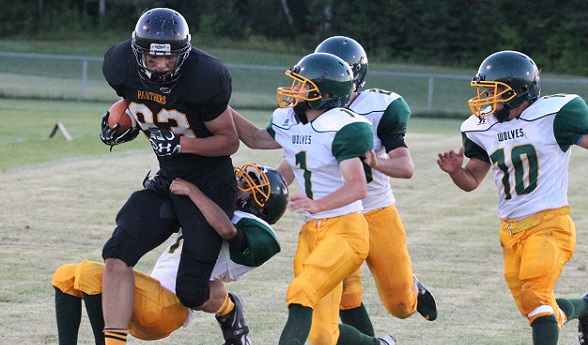 "It is more a one-on-one oriented game now," said coach Ben Mayer of Ontonagon, whose program has consolidated with neighboring Ewen-Trout Creek, which yearly battled small player turnouts just to keep the game alive. Fifteen E-TC students are playing football at Ontonagon, with six on the varsity, highlighted by 6-foot-7 receiver Jacob Witt, who caught MHSAA 8-player record 24 touchdown passes last season.
"Without 8-player, we would have gone under a while back," said Mayer, who played for U.P. Sports Hall of Fame coach Bob "Cubby" Carlson at Ontonagon. He said the Gladiators were forced to use four freshmen and had 130-pound athletes on the line in past years.
"Football has changed a lot in the last four years," he said of the time since the Gladiators moved to the 8-player game. "The ball is in the air. It is fun to watch.”
Mayer said 8-player also enables his program to offer junior varsity football to younger students, instead of having them compete against older, bigger and stronger players with the potential to increase injuries.
"There is not as much violence between the tight ends now because we don't play in those tight spaces," said Mayer.
He also recalls putting "wildly undersized kids in the line against bigger schools with monsters from legitimate programs, with kids getting stepped on and squashed on.
"You do have a lot of choices in 8-man. I can put smaller kids somewhere and they will be all right, and we can still play football."
Ostrenga said it seems injuries, especially of the serious variety, have also seemed to decrease. "We used to hit a lot more in practice. Now we do a lot of teaching and drill work and conditioning," he said, adding MHSAA officials have been in the forefront of trying to reduce injuries with new regulations.
Ostrenga said in the 11-player version, many times it came down to "men playing against boys."
He did say, however, that under the 8-player game coaches "can tend to overuse a player. You get a really good athlete and use him as a crutch in a game."
Ostrenga said it took time to support the change to 8-player football. "I was against 8-man football at first. Now it has made me more open-minded and allowed me to become more understanding." He said 8-player athletes need to have speed, strength, balance and shiftiness.
"Some big guys can't move that well," he said, indicating this version of football requires more agile and nimble athletes to cover the wide-open spaces. "The big thing is understanding you have to get your athletes on the field. You just have eight guys on the field and you are (more) exposed. In 11-man you can hide someone. In 8-man, coaches will find your weaknesses."
Rader agreed, noting, "It puts a lot of pressure on the defense because the game is so wide open. There is a little different strategy. It is a disadvantage for the defense because (the field) is so wide open and there is not a lot of help. You want to take the advantage your offense has over the defense in one-on-ones.
"We like to run the ball and throw the ball, so our athletes can utilize the open field.”
Barr said 8-player quarterbacks are more difficult to contain than typical pocket passers. "They are more elusive," he said, recalling how the 6-foot-4 Whitens could take the direct snap, survey the field and decide whether to throw or run the ball himself.
In the 2016 MHSAA title game, Whitens ran 17 times for a record 352 yards and six touchdowns as the Jets beat Deckerville 58-22. The Jets ran for 469 yards that night.
"You rarely see teams ground and pound," Barr said of the8-man game, noting he began to rely on the spread offense in 11-player football as he tried to figure out how to match up with the over-powering tailback-oriented rushing attack of perennial power Forest Park, which began playing 8-player football in 2016.
Barr said the kicking game is of vital importance now and that secondary tackling is a tough transition because of the explosive offense athletes.
He said "the hybrid player who has size and speed" is featured in 8-player "and it can eliminate the real big kids," which he said are seldom a factor for small schools anyway.
Another plus for the 8-player game comes in scheduling, where Class D schools no longer have to face larger Class C programs and can also find opponents in northern Wisconsin, which also has declining enrollments.
Bark River-Harris and Lake Linden-Hubbell are the only Class D schools still fielding 11-player football teams in the Upper Peninsula. Three other schools, Class D Wakefield-Marenisco and Bessemer and Class C Ironwood have formed a cooperative program, Gogebic Miners, for football purposes.
 Denny Grall retired in 2012 after 39 years at the Escanaba Daily Press and four at the Green Bay Press-Gazette, plus 15 months for WLST radio in Escanaba; he served as the Daily Press sports editor from 1970-80 and again from 1984-2012. Grall was inducted into the Upper Peninsula Sports Hall of Fame in 2002 and serves as its executive secretary. E-mail him at [email protected] with story ideas for the Upper Peninsula.
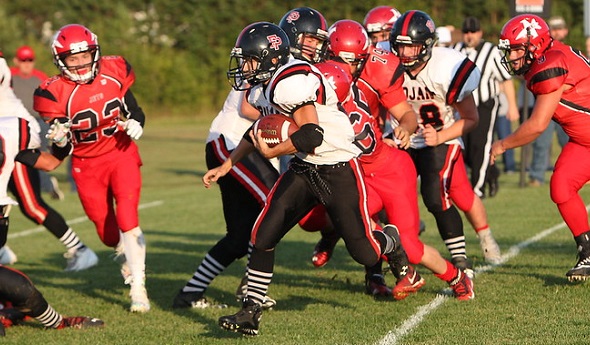
PHOTOS: (Top) Crystal Falls Forest Park downed Powers North Central 66-58 in Week 2 as the teams combined to score more than 100 points for the third time in two seasons. (Middle) Ewen-Trout Creek’s Jacob Witt, here against Carney-Nadeau last season, caught 24 touchdown passes in 2016 and is playing as part of a co-op team with Ontonagon this fall. (Photos by Paul Gerard.)

Football Participation
June 13, 2017
Each summer, the Michigan High School Athletic Association issues several news releases that, together, help to inform us about the health of high school sports in Michigan. These include reports regarding participation and attendance.
The first of these releases will occur later this month when we report on participation and make comparisons to previous years. Later, there will be a report of how participation in Michigan compares to other states.
Without going into detail now, I’ll preempt the first release to provide its biggest news – football participation was down about five percent in grades 9-12 in 2016 compared to 2015.
The decline in number of schools sponsoring 11-player football is matched by the increase in schools sponsoring the 8-player game. So overall, the number of football schools is stable; but squad size is smaller.
Among other things, this predicts continuing growth in 8-player football, which expects approximately 60 schools this fall when the MHSAA 8-player tournament expands from one to two 16-team divisions.
The latest participation data also requires that those of us who love the game of football have much work to do; and that work has little to do with how either the 8- or 11-player tournament is conducted.
The focus needs to be on practice – including how early in August it begins and how much contact is allowed; the focus must be on personnel – including the importance of hiring on-staff teachers as coaches; and the focus must be on perceptions – including our narrative that our game has never been healthier for junior high/middle school and high school students and never more important for the unity and identity of schools and communities.
Like other sports, football is challenged by declining high school age enrollment, expansion in the number of sports offered by schools and increased single-sport specialization, as well as a largely misplaced concern for injuries.
On June 28, the leadership of the Michigan High School Football Coaches Association is convening a focus group to help identify the themes that resonate best with parents and who the most trusted people are to deliver those messages. This is an important effort.