

All Hands on Deck, P-W Earns 1st Title
November 26, 2016
By Geoff Kimmerly
Second Half editor
DETROIT – Jared Smith’s final football game in a Pewamo-Westphalia uniform ended Saturday how he’d always dreamed.
He waved his arms up and down during the final seconds, beckoning to the crowd for a final blast of cheers as he first hugged teammates, then hoisted up assistant coach Nathan Thelen and spun him around a few times for probably his longest carry of the Division 7 Final.
With that, the most successful decoy in MHSAA championship game history began celebrating the history-making event that’s always mattered most.
It was apparent by halftime Saturday there would be no career rushing record for the Pirates senior back, who will graduate atop all-time lists in five other categories. He didn’t score this time and didn’t even lead his team in rushing. But the second-most traveled rusher in more than a century of Michigan high school football ended as a champion, drawing so much attention from opponent Detroit Loyola that his teammates could do the lifting in a 28-14 win at Ford Field.
“We have so many weapons on the team this year, so many tremendous athletes. … Teams are going to key on me just because of what I’ve done, and it opens up things for everybody else,” Smith said. “When everybody steps up, we’re hard to stop.
“I’ve got no problem with how we win if we come out with the win. I said at the beginning that I don’t care about my records. I just wanted a state championship.”
That championship was the first in Pirates football history, coming in their third Finals appearance, the final victory of a perfect 14-0 run. They entered the playoffs ranked No. 2 in Division 7 and beat No. 1 Traverse City St. Francis, No. 3 Saugatuck and No. 4 Ubly on the way to Detroit before downing No. 5 Loyola.
Last season, P-W led into the final four minutes of the Division 7 championship game before falling 22-16 to Ishpeming. And the lessons from that day – plus the familiarity with this stage from that trip – clearly paid off for a team that returned nine starters on both sides of the ball and the second player to go over 8,000 yards rushing for his career.
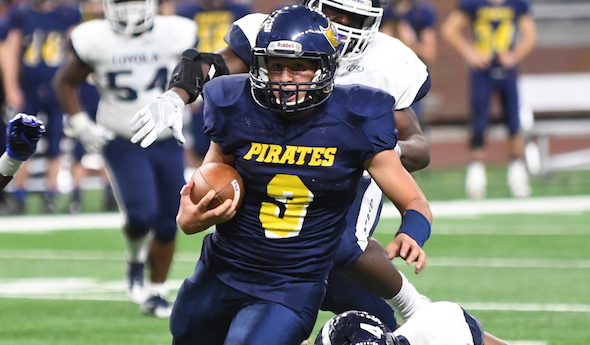
Smith entered with 8,140 yards over four varsity seasons, only 291 yards shy of the career record set by East Grand Rapids’ Kevin Grady from 2001-04. But Saturday, Smith ran for a mere 48 on 20 carries, not even the most on his team – but enough to open up opportunities for the Pirates’ pair of quarterbacks, senior Ryan Smith and junior Jimmy Lehman. They orchestrated an attack that scored the second-most points Loyola had allowed in the playoffs over the last five seasons – second only to the 30 P-W scored against the Bulldogs in a Semifinal win last fall.
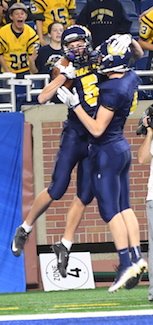
Ryan Smith led the Pirates in rushing with 81 yards and a touchdown, while Lehman was 6 of 8 passing for 127 yards and a pair of touchdowns tosses to senior Logan Hengesbach. Lehman also added a touchdown run from a yard out with 5:05 to play.
 That Lehman run score not withstanding, it’s been a little predictable which quarterback was going to do what. But with the Bulldogs keying on Jared Smith, it didn’t matter much. Lehman’s first touchdown pass came on play-action after a fake handoff to Smith. Ryan Smith’s running touchdown came after a fake dive up the middle to Jared, which drew the interior of Loyola’s defense as Ryan ran right two yards into the end zone.
“(The quarterback predictability) does speak to the play of our offensive line, which was solid today,” P-W coach Jeremy Miller said. “When Ryan comes in, we’re reading some stuff, and we want to get him going with his legs, but Ryan can also throw the ball, hurt you through the air. When Jimmy comes in, it’s more of a passing look for us, and we use him as more of a blocker, but then today Jimmy got a big play for us at the end of the game with his legs.
“To both of their credits, for the last two years they didn’t care who was in, they didn’t care who was carrying the ball, what we were doing. They supported each other, and that’s an example of the brotherhood we had on this team.”
Loyola, a three-time finalist this decade and the champion in 2014, pushed to the end despite facing a three-score deficit with just under nine minutes to play.
The Bulldogs (11-3) got on the board with an 18-yard touchdown pass from senior Price Watkins to junior tight end Keith Johnson, followed by a two-point run by Watkins that made the score 21-8. After Lehman’s run touchdown, Loyola drew to the final deficit on sophomore D’Vaun Bently’s scoring run with 2:04 to play.
The Bulldogs’ late offensive start surely wasn’t helped by the absence of senior Malcolm Mayes, who didn’t play (and was reported earlier in the week to be injured). The usually run-heavy veer offense gained only 123 yards on 38 carries and 186 yards of total offense.
“They attack with the D ends. They really were crashing them,” Watkins said. “So it was hard to make those outside runs. We run a veer, and it’s outside – so they crashed down with the D ends, and basically stopped us from running our plays.”
Senior linebackers Nathan Smith and Devon Pung led the Pirates’ defensive effort with nine and seven tackles, respectively. The most impressive individual defensive performance, however, came from Loyola senior linebacker Kailen Abrams – he had 16 tackles, including 4.5 for losses, at one point taking down Ryan Smith two plays in a row to help force a field goal attempt that ended up no good.
Total, the Bulldogs had nine tackles for losses and a sack. But the Pirates just kept coming.
“Our plan going in there was more concerned with that quarterback read (by Ryan Smith) than Jared. I thought with our speed, I thought we could contain Jared, but we were concerned with the read with the quarterback,” Loyola coach John Callahan said. “And he did an outstanding job on the read. He rode that until the very end, tucked it and took it.
“We watched enough film on them to know they had some receivers, had some guys. Early on that first half, the kids made some big-time plays. … (But) they aren’t just Jared, and obviously you saw that.”
The MHSAA Football Finals are sponsored by the Michigan National Guard.
PHOTOS: (Top) P-W quarterback Ryan Smith breaks a Detroit Loyola tackle during Saturday’s Division 7 Final. (Middle) Logan Hengesbach (5) and Garrett Trierweiler celebrate one of Hengesbach’s two touchdown catches.

NFHS Voice: Fall Fridays for HS Football
October 28, 2019
By Karissa Niehoff
NFHS Executive Director
Some of the top football matchups featuring Ohio teams Friday, Oct. 18, were Mentor vs. Shaker Heights, Cleveland St. Ignatius vs. Cincinnati Archbishop Moeller, Cincinnati St. Xavier vs. Massillon Washington and Northwestern vs. Ohio State.
That’s correct, Northwestern University vs. Ohio State University, on Friday night. While the game was in Evanston, Illinois, and not Columbus, it was televised on the Big Ten Network. Ohio State, one of the nation’s top-ranked college teams with one of the strongest fan bases, played on Friday night in direct competition with the several hundred high school games across the state.
And that wasn’t the only college football game on Friday night. There were three other FBS (I-A) matchups, including an Atlantic Coast Conference game between Pittsburgh and Syracuse. Through the first eight weeks of the season, there have been about 25 major college football games on Friday night.
A number of high schools in Ohio moved their games earlier in the hope of finishing before the start of the Ohio State-Northwestern game. Others moved their games to Thursday or Saturday. At least one school – Ursuline Academy in greater Cincinnati – urged its fans to not watch the Ohio State game:
“Please make a statement to Ohio State by NOT watching their Friday night game this week. Friday nights are for HS football. Let’s keep it that way. Support your local team. We play Boardman, and would love to have you in our stands, but that’s not the point. Support HS football.”
High schools should not have to adjust their schedules to accommodate colleges playing on Friday nights. High school coaches, administrators and fans are opposed to colleges playing on Friday nights. The NFHS and its member state associations are opposed. Even leaders in the Ohio State administration did not initially support the idea of the Buckeyes playing on Friday night. Friday nights are for high school football and should remain that way.
Two years ago, the NFHS membership adopted the following resolution:
“Be it RESOLVED that every Friday night during the fall in America is ‘High School Football Night.’
“Be it FURTHER RESOLVED that college and professional football teams should refrain from scheduling contests on Friday nights. Such restraint would be an investment in their own future success. It would also demonstrate that high school football has value well beyond the field of play. Schools, communities and scholastic teams for girls and boys all benefit when football is strong.
“THEREFORE, the National Federation of State High School Associations urges all parties to observe the central premise of this resolution.”
In addition to the Big Ten Conference, teams in the Pac-12, Mountain West, Atlantic Coast and American conferences, as well as Conference USA, have played on Friday nights. When these current television contracts expire, it is the desire of everyone within the high school community that new deals would preserve Friday nights for high school football.
Friday nights offer communities a traditional time and place to congregate and support their students. As was the case last week in Ohio, a college game on Friday night impacts interest and attendance at high school games.
Let’s maintain Friday nights in the fall for high school football. It is a win-win for everyone.
Dr. Karissa L. Niehoff is in her second year as executive director of the National Federation of State High School Associations (NFHS) in Indianapolis, Indiana. She is the first female to head the national leadership organization for high school athletics and performing arts activities and the sixth full-time executive director of the NFHS, which celebrated its 100th year of service during the 2018-19 school year. She previously was executive director of the Connecticut Association of Schools-Connecticut Interscholastic Athletic Conference for seven years.