

'All Together' Onekama Seeks 1st Football Title
November 16, 2018
By Chris Dobrowolski
Special for Second Half
ONEKAMA — The Upper Peninsula is soon to be invaded by Portagers.
 The village of Onekama, meanwhile, might resemble a ghost town.
A large and loyal following for the Onekama football team is geared up for a trip to the Superior Dome in Marquette, site of Saturday’s 8-Player Division 2 Football Final, where the Portagers (10-2) are taking on Rapid River (9-3) in their quest for the school’s first MHSAA football championship.
“It’s really energized the community,” said Onekama head coach John Neph. “I’m so happy that our local community has responded so well. It means so much to have this special event going on.”
Yard signs and window decorations have sprung up all over town. Residents have stepped forward to find out how they can aid the team during its journey to the championship game, while fans have shown up to games in droves as the team has advanced farther in the postseason, past the likes of Marion (22-6), Brethren (52-0) and Portland St. Patrick (28-14).
“Everyone’s supporting us. The community here is amazing, especially for the football program,” said running back/linebacker Ben Acton. “We had the most people we’ve ever had for our games in the playoffs this year. It’s awesome seeing everybody out there in the stands and after the games.”
The Portagers have given their fans plenty to cheer about. The program had four playoff wins all-time entering this season, and they have nearly doubled that total with this playoff run.
Getting to the championship game wasn’t at the forefront of Onekama’s goals this season, but it hasn’t come as a complete shock, either. The Portagers had five seniors and three top juniors returning to a squad that went 9-2 in 2017.
“We thought we could be pretty good,” said Neph. “Then we had a really good preseason camp, and we got better. We were very pleasantly surprised with the overall development of our players. Our guys have gotten better and better as the season has gone on.”
It’s a squad that has embraced the team aspect of the game. Sure, there are standouts — Acton and junior running back/linebacker Aaron Powers have been playmakers on both sides of the ball, senior Rylan Clarke has led from his tight end position, and senior Wyatt Lawson and junior Wade Sedlar anchor the offensive and defensive lines, respectively — but the Portagers relish functioning as one cohesive unit.
“This isn’t one person’s team. Or the coaches’ team. It’s our team,” said Neph. “It’s all of us together. That has made a huge difference with the morale, and the long run we’ve had. Sometimes at the end of a season you can get tired of going to practice, and I don’t think we’ve ever experienced that. It’s a group of guys that like coming out here, enjoy working with each other. We have some fun, and we’ve been winning, which helps.”
 Onekama has proven it can score points, having topped the 50-point plateau four times. The Portagers like to be known as a stout defensive team, though. They’ve backed that up by shutting out four teams this year, not counting two forfeit victories.
“We really take pride in our defense,” said senior defensive back Ben Johnson, one of four defensive players to receive accolades on the all-Midwest Central Michigan Conference West teams. “We’re a defensive team but our offense — when it clicks, it clicks too.”
The Portagers finished third in the West after they had tough losses to league champion Wyoming Tri-unity Christian (28-26) and runner-up Suttons Bay (13-8). Neph felt like the loss to Suttons Bay, which came two weeks before the start of the postseason, ignited Onekama’s push through the playoffs.
“We lost it late in the game on a long pass,” said Neph. “It felt like we were about to win the game, and to have it taken away from us like that, that was tough. I’m extremely proud of our guys. That’s where the upperclassmen stepped forward and said, ‘We lost today, but we’re going to bounce back and keep going.’ I would say that was a significant turning point for us. We got back to work and moved forward from there.”
The Portagers have reeled off four straight wins and whipped the entire school and community into a frenzy.
“It’s great,” Clarke said of the atmosphere at school. “Our math teacher looked at us today and said, ‘I still can’t believe you guys are going to the Finals.’ Our student support is tremendous. For a small community like us, this is great.”
Advancing this deep into the postseason has created a lot of additional planning and extra responsibilities for Neph and his staff, including making arrangements for hotel accommodations, transportation and meals for the team. He wouldn’t want to have it any other way, with the opportunity to win a Finals championship.
“It would just be an unbelievable, historical moment for our school to win the state championship,” he said. “It would be the crowning event of a lot of people putting hours and hours and hours of work into the football program. For the players, it would be the ultimate experience for them. Something that will last the rest of their lives.”
Win or lose, this season and this playoff performance already has created a deep bond among the 18 players on this year’s Onekama squad.
“We’re brothers,” said Clarke. “We’ll probably be brothers for the rest of our lives. We’ll probably all be coaching our kids together when we’re 30 and 40.”
 Chris Dobrowolski has covered northern Lower Peninsula sports since 1999 at the Ogemaw County Herald, Alpena News, Traverse City Record-Eagle and currently as sports editor at the Antrim Kalkaska Review since 2016. He can be reached at [email protected] with story ideas for Manistee, Wexford, Missaukee, Roscommon, Ogemaw, Iosco, Alcona, Oscoda, Crawford, Kalkaska, Grand Traverse, Benzie, Leelanau, Antrim, Otsego, Montmorency, Alpena, Presque Isle, Cheboygan, Charlevoix and Emmet counties.
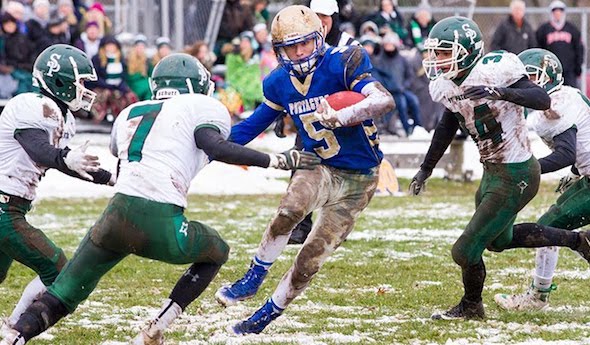
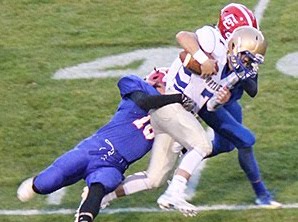
PHOTOS: (Top) Onekama’s Ben Acton (5) finds an opening among four Portland St. Patrick defenders during last week’s Semifinal win. (Middle) Luke Mauntler (7) drags along two Manistee Catholic Central defenders during a Week 6 victory. (Photos courtesy of the Onekama athletic department.)
Oakridge's Schugars Always To Be 'Coach'
April 26, 2013
By Geoff Kimmerly
Second Half editor
Jack Schugars led five Muskegon Oakridge teams to MHSAA football championship games during his 32 seasons running the program. He finished his high school coaching career in 2010 with a record of 262-78.
And of course, he impacted hundreds of lives in a community that, according to a former assistant, considers him a "saint."
Schugars was honored last week with the Duffy Daugherty Award for his outstanding achievements in high school football. Each spring, the Duffy Daugherty committee – made up of football supporters and media from the Lansing area – recognizes a high school coach along with a past or current college coach. The college award is among those recognized by the College Football Hall of Fame.
Among previous high school honorees present to congratulate Schugars during Thursday's banquet in East Lansing were Farmington Hills Harrison’s John Herrington, Birmingham Brother Rice’s Al Fracassa and former East Lansing coach Jeff Smith.
Schugars – now an assistant at Ferris State University – led his 1997, 2005 and 2008 teams to MHSAA titles, while his 1990 and 2003 teams finished MHSAA runners-up. He is a member of the Muskegon Sports Hall of Fame (class of 2009), the Michigan High School Coaches Association Hall of Fame (2008) and the Michigan High School Football Coaches Association Hall of Fame (1993). He received the MHSFCA’s highest honor, the Jim Crowley Award, in 2000.
The Schugars family is rooted in education. He also taught biology at the high school for 38 years, while his wife Julie taught English. Their daughter Amanda teaches in Battle Creek, and son Eric teaches and is the defensive coordinator at Traverse City Central.
Below are brief excerpts from the introduction of Schugars by his former football assistant and current Oakridge softball coach Joe Coletta, followed by Schugars' closing words of wisdom.
‘Faith, Family, Football’
(Coletta) “To Jack, those are not just words of hollow meaning. They are his compass.
 “Jack has won countless awards for his accomplishments on the football field. He absolutely refused to let anyone outwork him or his teams in preparation for a football game.
“But in my opinion, his strength as a football coach is his ability to take a kid that most people would give up on: a kid that some might label as no good, troublemaker, not worth the effort. He found a way to love the unlovable.
“He would give those kids direction; he would mentor them to be young men and young women and take them to where they could not possibly take themselves.
"When you can do that for a person, you let them see their worth as a human being and make a lasting impact so you can change the rest of their lives.
“That, to me, is what sets Jack apart from most coaches.”
What's most important
(Schugars) “The reason I'm on this Earth is to love the Lord your God with all my heart and soul and love your neighbors as yourself.
“So when I speak at clinics, when I talk to coaches, I tell them the greatest thing they can do for their team is to love their players.
“That is the greatest thing a coach can do. Love your players and be true role models each day.
“I could not ask for a better career than when ... a (former) player in the Navy Seal team calls me Coach. Lawyers, doctors, bankers, they call you Coach.
"Wow, that's a great word: Coach. That's what it's all about. Being a coach. Building relationships that will last a lifetime.
"I love the hundreds of players that are part of the Oakridge football family. And I hope I continue to build men out of boys, continue at the college level."
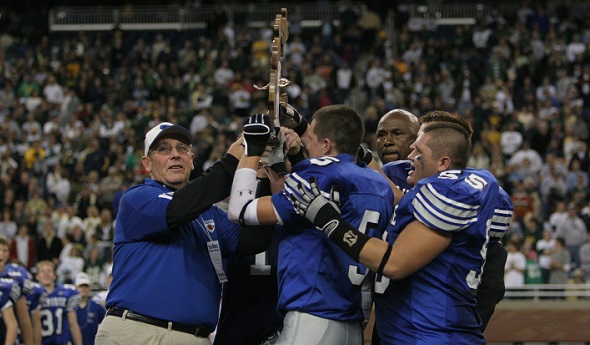
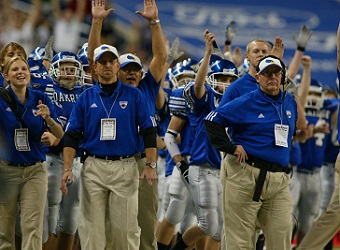
PHOTOS: (Top) Former Muskegon Oakridge football coach Jack Schugars holds up the 2005 Division 5 championship trophy with his players after their victory at Ford Field. (Middle) Schugars (right, with headset) monitors his team's play on the field against Jackson Lumen Christi.