


To Assist and Honor Those Who Served
September 7, 2012
By Geoff Kimmerly
Second Half editor
Born into a multiple-generation U.S. Military family, Eddie Ostipow understood early the honor in serving one’s country.
His father, Mike, did so in Vietnam. Grandfather Alex Ostipow – now 90 – was part of the D-Day Invasion of France during World War II, then taken as a prisoner of war during the Battle of the Bulge in Belgium, and earned three purple hearts while deployed from 1942-46.
Tonight, as the Orioles’ football coach leads his team against Eaton Rapids, both will take the field with him – symbolically at first, and then down from the stands with a larger group of veterans and active-duty soldiers who will be honored for their contributions to this country.
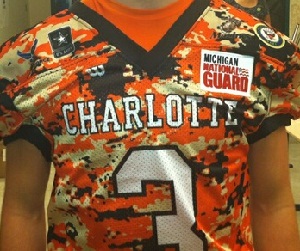 Mike and Alex Ostipow's names are among those that will be worn on both teams’ jerseys as part of their “Victory for Veterans” game to benefit the Veterans of Foreign Wars National Home for Children based in Eaton Rapids.
Funds raised from the purchase of those jerseys and other donations all will benefit the National Home, which was built in 1925 and provides a variety of services to military members and their families, including housing when a family member is deployed. Total, the schools raised roughly $6,300 for the home, which receives all of its funding through donations.
“The kids don’t always understand what those people sacrificed for the freedom we have to even play football on Friday nights,” Ostipow said. “It’s close to me. (And) for me, selfishly, I’ll be able to honor my grandfather.”
Kickoff is 7 p.m. Both teams will wear camouflage jerseys featuring the names of military personnel that were purchased with donations of $100. Charlotte players were given the opportunity to wear the names of family members. For those who did not have names to wear, jerseys were sponsored by teachers and other members of the community.
Charlotte 2002 graduates Nick Cantin and Matt Lamoreaux will serve as honorary captains – Cantin is in the Air Force and Lamoreaux serves in the Navy. After the game, players from both teams will present their jerseys to the service members or their families who they honored.
This cause was a natural for the Orioles. On the Friday before Memorial Day each spring, Charlotte hosts a school-wide round table of veterans, who speak candidly with students about their war experiences. And this opportunity allowed both communities to donate to an effort close to home – both schools are in Eaton County, and Eaton Rapids is only 11 miles from Charlotte.
Ostipow had heard of the home previously – in fact, his grandmother had visited the facility while his grandfather was deployed. But until he began researching for tonight’s event, he didn’t realize the variety of services it provides.
His student teacher, former Eaton Rapids quarterback Matt Marriott, is the son of one of the home’s facility managers. After a series of meetings with Marriott's dad, representatives from the home and Eaton Rapids’ administration and coaches, the plan was hatched.
The Orioles received a bonus when their local National Guard recruiter heard about the effort, and the Guard paid for $2,500 of the $2,800 it would have cost to print the Orioles’ jerseys. That meant $2,500 more that Charlotte could donate to the home.
Click to learn more about the VFW National Home for Children.

Drive for Detroit: Week 1 in Review
September 3, 2019
By Geoff Kimmerly
Second Half editor
Four of last season’s 10 MHSAA football champions began 2019 over the weekend 0-1. Ten teams that didn’t win a game last season stand 1-0 – and the two longest losing streaks in the state came to an end.

How's that for a new season and fresh start? And that's not even mentioning the storms that pushed many games to finish near or after midnight Thursday and roughly 40 to be completed later in the holiday weekend.
Below is our weekly review at some of the results that popped off the page most from every region of the state, with a little perspective on wins and losses that might mean even more as we get into late September and October.
"Drive for Detroit" is sponsored by MI Student Aid..
Bay & Thumb
HEADLINER Beaverton 16, Breckenridge 6 The Beavers are coming off two straight eight-win seasons and just missed catching Breckenridge on opening night last year, falling 20-19. This time they outpaced the Huskies, last season’s Division 8 runners-up, to take a 2-1 lead in their recent opening-night series. Click for more from the Midland Daily News and see highlights below from MI Sports Now.
Beaverton tops Breckenridge by 10 https://t.co/Xp7ZQ7nKtu pic.twitter.com/rEuoFVQb9M
— MISportsNow (@MISportsNow) August 30, 2019
Watch list Port Huron 33, Flint Carman-Ainsworth 6 Although Carman-Ainsworth is coming off a down season, expectations are always high – and Port Huron’s should be now too after avenging last season’s 38-22 defeat and as the Big Reds seek their first playoff berth since 2014.
Remember this one Montrose 16, Cass City 14 These two both could be on the way to big things; after last year’s 48-22 Montrose win, the Rams went on a Division 6 Semifinal run and Cass City won its league.
More shoutouts Freeland 27, Marshall 26 (OT) A blocked extra point and then a fumbled extra point attempt snap were part of a wild overtime that saw the Falcons defeat the Redhawks by three points or fewer for the second straight season. Davison 54, Fenton 27 The Cardinals came out best in a matchup of likely league contenders, scoring 50+ points against a Tigers program that hadn’t given up that many since 2016.
Greater Detroit
HEADLINER Detroit Catholic Central 24, Detroit Martin Luther King 22 These two met for the first time since the 2001 playoffs, and the result was the most exhilarating of an exceptional weekend of games at the Xenith Prep Kickoff Classic at Wayne State. DCC didn’t score during the second half but held off a potential King scoring drive late in the fourth quarter to edge the reigning Division 3 champion. Click for more from MLive-Detroit and see below for highlights from State Champs Sports Network.
VIDEO: Check out the highlights of the Detroit Catholic Central (@DCCfootball) vs. Detroit King (@DetKingFootball) football game from the Xenith Prep Kickoff Classic (@detpkc). @DETROITCCAD @DCCShamrocks.
Presented by @LawrenceTechU, @MHSAA & @hungryhowies pic.twitter.com/y1GiRtoZph— STATE CHAMPS! (@statechampsnet) September 3, 2019
Watch list Southfield Arts & Technology 28, Clarkston 14 These two will meet again in league play in Week 6, and it might be the statewide game of that week after the Warriors began their rebound from two straight sub-.500 seasons with a massive win over the reigning Division 1 runner-up.
Remember this one Bloomfield Hills Brother Rice 7, Utica Eisenhower 0 It’s “six wins and in” the playoffs for one more season, and with these teams representing two of the strongest leagues statewide – Brother Rice the Detroit Catholic League Central and Eisenhower the Macomb Area Conference Red – every win counts that much more.
More shoutouts Clinton Township Chippewa Valley 35, Saline 21 Reigning Division 1 champion Chippewa Valley graduated a ton on offense but found enough against another 2018 semifinalist in Saline. Lake Orion 17, Lapeer 7 The Dragons are 1-0 for the first time since 2013 after handing the Lightning its first regular-season loss since Week 8 of 2017.
Mid-Michigan
HEADLINER Pewamo-Westphalia 14, Reading 0 The Pirates handed reigning Division 8 champion Reading its first defeat since the end of 2017, but more impressively P-W locked down an offense that a year ago posted the 10th-most points in MHSAA 11-player history. The Pirates haven’t lost a regular-season game since their 2017 opener. Click for more from the Hillsdale Daily News.
Watch list Lansing Eastern 35, Owosso 0 One win meant a million for the Quakers, who broke a 38-game losing streak – and with one more victory would equal their best finish since 2010.
Remember this one New Lothrop 54, Lake City 7 Only a game of the P-W/Reading magnitude could bump this rematch from last season’s Division 7 Semifinals out of the headlining spot, as the reigning champion Hornets again put up 50+ points on the Trojans after winning last November 51-22.
More shoutouts DeWitt 31, Traverse City Central 26 The Panthers traveled to Thirlby Field and hung on for a nice win over an annual playoff qualifier. Central Montcalm 22, Morley Stanwood 20 After a winless 2018, Central Montcalm broke a 13-game losing streak with its first victory over Morley Stanwood since 2014.
Northern Lower Peninsula
HEADLINER Maple City Glen Lake 26, Millington 7 The Lakers’ nonleague schedule is loaded, and they almost couldn’t have hoped for better against a Millington team coming off its 15th straight playoff season. Glen Lake enjoyed three touchdown passes from Reece Hazelton in scoring all of its points during the first half. Click for more from the Traverse City Record-Eagle.
Watch list Evart 20, Frankfort 3 The Wildcats have made the playoffs once over the last five seasons and won a combined six games over the last two – but if opening night is an indication, they could match all of that this fall after downing a Frankfort team that’s made the playoffs five straight seasons and beat Evart in their last meeting 30-0 to open the 2016 playoffs.
Remember this one Grayling 22, Roscommon 6 The Vikings have made the playoffs seven times this decade, but finished only 3-6 a year ago – while Roscommon came into this season off a league title and 10-2 finish to 2018.
More shoutouts Alcona 16, Tawas 14 The Tigers went from two straight nine-win seasons to one victory in 2018, but the bounce-back has begun with this avenging of a 48-24 last-season loss. Kingsley 36, McBain 6 These teams combined to go 18-5 a year ago, and this result matched the second-best by the Stags’ defense from 2018.
Southeast & Border
HEADLINER Blissfield 33, Ottawa Lake Whiteford 14 The Royals broke a seven-game opening-night losing streak against Whiteford, in the process handing the Bobcats their first regular-season defeat since Week 9 of 2015. Whiteford also hadn’t given up 30 points in a game since the 2016 Division 8 Final. Click for more from the Toledo Blade and see highlights below from BCSN.
#ICYMI- Whiteford kicked off their season opener last night against Blissfield! The Bobcats put up a tough fight, but fell short 33-14. pic.twitter.com/x2l8ykk4AH
— BCSN (@BCSNsports) August 30, 2019
Watch list Erie Mason 58, Petersburg Summerfield 40 After four straight seasons of finishing 1-8, Erie Mason is 1-0 for the first time since 2003, the last time the Eagles made the playoffs.
Remember this one Jackson Lumen Christi 14, Kalamazoo United 12 The Titans ran their state-best winning streak to 24, but hardly with ease against a United team with some key new faces.
More shoutouts Homer 18, Michigan Center 0 The Trojans got off to the right start coming off their first sub-.500 season since 2009 by beating the reigning Cascades Conference runner-up. Ann Arbor Huron 63, Ecorse 14 The River Rats won for the first time in 40 games, putting up 63 points after scoring 98 over the entirety of 2018.
Southwest Corridor
HEADLINER Berrien Springs 28, Grand Rapids West Catholic 3 The Shamrocks are riding a string of five straight playoff seasons into the fall, but it’s hard to argue they’ve had a better start during this run. West Catholic has made the playoffs 16 straight seasons and is coming off a 2018 that saw respectable defeats to two eventual MHSAA champions. Click for more from the St. Joseph Herald-Palladium.
Watch list Paw Paw 42, Three Rivers 0 Edwardsburg tends to own the Wolverine Conference, and Three Rivers has been its biggest challenger the last few seasons – but that role could fall to Paw Paw coming off this big win and an 8-3 finish last year that also included a playoff victory over Three Rivers.
Remember this one Mendon 14, Decatur 7 Two of the best in the Southwest 10 Conference and also at least regionally in Division 8 saw each other right away with the Hornets running their recent winning streak over the Raiders to three straight.
More shoutouts St. Joseph 32, Battle Creek Central 19 The Bears avenged last season’s 34-27 loss to the Bearcats, a meeting that led things off for two eventual playoff qualifiers. Coldwater 47, Haslett 30 The Cardinals also evened the score against their opening night opponent after falling to Haslett 28-7 a year ago and going on to miss the playoffs for the first time since 2012.
Upper Peninsula
HEADLINER Iron Mountain 17, Negaunee 14 These teams have proven to be just about even over two straight openers, with the Mountaineers now winning both by three points. Last year the same result previewed an 8-3 season for Iron Mountain and a 5-4 by the Miners, who are looking to get back to the playoffs for the first time since 2016. Click for more from the Iron Mountain Daily News.
Watch List Lake Linden-Hubbell 32, Norway 14 The Lakes are coming off their first back-to-back sub-.500 seasons since the early 1970s, but they’re hoping that breaking a three-game losing streak to Norway is the start of a turnaround.
Remember this one Bark River-Harris 56, Gwinn 50 (OT) The Broncos are another team seeking a comeback after falling to 2-7 in 2018, and avenging last season’s 36-20 loss to Gwinn may have them on the way.
More shoutouts Sault Ste. Marie 22, Cheboygan 16 The Blue Devils went 5-4 last season while averaging just 15 points per game, and this week’s 22 would’ve been their second-highest total last fall. West Iron County 32, Munising 6 Beating Munising on opening night has been good to the Wykons, who made the playoffs all four previous seasons this decade after they won that matchup. West Iron missed the playoffs in 2015 after falling to the Mustangs in Week 1.
West Michigan
HEADLINER Muskegon 41, Warren De La Salle Collegiate 7 After closing last season with a tough defeat in the Division 3 Final, the Big Reds opened this fall with a second straight win over two-time reigning Division 2 champion De La Salle. During the first half alone, Muskegon quarterback Cameron Martinez ran 13 times for 109 yards and three scores. Click for more from the Muskegon Chronicle.
Check out the highlights of the Muskegon (@OnMuskegon) vs. De La Salle football game from tonight at the Xenith Prep Kickoff Classic (@detpkc). Brought to you by @LawrenceTechU, @MHSAA & @hungryhowies pic.twitter.com/BSm2ZDHFoZ
— STATE CHAMPS! (@statechampsnet) August 31, 2019
Watch List Grand Rapids Catholic Central 17, River Rouge 14 GRCC is coming off a third straight trip to at least the Division 4 Semifinals and is back in the swing after winning this one on a field goal with 2:15 to play.
Remember this one Hart 48, Holton 40 (2OT) Hart hasn’t had a winning season since 1997 and didn’t have a varsity at all in 2015, but started this fall with this victory over a 2018 Division 8 semifinalist.
More shoutouts Montague 42, Reed City 0 Last season’s Division 6 runner-up avenged a 34-13 loss to the Coyotes while handing them only their second regular-season defeat over the last five years. Zeeland West 28, East Grand Rapids 21 Surprisingly, this was the first meeting between these perennial Division 3 powers – so although they’d never met before, it’s not hard to anticipate them possibly meeting again in the playoffs.
8-Player
HEADLINER Brimley 24, Rapid River 12 Simply put, this was the Bay’s biggest win during a decade of 8-player football. Rapid River is the reigning 8-Player Division 2 champion and had beaten Brimley 80-55 in last year’s regular-season finale. Click for more from the Escanaba Daily Press.
Watch List Pickford 48, Crystal Falls Forest Park 16 A junior-heavy Pickford team finished 8-Player Division 1 runner-up last season and opened its return by nearly doubling up on last season’s 18-point win over the always-powerful Trojans.
Remember this one Climax-Scotts 16, Wyoming Tri-unity Christian 12 The Panthers’ 8-player debut was as good as expected, and they quickly will have more chances to show what they can do with Lawrence, Bellevue and Camden-Frontier coming up over the next three weeks.
More shoutouts Powers North Central 66, Cedarville 12 The Jets lasted only a week in last season’s Division 2 playoffs, but opened this fall with a win over a 2018 semifinalist. Martin 20, Bellevue 12 The Clippers are another new 8-player team and coming off a playoff season in 11, and they should be excited after this debut against one of the state’s best in 8 over the last two seasons.
Second Half’s weekly “Drive for Detroit” previews are powered by MI Student Aid, a part of the Office of Postsecondary Financial Planning located within the Michigan Department of Treasury. MI Student Aid encourages students to pursue postsecondary education by providing access to student financial resources and information. MI Student Aid administers the state’s 529 college savings programs (MET/MESP), as well as scholarship and grant programs that help make college Accessible, Affordable and Attainable for you. Connect with MI Student Aid at www.michigan.gov/mistudentaid and find more information on Facebook and Twitter@mistudentaid.
PHOTO: Davison put 54 points on the scoreboard to win its season opener against Fenton. (Photo by Terry Lyons.)