


Attending to Football
November 29, 2013
The interscholastic football season comes to an end this weekend with the MHSAA Finals at Ford Field, but the most talked about sport in high schools today will continue to make headlines for many months into the future.
Some of the headlines will introduce topics that are merely footnotes compared to what is really most important, that being the efforts to keep school-sponsored football the safest and sanest brand of football in America.
At the center of these efforts has been a task force appointed by the MHSAA to work throughout 2013 to advance these two objectives: “To promote the value of interscholastic football and to probe for ways to make the sport safer in Michigan.”
The tangible results of the task force’s four meetings are these:
-
- A proposal to the MHSAA Representative Council to revise football practice policies to improve acclimatization of players and to reduce head trauma. The proposal goes to the Representative Council Dec. 6 for discussion, then to the Michigan High School Football Coaches Association and MHSAA Football Committee in January and to the MHSAA League/Conference meeting in February, before returning to the Representative Council for action on March 22.
-
Three proposals to the NFHS Football Rules Committee to modify playing rules to promote player safety.
- A variety of print, online and broadcast promotions on behalf of the value of interscholastic football and its safety record and to encourage healthier out-of-season activities by students in all sports.
MHSAA research informs us that participation in 11- or 8-player football in member high schools this fall was down 3.0 percent compared to 2012, and down 7.63 percent since the 2008 season. The biggest reasons cited by those surveyed are, in declining order, safety issues, declining enrollment, athletes playing other school or non-school sports, cultural changes and pay-to-participate.
It is important to note that participation is not declining everywhere, not even everywhere where enrollments are down and participation fees are up. It is important to note also that some other sports are in much greater decline than football in terms of high school participation.
It is difficult for me to imagine my life without football as a part of it. It’s difficult to imagine schools and communities without football. I very much doubt that the absence of football would have improved my life or the schools and communities I’ve been a part of. It’s a sport that needs our attention, not its extinction.
Drive for Detroit: Week 9 Preview
October 20, 2016
By Geoff Kimmerly
Second Half editor
The sun is setting on another Michigan high school football regular season.
 But the lights haven't gone off yet for 180 teams holding out hope of playing their way into this season's playoff field.
Heading into Thursday night, 160 teams in 11-player could either qualify automatically with a win this weekend or set themselves up for a possible at-large bid. And 20 8-player teams, give or take a few, still look to be alive for one of 16 spots in that field.
A number of games including Detroit Public School League and Big 8/Cascades Conference crossovers were played Thursday. See the MHSAA Score Center for those scores and the schedule for tonight and Saturday. Be sure to tune in to Fox Sports Detroit at 7 p.m. Sunday for the announcement of this season's playoff brackets in all nine divisions. Click for more details on the Selection Sunday Show.
And see below for the final regular-season Drive for Detroit preview, powered by MI Student Aid, with some emphasis placed on games that could help decide the playoff field. All games are tonight unless noted.
Bay & Thumb
Frankenmuth (8-0) at Freeland (8-0)
This is a repeat of last year’s Week 9 scenario, when these Tri-Valley Conference champions – Frankenmuth from the East and Freeland from the Central – met in the final regular season game. Freeland won big, 42-7, and then won 35-12 when they met again two weeks later for a Division 5 District title. The numbers indicate a closer game between the two this time; Freeland’s defense remains stellar giving up only 8.6 points per game, but Frankenmuth’s is giving up only 5.4 and could be the key to reversing last season’s results.
Others that caught my eye: Lapeer (6-2) at Flint Carman-Ainsworth (6-2), Flint Powers Catholic (5-3) at Davison (8-0), Fenton (6-2) at Linden (6-2), Midland Dow (7-1) at Midland (4-4).
Greater Detroit
Detroit Cass Tech (8-0) vs. Detroit Martin Luther King (7-1) at Ford Field
As anticipated, these two will meet for the PSL Division 1 championship after also facing each other in division play three weeks ago. Cass Tech won that game 31-18, being held to its fewest points of the season but also locking down a King offense that has scored fewer than 39 only one other time. The Crusaders already got a taste of a rematch last week, when they played Detroit East English for the second straight and escaped with a two-point win after downing the Bulldogs by 38 the week before. King will hope for a similar tightening up of the score in this second meeting with the Technicians.
Others that caught my eye: Lake Orion (5-3) at Bloomfield Hills (8-0), Detroit Denby (7-1) vs. Detroit Mumford (7-1) at Ford Field, Oak Park (6-2) at Southfield Arts & Technology (5-3), Detroit Catholic Central (8-0) vs. Orchard Lake St. Mary’s (5-3) on Saturday at Ford Field
Mid-Michigan
Walled Lake Western (7-1) at Brighton (7-1)
This Lakes championship game features the winners of the Kensington Lakes Activities Association West (Brighton) and North (Western) in their first meeting since 1997. The Warriors are undefeated aside from having to forfeit an opening-night victory and have beaten three teams already qualified for the playoffs and two more that could get in at-large. Brighton has four wins against teams that are in or close, but did lose Week 2 to Northville – which lost to Western in Week 3.
Others that caught my eye: Grandville Calvin Christian (5-3) at Belding (5-3), Laingsburg (7-1) at Durand (5-3), Monroe St. Mary Catholic Central (4-4) at Lansing Catholic (7-1), Saginaw Michigan Lutheran Seminary (6-2) at New Lothrop (8-0).
Northern Lower Peninsula
Boyne City (6-2) at Traverse City St. Francis (8-0)
Boyne City’s rough start to this season is barely a memory two months later as it has a chance to finish this comeback with a Northern Michigan Football Conference Legends-clinching victory against reigning champion St. Francis. The Ramblers will have a little vengeance in mind after St. Francis' 32-13 win in their 2015 meeting decided the league title. But the Gladiators are riding high; St. Francis downed playoff-bound Kalkaska 49-0 last week, has given up 15 points over its last four games and no more than 14 in any game this fall.
Others that caught my eye: Traverse City Central (7-1) at Cadillac (6-2), Kalkaska (6-2) at Grayling (5-3), Clare (7-1) at Houghton Lake (5-3), Frankfort (8-0) at Onekama (6-2).
Southeast & Border
Birmingham Groves (8-0) at Saline (8-0)
Trying to pick an angle on this one is tough; it’s just a great matchup. Both teams went 9-0 last season, so the winner going undefeated won’t be something new. Both also rank among the highest in any division for playoff-point average, so the winner of this one could be looking at a nice playoff road – but the loser will be in good shape as well. Both are keyed by strong defenses: Saline has given up 12.7 points per game but only 31 points over their last four. Groves, meanwhile, has given up only 34 points over the last seven games and no more than eight since Week 2.
Others that caught my eye: Morenci (5-3) at Adrian Madison (4-4), Dearborn (7-1) at Ann Arbor Skyline (4-4), Sand Creek (7-1) at Petersburg-Summerfield (5-3), Grass Lake (7-1) at Springport (7-1).
Southwest Corridor
Portage Central (7-1) at St. Joseph (6-2)
Portage Central no doubt has been looking forward to this one; the Mustangs were cruising along to an outright Southwestern Michigan Athletic Conference West title and perfect regular season last year when St. Joseph busted both with a 22-6 Week 9 win. The teams ended up sharing the league title, and the Bears are in the same position of trying to force another share after losing to Stevensville Lakeshore in Week 4. Portage Central’s only loss this fall was on the road to one-loss Traverse City Central.
Others that caught my eye: Traverse City West (6-2) at Coldwater (6-2), Lawton (7-1) at Decatur (4-4), Portland (8-0) at Marshall (4-4), DeWitt (7-1) at Portage Northern (5-3).
Upper Peninsula
Newberry (7-1) at St. Ignace (7-1)
The Indians could add a major highlight to their best season since 2004 by avenging last year’s 50-20 playoff loss to the Saints. St. Ignace went on to the Division 8 Semifinals and this fall locked up an eighth-straight league title in its first season in the NMFL Legends division. Newberry can gain a share of the Mid-Eastern Conference title, but only if first-place and undefeated Lake Linden-Hubbell falls this weekend to Munising.
Others that caught my eye: Iron Mountain (6-2) at Norway (7-1), Kingsford (6-2) at Escanaba (6-2), Bark River-Harris (3-5) at Felch North Dickinson (5-3), Hancock (4-4) at Houghton (3-5).
West Michigan
Rockford (6-2) at Hudsonville (7-1)
For most of this season, it didn’t look like this game would mean as much as it does once again. Rockford has rattled off six straight wins after a rough start and holds a one-win advantage on both Grandville and Hudsonville in the Ottawa-Kent Conference Red. Hudsonville fell to Grandville in Week 4 but can create a three-way tie for the title if it can avenge last year’s pair of losses to the Rams – 28-27 in Week 9 and then 21-13 in their District Final.
Others that caught my eye: Grand Rapids West Catholic (7-1) at Allendale (6-2), Hudsonville Unity Christian (7-1) at Byron Center (7-1), Zeeland East (6-2) at Zeeland West (6-2), East Grand Rapids (6-2) at Grand Rapids South Christian (5-3).
8-Player
Powers North Central (8-0) at Stephenson (7-1)
The Jets have turned away all challengers in their quest to repeat as MHSAA champions. North Central has yet to lose a game in two seasons of 8-player football, and it’s scored at least 56 points in every game this fall and 76 or more four of the last five weeks. Enter Stephenson, which saw North Central twice last season and this fall has lost only to Crystal Falls Forest Park – the team to give North Central its toughest challenge so far.
Others that caught my eye: Camden-Frontier (5-1) at Waldron (4-4), New Haven Merritt (8-0) at Flint International Academy (6-2).
Second Half’s weekly “Drive for Detroit” previews are powered by MI Student Aid, a part of the Student Financial Services Bureau located within the Michigan Department of Treasury. MI Student Aid encourages students to pursue postsecondary education by providing access to student financial resources and information, including various student financial assistance programs to help make college more affordable for Michigan students. MI Student Aid administers the state’s 529 savings programs (MET/MESP) and eight additional aid programs within its Student Scholarships and Grants division. Click for more information and connect with MI Student Aid on Facebook and Twitter @mistudentaid.
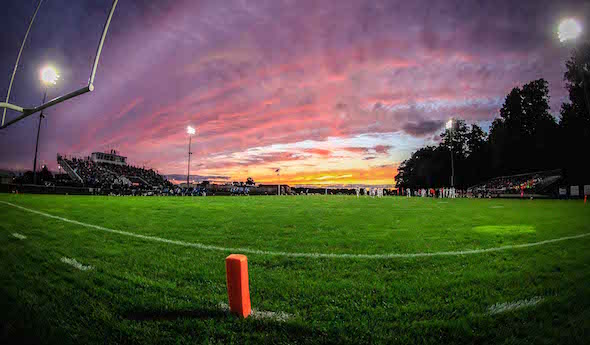
PHOTOS: Whitehall and Ravenna took the field under a picturesque sunset Oct. 7. (Photo by Tim Reilly.)