


Attending to Football
November 29, 2013
The interscholastic football season comes to an end this weekend with the MHSAA Finals at Ford Field, but the most talked about sport in high schools today will continue to make headlines for many months into the future.
Some of the headlines will introduce topics that are merely footnotes compared to what is really most important, that being the efforts to keep school-sponsored football the safest and sanest brand of football in America.
At the center of these efforts has been a task force appointed by the MHSAA to work throughout 2013 to advance these two objectives: “To promote the value of interscholastic football and to probe for ways to make the sport safer in Michigan.”
The tangible results of the task force’s four meetings are these:
-
- A proposal to the MHSAA Representative Council to revise football practice policies to improve acclimatization of players and to reduce head trauma. The proposal goes to the Representative Council Dec. 6 for discussion, then to the Michigan High School Football Coaches Association and MHSAA Football Committee in January and to the MHSAA League/Conference meeting in February, before returning to the Representative Council for action on March 22.
-
Three proposals to the NFHS Football Rules Committee to modify playing rules to promote player safety.
- A variety of print, online and broadcast promotions on behalf of the value of interscholastic football and its safety record and to encourage healthier out-of-season activities by students in all sports.
MHSAA research informs us that participation in 11- or 8-player football in member high schools this fall was down 3.0 percent compared to 2012, and down 7.63 percent since the 2008 season. The biggest reasons cited by those surveyed are, in declining order, safety issues, declining enrollment, athletes playing other school or non-school sports, cultural changes and pay-to-participate.
It is important to note that participation is not declining everywhere, not even everywhere where enrollments are down and participation fees are up. It is important to note also that some other sports are in much greater decline than football in terms of high school participation.
It is difficult for me to imagine my life without football as a part of it. It’s difficult to imagine schools and communities without football. I very much doubt that the absence of football would have improved my life or the schools and communities I’ve been a part of. It’s a sport that needs our attention, not its extinction.
Drive for Detroit: Week 4 Preview
September 15, 2016
By Geoff Kimmerly
Second Half editor
Predicting anything after three weeks of a high school football season is a fruitless endeavor, as so much can change over the next six weeks of play.
 But no fewer than 16 leagues across Michigan could eventually see this fall’s championship races affected significantly by what plays out on fields over the next 48 hours.
This week’s “Drive for Detroit” preview – powered by MI Student Aid – highlights a handful of key matchups and mentions many more below; we’ll discuss all of the ramifications that emerge in Monday’s weekend in review.
(Games below are Friday; for the full weekend schedule including Thursday and Saturday games, visit the MHSAA Score Center.)
Bay & Thumb
Alma (3-0) at Freeland (3-0)
Freeland is 7-1 against Alma over the teams’ last eight meetings and off to another fast start after making Division 5 Regional Finals and losing only one regular-season game over the last two seasons. But Alma beat Saginaw Swan Valley last week for the first time since 2011 to earn a 3-0 start for the first time since 2012 – the same season the Panthers got that most recent win against tonight’s Tri-Valley Conference Central opponent.
Others that caught my eye: Roscommon (3-0) at Beaverton (2-1), Almont (2-1) at Croswell-Lexington (2-1), Linden (2-1) at Flushing (2-1), Saginaw Nouvel (2-1) at Bay City John Glenn (2-1).
Greater Detroit
West Bloomfield (2-1) at Farmington Hills Harrison (2-1)
These Oakland County neighbors re-stoked their rivalry last season for the first time since 2006, with West Bloomfield claiming a 20-14 Week 9 win. The Lakers are following the strong arm of quarterback Bryce Veasley, who has thrown for 543 yards and five touchdowns over his team’s last two games. But he’s taking on a defense this week that has given up more than 20 points only three times – twice to East Kentwood and the third in a Division 2 Semifinal – over its last 17 games.
Others that caught my eye: Detroit East English (2-1) at Detroit Denby (3-0), St. Clair Shores South Lake (3-0) at Warren Fitzgerald (3-0), Clinton Township Chippewa Valley (2-1) at Utica Eisenhower (3-0), Birmingham Brother Rice (2-1) at Warren DeLaSalle (2-1).
Mid-Michigan
Lansing Catholic (3-0) at Portland (3-0)
This Capital Area Activities Conference White rivalry game is always a matchup of differing styles, and the result has been an even split of their last eight meetings. The Cougars’ wide open attack is led this year by dual-threat quarterback Michael Lynn III, with Portland’s physical running game paced by Logan Lefke among a collection of backs. Lynn threw for 161 yards and ran for 80 and two touchdowns in last week’s win over Everett, but the Raiders didn’t give up a point over the last two weeks to Hillsdale and Fowlerville – and are able to control the clock by grinding out yards on the ground.
Others that caught my eye: DeWitt (2-1) at Mason (3-0), Lake City (2-1) at Beal City (1-2), Flint Hamady (2-1) at New Lothrop (3-0), Bath (2-1) at Pewamo-Westphalia (3-0).
Northern Lower Peninsula
Portage Central (3-0) at Traverse City Central (3-0)
Some potential league title-deciding games from this region are mentioned below, but it’s tough not to highlight a matchup of undefeated powers who went a combined 17-3 a year ago. Traverse City Central is coming off an emotional 10-8 win over rival West last week and is giving up a meager 174 yards of offense per game. That sounds a lot like Portage Central, which downed rival Stevensville Lakeshore 37-0 in Week 3 and has given up eight points this season.
Others that caught my eye: Leroy Pine River (2-1) at McBain (3-0), St. Ignace (2-1) at East Jordan (3-0), AuGres-Sims (3-0) at Lincoln Alcona (2-1), Maple City Glen Lake (2-1) at Onekama (3-0).
Southeast & Border
Temperance Bedford (3-0) at Saline (3-0)
The difference in Bedford this season can be measured in part by its results against the same early opponents over the last two years; the Mules have outscored Toledo St. Francis de Sales, Fenton and Ann Arbor Pioneer by a combined 117-70 this fall after those three outscored Bedford by a combined 109-76 in kicking the Mules off to an 0-3 start a year ago. Next up is Saline, which beat Bedford 43-0 in 2015 and just got past winless Ann Arbor Skyline 24-21 last week – but also is 26-2 without a regular-season loss since falling on opening night in 2014.
Others that caught my eye: Ida (3-0) at Brooklyn Columbia Central (2-1), Hudson (3-0) at Dundee (2-1), Manchester (2-1) at Grass Lake (3-0), Sand Creek (3-0) at Morenci (2-1).
Southwest Corridor
Paw Paw (2-1) at Edwardsburg (3-0)
The Eddies are absolutely rolling, again, with three wins by a combined 145-14 score to take the lone lead in the Wolverine Conference. But Paw Paw has come closer than most over the last few seasons, and after Vicksburg in Week 3 of 2014 was the next most-recent team, in Week 9 of 2012, to hand Edwardsburg a regular-season defeat. The Redskins did drop a 14-6 heartbreaker to Sturgis last week, but scored first and outgained the Trojans before a late touchdown led to the final result.
Others that caught my eye: Niles (3-0) at Portage Northern (1-2), St. Joseph (3-0) at Stevensville Lakeshore (2-1), Berrien Springs (1-1) at Cassopolis (3-0), Sturgis (2-1) at Three Rivers (2-1).
Upper Peninsula
Negaunee (3-0) at Iron Mountain (3-0)
This may decide, and at the least will play a major role, in determining the Mid-Peninsula Conference title winner. Iron Mountain is back in the mix thanks to a Week 1 win over three-time reigning champion Ishpeming and has to be confident again having split the last six meetings with the powerful Miners. Negaunee has finished league runner-up two of the last three seasons and will bring a bullish attack that’s run for nearly 900 yards already this season; Neal Violetta had 475 yards and five touchdowns on the ground and Shane Ring has run for 228 yards and five scores.
Others that caught my eye: Newberry (3-0) at Felch North Dickinson (2-1), Calumet (2-1) at Houghton (3-0), Escanaba (3-0) at Marquette (1-2), Ishpeming (1-1) at Ishpeming Westwood (1-2).
West Michigan
Grandville (3-0) at Hudsonville (3-0)
Not only is Grandville off to its best on-field start since 2001 (the Bulldogs opened 2012 3-0 but received a forfeit win), but they’ve dominated giving up only 22 points total and scoring at least 44 in all three of their first games. The numbers don’t flash as much for Hudsonville because of the quality opponents the Eagles have beaten, including handing the only losses so far to 2015 playoff teams Grand Ledge and East Kentwood. The winner tonight will earn an enviable, although not entirely secure position atop the competitive Ottawa-Kent Conference Red.
Others that caught my eye: Grand Rapids South Christian (2-1) at Grand Rapids Christian (3-0), Byron Center (3-0) at Muskegon (2-1), Ludington (3-0) at Muskegon Catholic Central (3-0), Rockford (1-2) at Caledonia (1-2).
8-Player
Peck (3-0) at Deckerville (3-0)
This is the top 8-player rivalry of a strong 8-player thumb area, and Peck no doubt has been aching to get another shot at the Eagles after falling to them 50-6 in Week 8 and then 30-6 in the first round of last season’s playoffs. Deckerville is off to another dominating start, outscoring its first three opponents by a combined 128-20 after reaching MHSAA Semifinals the last two years.
Others that caught my eye: Onaway (2-1) at Cedarville (3-0), Rudyard (2-1) at Posen (2-1).
Second Half’s weekly “Drive for Detroit” previews are powered by MI Student Aid, a part of the Student Financial Services Bureau located within the Michigan Department of Treasury. MI Student Aid encourages students to pursue postsecondary education by providing access to student financial resources and information, including various student financial assistance programs to help make college more affordable for Michigan students. MI Student Aid administers the state’s 529 savings programs (MET/MESP) and eight additional aid programs within its Student Scholarships and Grants division. Click for more information and connect with MI Student Aid on Facebook and Twitter @mistudentaid.
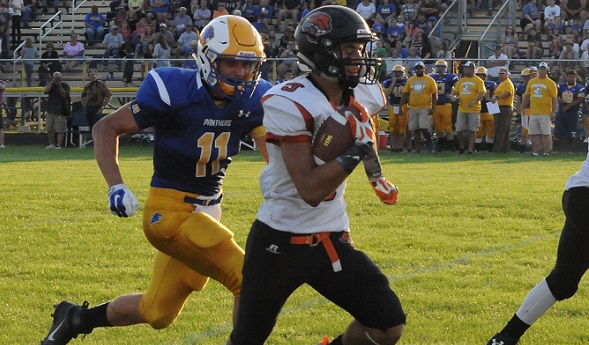
PHOTO: Alma ran past Birch Run in Week 1 and hopes to move to 4-0 this weekend against Freeland. (Click to see more from HighSchoolSportsScene.com.)