


Back to Building Boys Into Men, Munger Bringing Newfound Success to Newaygo
By
Tom Kendra
Special for MHSAA.com
November 6, 2024
NEWAYGO – After a long, physical practice Tuesday, as the light rain started to intensify, Newaygo coach Ralph Munger decided to squeeze in a quick game of “Simon Says.”
 Within a few minutes, players were laughing, making fun of each other for clapping their hands when Munger didn’t say the magic words (and doing five push-ups as punishment) – and learning mental focus in the process.
“He’s an old-style coach,” said Newaygo senior Henry Wood, a senior captain and two-way starter. “But he has a crazy passion for the sport, and his football IQ is insane.”
Simon Says is just one of proven techniques the longtime coach is using to teach and motivate his players at Newaygo, which is 8-2 and hosting Central Montcalm on Friday for a Division 6 District championship in just his second year as coach.
Munger, 72, is having a ball at his latest coaching stop and is up to 11 wins over his two years at Newaygo, a small, rural school northwest of Grand Rapids – after winning 80 games in 11 years at Frankenmuth and 255 games over 28 years at Rockford, the latter tenure including five Finals appearances and three titles. He entered this season the sixth-winningest coach in state football history, and heading into this weekend his career record is 343-117.
“We’re making strides, and things are starting to click,” said Munger, who was an all-state football player in his own right at Frankenmuth in the late 1960s. “I feel pretty good, and I thank God every day that he has allowed me to coach again.”
 Newaygo knocked off traditional Division 6 power Montague, 30-17, last week for the school’s first playoff win since 2018.
The Lions are doing it with Munger’s beloved power game, led by senior quarterback Blake Kerr (55-of-99 passing for 805 yards and 10 TDs), junior running back Porter Slominski (130 rushes for 934 yards and 13 TDs) and senior running back Ethan Reyburn (104 rushes for 673 yards and 8 TDs).
Kerr, who has good size at 6-foot-2 and 200 pounds, has thrown primarily to his two fellow senior captains in split end Hunter Yearsovich (18 catches for 255 yards and 3 TDs) and Wood (9 catches for 140 yards and 3 TDs).
Luis Ceja Alvarez (5-10, 155), is a crafty, undersized linebacker who leads the defense with 34 solo tackles and 52 assists. Fellow linebacker Xavier Stroud has 17 solos and 32 assists.
Yearsovich, a team leader and two-way starter with a 4.4 GPA, said he and his senior teammates had an immediate connection with their Hall of Fame coach.
“I’ll never forget when we met him in the gym last year because he talked to us like we were men,” said Yearsovich. “With him, we don’t ever have the mentality that we’re going to lose, no matter who we’re playing. It hasn’t always been like that around here.”
As the Lions broke into groups in the middle of Tuesday’s practice, Munger headed off with the defensive backs.
The joy of hands-on coaching was apparent as he schooled them on back-pedaling and cutting on what could be a muddy playing surface Friday night, and then concentrating and catching a wet ball.
Munger, who had quadruple-bypass, open-heart surgery in the summer of 2019 and has undergone three separate spine surgeries, is thankful to still be able to stalk the sidelines with a whistle around his neck. He endured one long autumn away from coaching, during the COVID year of 2020, which is when he knew he wasn’t done.
“I was going stir crazy,” said Munger with a grin. “I needed my football fix, anywhere.”
 That led him to tiny Mancelona High School, which is near his cabin in northern Michigan, where he helped coach the offensive and defensive lines in 2021 and 2022. He then in 2023 pursued and landed the Newaygo head coaching job, which is a 30-minute drive from his home in Rockford.
He led Newaygo to a fairly typical 3-6 record last year. But with a full year of his coaching under their belts, the Lions are enjoying a breakthrough fall.
Newaygo finished the regular season 7-2, with the only losses coming against Reed City and Big Rapids, who are both still alive in the playoffs. One of the wins came against this week’s playoff opponent, Central Montcalm, 21-12, in Week 2.
Another victory over CM would earn the Lions yet another home game, against the winner of Ovid-Elsie at Lansing Catholic, this time for a Regional championship. Newaygo has never won a football Regional title, and 2012 was the only year it won more than one playoff game, losing to Grand Rapids West Catholic in a Division 5 Regional Final.
Munger said, at this point in his life, his only goals are to bring some positive energy to Newaygo and help his players make the transition from boys to men – the same thing he has been doing for almost 50 years.
“I am enjoying myself, very much so,” said Munger, who is a member of six Halls of Fame for his coaching achievements. “I find it fun getting after all the challenges out here. That’s what drives me.
“That’s the calling that the Good Lord has given me.”
 Tom Kendra worked 23 years at The Muskegon Chronicle, including five as assistant sports editor and the final six as sports editor through 2011. E-mail him at [email protected] with story ideas for Muskegon, Oceana, Mason, Lake, Oceola, Mecosta and Newaygo counties.
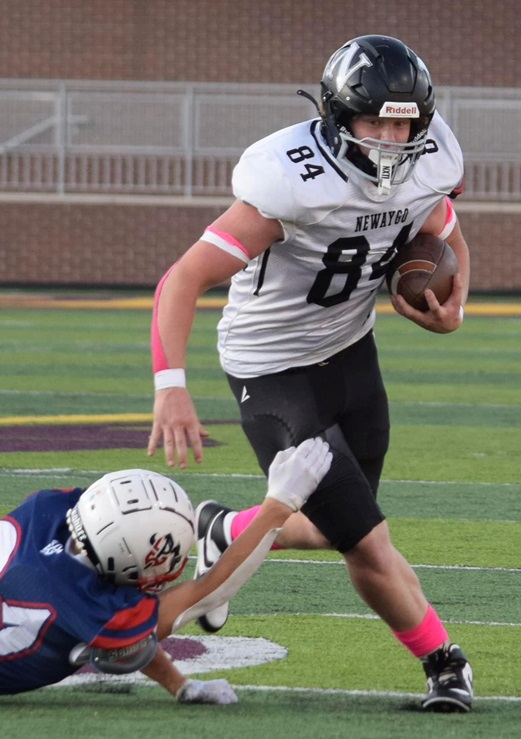
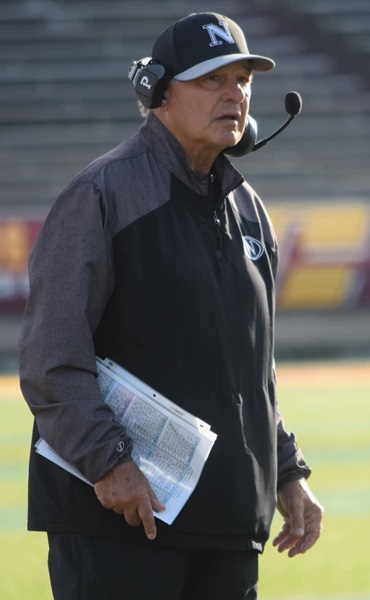
PHOTOS (Top) Newaygo varsity football coach Ralph Munger, right, talks things over with his senior quarterback Blake Kerr during a 53-26 win over Lake Odessa Lakewood on Oct. 18 at Central Michigan’s Kelly-Shorts Stadium. (Middle) Senior tight end Henry Wood (84) works to get past an outstretched defender. (Below) Munger, play sheet in hand, has led the Lions to an 8-2 record. (Photos by Tashina Kerr.)
Friday's Game-Winner Latest, Greatest Highlight for Adrian Kicker Hassan
By
Doug Donnelly
Special for MHSAA.com
September 30, 2025
When Zack Hassan was a freshman, he decided to play two sports at Adrian High School – soccer and football.
 Because he was a soccer player, the Maples’ football coaches decided he would be a good candidate to be a kicker.
“I had never really kicked a football before, but they thought I could because I played soccer,” Hassan said. “I thought, ‘Sure, why not?’”
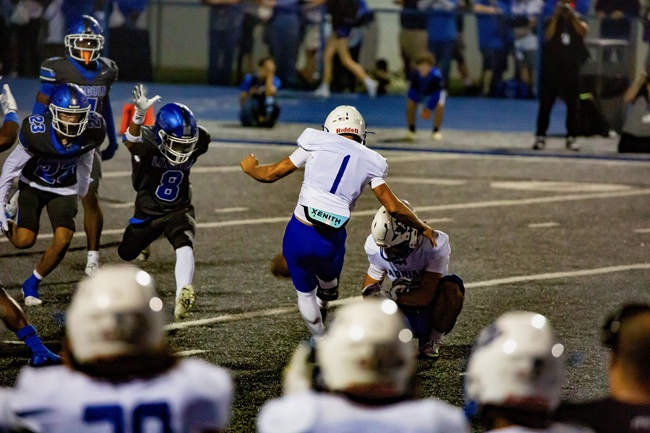
Fast forward four years and Hassan is no longer a soccer player. He not only is the Adrian kicker – he is eying a college football scholarship and Friday had the biggest moment of his career when he booted a 37-yard field goal as time expired to give Adrian its biggest football win in years.
“I love the pressure moments,” Hassan said. “I like having all of the eyes on me and going out there and kicking.”
Hassan also played receiver and defensive back the last couple of years, but is focused entirely on kicking this season because of a knee injury suffered toward the end of basketball season. He’s delayed surgery because he didn’t want to miss his senior year of football.
“I could have played receiver this season, but I wanted to be safe,” Hassan said. “I had a choice. I could have had surgery before the season or in the middle, but I just wanted to finish out my last year.”
The injured knee part of his kicking leg – but that’s probably for the best if he had to be injured at all.
“As a kicker its almost better because I don’t have to worry about planting,” he said. “That would be constant impact on it. It’s not super bad. I think I will recover quickly. I should be 100 percent by April or May. I should probably try to save the leg, but I enjoy kicking. I like to kick as much as possible in practice.”
Hassan handles all placekicking duties for Adrian, but doesn’t punt. Maples coach Joel Przygodski said Hassan would make a good punter, though.
“He has a strong leg,” he said. “He regularly kicks off to the 10-yard line. It’s a nice weapon to have.”
Hassan’s family moved to Adrian from Sylvania, Ohio, when he was in middle school.
“When I was growing up, I thought I was going to be a basketball player,” he said.
After he joined the varsity football team as a freshman, he decided he liked kicking.
“After freshman year I thought maybe I could get some free tuition out of this,” he said.
 He’s made two college visits already – to Baldwin Wallace in Ohio and Macalester College in Saint Paul, Minn., which has offered him a scholarship. He’s headed back to Macalester in a few weeks to check out what it’s like on game day.
“They are a very good school to get an education,” said Hassan, who has a grade point average above 4.0.
Hassan’s siblings stayed on the soccer route. His older sister was a college goalkeeper and his younger sister plays soccer for Adrian.
On Friday, Adrian was locked in a 0-0 tie with unbeaten Ypsilanti Lincoln. In the fourth quarter the two teams exchanged punts, swapping field position. Adrian got the ball back with fewer than 40 seconds left.
“As coaches, we talked about whether or not we wanted to play it safe, play for overtime,” Przygodski said.
After an incomplete pass on first down, running back Luke Bruggeman carried the ball up the middle and broke a tackle to put the ball past midfield. He even got out of bounds to stop the clock.
“I was thinking, okay, we are in business,” Przygodski said.
After quarterback Jaxon Dowling connected with receiver Adam Parker to reach the Lincoln 25-yard line, Przygodski knew the Maples had a chance. Hassan was warming up.
“We were telling him to be ready,” Przygodski said.
Hassan had missed two field goals earlier in the game. One of those attempts was from 48 yards out.
“My coaches just told me to get ready and told everyone else to stay away from me,” Hassan said.
With less than 1.5 seconds to play, Adrian reached the 20-yard line and called timeout. Hassan trotted out onto the field. The snap was a little slower than he was used to, he said, but he lined up perfectly and hit the 37-yarder, sending the Maples into a frenzy and stunning the home crowd of about 3,000 people at Lincoln’s homecoming.
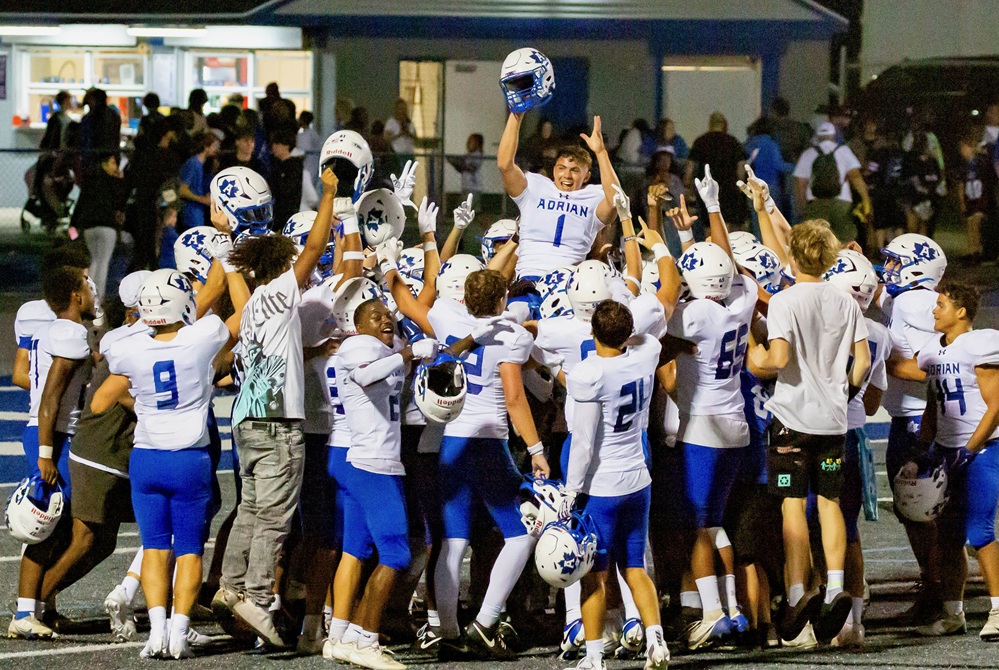
Hassan was carried off the field by teammates – and not because of an injury.
“After we shook hands, we went into huddle and everyone was like, ‘Lift him up, lift him up,’” he said.
The win was a big one for Adrian, which continues to make strides under Przygodski’s leadership. Adrian is 4-1 with chief rival Tecumseh coming up this week. The Maples have a lot of momentum for the rest of the season.
“Going into the season we were really unsure how we were going to be, because we lost a lot of seniors last year,” Hassan said. “It’s good. We’ve had a lot of people step up. We are turning a lot of eyes right now.”
 Doug Donnelly has served as a news and sports reporter at the Adrian Daily Telegram and the Monroe News for 30 years, including 10 years as city editor in Monroe. He's written a book on high school basketball in Monroe County and compiles record books for various schools in southeast Michigan. He is now publisher and editor of The Blissfield Advance, a weekly newspaper. E-mail him at [email protected] with story ideas for Jackson, Washtenaw, Hillsdale, Lenawee and Monroe counties.
PHOTOS (Top) Adrian kicker Zack Hassan is carried by his teammates after making the game-winning field goal Friday against Ypsilanti Lincoln. (Middle) Hassan steps into his winning kick. (Photos by Marnette Sutherland.)