

Back-up QB Sails South to D4 Title
November 23, 2012
By Bill Khan
Special to Second Half
DETROIT — The Grand Rapids South Christian community wouldn't allow Derek Woltjer to feel nervous or unsure of himself.
As soon as it became apparent that he would start for injured star quarterback Jon Wassink in the MHSAA Division 4 championship game, Woltjer was bombarded with encouraging messages from fans, teammates and friends.
Wassink broke his collarbone a week ago in a Semifinal victory over Comstock Park. Later that night, Woltjer was told he would start the title game against Detroit Country Day on Friday at Ford Field.
"I felt awful that he couldn't play," Woltjer said. "He's one of the biggest parts of our team, but I was ready to step up. I had people calling me, giving me texts that night, telling me they believe in me, telling me they have full confidence, telling me they stand behind me. I was very blessed with the people in the community."
That kind of support had a calming effect on Woltjer, who accounted for four touchdowns in South Christian's 40-7 victory over Country Day.
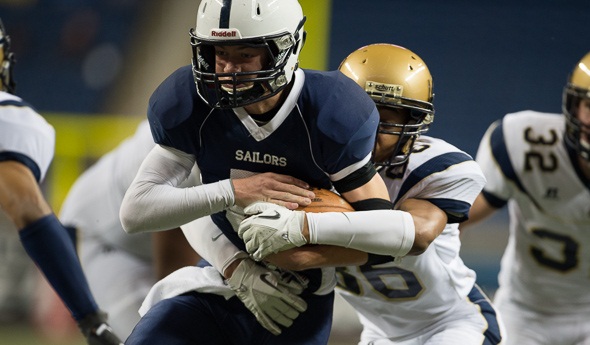
Woltjer, a senior who played sparingly at quarterback this season, was 7 for 7 for 88 yards and two touchdowns, while rushing 15 times for a game-high 136 yards and two scores.
"If I wouldn't have had all that (encouragement), my nerves today would've been just off the charts," Woltjer said. "I slept a good 10 hours last night. I wasn't nervous up until the kickoff today. With people behind you like that, it takes the nerves away from you quite a bit."
 There was no need to shake off any rust for Woltjer, who marched the Sailors down the field on their opening drive and scored on a 13-yard run with 3:21 left in the first quarter. It became 14-0 when Woltjer hit Jason Miller for a 41-yard touchdown pass on South Christian's second drive with 9:13 left in the second quarter.
"I knew he had it in him," South Christian coach Mark Tamminga said. "I talked to Derek before the game, just me and him, and I said, 'Derek, you don't have to win this football game for us. Play within yourself and make the plays you know you can make.' That's what he did. He did a tremendous job."
The Sailors' coaching staff made sure the team didn't get down over the loss of Wassink, a sophomore who threw for 3,400 yards and rushed for more than 700 this season.
"I knew we could win this without Jonny," said senior receiver Austin Diekevers, who scored two touchdowns. "Our coach has been telling us all week that Jonny is only one person. We've got 57 kids on this team. It takes more than one person to win a football game."
The Sailors kept Wassink's injury under wraps all week. Country Day prepared to face a South Christian team that would throw the ball all over the field, but instead got a squad that ran 39 times for 291 yards.
"We kind of prepared for No. 12 (Wassink)," Country Day coach Dan MacLean said. "We've been in that situation. Once several years ago, our quarterback broke his arm in the Semifinals and we won a thriller. Credit to those kids. They showed a lot of resolve and I think they kind of play up for the guy who goes down. They played very well. We obviously didn't, but a lot of that was attributable to them."
Country Day's only touchdown was a 54-yard pass from Tyler Wiegers to Maurice Ways with 3:40 left in the first half, cutting the margin to 14-7.
The Sailors took that lead into the break, but seized control of the game with two touchdowns in a 1:28 span of the third quarter. Woltjer hit Diekevers with a 20-yard touchdown pass on a corner route to make it 21-7 with 7:54 left in the third. Chad Sterk, who ran 11 times for 103 yards, made it 27-7 after a quick three-and-out by the Yellowjackets when he took a punt 31 yards to the end zone. On the punt return, he was aided by a devastating block by Seth VanEngen, a block that elicited some "ooohs" when it was replayed on the large screens at Ford Field.
The rout was on when Woltjer broke free for a 69-yard touchdown run with 2:24 left in the third quarter and Diekevers scored on a 6-yard run with 8:00 to go in the game.
"We probably ran the ball more than we've run the ball all year, there's no doubt about it," Tamminga said. "Derek ran the ball. Our running backs, our line played phenomenal tonight. They opened up holes for our backs and Derek."
It was the second MHSAA championship for South Christian, which also won the Division 4 title in 2002. The Sailors started the season 4-3 before winning their final seven games.
"I didn't think we'd win by this much, but I'm not surprised that we did win," Woltjer said. "We did very well today."
Click for full statistics and to watch a replay of the game.
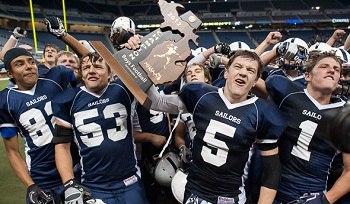
PHOTOS: (Top) Grand Rapids South Christian quarterback Derek Woltjer rushes for some of his 136 yards during Saturday's Division 4 Final. (Middle) South Christian players celebrate their MHSAA championship. (Click for more from Terry McNamara Photography.)
Thank Roosevelt for Football Weekends
December 20, 2013
By Rob Kaminski
MHSAA benchmarks editor
The next time you find yourself immersed in a tense crosstown football rivalry on a Friday night followed by a Saturday pilgrimage to the nearest college campus and a Sunday afternoon with a remote and your favorite snacks and beverages, take a moment to consider what the weekend would be like if it weren’t for Teddy Roosevelt.
The man who became our 26th President shortly after the turn of the 20th Century following the assassination of William McKinley in 1901 was a football fan like you. Maybe more so.
Today’s game of football has reached a critical crossroads. Player size and speed have increased across the board. Savage use of equipment as weapons rather than protective gear has been glorified on television networks and social media. Leaders of the game at all levels have recognized the need for change, employing new rules and widespread educational efforts to aid in preserving the sport.
History, as they say, is repeating itself.
In an ironic twist, it was Roosevelt who saved the then-brutally violent game of football from itself more than 100 years ago. Yes, the same “Rough and Ready Teddy” who led the charge up San Juan Hill during the Spanish-American War and often sparred in the boxing ring while in office from 1901-09 opined that football was becoming so gruesome that he delivered an ultimatum: clean up the game or it would be outlawed.
The Chicago Tribune reported that in 1904 alone, there were 18 football deaths and 159 serious injuries, mostly among prep school players. Football deaths suffered by younger players were reported on a nearly weekly basis, as outraged citizens called on colleges and high schools to banish football outright.
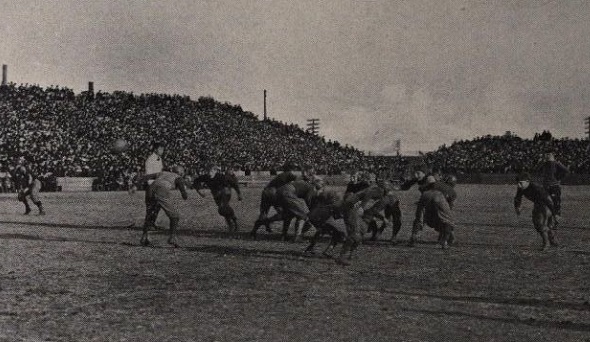
In stepped Roosevelt, who called head coaches and representatives from Harvard, Yale and Princeton – college powers at the time – to the White House in 1905 urging them to eliminate excessive violence and set an example of fair play for the rest of the country. When the casualties actually rose by one during the ensuing season, Roosevelt reacted with greater resolve and convened leading football authorities for the purpose of authoring drastic rules changes. What emerged was an intercollegiate conference which was the predecessor of the NCAA.
Among the most effective changes for the 1906 season were the legalization of the forward pass, the elimination of mass formations, and the creation of a neutral zone. Football fatalities fell to 11 in each of the next two seasons, and severe injuries fell drastically.
Thanks to the introduction of protective equipment and ever-evolving rules changes, football during the 100-plus years to follow has become an exponentially safer game. Yet, the game’s leaders always will need to adjust and react to scrutiny that comes with the territory.
So, as the game once again undergoes rules modifications in the name of safety, give a tip of the cap to President Roosevelt while you enjoy college bowl season and the NFL playoffs and begin to think ahead to the first high school practice of 2014.