

Back-up QB Sails South to D4 Title
November 23, 2012
By Bill Khan
Special to Second Half
DETROIT — The Grand Rapids South Christian community wouldn't allow Derek Woltjer to feel nervous or unsure of himself.
As soon as it became apparent that he would start for injured star quarterback Jon Wassink in the MHSAA Division 4 championship game, Woltjer was bombarded with encouraging messages from fans, teammates and friends.
Wassink broke his collarbone a week ago in a Semifinal victory over Comstock Park. Later that night, Woltjer was told he would start the title game against Detroit Country Day on Friday at Ford Field.
"I felt awful that he couldn't play," Woltjer said. "He's one of the biggest parts of our team, but I was ready to step up. I had people calling me, giving me texts that night, telling me they believe in me, telling me they have full confidence, telling me they stand behind me. I was very blessed with the people in the community."
That kind of support had a calming effect on Woltjer, who accounted for four touchdowns in South Christian's 40-7 victory over Country Day.
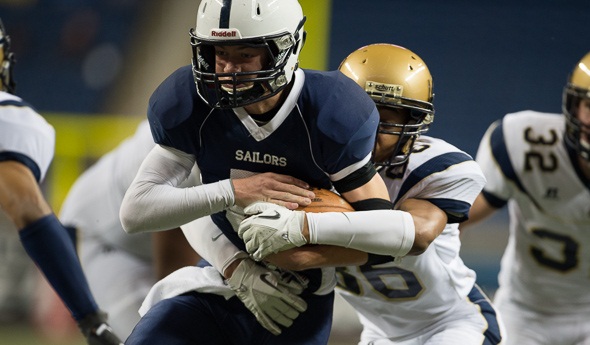
Woltjer, a senior who played sparingly at quarterback this season, was 7 for 7 for 88 yards and two touchdowns, while rushing 15 times for a game-high 136 yards and two scores.
"If I wouldn't have had all that (encouragement), my nerves today would've been just off the charts," Woltjer said. "I slept a good 10 hours last night. I wasn't nervous up until the kickoff today. With people behind you like that, it takes the nerves away from you quite a bit."
 There was no need to shake off any rust for Woltjer, who marched the Sailors down the field on their opening drive and scored on a 13-yard run with 3:21 left in the first quarter. It became 14-0 when Woltjer hit Jason Miller for a 41-yard touchdown pass on South Christian's second drive with 9:13 left in the second quarter.
"I knew he had it in him," South Christian coach Mark Tamminga said. "I talked to Derek before the game, just me and him, and I said, 'Derek, you don't have to win this football game for us. Play within yourself and make the plays you know you can make.' That's what he did. He did a tremendous job."
The Sailors' coaching staff made sure the team didn't get down over the loss of Wassink, a sophomore who threw for 3,400 yards and rushed for more than 700 this season.
"I knew we could win this without Jonny," said senior receiver Austin Diekevers, who scored two touchdowns. "Our coach has been telling us all week that Jonny is only one person. We've got 57 kids on this team. It takes more than one person to win a football game."
The Sailors kept Wassink's injury under wraps all week. Country Day prepared to face a South Christian team that would throw the ball all over the field, but instead got a squad that ran 39 times for 291 yards.
"We kind of prepared for No. 12 (Wassink)," Country Day coach Dan MacLean said. "We've been in that situation. Once several years ago, our quarterback broke his arm in the Semifinals and we won a thriller. Credit to those kids. They showed a lot of resolve and I think they kind of play up for the guy who goes down. They played very well. We obviously didn't, but a lot of that was attributable to them."
Country Day's only touchdown was a 54-yard pass from Tyler Wiegers to Maurice Ways with 3:40 left in the first half, cutting the margin to 14-7.
The Sailors took that lead into the break, but seized control of the game with two touchdowns in a 1:28 span of the third quarter. Woltjer hit Diekevers with a 20-yard touchdown pass on a corner route to make it 21-7 with 7:54 left in the third. Chad Sterk, who ran 11 times for 103 yards, made it 27-7 after a quick three-and-out by the Yellowjackets when he took a punt 31 yards to the end zone. On the punt return, he was aided by a devastating block by Seth VanEngen, a block that elicited some "ooohs" when it was replayed on the large screens at Ford Field.
The rout was on when Woltjer broke free for a 69-yard touchdown run with 2:24 left in the third quarter and Diekevers scored on a 6-yard run with 8:00 to go in the game.
"We probably ran the ball more than we've run the ball all year, there's no doubt about it," Tamminga said. "Derek ran the ball. Our running backs, our line played phenomenal tonight. They opened up holes for our backs and Derek."
It was the second MHSAA championship for South Christian, which also won the Division 4 title in 2002. The Sailors started the season 4-3 before winning their final seven games.
"I didn't think we'd win by this much, but I'm not surprised that we did win," Woltjer said. "We did very well today."
Click for full statistics and to watch a replay of the game.
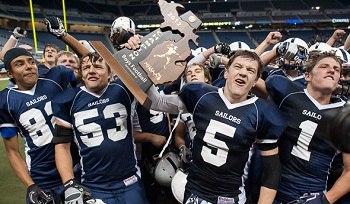
PHOTOS: (Top) Grand Rapids South Christian quarterback Derek Woltjer rushes for some of his 136 yards during Saturday's Division 4 Final. (Middle) South Christian players celebrate their MHSAA championship. (Click for more from Terry McNamara Photography.)

Heads and Heat
August 16, 2012
We are engaged in very serious discussions. They’re not only complicated, with unintended negative consequences possible from what are thought to be positive actions; they’re also a matter of life and death.
The topic is football – the high school sport under most scrutiny today and suffering from the most criticism it’s seen since the 1970s when catastrophic neck injuries spiked, liability awards soared, many insurers balked, and most helmet manufacturers abandoned the business altogether.
During recent years we have learned about the devastating long-term effects of repeated blows to the head; and we’re trying to reduce such hits. We’ve learned that 70 percent of concussions in football result from helmet-to-helmet contact, and we’re trying to have coaches teach blocking and tackling differently and have officials penalize “high hits” consistently and rigorously.
During the past several years we’ve learned that serious heat illness and heat-related deaths are 100 percent preventable, yet nationwide there were 35 heat-related deaths in high school football alone from 1995 to 2010; and we’re promoting practices that acclimatize athletes more gradually than “old school” traditionalists might advocate.
As we simultaneously address issues of heads and heat in football, some coaches may think we’re being overbearing, while many in medical fields say we’re out of date, citing higher standards of the American Academy of Pediatrics, National Athletic Trainers Association and National Federation of State High School Associations, as well as many of our counterpart organizations across the country.
As we consider in-season changes to improve athlete acclimatization and reduce blows to the head, we should be open to making out-of-season changes that work toward rather than in opposition to those objectives. There can be no sacred cows. The topic is too serious.
Ultimately, if we err in the outcome of this year’s discussions about heads and heat in football, it must be on the side of safety, on minimizing risks for student participants. They deserve it and, once again, the sport of football needs it.