


Balancing Football Playoffs
April 18, 2017
Every time the Michigan High School Athletic Association Football Playoffs have been expanded, two voices have been heard – one complaining that too many teams or divisions have watered down the tournament; the other advocating that every school should qualify for the tournament regardless of its regular-season performance.
The playoffs have expanded from 32 to 64 to 128 to 256 to 272 teams; and for 2017, with the addition of 16 more 8-player teams, to 288 of the 626 MHSAA member schools’ football teams in Michigan.
We have reached the point where 46 percent of the schools which sponsor football qualify for the Football Playoffs, and we are approaching closely the point of qualifying every team with winning records during the regular season.
Those stats sound about right for a collision sport conducted mostly outdoors in a cold climate for teenagers. A longer tournament is unwise; a larger tournament is unneeded.
What is needed and wise is more attention to the regular season, and especially to practices which occur at least five times more frequently than games. That’s where the teaching and learning of football skills and life lessons can be everyday occurrences for every team in Michigan.
Drive for Detroit: Week 8 Preview
October 13, 2016
By Geoff Kimmerly
Second Half editor
The MHSAA football playoff picture should become much clearer by the time the cooled-off dirt and grass settle at the end of this weekend.
 So far, 115 teams have earned automatic berths for the 256-team 11-player postseason field. A total of 91 teams can earn automatic berths this weekend, although, in at least a few cases, hopefuls will face off.
We look at some of those matchups and many more below in the Week 8 edition of Drive for Detroit, powered by MI Student Aid. Remember to follow the MHSAA Score Center for up-to-date scores, standings and playoff point rankings as results come in. All games below are Friday unless noted.
Bay & Thumb
Richmond (6-1) at Algonac (7-0)
The only loss between these two this season was by Richmond on opening night to Marysville, which can win the Macomb Area Conference Gold title outright tonight. And the only regular-season loss Algonac suffered during its miraculous turnaround last fall from 1-8 in 2014 to 10-2 was 15-14 to Richmond in the final game of the Blue Water Area Conference schedule. That defeat created a shared title between the two; the winner of this rematch will take the BWAC championship outright.
Others that caught my eye: Ubly (7-0) at Harbor Beach (4-3), Midland (4-3) at Lapeer (5-2), Flint Carman-Ainsworth (5-2) at Midland Dow (7-0), Pinconning (5-2) at Saginaw Michigan Lutheran Seminary (5-2).
Greater Detroit
Warren Mott (6-1) at Utica Eisenhower (7-0)
Mott’s unexpected 31-8 loss to Romeo last week took a bit of wind out of this anticipated matchup – but it could return if Mott does win to force a shared Macomb Area Conference Red championship with Eisenhower and possibly Romeo as well. Mott has lost all five meetings with Eisenhower over the last six seasons, but knows winning well with six straight playoff berths. The Eagles, meanwhile, clinched their 17th playoff berth over the last 18 seasons with their best start since 2004 – and haven’t allowed more than 14 points in a game despite playing in one of the most respected leagues in the state.
Others that caught my eye: Berkley (5-2) at Bloomfield Hills (7-0), Dearborn (6-1) at Dearborn Fordson (7-0), Clarkston (5-2) at Lake Orion (5-2), Harper Woods Chandler Park (5-2) at Warren Michigan Collegiate (6-1).
Mid-Michigan
Brighton (6-1) at Howell (5-2)
This rivalry game between old Kensington Valley Conference neighbors hasn’t carried much in league title significance during their near-decade in the Kensington Lakes Activities Association West – but tonight’s game can either cement an outright championship for Brighton or give Howell a share. The Highlanders own a 5-3 advantage in those KLAA West meetings and also beat Brighton in a 2010 rematch in the playoffs, but the Bulldogs have navigated the league a little more carefully this fall with a four-point win over Pinckney (which beat Howell) and a one-pointer over Grand Blanc.
Others that caught my eye: Wyoming Kelloggsville (6-1) at Belding (5-2), Menominee (7-0) at DeWitt (6-1), Grand Ledge (6-1) at East Lansing (5-2), Pewamo-Westphalia (7-0) at Fowler (5-2).
Northern Lower Peninsula
Frankfort (7-0) at Charlevoix (6-1)
Frankfort has two league games remaining but can clinch a share of the Northern Michigan Football Conference Leaders championship with a win tonight. Charlevoix and Maple City Glen Lake both have a loss in the league, so the Rayders could really shake things up. Their only loss this season was to Glen Lake, by 42, in Week 5; Frankfort beat Glen Lake by five a week later. Charlevoix and Frankfort both were undefeated in the league when they played each other last year, and the Panthers won 20-0 to claim the title outright.
Others that caught my eye: Cadillac (5-2) at Manistee (4-3), Johannesburg-Lewiston (3-4) at East Jordan (4-3), Hillman (4-3) at Whittemore-Prescott (4-3), Kalkaska (6-1) at Traverse City St. Francis (7-0) on Saturday.
Southeast & Border
Ottawa Lake Whiteford (7-0) at Sand Creek (7-0)
Six of eight teams in the Tri-County Conference are at least 4-3 and can still clinch automatic playoff berths, but the title race has finally been whittled down to Whiteford and Sand Creek. Whiteford has had its share of success over the years and this season qualified for the playoffs for the fifth straight, but has never gone undefeated in the league dating back to its first year, 1975. Sand Creek had a perfect TCC run in 2011 but then won a combined eight games over the next four seasons – a total they can equal just this season with another win tonight.
Others that caught my eye: Hillsdale (4-3) at Ida (6-1), Battle Creek Pennfield (4-3) at Jackson Lumen Christi (5-2), Adrian Madison (4-3) at Petersburg-Summerfield (4-3), Dundee (3-4) at Brooklyn Columbia Central (5-2).
Southwest Corridor
Three Rivers (6-1) at Edwardsburg (7-0)
It seems like the Eddies have had only one or two games of consequence during a four-year undefeated run in the Wolverine Conference, but this will be one of those games. This meeting could look a lot more like Edwardsburg’s 42-40 win in 2014 than its 65-21 defeat of Three Rivers a year ago. The Eddies can clinch a share of the league title with a 27th straight conference win. But a Three Rivers victory could create a three-team tie for first (along with Vicksburg) with a week to play. The Wildcats’ lone loss was the Plainwell on opening night.
Others that caught my eye: Marshall (4-3) at Battle Creek Harper Creek (6-1), Berrien Springs (4-2) at Buchanan (4-2), Kalamazoo Central (4-3) at Portage Central (6-1), Springport (6-1) at Quincy (5-2).
Upper Peninsula
Felch North Dickinson (5-2) at Lake Linden-Hubbell (7-0), Saturday
North Dickinson is reportedly taking its long history of success to 8-player next season, and there would be little better way to finish in 11 than by knocking newcomer Lake Linden-Hubbell off its roost atop the Mid-Eastern Conference. The Lakes are working toward a second straight perfect regular season and haven’t allowed an opponent closer than 14 points since opening night. But the Nordics, on the verge of securing their first winning season and playoff berth in three years, could move into first place in the league with a victory and set up an opportunity to share the title for the first time since winning five straight from 2009-13.
Others that caught my eye: Norway (6-1) at Gwinn (5-2), Hancock (4-3) at Iron River West Iron County (4-3), St. Ignace (6-1) at Ishpeming (3-3), Gladstone (3-4) at Kingford (5-2)
West Michigan
Grand Rapids West Catholic (6-1) at Grand Rapids Catholic Central (7-0)
This rivalry will play out for the first time since 2009 because these teams are now together in the Ottawa-Kent Conference Blue – and tied for first with two league games to play. The winner claims a share of the league title, which would be a repeat performance for both – West Catholic won the last two Blue titles, and GRCC came over after winning the O-K Green last fall. The Falcons have given up a total of 14 points over four league games, but haven’t yet faced third-place Allendale, which put 20 on a GRCC defense that otherwise hasn’t given up more than 15 in a game.
Others that caught my eye: Rockford (5-2) at East Kentwood (4-3), Hudsonville Unity Christian (6-1) at Hamilton (5-2), Muskegon Mona Shores (4-3) at Muskegon (6-1), Byron Center (6-1) at Zeeland East (6-1).
8-Player
Fife Lake Forest Area (6-1) at Wyoming Tri-unity Christian (7-0)
The inaugural Midwest Central 8-Player Conference championship comes down to this game as both teams are undefeated in league play heading into the finale. Tri-unity has been stellar giving up only 36 points in winning more games this fall than the last four seasons combined. Fife Lake Forest Area has a similar story with six wins for the first time since 2008. The Warriors made the move to 8-player this fall after winning 11 games total over the last five seasons.
Others that caught my eye: Morrice (4-3) at Webberville (5-2), Pickford (6-1) at Cedarville (6-1).
Second Half’s weekly “Drive for Detroit” previews are powered by MI Student Aid, a part of the Student Financial Services Bureau located within the Michigan Department of Treasury. MI Student Aid encourages students to pursue postsecondary education by providing access to student financial resources and information, including various student financial assistance programs to help make college more affordable for Michigan students. MI Student Aid administers the state’s 529 savings programs (MET/MESP) and eight additional aid programs within its Student Scholarships and Grants division. Click for more information and connect with MI Student Aid on Facebook and Twitter @mistudentaid.
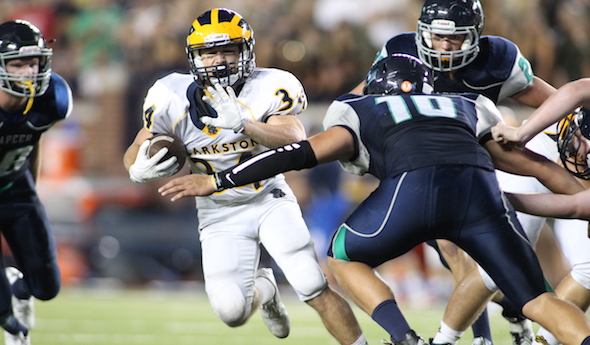
PHOTOS: A Clarkston ball carrier prepares to collide with a Lapeer defender during their Week 1 game this season at the University of Michigan. (Click to see more from HighSchoolSportsScene.com.)