


Be the Referee: 40-Second Play Clock
August 29, 2019
This week, MHSAA Assistant Director Brent Rice explains the change in football to a 40-second play clock.
Be The Referee is a series of short messages designed to help educate people on the rules of different sports, to help them better understand the art of officiating, and to recruit officials.
Below is this week's segment - 40-Second Play Clock - Listen
One of the rules changes in high school football this year involves timing between downs.
All varsity games will be played with a 40-second play clock that begins after the conclusion of the previous play, with exceptions for things like timeouts, penalties, measurements and at the start of a period – when a 25-second count will be used.
In experiments in Michigan over the past few seasons, the 40-second play clock proved to improve the pace of play and consistency between plays because it is not dependent on the referee’s subjective signal. And while some schools may choose to purchase visible play clocks for their fields, it is not required. The Back Judge, who has the primary responsibility for the play clock, will signal at 10 seconds and count the last five seconds.
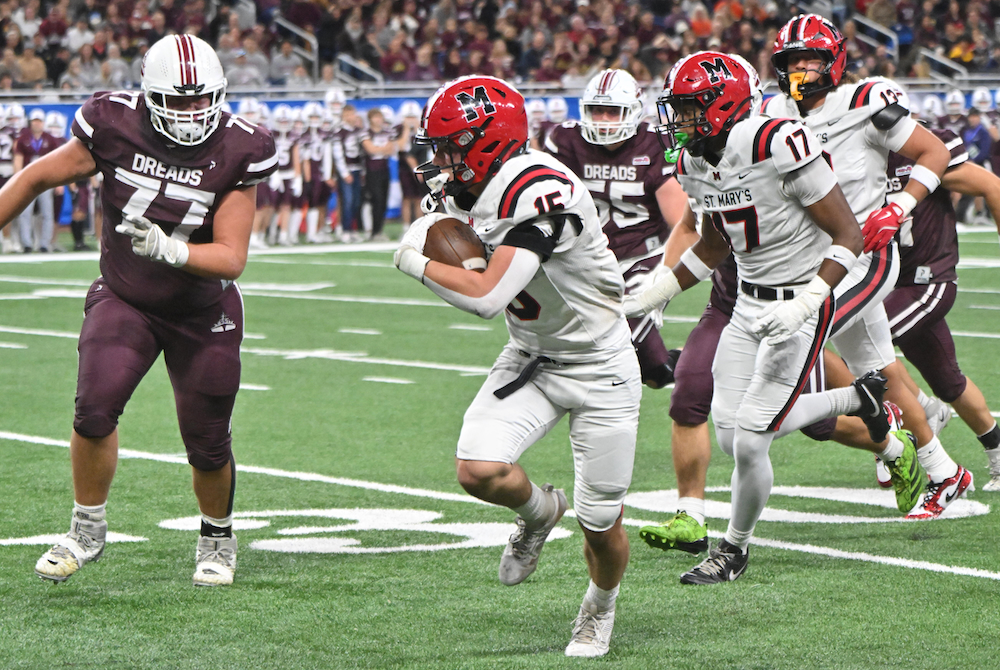
St. Mary's Finishes Repeat Run with Defensive Stand Against Record-Setting Dexter
By
Paul Costanzo
Special for MHSAA.com
November 29, 2025
DETROIT – Camari Patterson and his defensive teammates at Orchard Lake St. Mary’s knew what they were up against in Dexter’s record-setting pass offense Friday night in the Division 2 Football Final.
But they weren’t worried, as they knew what Dexter was up against, too.
“I feel like we’ve got the best defense in the state, and all the points that you put on everybody else really doesn’t matter to us; you gotta show us,” Patterson said. “Last year we had the best defense in the state, and we’re standing on that. All those points that you scored on the big teams, that doesn’t matter, you gotta come show us.”
Patterson and his teammates did the showing as the Eaglets defeated Dexter 51-14 at Ford Field to claim their second-straight Division 2 title and 10th overall.
“Coming to St. Mary’s is like a brotherhood,” Patterson said. “I couldn’t imagine as a senior going back to back, so doing it with these guys, it’s a dream come true.”
St. Mary’s (11-2) held an explosive Dexter offense to 266 total yards and 4.8 yards per play, dominating the third quarter to pull away. Of those 266 yards, just 69 were gained during the second half by the Dreadnaughts.
“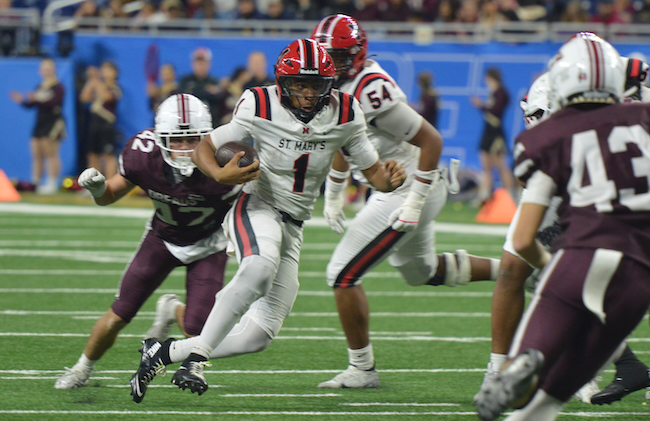 We get to take all the credit, but coach (Jeff Phillips), coach (Bobby) Clouse, coach (Emil Miclea) behind the scenes, they give us the best gameplan, they’re the best defensive coaches in the state,” OLSM senior linebacker Luke Jackson said. “They help us out big time.”
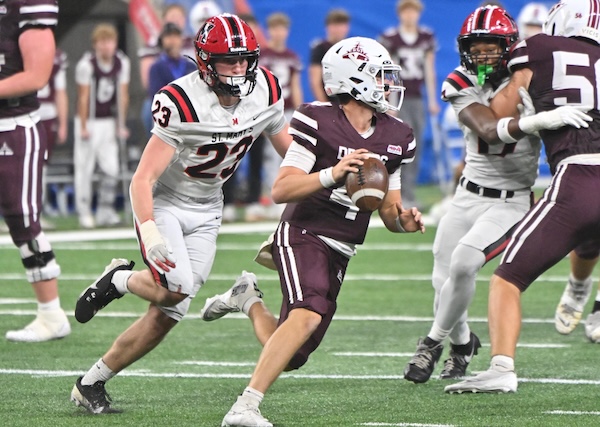
Dexter quarterback Cooper Arnedt did manage to throw for 215 yards on 24-of-37 passing. With that effort, he finished the season with 4,523 yards, an MHSAA record. His No. 1 receiver, Cole Novara, had 10 catches for 64 yards, putting him at 2,162 yards on the season, adding to the record total he had reached a week ago. He also set the state records for receiving touchdowns (28) and receptions (128) in a season.
“I’ve been throwing with these guys since last year,” Arnedt said. “I knew we had a special group, and they make my job easy. I just have to get the ball to them. They make moves and (Novara) broke the record last week, so that shows you just how talented this group is. We had a couple guys injured and a couple other talented receivers – Oliver Hutchinson, Will Simpson, Pearson Taylor, Holden Niemi who’s obviously injured. They make my job easy. It’s really special to do that and be able to share that with them. It’s not just my record.”
The first half was full of fireworks, with the Eaglets building a lead despite taking some time to get their offense into gear.
They had a 10-0 lead despite having gained just four yards over two possessions. A long punt return by Daniel Taylor Jr. led to a 33-yard Becket Kiefer field goal, as St. Mary’s went backward one yard during the drive.
Taylor then did it all himself on Dexter’s next drive, picking up a fumble and returning it 59 yards for a touchdown.
When Dexter managed to get on the board early in the second quarter with a 13-yard touchdown pass from Arnedt to Simpson, it had a 144-33 edge in yards, but trailed 10-7.
And that didn’t include a long catch and run from Novara that was called back on a hold.
St. Mary’s settled in offensively in the second quarter, getting a five-yard touchdown pass from Jabin Gonzalez to Lorenzo Barber and a one-yard run by Taylor to take a 24-7 lead.
Taylor’s touchdown run finished off a 27-yard drive, as a Reese Hurst interception set the Eaglets up deep in Dexter territory.
 With 1:01 left in the second quarter, it appeared St. Mary’s would be taking its 17-point lead into the half, but Novara had other plans, returning the ensuing kickoff 96 yards for a score to bring his team to within 10 at 24-14.
That somehow left time for one more wild play, as Gonzalez hit a streaking Barber down the sidelines. His 43-yard reception looked to have set the Eaglets up inside the 10, but Dexter’s Gabe Dobry forced a fumble and it was recovered by Jake Stepaniak, keeping the score at 24-14.
Things showed zero sign of slowing down in the second half, at least for St. Mary’s, as it scored on its second play when Brandon Adams Jr. turned a slant pass from Gonzalez into a 65-yard touchdown.
Barber would add another catch-and-run touchdown on the Eaglets’ next possession, taking a quick hitter from Gonzalez 40 yards for a score and a 38-14 St. Mary’s lead.
“We had to make a couple adjustments because they went hurry-up and they went spread, and we didn’t have an answer for it,” Dexter coach Phil Jacobs said. “We had a couple adjustments, but had a couple of breakdowns. They’re just a better team. They were better athletes, and I can’t complain. Our kids played their hearts out, the ball just didn’t bounce our way tonight.”
Jamari Givhan would add a two-yard touchdown run late in the third quarter, while Brannon Hardy caught a 27-yard TD pass from Gonzales in the fourth.
Gonzales finished with more than 400 total yards of offense, throwing for 304 and four TDs on 17-of-22 passing, and rushing for 102 on 13 carries.
“It was just playing my game, playing me,” Gonzales said. “Like my dad (OLSM coach Jermaine Gonzales) always says, don’t be Superman, do you and everything is going to fall into place.”
Barber led St. Mary’s receivers with 149 yards on eight catches. Taylor led the defense with 10 tackles. Gage Nessen had two sacks for the Eaglets, and Ryan Harrington had 1.5.
Simpson had eight catches for 91 yards for Dexter, while Mateo Kipke, Nathan Gersh and Charlie Pomo each had seven tackles.
PHOTOS (Top) Orchard Lake St. Mary’s Daniel Taylor Jr. (15) sprints down the sideline as Dexter’s Grant Davis (77) and others chase him Friday. (Middle) The Eaglets’ Jabin Gonzales (1) bursts into the open. (Below) St. Mary’s Gage Nessen (23) pursues Dexter quarterback Cooper Arnedt.